Ohm’s Law Calculator Solve for Current: Formula, Steps & Examples 2026

Flip a switch and current starts flowing before you even finish the motion. That current isn’t random.
It follows one clean rule: current equals voltage divided by resistance. An ohm’s law calculator solve for current tool turns that rule into an instant answer.
Table of Contents
How Do You Solve for Current with Ohm’s Law?
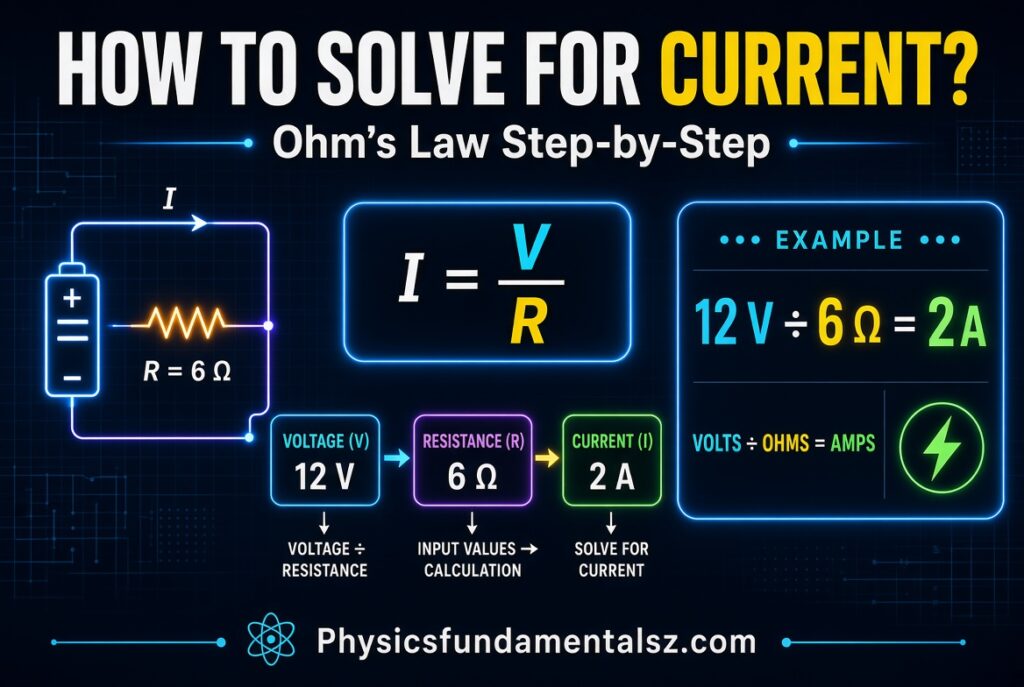
To solve for current, divide voltage by resistance: I = V/R.
Plug in your voltage in volts and your resistance in ohms, and the result is current in amperes.
What Is Ohm’s Law?
Ohm’s law describes the relationship between voltage (V), current (I), and resistance (R) in an electrical circuit.
Georg Simon Ohm proved this relationship experimentally in 1827, and it still governs how every resistive circuit behaves today.
The law states that current through a conductor is directly proportional to voltage and inversely proportional to resistance.
The Three Forms of Ohm’s Law
| Formula | Solves For | Units |
|---|---|---|
| I = V / R | Current | Amps (A) |
| V = I × R | Voltage | Volts (V) |
| R = V / I | Resistance | Ohms (Ω) |
For this article, the focus stays on the first formula: solving for current.
Ohm’s Law Formula to Solve for Current
The formula is simple: I = V ÷ R.
I is current in amperes, V is voltage in volts, and R is resistance in ohms.
Higher voltage pushes more current through a circuit. Higher resistance chokes that current back down.
Key Takeaway
- Current rises when voltage increases and resistance stays fixed.
- Current falls when resistance increases and voltage stays fixed.
- Doubling voltage doubles current, all else equal.
How to Use an Ohm’s Law Calculator to Solve for Current
An online ohm’s law calculator solve for current tool needs just two inputs to work.
Step 1: Find Your Voltage Value
Locate the voltage source in your circuit, such as a battery or power supply rating, measured in volts.
Step 2: Find Your Resistance Value
Identify the resistance of the component, measured in ohms, often printed on the resistor itself.
Step 3: Enter Both Values Into the Calculator
Type the voltage and resistance into the calculator’s input fields.
Step 4: Read the Current Result
The tool divides voltage by resistance automatically and displays the current in amps.
Try the free Ohm’s Law Calculator on Physics Fundamentals to run this instantly with your own numbers.
Worked Examples: Solving for Current
Real numbers make the formula click faster than theory alone.
Example 1: Simple Circuit
A circuit has 12 volts and 4 ohms of resistance.
I = V/R = 12/4 = 3 amps.
Example 2: Household Appliance
An appliance runs on 120 volts through a 60-ohm heating element.
I = 120/60 = 2 amps.
Example 3: Low-Voltage Electronics
An LED circuit uses 9 volts across a 450-ohm resistor.
I = 9/450 = 0.02 amps, or 20 milliamps.
Example 4: High-Resistance Circuit
A 5-volt source connects to a 10,000-ohm resistor.
I = 5/10,000 = 0.0005 amps, or 0.5 milliamps.
The Ohm’s Law Triangle
The Ohm’s law triangle is a memory tool for rearranging the formula fast.
Cover the letter you want to solve for, and the remaining two letters show the operation needed.
Cover I, and V sits over R — confirming I = V/R.
Ohm’s Law Calculator vs. Manual Calculation

| Factor | Calculator | Manual Math |
|---|---|---|
| Speed | Instant | Slower |
| Accuracy | High, no arithmetic errors | Prone to mistakes |
| Shows formula used | Yes, usually | You must track it yourself |
| Best for | Quick checks, multiple values | Learning the derivation |
| Unit conversion | Often automatic | Manual |
Both methods matter. Use manual math while learning, then switch to a calculator for speed once the concept is solid.
Common Mistakes When Solving for Current
Avoid these errors to keep your calculations accurate.
- Mixing up units. Milliamps and amps, or kilohms and ohms, must be converted before dividing.
- Swapping voltage and resistance. Double-check which number goes in the numerator.
- Ignoring temperature effects. Resistance in real components can shift as they heat up.
- Forgetting non-ohmic devices. Diodes and transistors don’t follow a fixed resistance value.
- Rounding too early. Keep extra decimal places until the final answer.
Real-World Applications of Solving for Current
Engineers, electricians, and students all rely on this calculation daily.
- Circuit design: confirming a component won’t exceed its rated current.
- Fuse and breaker sizing: matching protection devices to expected current draw.
- Troubleshooting: spotting a short circuit when measured current is far too high.
- Battery life estimates: current draw determines how long a battery lasts.
- Electronics hobby projects: sizing resistors correctly to protect LEDs and sensors.
Expert Tips for Faster, More Accurate Results

A few habits make this calculation nearly foolproof.
- Always write down units next to every number before you calculate.
- Use a calculator that shows the formula, not just the final digit.
- Cross-check unusual results against a second known value if you have one.
- Remember that current is measured in series, so it stays the same through a single-loop circuit.
Also Read:
- Ohm’s Law Explained: V = IR
- Ohm’s Law and Temperature: How Resistance Really Changes With Heat
- Electric Current: I = Q/t, Drift Velocity & Ohm’s Law Connection
- Resistors in Series and Parallel: Formulas, Rules & Worked Examples
- Power in Electrical Circuits: P = IV = I²R = V²/R Explained
- Electric Circuits & Kirchhoff’s Laws: KCL, KVL & Worked Examples
- Kirchhoff’s Laws Advanced: Solving Multi-Loop Circuits Step by Step
- Electric Potential Energy: E = kQq/r, Work Done & Worked Examples
- Electric Field and Potential
- Electric Charge and Coulomb’s Law Explained
- Magnetic Fields and Forces
- Electromagnetic Induction
- Lenz’s Law: The Direction of Induced Current Explained
- Electromagnetic Waves: Speed, Spectrum & Wave Properties
- Momentum Calculator Physics: Formula, Steps & Worked Examples
- Ideal Gas Law Calculator With Steps: PV = nRT Formula & Examples
- Projectile Motion Calculator With Angle: Formulas & Worked Examples
- Wave Speed Calculator Frequency Wavelength: Formula, Steps & Worked Examples
- Half Life Calculator With Steps: Formula, Examples & Full Guide
- Newton’s Laws of Motion
- What Is Energy?
- Conservation of Momentum
- Projectile Motion: Complete Guide
- Wave Speed, Frequency & Wavelength
- Transverse Waves Explained
Frequently Asked Questions (FAQs)
What is the formula to solve for current using Ohm’s law?
Current equals voltage divided by resistance: I = V/R, measured in amps.
How do I calculate current from voltage and resistance?
Divide the voltage value by the resistance value. The result is current in amperes.
What units does an Ohm’s law calculator use for current?
Current is measured in amperes (A), often shown as milliamps (mA) for small circuits.
Can I solve for current if I only know power and resistance?
Yes. Use I = √(P/R), where P is power in watts and R is resistance in ohms.
Can I solve for current if I only know power and voltage?
Yes. Use I = P/V, dividing power in watts by voltage in volts.
Does Ohm’s law work for AC circuits?
Yes, for purely resistive AC circuits. Circuits with capacitors or inductors need impedance instead of plain resistance.
Why does current increase when resistance decreases?
Resistance opposes current flow. Less opposition at the same voltage lets more current pass through.
What happens to current if voltage doubles?
Current doubles too, as long as resistance stays constant, because the two values are directly proportional.
Is Ohm’s law accurate for every material?
No. Ohmic materials like copper follow it closely. Non-ohmic materials like diodes do not have constant resistance.
What is a safe current level for household circuits?
Safe levels depend on wire gauge and breaker rating, typically 15 to 20 amps for standard household circuits.
How accurate is an online Ohm’s law calculator?
It’s as accurate as the values you enter. The math itself carries no rounding error beyond display precision.
What is the difference between current and voltage?
Voltage is the electrical pressure pushing charge through a circuit. Current is the actual flow rate of that charge.
Can resistance be negative in Ohm’s law?
No. Standard resistance values are always positive in typical resistive circuits.
How do I convert milliamps to amps before calculating?
Divide milliamps by 1,000 to get amps before plugging the value into the formula.
What tool measures actual current in a real circuit?
An ammeter, or a multimeter set to the current-measuring mode, measures actual current directly.
Why does my calculated current not match my multimeter reading?
Component tolerances, temperature changes, and wire resistance can create small real-world differences.
Does temperature affect the current I calculate?
Yes. Resistance in most conductors rises with temperature, which lowers current for the same voltage.
What is the Ohm’s law triangle used for?
It’s a visual memory aid showing how to rearrange V, I, and R depending on which value you need.
Can I use this formula for parallel circuits?
Yes, but apply it to each branch separately, since voltage stays equal across parallel branches.
Can I use this formula for series circuits?
Yes, and current stays the same through every component in a single series loop.
What is the current in a short circuit?
Current spikes sharply because resistance drops near zero, which is why fuses and breakers exist.
Conclusion
Solving for current with Ohm’s law comes down to one formula: I = V/R.
Once you know your voltage and resistance, a calculator gives you the answer in seconds, while understanding the math behind it helps you catch mistakes and troubleshoot real circuits with confidence.
Practice with a few worked examples, keep your units consistent, and this calculation becomes second nature for any circuit you encounter.