Electric Charge and Coulomb’s Law Explained
Rub a balloon on your hair and it sticks to a wall; lightning leaps across the sky; your phone’s screen senses your finger. All of these spring from a single property of matter: electric charge. Coulomb’s law tells us, with surprising precision, how charges push and pull on one another.
What is electric charge?
Charge is a fundamental property of matter, like mass. It comes in two kinds, which Benjamin Franklin labeled positive and negative. The rule of thumb is simple and exact: like charges repel, opposite charges attract.
Ordinary matter is built from positively charged protons and negatively charged electrons in equal numbers, so it is electrically neutral overall. Charge is measured in coulombs (C). The charge on a single electron is tiny — about 1.6 × 10⁻¹⁹ C — which is why it takes vast numbers of electrons to make everyday effects.
Conservation and quantization
Two deep principles govern charge:
- Conservation: charge is never created or destroyed, only moved. When you charge a balloon, you transfer electrons from your hair to the balloon — the total charge of the system is unchanged.
- Quantization: charge comes in whole-number multiples of the elementary charge e. You can have 1 or 2 or a billion units, but never 1.5.
Coulomb’s law
In the 1780s Charles-Augustin de Coulomb measured the force between charged spheres and found it obeys an inverse-square law strikingly similar in form to gravity:
Here q₁ and q₂ are the two charges, r is the distance between them, and k ≈ 8.99 × 10⁹ N·m²/C² is Coulomb’s constant. The force acts along the line joining the charges. A positive result means repulsion; a negative result means attraction.
The inverse-square part is the heart of it: double the distance and the force drops to a quarter; triple it and the force falls to a ninth.
Coulomb’s law and Newton’s law of gravity share the same mathematical skeleton — both fall off as 1/r². But electric forces can both attract and repel, and they are vastly stronger: the electric repulsion between two protons dwarfs their gravitational attraction by some 10³⁶ times.
The electric field
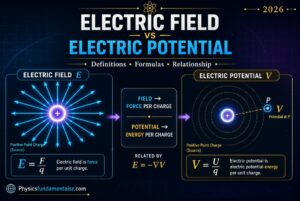
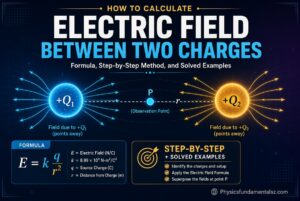
Rather than think of charges reaching across empty space, physicists picture each charge filling the space around it with an electric field. A second charge then simply responds to the field it sits in. The field strength from a point charge is:
The force on a test charge is then F = q·E. Field lines point away from positive charges and toward negative ones, and their density shows how strong the field is. This field idea is the gateway to understanding how electric and magnetic effects combine — see the electromagnetic spectrum.
Why static cling and lightning happen
Everyday “static electricity” is just charge separation. Rubbing two materials transfers electrons, leaving one positive and one negative. The balloon clings because its charge induces an opposite charge in the wall, and the attraction holds it up.
Lightning is the dramatic end of the same story: charge separates within a storm cloud until the electric field becomes strong enough to rip electrons from air molecules, creating a conducting channel and a sudden, violent discharge.
Putting numbers to work
Coulomb’s law is the starting point for analyzing circuits, capacitors, and atoms. Once charges start moving, the flow becomes current, and the relationship between push and flow is captured by Ohm’s law. The same constant k also sets how much energy it takes to bring charges together, which underlies how batteries and capacitors store energy.
- Two charges of 1 C held 1 m apart would exert roughly 9 billion newtons on each other — a reminder that a coulomb is an enormous amount of charge.
- Inside an atom, this same force binds electrons to the nucleus.
Frequently asked questions
Why are there only two kinds of charge?
This is simply what experiments reveal: every charged particle either attracts or repels a given reference charge, with no third behavior. The two-sign structure is built into the Standard Model of particle physics; there is no known particle with a “third type” of charge.
How is Coulomb’s law different from gravity?
Both follow an inverse-square law, but gravity only attracts and depends on mass, while the electric force depends on charge and can attract or repel. The electric force is also enormously stronger for fundamental particles.
What does the constant k actually represent?
It sets the strength of the electric force in our chosen units and reflects the permittivity of free space, ε₀, through k = 1/(4π·ε₀). It is the bridge between the abstract charges and the real newtons of force you measure.