Electric Field and Potential

Electric charges push and pull on each other across empty space, with no strings attached. To make sense of this action at a distance, physicists invented two closely related tools: the electric field, which tells a charge which way it will be pushed, and the electric potential, which tells it how much energy it has. Master both and electricity stops being magic.
The electric field: force per charge
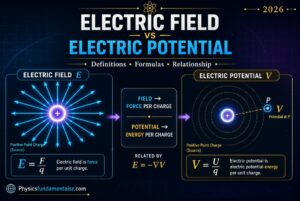
An electric field exists wherever a charge would feel an electric force. We define it as the force per unit charge that a tiny positive test charge would experience at a point.
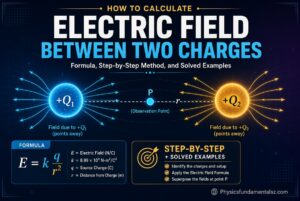
The field E is a vector, measured in newtons per coulomb (N/C), pointing in the direction a positive charge would be pushed. Around a single point charge Q, the field follows an inverse-square law, growing weaker with the square of the distance r.
Here k is Coulomb’s constant. Field lines point away from positive charges and toward negative ones, and they never cross — at any point the field has a single, definite direction.
Visualising fields with lines
Field lines are a wonderfully intuitive picture. Where the lines crowd together the field is strong; where they spread apart it is weak. They emerge from positive charges like a hedgehog’s spines and converge onto negative ones.
The electric field is a property of space itself, present whether or not a test charge is there to feel it. The charge that creates the field reaches out and modifies the space around it; any other charge then responds to the local field, not directly to the distant source.
Electric potential: energy per charge
The electric field tells you about force; the electric potential V tells you about energy. It is the potential energy per unit charge at a point — how much energy each coulomb would carry if placed there.
Potential is measured in volts (V), where one volt is one joule per coulomb. For a single point charge, the potential falls off as 1/r — more gently than the field’s 1/r².
Crucially, potential is a scalar, not a vector. It has no direction, which makes it far easier to add up the contributions from many charges: you just sum the numbers, no angles required.
How field and potential connect
Field and potential are two views of the same situation, linked by a simple idea: the field points in the direction of steepest decrease of potential, and its strength is how rapidly the potential changes with distance.
Think of potential as the height of a landscape and the field as the slope. A ball rolls downhill toward lower height; a positive charge “rolls” toward lower potential. Where the potential landscape is steep, the field is strong. Surfaces of constant potential — equipotentials — are always perpendicular to the field lines, just as contour lines on a map run across the direction of steepest descent.
Why voltage drives circuits
The everyday word for a potential difference is voltage. A battery maintains a potential difference between its terminals, and that difference is what pushes charges around a circuit. The energy gained by a charge q moving through a potential difference V is simply their product.
This is why a 9-volt battery delivers more energy per charge than a 1.5-volt one. The same idea connects to magnetic fields, since moving charges driven by potential differences are exactly what create magnetism. To work through numbers, an electric field calculator handles the inverse-square arithmetic.
Frequently asked questions
What is the difference between electric field and potential?
The electric field is a vector giving the force per unit charge at a point — it tells a charge which way and how hard it is pushed. Potential is a scalar giving the energy per unit charge — it tells you how much energy a charge has there. The field is the slope of the potential landscape.
Why is potential easier to work with than field?
Because potential is a scalar with no direction. To find the total potential from many charges you simply add numbers, whereas combining fields requires adding vectors with their directions and angles. Many problems are far simpler when solved through potential first.
Can the electric field be zero where the potential is not?
Yes. The field depends on how fast the potential changes, not on its value. At the centre between two equal positive charges, the potential is high but the fields cancel, giving zero field with non-zero potential. Conversely, the field can be non-zero where the potential happens to be zero.