Ohm’s Law Explained: V = IR
Ohm’s law is the single most useful relationship in electronics. In one compact equation it ties together the three quantities that define how a circuit behaves: voltage, current, and resistance. Understand it deeply and most introductory circuit problems become almost trivial.
The three players
Before the equation makes sense, you need a feel for what each quantity means physically.
- Voltage (V), measured in volts: the electrical “push,” or the energy given to each unit of charge. Think of it as pressure in a water pipe.
- Current (I), measured in amperes: the rate at which charge flows past a point. This is the flow rate of the water.
- Resistance (R), measured in ohms (Ω): how strongly the material opposes the flow. A narrow, rough pipe has high resistance.
The law itself
Georg Ohm found in 1827 that, for many conductors, current is directly proportional to the voltage across them. The constant of proportionality is the resistance:
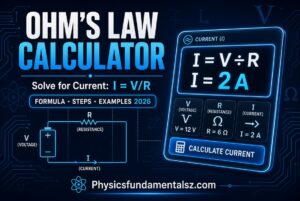
Rearranged, this gives I = V / R and R = V / I. So if you know any two of the three, you can always find the third. Raise the voltage and the current rises in step; raise the resistance and the current falls.
Ohm’s law is not a law of nature in the way that conservation of energy is. It is an empirical description that holds for “ohmic” materials — chiefly metals at constant temperature. Diodes, filaments, and many devices deliberately disobey it.
A water analogy that actually works
Picture a tank of water on a tower feeding a pipe. The height of the tank sets the pressure (voltage). The pipe’s width and roughness set the resistance. The resulting flow of water is the current. Open a wider pipe (lower resistance) and more water flows for the same pressure — exactly what I = V/R predicts.
The analogy even handles the energy story: lifting water to the tank is like a battery doing work to separate charge. For the deeper picture of where that charge comes from, see electric charge and Coulomb’s law.
Power: where the energy goes
Pushing current through a resistance dissipates energy as heat — the reason a toaster glows and a phone charger warms up. Electrical power combines voltage and current:
All three forms are equivalent via Ohm’s law; you pick whichever matches the quantities you know. The I²R form explains why long power lines are run at very high voltage: high voltage means low current for the same power, and low current means far less heat wasted in the wires.
Series and parallel resistors
Real circuits combine resistors. The rules follow directly from Ohm’s law:
- Series: resistances add, R = R₁ + R₂ + … The same current flows through each, and the voltages add up to the source.
- Parallel: the reciprocals add, 1/R = 1/R₁ + 1/R₂ + … The same voltage sits across each branch, and the total resistance is always smaller than the smallest branch.
When Ohm’s law breaks down
The relationship assumes resistance stays constant. In reality:
- A lightbulb filament heats up as current rises, increasing its resistance, so its V–I graph curves.
- Semiconductor devices like diodes conduct strongly one way and barely at all the other.
- Superconductors drop to zero resistance below a critical temperature, breaking the rule entirely.
For these “non-ohmic” components we keep the definition R = V/I as an instantaneous ratio, but it is no longer a single fixed number.
Frequently asked questions
Is Ohm’s law true for all materials?
No. It holds well for metallic conductors at steady temperature. Filaments, diodes, transistors, electrolytes, and gases generally do not follow a simple linear V = IR relationship.
Does higher resistance always mean less current?
Only if the voltage is held fixed. From I = V/R, raising R lowers I at constant V. But if the voltage also changes — as it can in a complex circuit — you must analyze the whole network, not just one resistor.
Why do power lines use such high voltages?
Because power lost as heat in the wires is I²R. Transmitting the same power at higher voltage means lower current, which slashes the I² heating loss in the cables, even though the cable resistance R is unchanged.