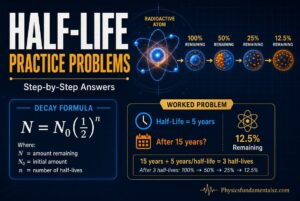
Half Life Calculator With Steps: Formula, Examples & Full Guide 2026
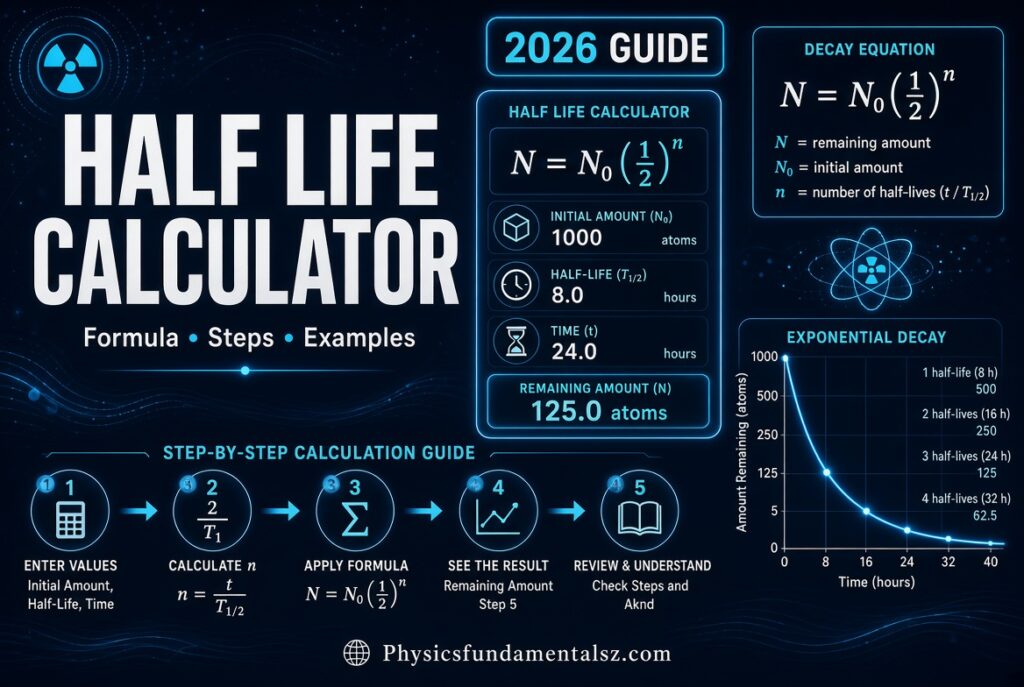
Radioactive isotopes, medications, and even chemical reactions all shrink by the same predictable pattern. Half of what remains disappears every fixed interval of time.
A half life calculator with steps tool turns that pattern into a fast, reliable answer instead of a messy algebra problem. Enter what you know, and it solves for the rest while showing every step.
Table of Contents
Half Life Calculator With Steps
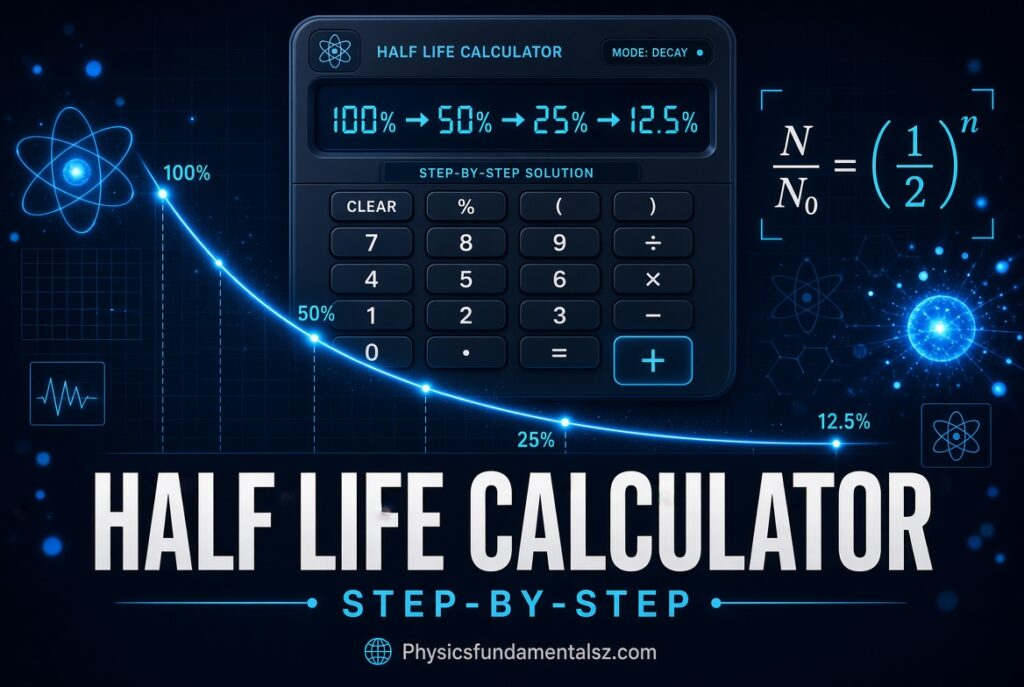
Half-life is the time required for a quantity to fall to half its starting value: N = N₀ × (1/2)^(t / t½). Here N₀ is the initial amount, N is the amount remaining, t is elapsed time, and t½ is the half-life.
What Is Half-Life
Half-life is the time it takes for exactly half of a decaying substance to disappear. It applies to radioactive isotopes, drugs in the body, and any process that follows exponential decay.
Half-life stays constant no matter how much material you start with. A sample with a 10-year half-life always takes 10 years to drop to half, whether you begin with 1 gram or 1,000 grams.
This constant-ratio behavior is what makes half-life so useful for dating fossils, scheduling medication doses, and modeling nuclear decay.
The Half-Life Formula Explained
The two core equations behind every half-life calculation are:
N = N₀ × (1/2)^(t / t½)
t½ = ln(2) / k
- N = amount remaining
- N₀ = initial amount
- t = elapsed time
- t½ = half-life
- k = decay constant
- ln(2) = natural log of 2, approximately 0.693
| Solve For | Formula |
|---|---|
| Remaining amount (N) | N = N₀ × (1/2)^(t/t½) |
| Half-life (t½) | t½ = ln(2) ÷ k |
| Decay constant (k) | k = ln(2) ÷ t½ |
| Elapsed time (t) | t = t½ × log₂(N₀/N) |
How to Use a Half-Life Calculator
Using a half life calculator with steps tool follows a simple pattern regardless of which site you use.
- Choose the variable you want to solve for (half-life, remaining amount, initial amount, or elapsed time).
- Identify the values you already know from the problem.
- Enter each known value into its matching field, keeping time units consistent.
- Click calculate and review the result alongside the shown formula steps.
- Check the displayed decay constant or fraction remaining for extra context.
Matching time units matters most. If half-life is in years, elapsed time must also be entered in years, not days or hours.
Worked Example 1: Finding Remaining Amount
A 100 mg sample has a half-life of 8 days. Find how much remains after 24 days.
24 days divided by 8 days equals 3 half-lives. Using N = 100 × (1/2)³, the remaining amount is 12.5 mg.
Worked Example 2: Finding Half-Life From Decay Constant
A substance has a decay constant of 0.0247 per year. Find its half-life.
Using t½ = ln(2) ÷ k, divide 0.693 by 0.0247. The half-life is approximately 28 years.
Worked Example 3: Finding Elapsed Time
A sample started at 80 mg and has decayed to 10 mg. Its half-life is 5 hours. Find the elapsed time.
80 divided by 10 equals 8, and 8 is 2³, meaning 3 half-lives have passed. Multiplying 3 by 5 hours gives an elapsed time of 15 hours.
Half-Lives of Common Isotopes and Substances
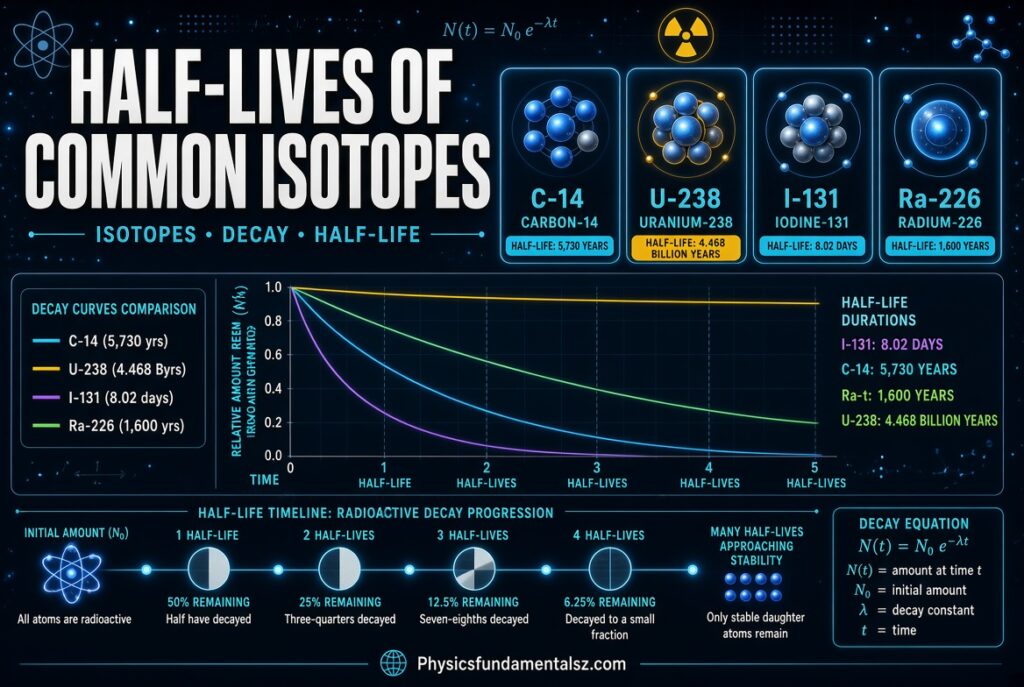
This table lists commonly referenced half-lives across science and medicine.
| Substance | Approximate Half-Life | Common Use |
|---|---|---|
| Carbon-14 | 5,730 years | Dating organic material |
| Uranium-238 | 4.5 billion years | Dating rocks, Earth’s age |
| Potassium-40 | 1.25 billion years | Geological dating |
| Iodine-131 | 8 days | Thyroid treatment |
| Technetium-99m | 6 hours | Medical imaging |
| Caffeine (in adults) | ~5 hours | Pharmacokinetics |
Fraction Remaining After Multiple Half-Lives
This table shows how quickly a substance disappears as half-lives pass.
| Half-Lives Passed | Fraction Remaining | Percent Remaining |
|---|---|---|
| 1 | 1/2 | 50% |
| 2 | 1/4 | 25% |
| 3 | 1/8 | 12.5% |
| 4 | 1/16 | 6.25% |
| 5 | 1/32 | 3.125% |
| 10 | 1/1024 | ~0.1% |
Why This Formula Matters
Half-life calculations show up constantly in chemistry, physics, medicine, and archaeology. Each field applies the exact same underlying math to very different problems.
Archaeologists use carbon-14 half-life to date organic remains up to about 50,000 years old. Geologists use uranium and potassium isotopes with far longer half-lives to date rocks and estimate Earth’s age.
Doctors rely on drug half-life to plan dosing schedules and avoid toxic buildup. Nuclear medicine technicians choose isotopes with short half-lives, like Technetium-99m, to limit patient radiation exposure.
Common Mistakes to Avoid
- Mixing time units, such as entering half-life in years while elapsed time is in days.
- Forgetting that half-life stays fixed regardless of the starting quantity.
- Confusing decay constant (k) with half-life (t½) — they are related but not interchangeable.
- Assuming linear decay instead of exponential decay, which leads to inflated remaining amounts.
- Rounding intermediate steps too early, which introduces compounding errors in longer calculations.
Expert Tip
When elapsed time is not a clean multiple of the half-life, use logarithms instead of counting half-lives manually. The formula t = t½ × log₂(N₀/N) handles any ratio precisely, without guesswork.
Real-World Applications
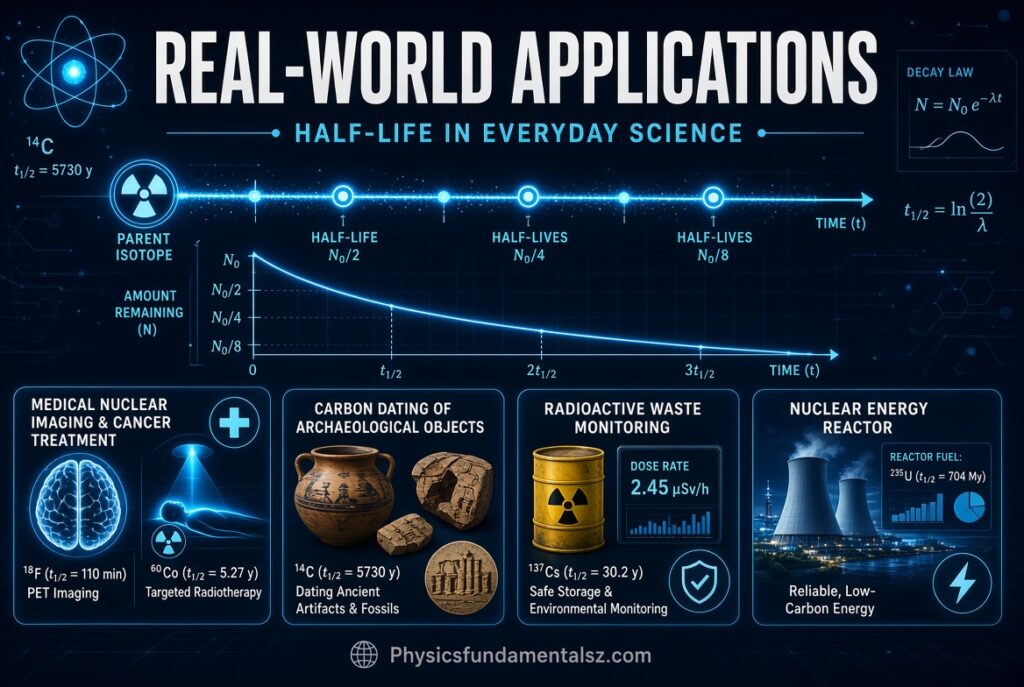
- Radiometric dating: estimating the age of fossils, rocks, and archaeological artifacts.
- Nuclear medicine: selecting isotopes for imaging and cancer treatment based on decay speed.
- Pharmacology: setting medication dosing intervals based on how fast a drug clears the body.
- Nuclear engineering: predicting radioactive waste decay timelines for storage planning.
- Environmental science: modeling the breakdown of pollutants and radioactive fallout.
Also Read:
- Half-Life Calculations: Formula & Worked Examples
- Nuclear Decay Equations: Alpha, Beta & Gamma Decay
- Mass-Energy Equivalence: E = mc²
- Photoelectric Effect Calculations
- Bohr Model of the Atom
- De Broglie Wavelength: Formula & Derivation
- Heisenberg Uncertainty Principle Explained
- Wave Speed, Frequency and Wavelength
- Transverse Waves Explained
- Longitudinal Waves Explained
- The Electromagnetic Spectrum
- The Doppler Effect
- Momentum Calculator Physics: Formula & Examples
- Ideal Gas Law Calculator With Steps
- Projectile Motion Calculator With Angle
- Projectile Motion: Complete Guide
- Newton’s Laws of Motion
- What Is Energy?
- Conservation of Momentum
- Electric Potential Energy Explained
- Electric Current: Formula & Ohm’s Law Connection
- Magnetic Flux and Faraday’s Law
- Lenz’s Law: Direction of Induced Current
- Resistors in Series and Parallel
- Power in Electrical Circuits Explained
Frequently Asked Questions (FAQs)
What is the formula for half-life?
Half-life is calculated using N = N₀ × (1/2)^(t/t½), where N₀ is the starting amount and N is the amount left after time t.
How do you calculate half-life with steps?
Identify the known values, plug them into N = N₀(1/2)^(t/t½) or t½ = ln(2)/k, then solve algebraically for the missing variable.
What is the relationship between half-life and decay constant?
Half-life equals ln(2) divided by the decay constant: t½ = ln(2) ÷ k. A larger decay constant always means a shorter half-life.
How long does it take for a substance to fully decay?
Technically, a substance never reaches exactly zero through exponential decay. After 10 half-lives, less than 0.1% of the original amount remains.
What is the half-life of Carbon-14?
Carbon-14 has a half-life of about 5,730 years. This makes it useful for dating organic material up to roughly 50,000 years old.
How is half-life used in medicine?
Doctors use a drug’s half-life to plan dosing intervals that keep blood concentration in a safe, effective range. After 4 to 5 half-lives, over 95% of a drug is typically cleared.
Can half-life be used for non-radioactive substances?
Yes. Any process following first-order exponential decay, including certain chemical reactions and drug elimination, follows the same half-life math.
What is the difference between half-life and mean lifetime?
Half-life is the time for half a sample to decay, while mean lifetime is the average time a single particle survives before decaying. Mean lifetime is always longer than half-life for the same substance.
How do you find the initial amount if you know the remaining amount?
Rearrange the formula to N₀ = N ÷ (1/2)^(t/t½). Enter the known remaining amount, elapsed time, and half-life to solve.
Does temperature affect radioactive half-life?
No. Radioactive half-life is a nuclear property and stays constant regardless of temperature, pressure, or chemical environment.
What is the half-life of Uranium-238?
Uranium-238 has a half-life of about 4.5 billion years. Scientists use it to estimate the age of the Earth and ancient rock formations.
How many half-lives until a substance is considered gone?
After about 10 half-lives, less than 0.1% of the original material remains, which is often treated as negligible in practical terms.
What units should I use for half-life calculations?
Use consistent time units throughout, such as all years or all hours. Mixing units like years with days produces incorrect results.
What is the decay constant?
The decay constant (k) represents the probability per unit time that a nucleus will decay. It is directly related to half-life through t½ = ln(2)/k.
How is half-life applied in nuclear medicine?
Isotopes like Technetium-99m, with a 6-hour half-life, are chosen so radiation clears the body quickly after imaging. Longer half-life isotopes are avoided for routine scans.
Why does half-life stay the same no matter the starting amount?
Exponential decay reduces a quantity by a constant proportion each period, not a fixed amount. This proportional behavior keeps the half-life constant regardless of sample size.
What is an example of half-life in pharmacology?
Caffeine has a half-life of roughly 5 hours in most adults. After about 25 hours, or 5 half-lives, over 95% of it is eliminated from the body.
How do you calculate half-life from a graph?
Find the time it takes for the curve to drop from its starting value to exactly half that value on the y-axis. Read the corresponding time directly from the x-axis.
Is half-life the same as radioactive decay rate?
No. Decay rate describes how fast decay happens at a given moment, while half-life is a fixed time interval derived from that rate.
What tools can check my half-life calculation?
Any half life calculator with steps tool works well as a quick check. Compare its result against your manual calculation using the same formula.
How accurate is carbon dating using half-life?
Carbon dating is highly reliable for organic material younger than about 50,000 years, after which remaining Carbon-14 becomes too small to measure accurately.
What is the half-life of Potassium-40?
Potassium-40 has a half-life of about 1.25 billion years. Geologists use it alongside other isotopes for dating very old rock samples.
Can two substances have the same half-life but decay differently?
No. If two substances share the same half-life, they follow identical proportional decay curves, though their absolute starting amounts may differ.
Conclusion
Half-life calculations rest on one dependable relationship: N = N₀ × (1/2)^(t/t½). Once you know any three of the key variables, solving for the fourth is straightforward.
A half life calculator with steps tool speeds up the process, but understanding the formula means you can verify results and solve problems by hand too. Use the tables and worked examples above whenever you need a quick, reliable reference.