Projectile Motion: The Complete Guide

Projectile motion describes anything launched into the air and left to fall under gravity alone: a thrown ball, a fired arrow, a stream of water from a hose. The path looks like a graceful curve, but the secret to mastering it is surprisingly simple. The motion splits cleanly into two independent pieces, one horizontal and one vertical, and each piece follows rules you already know.
The key insight: independence of axes
Once a projectile leaves your hand, the only force on it (ignoring air resistance) is gravity, and gravity points straight down. That means the horizontal direction feels no force at all. Horizontally, the projectile coasts at constant velocity; vertically, it accelerates downward exactly like a dropped stone.
These two motions happen at the same time but do not affect each other. Drop a ball and fire another horizontally from the same height at the same instant, and both hit the ground together. The horizontal motion is irrelevant to the falling.
Treat horizontal and vertical motion as two separate problems linked only by a shared clock. Gravity acts on the vertical part; the horizontal part simply drifts at constant speed.
The equations
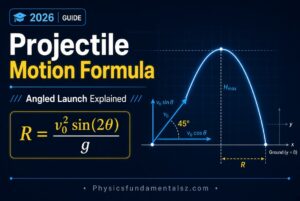
Launch a projectile with speed v₀ at angle θ above the horizontal. Split the launch velocity into components:
The horizontal position grows steadily because there is no horizontal acceleration:
The vertical position obeys the standard equation for constant downward acceleration g (about 9.8 m/s² near Earth’s surface):
Everything you want to know (peak height, flight time, range) comes from these three relationships. The shared variable t is the bridge between them.
Time of flight, peak height, and range
At the highest point the vertical velocity is momentarily zero. Setting v₀·sin θ − g t = 0 gives the time to reach the top, and doubling it gives the total flight time for level ground:
- Time to peak: t_peak = v₀·sin θ / g
- Maximum height: H = (v₀·sin θ)² / (2g)
- Total flight time (level ground): T = 2·v₀·sin θ / g
Multiply the flight time by the horizontal speed and you get the range, the horizontal distance travelled:
This compact formula reveals something elegant about the launch angle.
Why 45° gives maximum range
Because R depends on sin(2θ), and the sine function peaks at 90°, the range is greatest when 2θ = 90°, that is θ = 45°. Launch too flat and the projectile lands quickly; launch too steep and it spends time going up and down without covering ground. Forty-five degrees is the sweet spot that balances flight time against horizontal speed.
A neat consequence: angles equally above and below 45° give the same range. A shot at 30° and one at 60° land in the same spot, though the steeper one flies higher and stays aloft longer. Real projectiles deviate from this because air resistance is not negligible, which usually lowers the optimal angle below 45°.
Common mistakes to avoid
- Mixing axes: never put a horizontal quantity into a vertical equation. Keep the two columns separate.
- Forgetting the sign of g: downward acceleration is negative if you call up positive. Be consistent.
- Assuming the peak is the midpoint of range only on level ground: if launch and landing heights differ, the trajectory is not symmetric.
Projectile motion is really just Newton’s second law applied to a constant downward force. If you want to confirm a numerical answer, try our projectile motion calculator.
Frequently asked questions
Does a heavier projectile fall faster?
No. Ignoring air resistance, all objects accelerate downward at the same rate g regardless of mass. A cannonball and a pebble launched identically follow identical paths in a vacuum.
What shape is the trajectory?
A parabola. Combining constant horizontal velocity with constant vertical acceleration produces y as a quadratic function of x, and a quadratic graph is a parabola.
How does air resistance change things?
Air resistance removes energy and curves the path into an asymmetric shape, shortening the range and lowering the optimal launch angle below 45°. For dense, fast objects over short distances the effect is small enough to ignore.