v=fλ: The Universal Wave Equation (Wave Speed Formula)
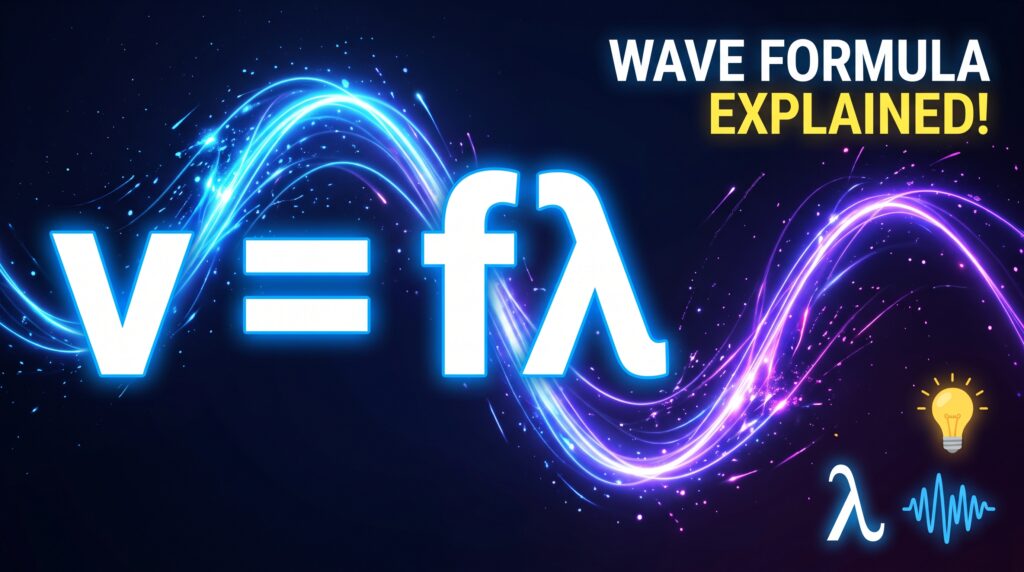
Every wave you’ve ever encountered, the sound of a voice, a ripple across a pond, the light reaching your eyes from this screen, obeys one simple relationship: v = fλ. This equation connects wave speed (v), frequency (f), and wavelength (λ), and it’s one of the most foundational formulas in physics.
In this guide, you’ll learn what each symbol means, how to derive the formula from first principles, how it applies to light and sound, and how to use it to solve real problems.
Table of Contents
What Is the Equation for Wave Velocity?
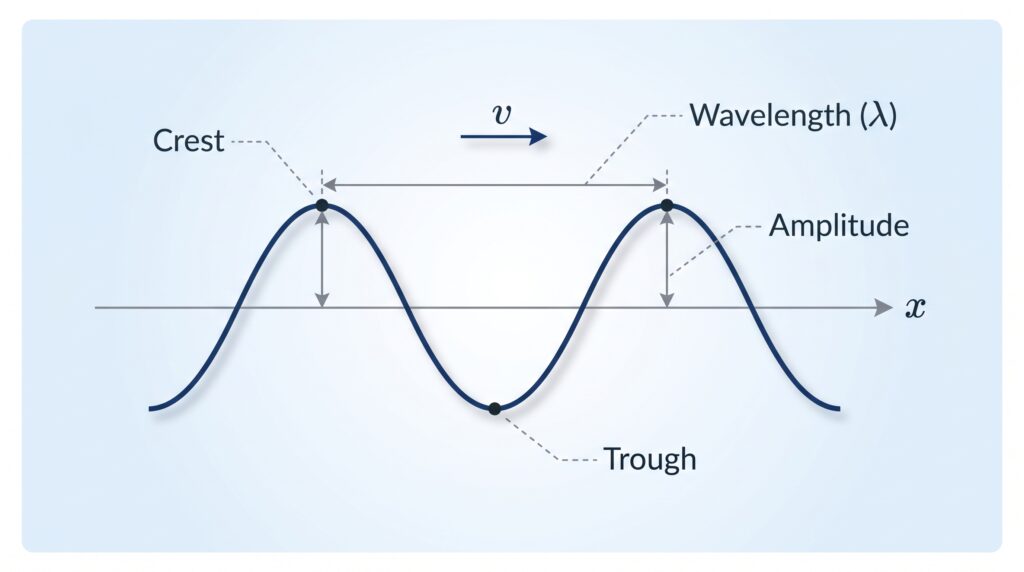
The wave velocity equation states that the speed of a wave equals its frequency multiplied by its wavelength:
v = fλ
This single line packs together three distinct physical quantities, each worth understanding on its own before combining them.
Wave Speed (v), Frequency (f), and Wavelength (λ) Defined
Wave speed (v) is how fast the wave pattern itself travels through a medium, measured in meters per second (m/s). It is not the speed of any individual particle in the medium; it’s the speed of the disturbance moving through it.
Frequency (f) is the number of complete wave cycles that pass a fixed point every second, measured in hertz (Hz). A 440 Hz sound wave completes 440 full oscillations every second.
Wavelength (λ, lambda) is the physical distance between two successive points on a wave that are “in phase,” for example, the distance from one crest to the next. It’s measured in meters.
Why Does v = fλ? (The Geometric Explanation)
The relationship isn’t an abstract law you need to memorize blindly. It falls directly out of the definitions above. In one second, f complete waves pass a given point, and each of those waves is λ meters long. The total distance the wave front covers in that second is simply the number of waves times their length: f × λ. Since distance covered per second is, by definition, speed, we arrive at v = fλ.
This is why physicists sometimes call it a geometric identity rather than a “law.” It’s true simply because of what frequency and wavelength mean, and it holds for every kind of wave: sound, water, light, and beyond.
How to Derive the Wave Speed Formula
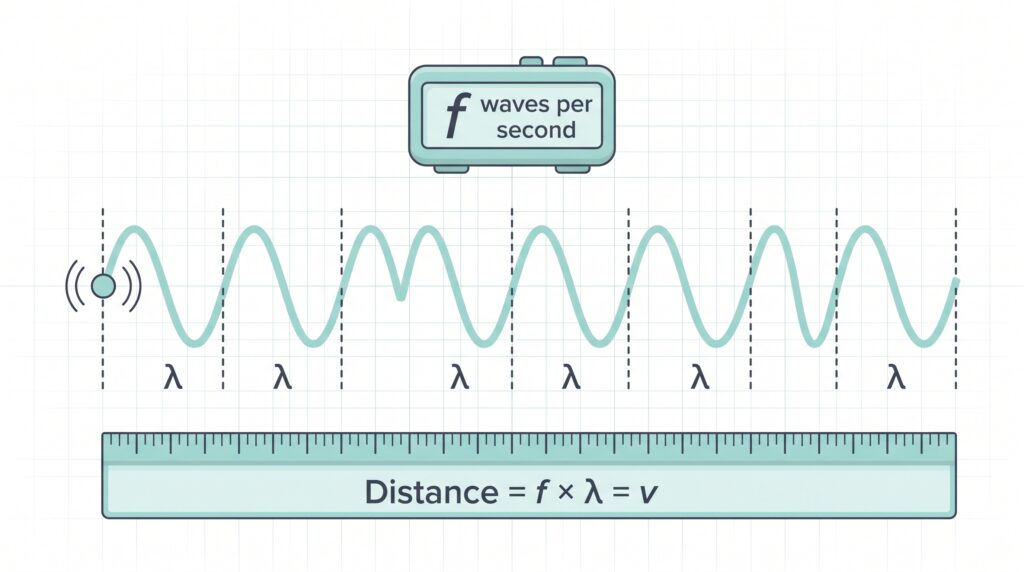
Step-by-Step Derivation of v = λf
- Imagine a wave moving past a fixed observation point.
- In one period (T), exactly one full wavelength (λ) passes the point.
- Speed is distance divided by time, so for one cycle: v = λ / T.
- Frequency is defined as the reciprocal of the period: f = 1/T.
- Substituting T = 1/f into the speed equation gives v = λ / (1/f), which simplifies to v = λf.
This derivation works regardless of the wave type, which is why the formula applies universally, from ocean swells to gamma rays.
Period (T) and the Alternate Form v = λ/T
Because frequency and period are reciprocals of one another, the wave equation can also be written as:
v = λ/T
This form is sometimes more intuitive: it says the wave travels exactly one wavelength in the time it takes to complete one cycle. A 440 Hz sound wave has a period of about 0.00227 seconds (2.27 ms); a slow 0.1 Hz ocean swell has a period of 10 seconds per wave.
Importantly, for a given medium and wave type, the speed v is generally fixed by the properties of that medium, not by the source’s frequency. That means frequency and wavelength must adjust to each other to keep v constant. Higher frequency necessarily means shorter wavelength, and vice versa.
v = fλ vs. c = fλ: Wave Speed and the Speed of Light
The Electromagnetic Wave Equation (c = fλ)
When the wave in question is light or any other electromagnetic radiation, the formula is typically written with c instead of v:
c = fλ
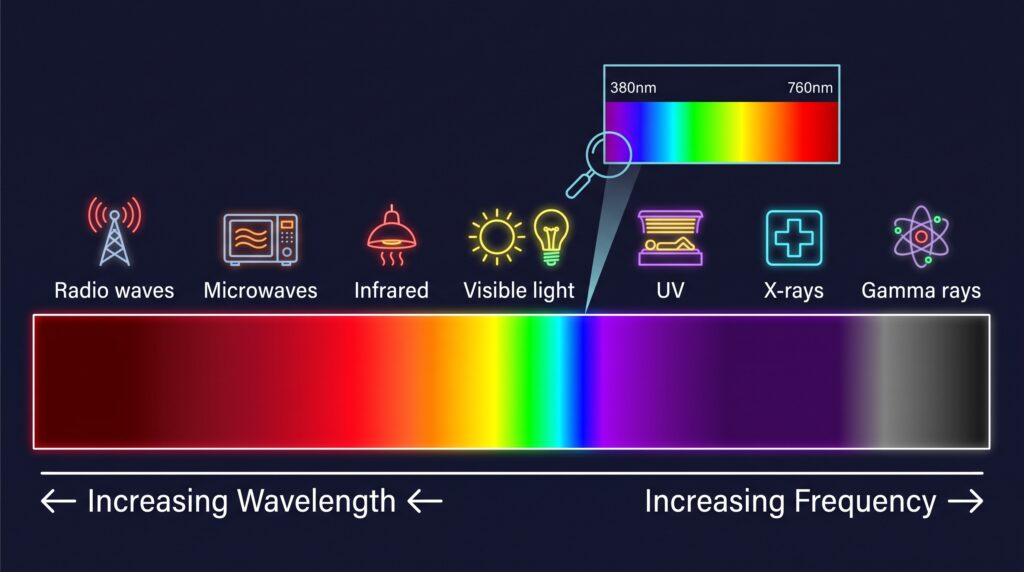
Here, c = 2.998 × 10⁸ m/s, the speed of light in a vacuum. Every part of the electromagnetic spectrum, radio waves, microwaves, visible light, X-rays, and gamma rays, obeys this same equation. The only thing that differs between them is frequency (and therefore wavelength); the speed in vacuum is identical for all of them.
Higher-frequency electromagnetic waves have shorter wavelengths, carry more energy per photon (following E = hf), and have greater penetrating power. That’s the underlying reason X-rays pass through soft tissue but not bone, while gamma rays can penetrate almost anything.
Speed of Light in a Medium (v = c/n and Index of Refraction)
Light slows down when it travels through a medium like glass or water. Its speed in that medium is given by:
v = c/n
where n is the medium’s index of refraction. Dividing both sides of c = fλ by n gives v = fλ/n, which means the wavelength inside the medium (λₙ) is shorter than the wavelength in vacuum: λₙ = λ/n. Crucially, the frequency stays the same as light moves from one medium to another; only speed and wavelength change.
v = fλ Examples and Applications
Sound Wave Example (Frequency to Wavelength Conversion)
If a sound wave travels at 343 m/s (the approximate speed of sound in air) and has a frequency of 440 Hz, its wavelength can be found by rearranging the formula:
λ = v / f = 343 / 440 ≈ 0.78 meters
This kind of frequency-to-wavelength conversion is the most common practical use of v = fλ in introductory physics problems.
Visible Light and the Electromagnetic Spectrum
Visible light occupies a narrow band of wavelengths, roughly 380 to 760 nanometers. Using c = fλ, you can calculate that red light (around 700 nm) has a lower frequency than violet light (around 400 nm), even though both travel at the same speed in a vacuum.
The Doppler Effect and v = fλ
The Doppler effect, the apparent change in a wave’s frequency due to relative motion between source and observer, is a direct consequence of v = fλ. As an ambulance approaches, the waves in front of it get compressed, decreasing wavelength; since v stays fixed, frequency must increase, which is why the siren sounds higher-pitched. As the ambulance passes and moves away, the wavelength stretches behind it, frequency drops, and the pitch lowers.
Common Questions About the Wave Speed Formula
Is v = fλ True for All Waves?
Yes. The relationship holds for any periodic wave, mechanical waves like sound and water waves, as well as electromagnetic waves like light. What changes between wave types is the typical speed and the medium that determines it.
Does Wave Speed Depend on Frequency or Wavelength?
No. For a given medium, wave speed is set by the physical properties of that medium (such as tension and density for a string, or density and elasticity for sound in air), not by the source’s frequency. Frequency and wavelength adjust to each other to satisfy v = fλ, but they don’t independently change the wave’s speed.
v = fλ Practice Problems (with Worked Solutions)
Problem 1: A wave has a frequency of 5 Hz and a wavelength of 2 meters. Find its speed. Solution: v = fλ = 5 × 2 = 10 m/s
Problem 2: Light travels at 3 × 10⁸ m/s and has a wavelength of 500 nm. Find its frequency. Solution: f = c/λ = (3 × 10⁸) / (500 × 10⁻⁹) = 6 × 10¹⁴ Hz
Problem 3: A water wave has a period of 4 seconds and a wavelength of 8 meters. Find its speed. Solution: v = λ/T = 8/4 = 2 m/s
Key Takeaways: v = fλ Summary
- v = fλ relates wave speed, frequency, and wavelength, and holds true for every type of wave.
- It can also be written as v = λ/T, using the period instead of frequency.
- For light, the formula becomes c = fλ in a vacuum, or v = c/n in a medium.
- Wave speed is generally fixed by the medium; frequency and wavelength adjust to maintain that speed.
- The Doppler effect, the electromagnetic spectrum, and refraction are all direct applications of this single formula.