Free Fall and Terminal Velocity

Drop a coin and a sheet of paper together and the coin wins easily. Crumple the paper into a tight ball first, and suddenly they land together. Nothing about gravity changed — only the air resistance did. Untangling gravity from drag is the whole story of free fall and terminal velocity.
What free fall really means
In physics, free fall means motion under gravity alone, with no other forces acting. On Earth, that means we ignore air resistance. Every object in free fall accelerates downward at the same rate, regardless of its mass, traditionally written g.
This is the famous result attributed to Galileo: a heavy ball and a light ball, dropped together in a vacuum, hit the ground at the same instant. It seems to defy intuition, because heavier things are pulled harder — but they are also harder to accelerate, and the two effects cancel exactly.
Gravity pulls harder on heavier objects, but heavier objects also resist acceleration more. The two effects cancel perfectly, so in a vacuum everything falls at the same rate. Astronauts demonstrated this on the Moon by dropping a hammer and a feather side by side.
The equations of falling motion
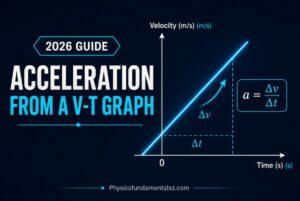
Since the acceleration is constant, the standard kinematic equations apply. Starting from rest, an object’s speed after time t and the distance it has fallen are:
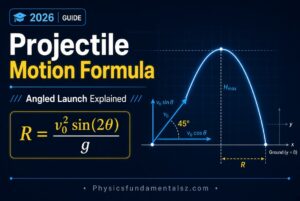
The distance grows with the square of time, which is why falls become dangerous so quickly. Fall for one second and you drop about 5 metres; fall for two seconds and it is 20 metres, not 10. These same patterns govern projectiles too — see projectile motion for the horizontal-plus-vertical case.
Enter air resistance
Real falls happen in air, which pushes back. This drag force grows with speed — roughly with the square of speed for everyday objects — and it depends on the object’s size, shape, and the air’s density ρ.
Here A is the cross-sectional area facing the airflow and C is a drag coefficient capturing the shape. The key point is the v² dependence: the faster you fall, the harder the air pushes back, growing steeply.
Reaching terminal velocity
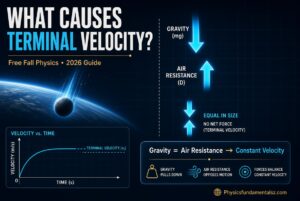
At the start of a fall, gravity dominates and the object accelerates. But as speed rises, drag rises faster, until the upward drag exactly balances the downward weight. At that moment the net force is zero, acceleration stops, and the speed becomes constant. That steady speed is the terminal velocity.
Setting weight equal to drag and solving for speed gives:
- A skydiver in a belly-down spread falls at roughly 55 m/s (about 200 km/h).
- The same skydiver in a head-down dive cuts their area and can exceed 90 m/s.
- A raindrop reaches only a few metres per second, which is why rain stings but doesn’t injure.
Why a parachute works
A parachute is a brute-force way to change terminal velocity. By dramatically increasing the area A, it lowers the terminal velocity to a survivable few metres per second — slow enough to land like a small jump. The fall doesn’t stop; it simply settles to a new, gentler steady speed where the larger drag again balances gravity.
Notice that terminal velocity depends on mass through the m in the numerator: heavier objects do fall faster in air, because they need more drag, hence more speed, to balance their greater weight. This is exactly why the crumpled paper beats the flat sheet — same mass, far less area.
Frequently asked questions
Do heavier objects fall faster?
In a vacuum, no — everything falls at the same rate g. In air, yes, slightly, because a heavier object needs a higher speed before drag can balance its weight, giving it a larger terminal velocity. The everyday illusion that heavy things fall faster is really about air resistance, not gravity.
What exactly is terminal velocity?
It is the constant speed reached when the upward air resistance grows large enough to exactly cancel the downward pull of gravity. At terminal velocity the net force is zero, so there is no more acceleration and the object falls at a steady, unchanging speed.
Why does g not depend on mass?
Gravity’s pull on an object is proportional to its mass, but so is the object’s resistance to being accelerated (its inertia). When you compute acceleration as force divided by mass, the mass cancels out, leaving the same g for everything.