Bohr Model of the Atom: Energy Levels, Emission & Absorption Spectra
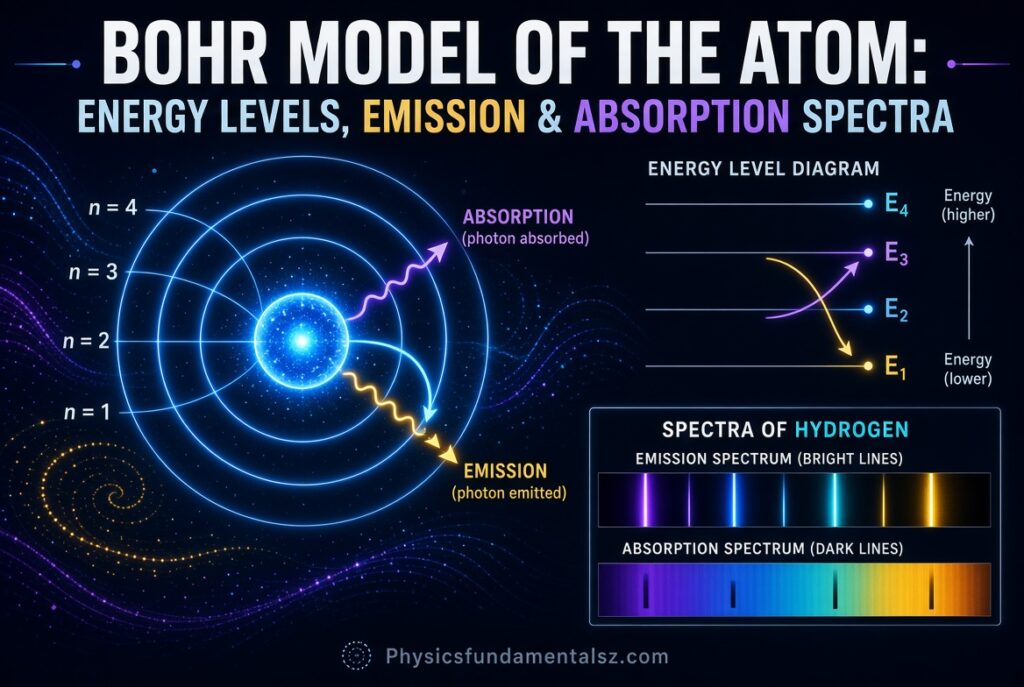
Picture the atom as a tiny solar system, with electrons circling a nucleus in fixed lanes. That picture is exactly what the Bohr model of the atom gave the world in 1913.
Table of Contents
What Is the Bohr Model of the Atom?
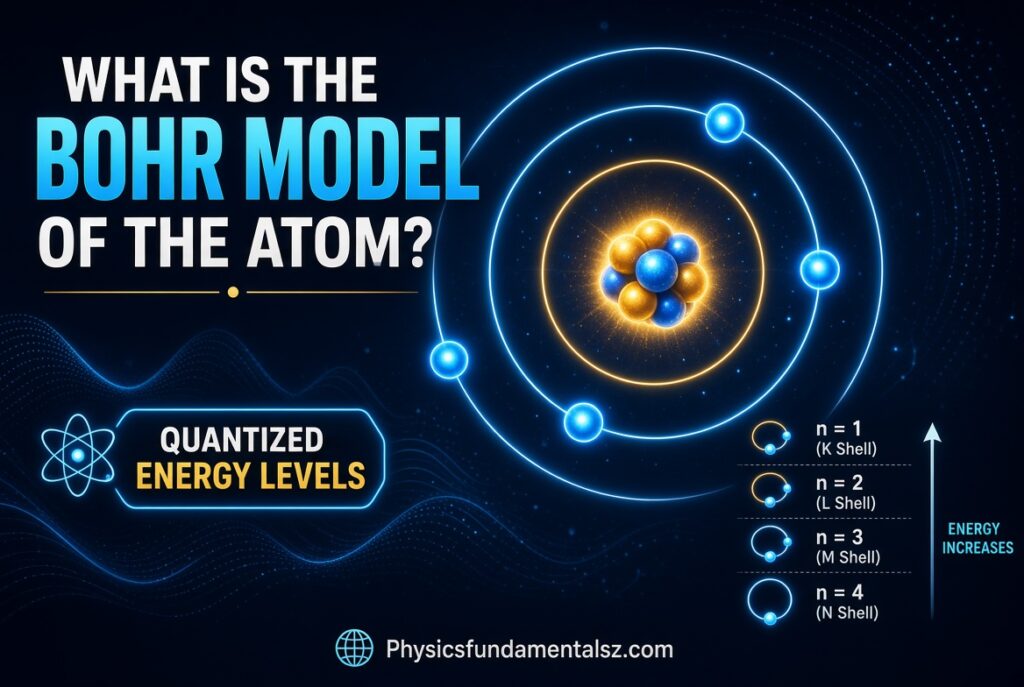
The Bohr model describes an atom as a small, positively charged nucleus surrounded by electrons that orbit in fixed, quantized energy levels.
Electrons do not lose energy while staying in one of these orbits. They only gain or release energy by jumping between them, which explains the sharp lines seen in atomic spectra.
Who Was Niels Bohr?
Niels Bohr was a Danish physicist who proposed this atomic model in 1913, building directly on Ernest Rutherford’s nuclear model. Rutherford had shown that atoms have a dense, positive nucleus, but could not explain why electrons don’t simply spiral into it.
Bohr solved that problem by introducing quantized orbits, borrowing ideas from Max Planck’s quantum theory. He won the 1922 Nobel Prize in Physics largely for this work.
The Four Key Postulates of the Bohr Model
- Fixed orbits: electrons move around the nucleus in specific circular paths called stationary states or shells.
- No energy loss in orbit: electrons in a stationary orbit do not radiate or lose energy, keeping the atom stable.
- Quantized angular momentum: angular momentum can only take values that are whole-number multiples of h/2π.
- Energy jumps: electrons absorb or emit energy only when jumping between orbits, as a photon of specific frequency.
The Bohr Model Formula for Angular Momentum
The quantization condition is written as:
mvr = nh / 2π
Here, m is the electron’s mass, v is its velocity, r is the orbit radius, n is a positive integer (the principal quantum number), and h is Planck’s constant.
This single equation is what forces electrons into specific, discrete orbits instead of any orbit at all.
The Bohr Model Formula for Energy Levels
For a hydrogen atom, the energy of an electron in orbit n is:
Eₙ = −13.6 eV / n²
The negative sign shows the electron is bound to the nucleus. As n increases, the energy becomes less negative, meaning the electron is less tightly held.
Breaking Down Each Variable
- n (principal quantum number): an integer, 1, 2, 3, and so on, identifying the orbit.
- Eₙ (energy level): the electron’s total energy at that specific orbit, in electron volts.
- h (Planck’s constant): the fundamental quantum constant, 6.626 × 10⁻³⁴ J·s.
- r (orbit radius): the distance from the nucleus to that orbit.
- 13.6 eV: the ionization energy of hydrogen, the reference value for the formula.
How the Bohr Model Explains Atomic Spectra
When an electron drops from a higher orbit to a lower one, it releases a photon whose energy equals the exact difference between the two levels. Since these energy gaps are fixed, only certain photon frequencies are possible.
This is why hydrogen produces a line spectrum instead of a continuous rainbow of colors. Each line corresponds to one specific electron transition.
Step-by-Step: Calculating an Energy Level
- Identify the orbit number (n) for the electron you are studying.
- Square the value of n.
- Divide −13.6 eV by n².
- Record the result as the electron’s energy at that level, in electron volts.
- Repeat for a second orbit if you need to find the energy released or absorbed during a transition.
Worked Example 1: Energy of an Electron in the First Orbit
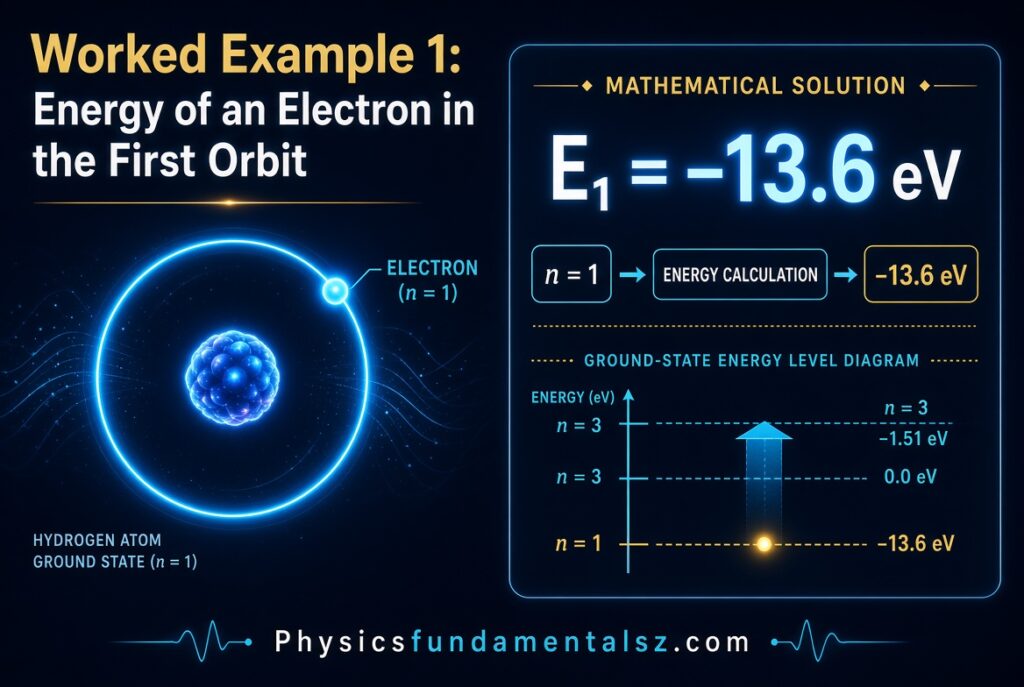
For n = 1, the ground state, the energy is:
E₁ = −13.6 / 1² = −13.6 eV, the most tightly bound state an electron can occupy in hydrogen.
Worked Example 2: Energy Released During a Transition
An electron drops from n = 3 to n = 2. First find each level: E₃ = −13.6/9 ≈ −1.51 eV, and E₂ = −13.6/4 = −3.4 eV.
The energy released is the difference: −1.51 − (−3.4) = 1.89 eV, which corresponds to a specific visible red line in hydrogen’s spectrum.
Comparison Table: Bohr Model vs. Rutherford Model vs. Quantum Mechanical Model
| Feature | Rutherford Model | Bohr Model | Quantum Mechanical Model |
|---|---|---|---|
| Electron path | Undefined, random | Fixed circular orbits | Probability clouds (orbitals) |
| Energy levels | Not addressed | Quantized, discrete | Quantized, described by wavefunctions |
| Explains spectra | No | Yes, for hydrogen | Yes, for all atoms |
| Works for multi-electron atoms | No | No | Yes |
| Basis | Classical physics | Early quantum theory | Full quantum mechanics |
Why the Bohr Model Was a Breakthrough
Before Bohr, no model could explain why atoms are stable or why they emit light only at specific wavelengths. Classical physics predicted electrons should spiral into the nucleus almost instantly.
Bohr’s quantization idea solved both problems at once. It gave the first working link between atomic structure and the emerging field of quantum theory.
Limitations of the Bohr Model
- Fails for multi-electron atoms: it only gives accurate results for hydrogen and hydrogen-like single-electron ions.
- Ignores electron-electron interactions: the model cannot account for repulsion between multiple electrons.
- Contradicts the uncertainty principle: it assumes exact orbits and velocities, which quantum mechanics later showed is impossible.
- Cannot explain fine spectral structure: subtle splitting of spectral lines observed with better instruments goes unexplained.
- No explanation for chemical bonding: the model does not describe how atoms share or transfer electrons.
How the Bohr Model Led to Modern Quantum Mechanics
Erwin Schrödinger and Werner Heisenberg later replaced fixed orbits with probability-based orbitals, giving a far more accurate atomic model. This is often called the quantum mechanical or wave model of the atom.
Even so, the Bohr model’s quantized energy levels remain a correct and useful idea. Modern quantum theory refined the picture rather than discarding it entirely.
Where the Bohr Model Still Matters Today
- Chemistry education: it remains the standard first introduction to electron energy levels in most curricula.
- Spectroscopy basics: it explains the core reasoning behind emission and absorption spectra.
- Laser technology: the concept of electrons jumping between energy levels underlies how lasers emit coherent light.
- X-ray spectroscopy: inner-shell electron transitions, used in materials analysis, follow Bohr-style energy jumps.
- Astronomy: hydrogen emission lines from stars and nebulae are still interpreted using Bohr-level transitions.
Common Mistakes When Studying the Bohr Model
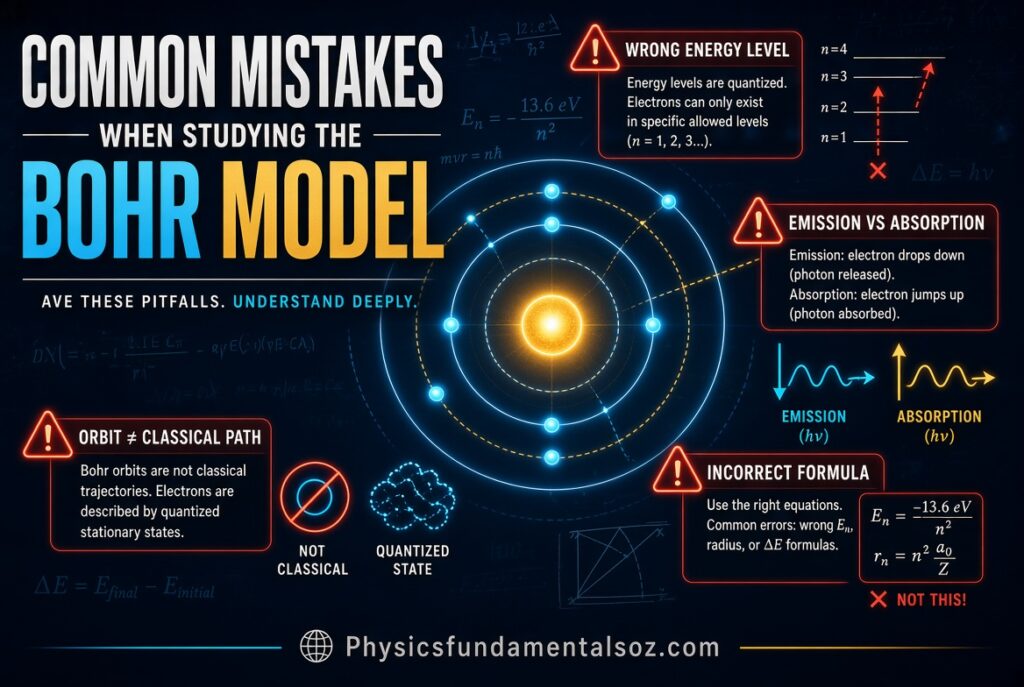
- Applying it to atoms other than hydrogen: results become inaccurate for anything with more than one electron.
- Confusing orbits with orbitals: Bohr orbits are fixed paths, while quantum orbitals are probability regions.
- Forgetting the negative sign in energy: dropping it leads to incorrect transition-energy calculations.
- Mixing up electron volts and joules: always double-check which energy unit a problem expects.
- Assuming stability means no motion: electrons still move continuously; they simply don’t radiate energy while doing so.
Expert Tips for Students
- Always double-check whether a problem specifies hydrogen or a hydrogen-like ion, since the formula changes.
- Remember that higher n values mean the electron is farther from the nucleus and less tightly bound.
- Practice both directions: calculating energy from n, and finding transition energy from two given levels.
- Keep the quantum mechanical model in mind as the more accurate successor, especially for exam context questions.
Key Takeaways
- The Bohr model pictures electrons orbiting the nucleus in fixed, quantized energy levels.
- Its core equations are mvr = nh/2π and Eₙ = −13.6 eV/n² for hydrogen.
- It successfully explained hydrogen’s line spectrum but fails for multi-electron atoms.
- Quantum mechanics later replaced fixed orbits with probability-based orbitals.
- Despite its limits, the model remains foundational for teaching atomic structure.
Also Read:
- Quantum Numbers: n, l, m_l, m_s and Electron Configuration
- Photoelectric Effect Calculations: hf = work-function + KE_max
- Mass-Energy Equivalence: E = mc² Derivation & Nuclear Applications
- Nuclear Decay Equations: Alpha, Beta & Gamma Decay Explained
- Half-Life Calculations: Formula & Worked Examples
- Electromagnetic Waves: Speed, Spectrum & Wave Properties
- Young’s Double-Slit Experiment: Fringe Formula & Applications
- Diffraction: Single Slit, Diffraction Gratings & dsinθ = nλ
- Interference of Waves: Constructive, Destructive & Superposition
- Standing Waves & Resonance: Nodes, Antinodes & Harmonics
- Wave Superposition: Adding Waves, Phase & Interference Patterns
- Wave Speed, Frequency & Wavelength
- Transverse Waves Explained
- Polarisation of Light: Malus’s Law & Applications
- Snell’s Law: Derivation & Total Internal Reflection
- Electric Charge and Coulomb’s Law
- Coulomb’s Law Calculations: F = kQ1Q2/r²
- Electric Potential Energy: E = kQq/r, Work Done & Examples
- Electric Current: I = Q/t, Drift Velocity & Ohm’s Law
- Magnetic Flux and Faraday’s Law: Formula & Applications
- Newton’s Law of Universal Gravitation: Full Guide
- Conservation of Momentum
- What Is Energy?
- Newton’s Laws of Motion
Frequently Asked Questions (FAQs)
What is the Bohr model of the atom in simple words?
It describes an atom as a nucleus surrounded by electrons moving in fixed, quantized orbits, with energy exchanged only when electrons jump between them.
Who proposed the Bohr model of the atom?
Niels Bohr, a Danish physicist, proposed it in 1913, and later won the 1922 Nobel Prize in Physics for related work.
What are the main postulates of the Bohr model?
Electrons orbit in fixed stationary states, do not lose energy while in orbit, have quantized angular momentum, and only exchange energy when jumping between orbits.
What is the formula for energy levels in the Bohr model?
For hydrogen, Eₙ = −13.6 eV / n², where n is the principal quantum number of the orbit.
Why doesn’t the Bohr model work for atoms other than hydrogen?
It ignores repulsion between multiple electrons, so it becomes inaccurate once more than one electron is present.
What is angular momentum quantization in the Bohr model?
It states that angular momentum can only equal whole-number multiples of h/2π, expressed as mvr = nh/2π.
How does the Bohr model explain hydrogen’s spectral lines?
Each spectral line corresponds to an electron dropping between two specific, quantized energy levels, releasing a photon of fixed energy.
What replaced the Bohr model?
The quantum mechanical model, based on Schrödinger’s equation, replaced fixed orbits with probability-based electron orbitals.
Is the Bohr model still taught today?
Yes, it remains a standard introductory model in chemistry and physics courses because it is intuitive and mathematically simple.
What is the ground state in the Bohr model?
It is the lowest possible energy level, n = 1, where the electron is most tightly bound to the nucleus.
What happens when an electron absorbs energy in the Bohr model?
It jumps to a higher, less tightly bound orbit, and later releases that energy as a photon when it falls back down.
What is the significance of the number 13.6 eV in the Bohr model?
It is the ionization energy of hydrogen, the energy needed to completely remove an electron from its ground state.
Does the Bohr model violate the uncertainty principle?
Yes, because it assumes both the exact position and velocity of an electron can be known simultaneously, which quantum mechanics later disproved.
Can the Bohr model be applied to helium?
Only approximately, and mainly to single-electron ions like He⁺, since neutral helium has two interacting electrons.
What is a stationary orbit in the Bohr model?
It is an orbit where an electron can exist indefinitely without radiating or losing energy.
How did Rutherford’s model lead to Bohr’s model?
Rutherford identified the nucleus but could not explain electron stability, a gap Bohr closed using quantized orbits.
What is the difference between an orbit and an orbital?
An orbit is a fixed circular path from the Bohr model, while an orbital is a three-dimensional probability region from quantum mechanics.
Why do larger orbits have higher energy in the Bohr model?
Electrons farther from the nucleus are less tightly bound, so their energy value becomes less negative as n increases.
What experimental evidence supports the Bohr model?
The precise match between predicted and observed spectral lines of hydrogen strongly supported the model early on.
How is the Bohr model used in modern spectroscopy?
It still explains the basic principle of emission and absorption lines used to identify elements in labs and stars.
Conclusion
The Bohr model of the atom gave physics its first working bridge between classical ideas and quantum theory, explaining why atoms are stable and why they glow in specific colors. It was later refined by quantum mechanics, but its core insight, that energy comes in fixed, quantized steps, remains true.
Understanding these postulates and formulas gives you the foundation needed for every atomic structure topic that follows, from electron configuration to modern quantum theory.