Standing Waves & Resonance: Nodes, Antinodes & Harmonics Explained
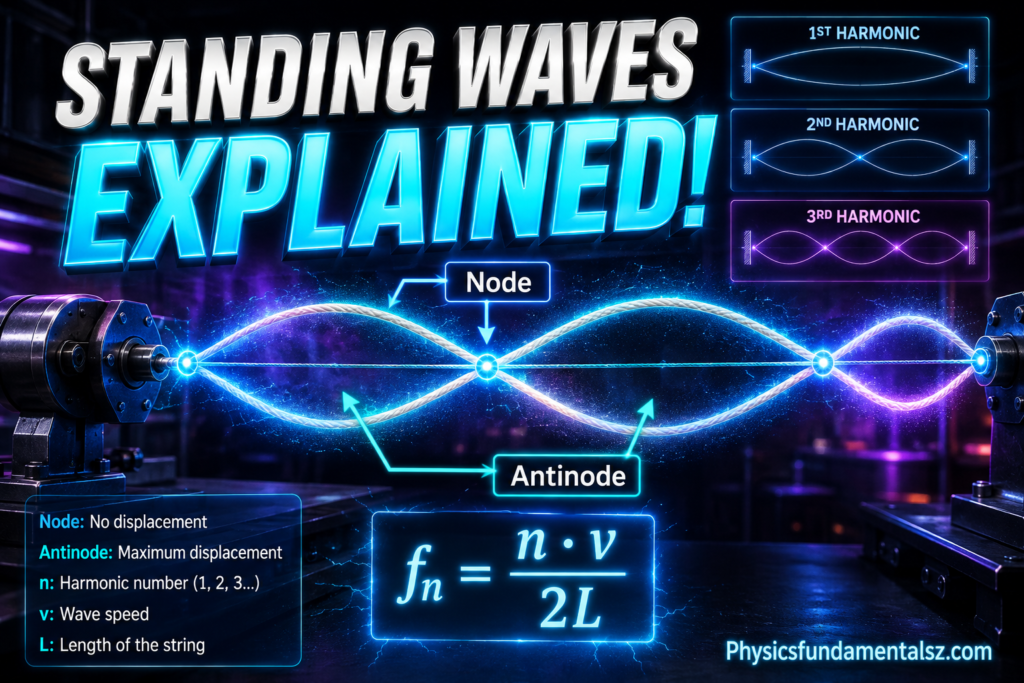
Standing waves resonance is one of the most fundamental yet fascinating phenomena in all of wave physics, and once you understand it, you start seeing it everywhere: in a guitar string, a flute, a wine glass that shatters from a singing voice, and even in the design of bridges and buildings.
Table of Contents
What Are Standing Waves and Resonance?
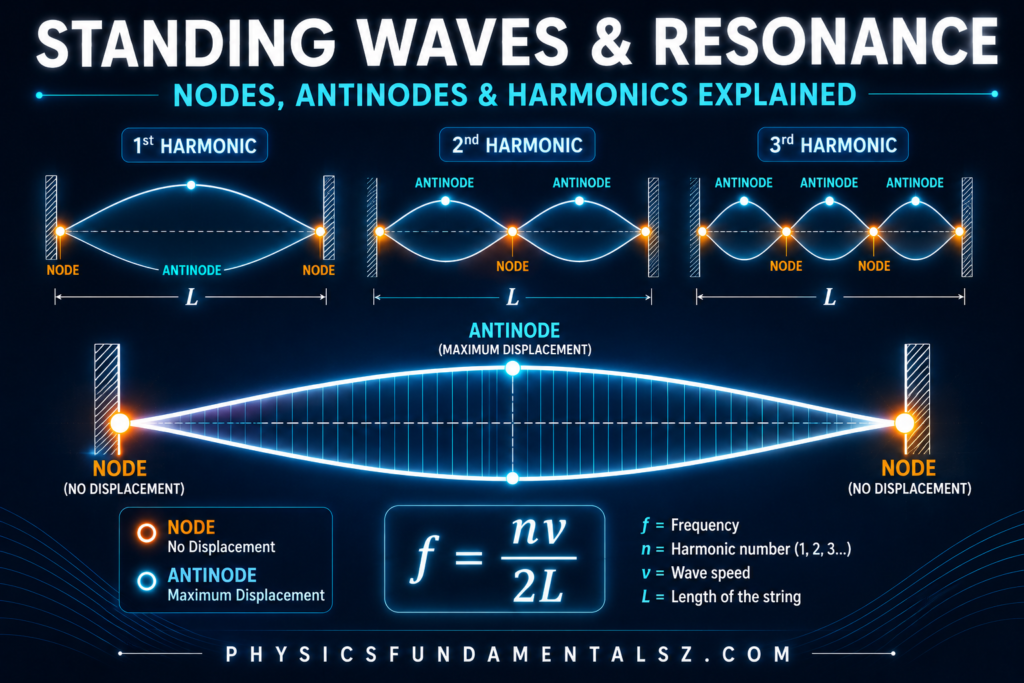
A standing wave is a wave pattern that appears to stay fixed in place instead of traveling through space. It forms when two waves of the same frequency and amplitude travel in opposite directions through the same medium and overlap. Instead of the wave shape moving forward like it does in a typical transverse wave, certain points stay completely still while others oscillate up and down with maximum intensity.
Resonance is closely tied to this idea. Resonance happens when a system is driven at one of its natural frequencies, causing the amplitude of oscillation to grow far larger than it would at any other frequency. When standing waves resonance occurs in a physical system such as a string, a tube of air, or a mechanical structure, the result is a stable, high-amplitude vibration pattern that can be sustained with relatively little energy input.
Together, standing waves and resonance explain how musical instruments produce specific musical notes, how radio antennas are tuned, and why certain structures can fail catastrophically when exposed to a matching frequency of vibration.
How Standing Waves Form: Wave Interference and Superposition
Standing waves are a direct result of wave interference, which is described by the principle of wave superposition. When two identical waves travel toward each other, typically because one wave reflects off a boundary and meets the incoming wave, they combine at every point in space according to the superposition principle.
At certain points, the two waves are always in phase, so their displacements add together and produce large oscillations. At other points, the waves are always out of phase, so their displacements cancel out completely. This alternating pattern of reinforcement and cancellation is what creates the recognizable standing wave shape, with fixed regions of no motion and fixed regions of maximum motion.
This is why boundaries matter so much in standing wave systems. A fixed end, such as the clamped end of a guitar string, forces a reflection that inverts the wave, while a free end reflects the wave without inverting it. These reflection properties directly shape where the nodes and antinodes end up.
Nodes and Antinodes in Standing Wave Patterns
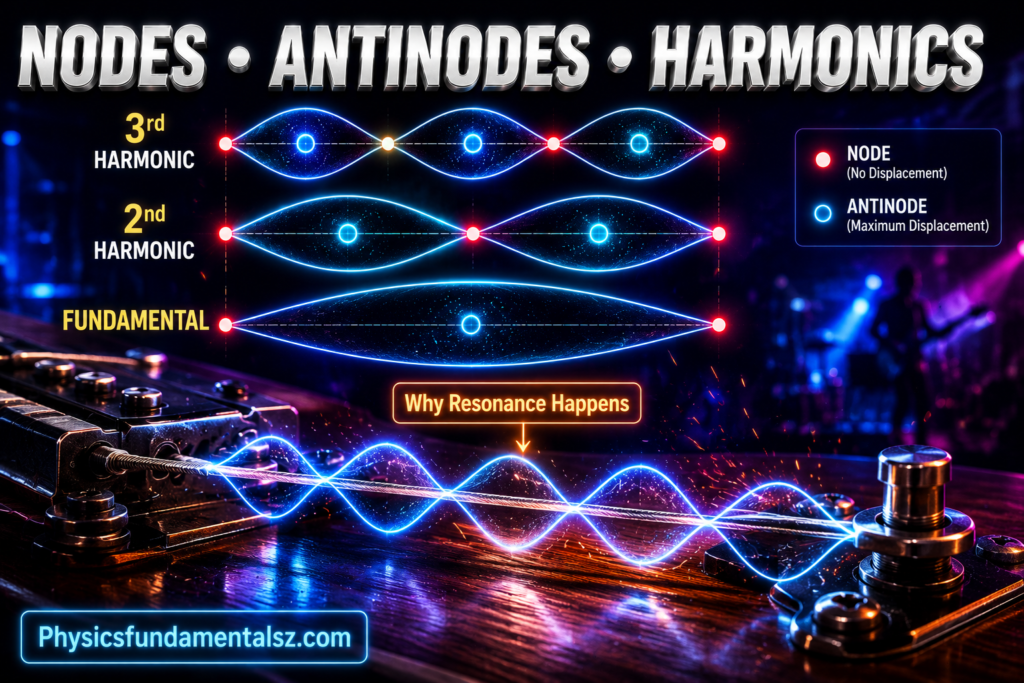
Every standing wave pattern is defined by two key features: nodes and antinodes.
Nodes are points along the medium that remain completely stationary at all times. At a node, the two interfering waves are always perfectly out of phase, so their displacements cancel and the net displacement is zero.
Antinodes are points that oscillate with the maximum possible amplitude. At an antinode, the two interfering waves are always perfectly in phase, so their displacements add together constructively.
Nodes and antinodes always alternate along the length of the medium, and they are spaced exactly half a wavelength apart. The distance between two adjacent nodes, or between two adjacent antinodes, is always half a wavelength, while the distance between a node and the next antinode is a quarter wavelength. This spacing pattern is the key to understanding harmonics and why only certain frequencies can produce a stable standing wave in a given system.
Resonance Frequency and Natural Frequency
Every physical system, whether it is a guitar string, an air column in a pipe, or a swaying skyscraper, has one or more natural frequencies at which it “prefers” to vibrate. These are called resonance frequencies.
When a system is driven at a frequency that does not match a natural frequency, the resulting oscillations are usually small and quickly die out. But when the driving frequency matches a natural frequency, energy is added to the system in a way that consistently reinforces the existing motion. The amplitude builds up dramatically, and a clear standing wave pattern emerges.
This is why pushing a child on a swing works best when your pushes are timed to match the swing’s natural rhythm, and it is exactly the same underlying principle that lets a singer shatter a wine glass by matching their voice to the glass’s resonance frequency.
Harmonics and Overtones Explained
The set of frequencies at which a system can naturally form a standing wave is called its harmonic series. Each of these frequencies corresponds to a specific standing wave pattern with its own arrangement of nodes and antinodes.
Fundamental Frequency (First Harmonic)
The lowest possible resonance frequency of a system is called the fundamental frequency, or the first harmonic. This pattern has the simplest possible node and antinode arrangement and requires the least energy to produce. In a string fixed at both ends, the fundamental frequency corresponds to a standing wave with exactly one antinode in the middle and nodes at each fixed end.
Higher Harmonics and Overtones
Beyond the fundamental frequency, a system can also resonate at integer multiples of that frequency. These higher resonance frequencies are called harmonics, and all harmonics above the first are also referred to as overtones. The second harmonic vibrates at twice the fundamental frequency, the third harmonic at three times the fundamental frequency, and so on. Each successive harmonic adds an extra node and antinode to the standing wave pattern, producing a more complex shape.
Harmonics and overtones are the reason different instruments playing the same musical note still sound distinct. The fundamental frequency determines the pitch you hear, but the relative strength of the different overtones determines the instrument’s unique tone quality, or timbre.
Standing Waves in Strings (Both Ends Fixed)
A vibrating string fixed at both ends, such as on a guitar or violin, is one of the clearest examples of standing waves resonance in action. Because both ends are fixed, both ends must always be nodes, since the string cannot move at the points where it is clamped.
This boundary condition means only specific wavelengths can fit on the string. The fundamental frequency occurs when exactly half a wavelength fits between the two fixed ends. The second harmonic fits a full wavelength, the third harmonic fits one and a half wavelengths, and this pattern continues indefinitely.
Because the speed of a wave on a string depends on the string’s tension and mass per unit length, changing either of these properties, along with the string’s length, changes the resonance frequencies. This is exactly how tuning a guitar works: adjusting the tension of a string shifts its fundamental frequency up or down. For a deeper look at how wave speed, frequency, and wavelength relate to one another, see this guide on wave speed, frequency and wavelength.
Standing Waves in Air Columns
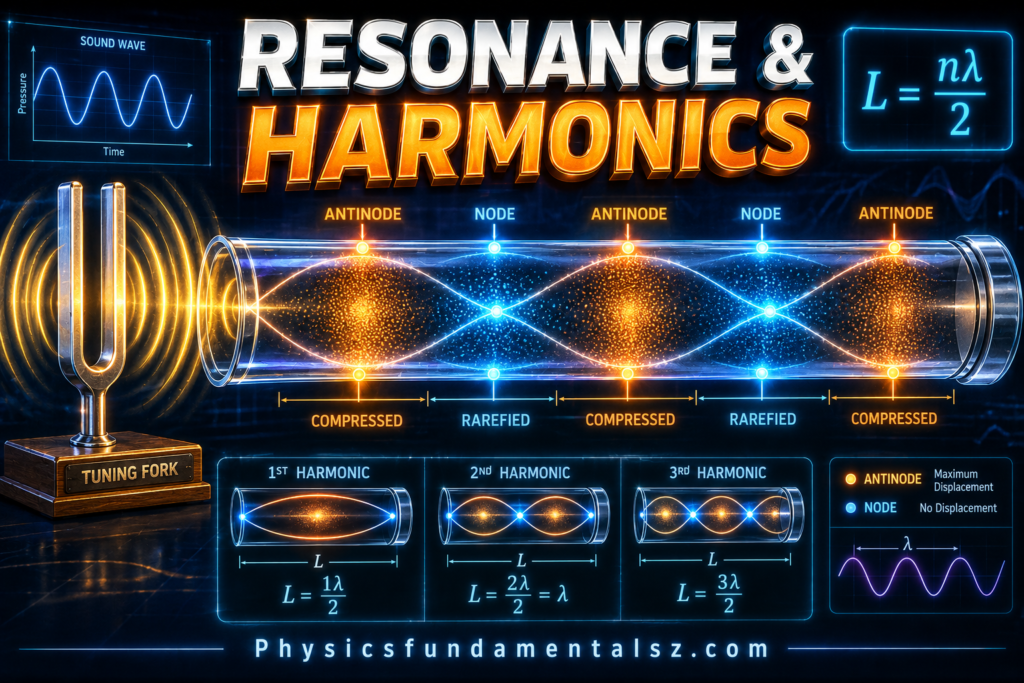
Standing waves also form in columns of air, which is how wind instruments like flutes, clarinets, and organ pipes produce sound. Since sound itself travels as a longitudinal wave, the standing wave pattern in an air column consists of alternating regions of compression and rarefaction rather than the up-and-down motion seen in a string.
Closed Air Columns
In a tube that is closed at one end and open at the other, the closed end must always be a node, since air cannot move freely there, while the open end is always an antinode. This boundary condition only allows odd-numbered harmonics to form: the first, third, fifth, and so on. This is why instruments built on closed air columns, such as a clarinet, tend to produce a distinctive tone that lacks even harmonics.
Open Air Columns
In a tube that is open at both ends, both ends must be antinodes. This configuration allows all harmonics, both odd and even, to occur, which is why instruments like flutes have a richer and more complete harmonic series than closed-pipe instruments.
Real-World Examples of Standing Waves and Resonance
Standing waves resonance is not just a classroom concept. It shapes technology and even safety engineering in ways that are easy to overlook.
Musical instruments rely entirely on controlled standing waves resonance to produce specific pitches, and the design of a concert hall depends on managing how sound waves reflect and interfere to avoid unwanted resonance points called room modes. Radio and microwave engineers use standing waves resonance when designing antennas and cavity resonators, tuning the physical length of a conductor so it resonates at the desired transmission frequency.
On a larger scale, structural engineers must account for resonance frequency when designing bridges and buildings, since a structure driven at its natural frequency by wind, foot traffic, or seismic activity can develop dangerously large oscillations. The historical collapse of the Tacoma Narrows Bridge is frequently cited as a case where aerodynamic forces excited a resonance frequency in the structure, though the full mechanism involved more complex aeroelastic flutter rather than simple forced resonance.
Standing waves resonance patterns can also form when waves reflect off a boundary, a topic closely connected to how waves behave at interfaces, covered in more detail in this article on reflection and refraction.
Standing Wave Equation and Key Formulas
The mathematics behind standing waves resonance follows directly from the general wave relationship linking speed, frequency, and wavelength: v = fλ, where v is wave speed, f is frequency, and λ is wavelength.
For a string fixed at both ends of length L, the allowed wavelengths are given by:
λₙ = 2L / n
And the corresponding resonance frequencies are:
fₙ = n(v / 2L)
where n is a positive integer representing the harmonic number (n = 1 for the fundamental, n = 2 for the second harmonic, and so on).
For a tube closed at one end and open at the other, only odd values of n are allowed, and the formula becomes:
fₙ = n(v / 4L), where n = 1, 3, 5…
For a tube open at both ends, all integer values of n are allowed, using the same form as the fixed-fixed string:
fₙ = n(v / 2L), where n = 1, 2, 3…
These equations show clearly why only discrete resonance frequencies are possible in any bounded system, and why increasing the length of a string or tube always lowers its resonance frequencies.
Frequently Asked Questions (FAQs)
What is the difference between a standing wave and a traveling wave?
A traveling wave moves continuously through a medium, transporting energy from one location to another. A standing wave appears to stay in place, with fixed nodes and antinodes, because it results from the interference of two waves moving in opposite directions.
Why are nodes and antinodes always evenly spaced?
Nodes and antinodes are spaced according to the wavelength of the interfering waves. Since the interference pattern repeats with a fixed periodicity, nodes end up exactly half a wavelength apart, and antinodes fall exactly halfway between adjacent nodes.
What causes resonance to occur?
Resonance occurs when a system is driven at a frequency that matches one of its natural frequencies, allowing energy to be added efficiently on every cycle, which causes the amplitude of oscillation to grow significantly larger than at other frequencies.
Do all harmonics occur in every system?
No. The boundary conditions of a system determine which harmonics are allowed. A string fixed at both ends and a tube open at both ends allow all harmonics, while a tube closed at one end only allows odd harmonics.
Conclusion
Standing waves resonance sits at the intersection of interference, boundary conditions, and natural frequency, and understanding it unlocks a clear explanation for how musical instruments produce pitch, why certain structures are vulnerable to specific vibrations, and how engineers tune everything from antennas to concert halls.
By understanding nodes, antinodes, harmonics, and the resonance frequency equations covered here, you now have the foundation needed to analyze standing wave behavior in strings, air columns, and beyond.