Reflection and Refraction
When light meets a boundary between two materials, two things can happen: some of it bounces back, and some of it crosses over while changing direction. These are reflection and refraction, the twin behaviours that make mirrors, lenses, rainbows, and your own eyesight possible.
Reflection: the law of equal angles
Reflection is the simpler of the two. When a ray of light strikes a smooth surface, it bounces off so that the angle it leaves equals the angle it arrived. Both angles are measured from the normal, an imaginary line perpendicular to the surface.
This is the law of reflection, and it holds for every smooth reflecting surface. A flat mirror gives a clean, undistorted image because every parallel ray obeys the same rule. A rough surface still reflects each tiny ray by the same law, but because the surface points in many directions, the rays scatter, which is why a sheet of paper looks matte rather than mirror-like.
Refraction: light changes speed
Refraction is what happens to the part of the light that crosses the boundary. Light travels at different speeds in different materials, slower in glass or water than in air or vacuum. When a ray enters a slower medium at an angle, the part of the wavefront that arrives first slows down before the rest, swinging the whole beam toward the normal. Leaving a slow medium for a fast one bends it away from the normal.
The amount of slowing is captured by the refractive index n, defined as the speed of light in vacuum divided by its speed in the material:
Air has n ≈ 1.0, water about 1.33, and typical glass about 1.5. A higher index means light travels more slowly and bends more sharply. Because the speed of light in vacuum is fixed, the index is always greater than or equal to one. See our piece on the speed of light for why c is the universal upper limit.
Snell’s law: the bending rule
The exact relationship between the angles and the indices is Snell’s law:
This single equation predicts how much any ray bends at any boundary. It explains why a straw in a glass of water looks broken at the surface, why a swimming pool looks shallower than it is, and how a camera lens focuses light onto a sensor.
Reflection depends only on geometry, but refraction depends on speed. Light bends because it changes pace crossing a boundary, exactly as a marching band turns when one side slows on soft ground.
Total internal reflection
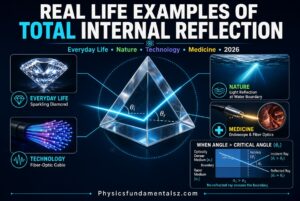
Something dramatic happens when light tries to leave a slow medium for a faster one at a steep angle. As the angle of incidence increases, the refracted ray bends further from the normal until it would have to exceed 90°, which is impossible. Beyond this critical angle, no light escapes; it is all reflected back inside. This is total internal reflection.
The critical angle is found from Snell’s law by setting the refracted angle to 90°:
Total internal reflection is the principle behind optical fibres, which trap light inside a glass thread and guide it for kilometres with almost no loss, carrying the internet’s data as pulses of light.
Dispersion and rainbows
The refractive index of a material is not quite the same for every colour of light. Violet light is slowed slightly more than red, so it bends a little more. This spreading of colours is called dispersion. When white sunlight passes through a glass prism or a raindrop, the colours fan out, producing a spectrum or a rainbow. The same effect can blur a cheap lens, which is why quality optics combine several glass types to cancel it out.
Where you meet these effects
- Mirrors and periscopes rely on reflection.
- Eyeglasses, cameras, and microscopes rely on refraction through curved lenses.
- Optical fibres and binocular prisms rely on total internal reflection.
- Rainbows and prisms showcase dispersion.
To see how light behaves as a wave when it overlaps with itself, explore Young’s double-slit experiment.
Frequently asked questions
Why does light bend toward the normal entering glass?
Light slows down in glass. The edge of the wavefront that enters first is delayed, so the beam pivots toward the normal, just as a wheel turning onto soft sand veers toward the side that slows first.
Does reflection happen at every surface?
Yes, partially. Whenever light crosses between materials of different refractive index, some reflects and some refracts. Even clear glass reflects a few percent of the light, which is why you can see a faint image of yourself in a window.
What is the difference between refraction and diffraction?
Refraction is the bending of light as it changes speed crossing a boundary. Diffraction is the spreading of waves around edges or through narrow openings, a wave behaviour that does not require a change of medium.