The Doppler Effect
An ambulance races past and its siren seems to swoop from high to low. You have just heard the Doppler effect: the change in a wave’s observed frequency caused by motion between the source and the observer. The same principle lets astronomers measure the expansion of the universe and police clock your speed.
The core idea: bunching and stretching
Imagine a source emitting waves at a steady rate. If the source moves toward you, each successive crest is launched a little closer than the last, so the crests bunch up and reach you more often — a higher frequency. If the source moves away, the crests spread out and arrive less often — a lower frequency.
It is the relative motion that matters. The same bunching happens whether the source approaches you or you approach the source. Nothing about the wave’s true emission changes; only the spacing as it reaches the observer.
Sound: the everyday Doppler effect
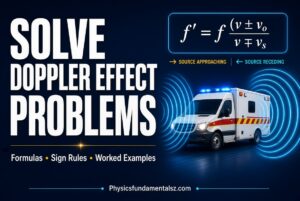
For sound, the medium (air) is fixed, so the formula distinguishes a moving source from a moving observer. For a source moving toward a stationary listener at speed v_s, the observed frequency is:
Here v is the speed of sound and f the emitted frequency. As the source approaches, the denominator shrinks and f’ rises; once it passes and recedes, v_s flips sign and f’ drops. That sudden switch as the ambulance passes is exactly the pitch drop you hear.
The siren itself never changes pitch. What changes is the spacing of the sound waves as they reach your ear — compressed in front of the moving source, stretched out behind it. The Doppler effect is a geometry of arriving wavefronts, not a property of the source.
Light: red shifts and blue shifts
Light waves Doppler-shift too, but light needs no medium, so only the relative velocity matters. A source moving away has its light stretched to longer wavelengths — shifted toward the red end of the spectrum. A source approaching is shifted toward the blue. For speeds far below light speed:
This tiny fractional change in wavelength is measurable with precise instruments and forms the basis of much of modern astronomy. To see where red and blue sit among all wavelengths, visit the electromagnetic spectrum.
How astronomers use redshift
When Edwin Hubble measured the light from distant galaxies, he found their spectra systematically shifted to the red — and the farther the galaxy, the greater the shift. The conclusion was momentous: the galaxies are receding, and the universe is expanding. Cosmological redshift is subtly different from a simple motion-Doppler shift (it reflects the stretching of space itself), but the spirit is the same: stretched light reveals recession.
- Blueshift: object approaching (e.g., the Andromeda galaxy, drifting toward us).
- Redshift: object receding (e.g., the vast majority of distant galaxies).
Everyday and practical uses
The Doppler effect is quietly at work in many technologies:
- Radar guns bounce microwaves off a car; the frequency shift of the reflection reveals the car’s speed.
- Doppler ultrasound measures blood-flow velocity by the shift in reflected sound.
- Weather radar detects the motion of rain and wind inside storms.
At very high speeds, the simple formulas above must be corrected by special relativity, which adds a time-dilation factor to the optical Doppler shift. A subtle but striking consequence is the transverse Doppler effect: even when a source moves exactly sideways, neither toward nor away from you, its light is still shifted slightly to the red purely because its moving clock runs slow. This relativistic redshift has no counterpart in the simple sound picture, and its measurement was one of the early confirmations that time dilation is real rather than a mathematical curiosity.
Frequently asked questions
Does the source actually change its frequency?
No. The source emits at a constant frequency. The effect is entirely in how the wavefronts pile up or spread out due to relative motion, changing the frequency that the observer detects.
Why is the sound formula different from the light formula?
Sound travels through a medium (air), so it matters whether the source or the observer moves relative to that medium. Light needs no medium, so only the relative velocity between source and observer matters, and the relativistic version is symmetric.
What does “redshift” tell us about the universe?
The systematic redshift of distant galaxies shows they are moving away from us, and that more distant galaxies recede faster. This is the central observational evidence that the universe is expanding.