Special Relativity Explained
In 1905, a young patent clerk named Albert Einstein published a theory that demolished centuries of certainty about space and time. Special relativity begins with two innocent-sounding ideas and follows them ruthlessly to conclusions that still feel impossible: time slows down, lengths contract, and mass and energy are the same thing. Remarkably, it is all true and tested to extraordinary precision.
The two postulates
Everything in special relativity flows from just two assumptions:
- The principle of relativity: the laws of physics are the same for all observers moving at constant velocity. There is no experiment that can tell you whether you are “really” moving or at rest.
- The constancy of light speed: the speed of light in a vacuum, c, is the same for every observer, regardless of how the source or observer moves.
The second postulate is the troublemaker. It clashes head-on with common sense: if you chase a beam of light, you might expect it to recede more slowly, yet it always streaks away at the same c.
Time dilation
To keep light’s speed constant for everyone, time itself must bend. A clock moving relative to you ticks more slowly than your own. The factor by which time stretches is the Lorentz factor γ:
At everyday speeds v is tiny compared with c, so γ is essentially 1 and the effect is unnoticeable. But as v approaches c, γ balloons toward infinity. A muon — a particle created high in the atmosphere — reaches the ground only because, at near-light speed, its internal clock runs slow enough to survive the trip. GPS satellites must correct for time dilation to stay accurate to within meters.
There is no universal “now.” Two events that one observer sees as simultaneous, another moving observer sees as happening at different times. Space and time are not separate, fixed stages — they merge into a single, flexible fabric called spacetime, and motion trades one for the other.
Length contraction
Just as time stretches, space shrinks. An object moving past you is measured to be shorter along its direction of motion than it would be at rest, by the same Lorentz factor:
From the muon’s own point of view, it is not time that stretches — instead, the atmosphere it must cross is contracted to a fraction of its thickness. Both observers agree on the outcome (the muon reaches the ground), but they account for it differently. This even-handedness is a hallmark of relativity: every inertial observer’s perspective is equally valid.
Mass–energy equivalence
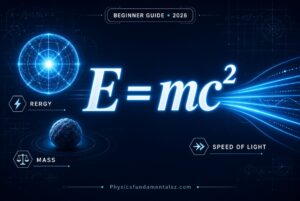
The most famous equation in physics emerges naturally from the theory. Mass and energy are two faces of the same coin:
Because c² is enormous, a tiny amount of mass holds a staggering amount of energy. This is the source of the sun’s power and of nuclear energy: converting a sliver of mass releases tremendous energy. It also means that as an object speeds up, its energy — and effective inertia — grows, which is why nothing with mass can ever quite reach the speed of light. Pushing harder simply pours more energy into γ without ever crossing the barrier.
What relativity does not say
A few clarifications head off common misconceptions:
- Relativity does not mean “everything is relative” — observers disagree about time and length, but they all agree on the laws of physics and on c.
- It applies to constant-velocity (inertial) motion. Acceleration and gravity require the later general theory of relativity.
- The effects are real, not illusions of perception — they have been confirmed by atomic clocks, particle accelerators, and the Doppler shifts measured in the Doppler effect at high speeds.
The whole framework reshapes the classical mechanics built on Newton’s laws of motion, which survive as an excellent approximation whenever speeds are small compared with light.
Frequently asked questions
Why can’t anything go faster than light?
As an object’s speed approaches c, the energy required to accelerate it further grows without bound, heading toward infinity. Since infinite energy is unavailable, no object with mass can reach, let alone exceed, the speed of light.
Is time travel possible under special relativity?
Travel into the future is, in a limited sense. Because moving clocks run slow, an astronaut traveling near light speed ages less than people on Earth, effectively jumping forward in time relative to them. Travel into the past, however, is not permitted by the theory.
Does relativity ever matter in daily life?
Yes. The GPS in your phone relies on satellite clocks that, without relativistic corrections for both their speed and altitude, would drift by enough to make navigation fail within hours.