How Does GPS Use Einstein Relativity Physics Explanation: Time Dilation, Gravity, and Clock Corrections Explained 2026
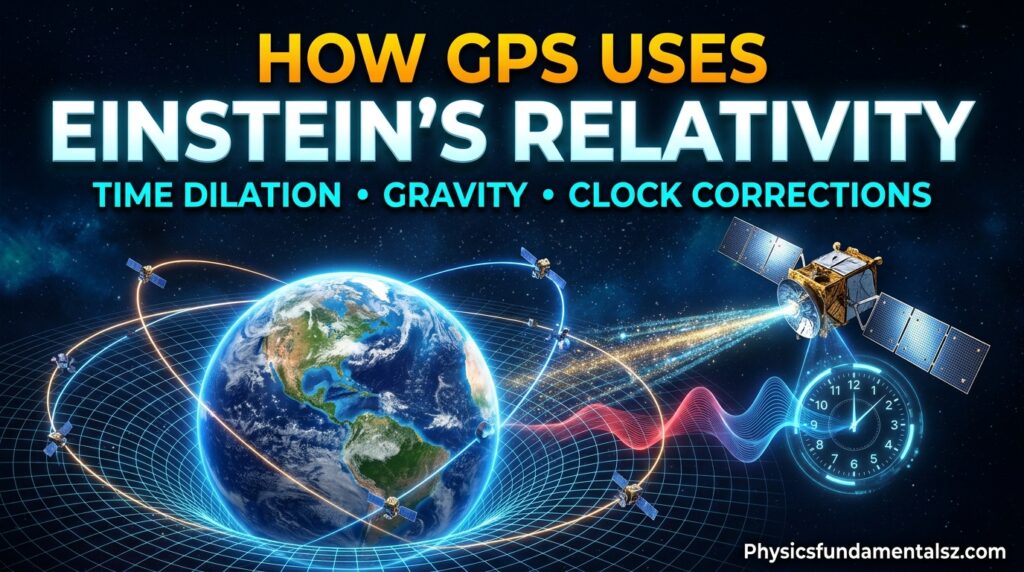
Right now, a satellite more than 20,000 kilometers above your head is running its clock at the wrong speed. Not by much. Just 38 millionths of a second per day. And if engineers ignored that tiny error, your map app would drift off by about 11 kilometers every single day.
That is the strange truth behind the question: how does GPS use Einstein relativity? Physics explanation is not a footnote or a bonus feature. It is a built-in requirement. Without it, satellite navigation would fail within hours.
Einstein never imagined a navigation system. Yet every time your phone finds a coffee shop, it relies on two of his ideas working together, one slowing the satellite clocks and the other speeding them up.
Table of Contents
How Does GPS Use Einstein Relativity Physics Explanation
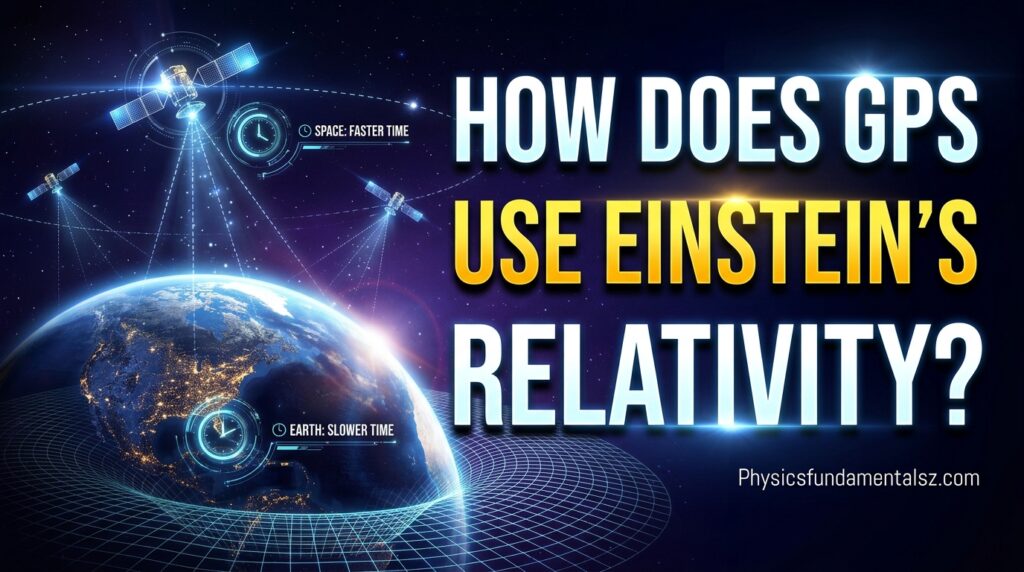
GPS satellites carry atomic clocks. Because the satellites move fast, special relativity makes their clocks tick about 7 microseconds per day slower. Because they sit higher in Earth’s gravity, general relativity makes them tick about 45 microseconds per day faster.
The net result is that satellite clocks run about 38 microseconds per day fast compared with clocks on the ground. Engineers correct this by adjusting the clock frequency before launch and by applying small software corrections in receivers.
The Key Numbers at a Glance
| Effect | Cause | Direction | Size per day |
|---|---|---|---|
| Special relativity | Orbital speed of about 3.87 km/s | Satellite clock runs slow | About −7 microseconds |
| General relativity | Weaker gravity at orbit height | Satellite clock runs fast | About +45 microseconds |
| Net effect | Both combined | Satellite clock runs fast | About +38 microseconds |
| Position error if ignored | 38 microseconds × speed of light | Drifts continuously | About 11 km per day |
How Does GPS Work?
Before adding Einstein, it helps to understand the basic system. GPS is a timing system disguised as a map.
Each satellite continuously broadcasts a radio signal that contains its location and the exact time it was sent. Your receiver listens to several of them and does some simple math.
The Space Segment
The Global Positioning System is operated by the U.S. Space Force. The constellation is designed around at least 24 satellites, and more are usually active as spares.
The satellites orbit at an altitude of roughly 20,200 kilometers. Each one circles Earth about twice per day, with an orbital period of just under 12 hours.
Orbital Speed
At that height, a GPS satellite moves at about 3.87 kilometers per second, or roughly 14,000 kilometers per hour. That is fast by everyday standards, but only about 0.001% of the speed of light.
Small as that fraction is, it matters. Relativistic effects scale with the square of that ratio, and GPS clocks are extremely precise.
The Atomic Clocks
Every GPS satellite carries atomic clocks, typically rubidium and cesium types. They keep time using the natural vibration of atoms, and they are accurate to a few nanoseconds.
To see why atoms make good clocks, read our guide to the Bohr model of the atom, where energy levels and fixed transition frequencies are explained.
The Signal
Satellites transmit on radio frequencies such as L1 at 1575.42 MHz. The signal travels at the speed of light and carries a code that tells the receiver when it left the satellite.
Radio waves follow the same relationship as any wave. Our guide to wave speed, frequency, and wavelength explains how frequency and wavelength connect.
The Ground Segment
Ground stations track every satellite and upload corrections for its clock and orbit. The master control station is in Colorado, with monitoring stations around the world.
These stations keep the whole system aligned with a common time standard.
How a Receiver Finds Your Position
Your phone or car navigation unit does not send anything to the satellites. It only listens.
It measures how long each signal took to arrive. Multiplying that delay by the speed of light gives the distance to that satellite.
Trilateration in Simple Terms
If you know your distance from one satellite, you are somewhere on a huge sphere. Two satellites narrow it to a circle where spheres meet. Three narrow it to two points, and one of them is usually in space.
That gives you a position in three dimensions, in principle.
Why Four Satellites Are Needed
Your phone does not have an atomic clock. Its internal clock is cheap and slightly wrong.
So the receiver solves for four unknowns: latitude, longitude, altitude, and its own clock error. That needs signals from at least four satellites.
Why Nanoseconds Matter
Light travels about 30 centimeters in one nanosecond. A timing error of just 1 nanosecond becomes a distance error of about 30 centimeters.
A timing error of 1 microsecond (1,000 nanoseconds) becomes about 300 meters. This is why GPS is so sensitive to clock drift.
Typical Accuracy
According to the U.S. government’s GPS website, smartphones are typically accurate to within about 5 meters under open sky. Specialized receivers can do far better.
Every bit of that accuracy depends on the satellite clocks being correct to within billionths of a second.
Einstein’s Two Theories of Relativity
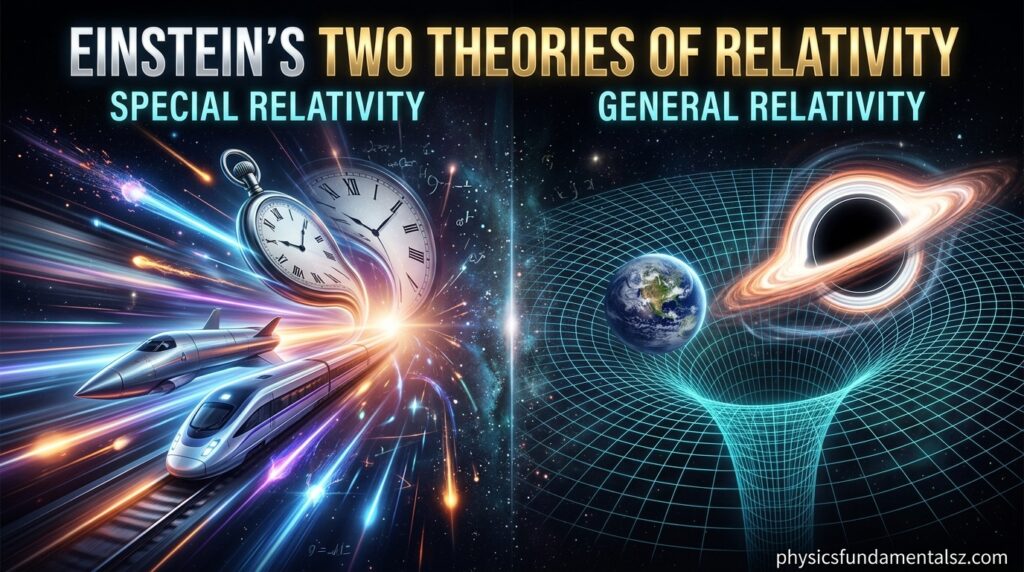
Einstein published two relativity theories. Both change how time works, and GPS needs both.
They are separate ideas, even though they are often mixed together in popular explanations.
Special Relativity (1905)
Special relativity says the laws of physics are the same for everyone moving at constant speed, and that the speed of light is the same for all observers. One consequence is that moving clocks tick more slowly.
For a full introduction, read our guide to special relativity explained.
General Relativity (1915)
General relativity describes gravity as the curvature of spacetime. One consequence is that clocks run more slowly in stronger gravity.
A clock deep in a gravitational field ticks slower than one higher up, where gravity is weaker.
The Equivalence Principle
Einstein’s key insight was that gravity and acceleration are locally indistinguishable. Standing on Earth feels the same as being in a rocket accelerating upward.
This idea led him to predict that gravity affects time, long before anyone could measure it.
Why Both Theories Appear in GPS
The satellites are moving fast, so special relativity applies. They are also high above Earth, so general relativity applies.
The two effects push in opposite directions, and general relativity wins by a wide margin.
Special Relativity in GPS: Moving Clocks Run Slow
Special relativity predicts time dilation. A clock moving relative to an observer ticks more slowly than a clock at rest.
This is not a flaw in the clock. Time itself passes at a different rate for the moving observer.
The Time Dilation Formula
The time measured on the moving clock is:
Δt′ = Δt × √(1 − v²/c²)
For small speeds, this simplifies to a handy approximation:
Δt′ ≈ Δt × (1 − v²/2c²)
Applying It to a GPS Satellite
A GPS satellite moves at about 3,870 meters per second. The speed of light is about 3.00 × 10⁸ meters per second.
The fractional slowing is v²/2c², which equals about 8.3 × 10⁻¹¹. That is a very small number, but it adds up over time.
Daily Result
There are 86,400 seconds in a day. Multiplying 8.3 × 10⁻¹¹ by 86,400 gives about 7.2 × 10⁻⁶ seconds.
So the satellite clock loses about 7 microseconds per day because of its speed.
An Everyday Analogy
Imagine two runners comparing stopwatches after a long race. The one who moved faster through space has a stopwatch that ticked slightly less.
At everyday speeds the difference is impossible to notice. At satellite speeds, over days, it becomes measurable.
General Relativity in GPS: Gravity Makes Clocks Run Fast
General relativity predicts gravitational time dilation. A clock at higher altitude, where gravity is weaker, ticks faster than a clock closer to Earth.
For GPS, this effect is much larger than the special relativity effect.
The Gravitational Time Dilation Formula
For weak gravity, the fractional difference in clock rates is approximately:
Δf / f ≈ (GM / c²) × (1/r₁ − 1/r₂)
Here G is the gravitational constant, M is Earth’s mass, and r₁ and r₂ are the distances of the two clocks from Earth’s center.
Applying It to GPS
Use Earth’s radius of about 6,371 km for the ground clock. Use about 26,560 km from Earth’s center for the satellite clock, which is the radius of the orbit.
The product GM/c² is about 4.4 × 10⁻³ meters. The difference between 1/r values is about 1.19 × 10⁻⁷ per meter. Multiplying gives about 5.3 × 10⁻¹⁰.
Daily Result
Multiply 5.3 × 10⁻¹⁰ by 86,400 seconds. The result is about 4.6 × 10⁻⁵ seconds, or roughly 45 microseconds.
The satellite clock gains about 45 microseconds per day because it sits higher in Earth’s gravity.
An Everyday Analogy
Think of gravity as a kind of slow zone for time. The deeper you are, the more sluggish the clock.
Your feet age very slightly slower than your head. The effect is far too small to feel, yet atomic clocks can measure height differences of about a meter.
The Net Effect: A 38 Microsecond Daily Error
Now combine the two effects. Special relativity subtracts about 7 microseconds. General relativity adds about 45 microseconds.
The net is about +38 microseconds per day. Satellite clocks run fast relative to ground clocks.
Step-by-Step Net Calculation
| Step | Calculation | Result |
|---|---|---|
| Special relativity effect | −(v²/2c²) × 86,400 s | About −7.2 μs/day |
| General relativity effect | +(GM/c²)(1/r₁ − 1/r₂) × 86,400 s | About +45.7 μs/day |
| Net daily offset | 45.7 − 7.2 | About +38.5 μs/day |
Why Gravity Wins
Special relativity grows with the square of speed, while general relativity depends on altitude. At the GPS orbit, the altitude effect is about six times larger than the speed effect.
At lower orbits, such as the International Space Station, the balance is different, and the speed effect actually dominates.
What Would Happen If GPS Ignored Relativity?
Without correction, the 38 microsecond daily drift would corrupt every distance measurement. The error would accumulate steadily.
This is not a subtle problem. It would break the system within a single day.
Turning Time Error Into Distance Error
Multiply the timing error by the speed of light. 38 × 10⁻⁶ seconds times 3.00 × 10⁸ meters per second gives about 11,400 meters.
Position errors would grow by roughly 11 kilometers per day. Within minutes, your phone would place you in the wrong neighborhood.
Error Growth Over Time
| Time without correction | Approximate position error |
|---|---|
| 1 hour | About 0.5 km |
| 6 hours | About 2.9 km |
| 1 day | About 11 km |
| 1 week | About 80 km |
Why You Cannot Just Reset the Clocks
You might think engineers could simply reset the satellites often. Unfortunately, the drift is continuous, and the system needs every satellite to share a common time.
It is far better to prevent the drift than to chase it.
How Engineers Correct for Relativity in GPS
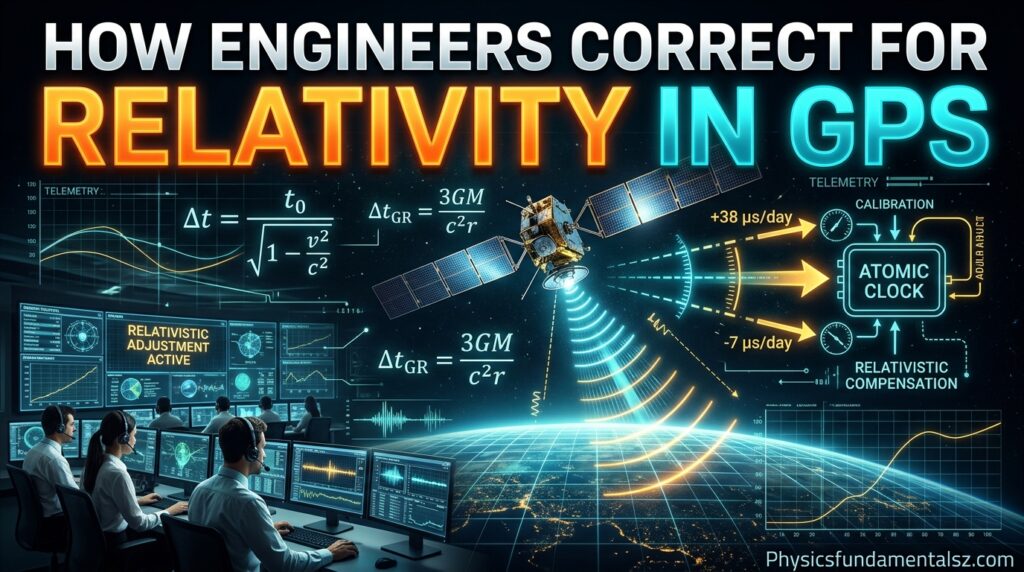
The fix is elegant. GPS engineers adjust the clocks so that, after relativity acts on them, they appear to tick at the right rate to observers on the ground.
The solution has two parts: a frequency offset before launch and small corrections in the signal and receiver.
The Pre-Launch Frequency Offset
The satellite clock’s natural frequency is 10.23 MHz. Before launch, engineers set it slightly lower, at about 10.22999999543 MHz.
That reduces the frequency by about 4.465 millihertz, a fractional change of roughly 4.5 × 10⁻¹⁰. In orbit, relativity speeds it back up to exactly 10.23 MHz as seen from Earth.
Why the Numbers Match
The fractional offset of 4.5 × 10⁻¹⁰ is the same as the net relativistic rate difference. Multiply by 86,400 seconds and you get the 38 microseconds per day.
The pre-launch offset cancels it almost exactly.
The Eccentricity Correction
GPS orbits are not perfectly circular. A slightly elliptical orbit means the satellite speed and altitude vary during each orbit.
This produces a small periodic clock effect of tens of nanoseconds. Receivers calculate and remove it using data in the navigation message.
The Sagnac Effect
Earth rotates while the signal travels from the satellite to the receiver. This adds a small timing difference of up to roughly 100 nanoseconds.
Receivers apply a correction for it. It is a separate effect from time dilation, though it is also part of relativistic navigation.
The Role of the Navigation Message
Each satellite broadcasts parameters describing its clock offset and orbit. These are updated by the ground segment, and receivers use them to finish the correction.
The system is a layered fix: hardware, signal data, and software all work together.
Do We Have Experimental Proof of These Effects?
Yes, and the evidence goes well beyond GPS. Multiple experiments have confirmed both kinds of time dilation.
GPS is arguably the largest continuous test of relativity ever built.
The Pound-Rebka Experiment (1959)
Robert Pound and Glen Rebka measured the gravitational shift of gamma rays traveling up a tower at Harvard. The shift matched the prediction of general relativity.
Gamma rays are photons from the nucleus. If you want to learn more about them, see our guide to nuclear decay equations.
The Hafele-Keating Experiment (1971)
Joseph Hafele and Richard Keating flew cesium atomic clocks around the world on commercial airliners. When compared with clocks that stayed on the ground, the flown clocks differed by amounts consistent with both special and general relativity.
Gravity Probe A (1976)
NASA launched a hydrogen maser clock to about 10,000 kilometers altitude. It tested gravitational time dilation to a precision of about 70 parts per million.
Galileo Satellites in Elliptical Orbits (2018)
Two European Galileo satellites were accidentally launched into elliptical orbits. Researchers used their changing altitude to test gravitational redshift and improved on the earlier precision.
GPS Itself
Early GPS test satellites included a switch to turn the relativistic offset on or off. Observations confirmed that the predicted offset was needed.
Today, GPS operates daily with the correction built in and continues to work to a few nanoseconds.
Is GPS Proof That Einstein Was Right?
GPS strongly supports relativity, but it is more accurate to say that it depends on it. The corrections work because the theory is accurate.
If relativity were wrong, the system would need very different corrections. Engineers designed GPS using relativity, and it performs as predicted.
Relativity Is Now Everyday Engineering
Once a theory is reliable enough, it becomes a tool. Time dilation is now part of a standard engineering manual, like Newton’s laws for bridge design.
This is one of the best examples of abstract physics becoming practical technology.
Newtonian Physics vs Einstein’s Relativity in GPS
Newton’s mechanics treats time as universal. Every clock ticks at the same rate, no matter its speed or location.
Einstein’s relativity says otherwise, and GPS confirms it. For a refresher on classical foundations, see our guide to Newton’s laws of motion.
| Feature | Newtonian view | Einstein’s view | Effect on GPS |
|---|---|---|---|
| Time | Absolute and universal | Depends on speed and gravity | Clocks drift apart |
| Gravity | Force | Curvature of spacetime | Clocks run faster at altitude |
| Speed of light | Can be added to speeds | Same for all observers | Signal timing stays reliable |
| Accuracy for GPS | Fails within hours | Works to nanoseconds | Navigation requires relativity |
Other Satellite Navigation Systems
GPS is not the only system. Russia’s GLONASS, the European Union’s Galileo, and China’s BeiDou all work in a similar way.
They all use atomic clocks and all need relativistic corrections.
Different Orbits, Different Offsets
Each system uses a different orbital altitude. That changes both the speed and the gravitational effect, so each needs its own calculation.
The principle is identical, though: speed slows clocks, height speeds them up, and engineers cancel the net result.
Multi-Constellation Receivers
Modern phones use signals from several systems at once. Each satellite carries its own corrected time, and the receiver combines them.
This is why your phone can often locate you faster and more accurately than older devices.
How Relativity Shows Up in Everyday GPS Use
You might never think about relativity when you use a map. Yet it supports many daily activities.
The same timing precision supports much more than navigation.
Navigation and Maps
Driving directions, ride-sharing, and delivery tracking all depend on accurate positions. Relativity corrections make them reliable.
Aviation and Shipping
Aircraft use GPS for en-route navigation and many approach procedures. Ships rely on it for routes and collision avoidance.
Timing for Infrastructure
Cell towers, power grids, and financial networks use GPS time signals to stay synchronized. A drift of microseconds could disrupt them.
This timing role is just as important as the map function.
Surveying and Agriculture
Surveyors and farmers use high-precision GPS to reach centimeter accuracy. Automated tractors follow rows with the help of corrected satellite signals.
How Atomic Clocks Keep Time in Orbit
A clock is only as good as its repeating process. A pendulum swings, a quartz crystal vibrates, and an atomic clock counts the oscillations of light tied to atomic energy levels.
Atoms of the same element are identical, so they make superb timekeepers. A cesium atom, for example, absorbs microwaves at a precise frequency, and that frequency defines the second.
Why Atomic Clocks Beat Quartz
A quartz watch can drift by seconds per month. An atomic clock drifts by billionths of a second per day, which is the level GPS needs.
Even so, relativity changes their rate when they travel. That is why the same clock design behaves differently on a satellite than in a laboratory.
Multiple Clocks on Every Satellite
Each satellite carries several clocks for redundancy. If one fails or drifts, the ground segment can switch to another.
The ground segment also compares them continuously against a master timescale maintained by the U.S. Naval Observatory and tied to international time standards.
Why Clock Stability Beats Raw Accuracy
GPS does not need every satellite clock to be perfect. It needs each one to be predictable, so ground stations can describe its small errors in the navigation message.
Relativity is one of those predictable errors. That is why it can be removed so cleanly.
A Short Timeline of Relativity and GPS
The story spans more than a century. Each step turned an abstract idea into something measurable.
| Year | Milestone |
|---|---|
| 1905 | Einstein publishes special relativity, predicting that moving clocks run slow |
| 1915 | Einstein completes general relativity, predicting that gravity slows clocks |
| 1959 | Pound and Rebka measure gravitational redshift on Earth |
| 1971 | Hafele and Keating fly atomic clocks on airliners |
| 1976 | Gravity Probe A tests gravitational time dilation in space |
| 1977 | An early GPS test satellite carries a switchable relativity offset |
| 1990s | GPS reaches full operation for civilian and military users |
| 2018 | Galileo satellites in elliptical orbits provide a new redshift test |
Why the Timeline Matters
By the time GPS was built, relativity had been tested for decades. Engineers had good reason to trust the equations.
That trust paid off. The system worked once the corrections were in place.
Worked Examples: GPS and Relativity Calculations
Practice with numbers helps the ideas feel real. Try these before reading the answers.
Example 1: Special Relativity Time Loss
A GPS satellite moves at 3,870 m/s. How much time does its clock lose per day because of its speed? Use c = 3.00 × 10⁸ m/s.
Compute v²/2c²: (3,870)² ÷ (2 × 9.0 × 10¹⁶) = 1.498 × 10⁷ ÷ 1.8 × 10¹⁷ ≈ 8.3 × 10⁻¹¹. Multiply by 86,400 s to get about 7.2 × 10⁻⁶ s, or 7.2 microseconds.
Example 2: Position Error From a Timing Error
A receiver’s clock is off by 100 nanoseconds. How large is the distance error?
Multiply time by the speed of light: 100 × 10⁻⁹ s × 3.00 × 10⁸ m/s = 30 meters.
Example 3: Net Clock Drift
A satellite clock gains 45.7 microseconds per day from gravity and loses 7.2 microseconds from speed. What is the net daily drift?
Subtract: 45.7 − 7.2 = 38.5 microseconds per day. The clock runs fast.
Example 4: Daily Position Error
Using the net drift from Example 3, how large would the daily position error be without correction?
Multiply: 38.5 × 10⁻⁶ s × 3.00 × 10⁸ m/s ≈ 11,550 meters, or about 11.5 kilometers.
Example 5: Fractional Frequency Offset
The net drift is 38.5 microseconds per day. What is the fractional frequency offset?
Divide by the seconds in a day: 38.5 × 10⁻⁶ ÷ 86,400 ≈ 4.5 × 10⁻¹⁰. This matches the pre-launch adjustment engineers apply to the satellite clock.
Common Misconceptions About GPS and Relativity
Many popular articles oversimplify this topic. Here are the most common mistakes.
“GPS Only Uses Special Relativity”
Both theories are needed, and general relativity actually contributes the larger share. Special relativity alone gives the wrong answer in sign and size.
“Satellite Clocks Are Broken”
They are not broken. They tick exactly as relativity predicts. The correction is intentional.
“Relativity Only Matters at the Speed of Light”
Relativistic effects exist at every speed. They are tiny at everyday speeds and measurable with precise clocks.
“GPS Measures Gravity”
GPS does not measure gravity directly. It uses relativity to correct timing, though geodesists use GPS data in studies of Earth’s shape and motion.
“Relativity Makes GPS Less Accurate”
The opposite is true. Relativity corrections make GPS accurate. Ignoring them would cause failure.
Memory Tricks to Remember the GPS Relativity Story
A few simple rules make the story easy to recall in an exam or conversation.
Fast Means Slow
Moving fast slows the clock. Special relativity takes away about 7 microseconds per day.
High Means Fast
Being higher in gravity speeds the clock. General relativity adds about 45 microseconds per day.
45 Minus 7 Equals 38
The satellite clock gains about 38 microseconds per day. Multiply by the speed of light for the error: about 11 kilometers.
Why This Matters for Learning Physics
GPS shows that relativity is not just abstract mathematics. It is a working technology used by billions of people.
It also shows how different areas of physics connect. Time, gravity, light, energy, and atoms all appear in one system.
Connecting to Energy and Mass
Relativity also links mass and energy. For that story, read our guide to mass-energy equivalence.
Connecting to Waves and the Doppler Effect
Satellite signals experience a Doppler shift because of relative motion. For the classical version of the idea, see our guide to how to solve Doppler effect problems.
Connecting to Clocks and Oscillations
Every clock needs a repeating process. A pendulum is the classic example, and our guide to the simple pendulum shows how period and length relate.
Connecting to Energy Basics
If you want a refresher on the concept of energy before diving deeper into relativity, start with what is energy.
Authoritative Sources for Further Reading
For official data and deeper reading, consult GPS.gov, which is run by the U.S. government, and the U.S. Space Force. NASA and the National Institute of Standards and Technology publish accessible material on time and navigation.
For a technical treatment, Neil Ashby’s review article “Relativity in the Global Positioning System” in Living Reviews in Relativity is a well-known reference. It walks through the derivations in detail.
Also Read:
- Special Relativity Explained
- Mass-Energy Equivalence: E = mc² Derivation & Nuclear Applications
- What Is Energy?
- Newton’s Laws of Motion
- Wave Speed, Frequency & Wavelength
- Transverse Waves Explained
- How to Solve Doppler Effect Problems Step by Step: Formulas, Sign Rules, and Worked Examples 2026
- Photoelectric Effect Calculations: hf = work-function + KE_max
- Bohr Model of the Atom: Energy Levels, Emission & Absorption Spectra
- Quantum Numbers: n, l, m_l, m_s and Electron Configuration
- De Broglie Wavelength: λ = h/mv Formula, Derivation & Examples
- How to Calculate De Broglie Wavelength of an Electron: Formulas, Steps and Worked Examples 2026
- Heisenberg Uncertainty Principle: ΔxΔp ≥ ℏ/2 — Explained Simply
- Nuclear Decay Equations: Alpha, Beta & Gamma Decay Explained
- Half-Life Calculations: Formula & Worked Examples Explained
- Difference Between Fission and Fusion With Examples: How Splitting and Joining Atoms Release Energy 2026
- Work-Energy Theorem: Complete Guide with Formula, Derivation, and Examples
- Conservation of Momentum
- Projectile Motion
- Simple Pendulum: Definition, Formula, Time Period, and Derivation
- Real Life Examples of Conduction Convection Radiation: Everyday Heat Transfer Explained 2026
- How to Calculate Decibel Levels from Sound Intensity: Formula, Steps, and Worked Examples 2026
Frequently Asked Questions (FAQs)
How does GPS use Einstein’s relativity?
GPS uses both special and general relativity to correct its satellite clocks. Without these corrections, timing errors would cause position errors of about 11 kilometers per day.
Why does GPS need relativity?
GPS depends on extremely accurate time. Relativity changes how fast satellite clocks tick compared with ground clocks, so it must be accounted for to keep positions accurate.
What is the relativistic effect on GPS satellite clocks?
Special relativity makes them run about 7 microseconds per day slower because of speed. General relativity makes them run about 45 microseconds per day faster because of weaker gravity. The net is about 38 microseconds fast per day.
Do GPS satellite clocks run fast or slow?
Compared with clocks on Earth, they run fast by about 38 microseconds per day before correction.
How much error would GPS have without relativity?
About 11 kilometers per day. The error grows steadily as the clock drift accumulates.
What is time dilation?
Time dilation is the slowing of a clock due to motion or gravity. In special relativity, moving clocks tick slower. In general relativity, clocks in stronger gravity tick slower.
What is gravitational time dilation?
It is the effect where clocks run slower in stronger gravitational fields. A clock at sea level ticks slightly slower than one high above Earth.
Which effect is larger for GPS, special or general relativity?
General relativity is larger. It adds about 45 microseconds per day, while special relativity subtracts about 7 microseconds per day.
How fast do GPS satellites move?
About 3.87 kilometers per second, or roughly 14,000 kilometers per hour.
How high are GPS satellites?
They orbit at an altitude of about 20,200 kilometers above Earth’s surface.
How do engineers fix the relativistic error?
They set the satellite clock to a slightly lower frequency before launch, about 10.22999999543 MHz instead of 10.23 MHz. In orbit, relativity brings it to the correct rate as seen from Earth. Receivers apply smaller corrections as well.
How many satellites does GPS need to find my position?
At least four. Three provide the position, and the fourth lets the receiver solve for its own clock error.
Why do receivers need four satellites?
Receivers have four unknowns: three position coordinates and the clock error. Each satellite signal provides one equation.
How accurate is GPS?
Smartphones are typically accurate to within about 5 meters under open sky, according to the U.S. government’s GPS website. Specialized equipment can reach centimeter accuracy.
What is the Sagnac effect in GPS?
It is a timing correction caused by Earth’s rotation during signal travel. It can reach about 100 nanoseconds, and receivers correct for it.
Is GPS proof of relativity?
GPS strongly supports relativity, because the system works only when relativistic corrections are applied. It is one of the most visible everyday confirmations of the theory.
Do other navigation systems use relativity too?
Yes. Galileo, GLONASS, and BeiDou all rely on atomic clocks and apply relativistic corrections, adjusted for their own orbits.
Has anyone tested time dilation with real clocks?
Yes. The Hafele-Keating experiment in 1971 used atomic clocks on airplanes, and Gravity Probe A in 1976 tested gravitational time dilation with a clock in space.
Does the ISS also experience time dilation?
Yes. Astronauts on the International Space Station age very slightly slower than people on the ground, mainly because of their speed. The difference amounts to milliseconds over many months.
Why does a clock at higher altitude run faster?
General relativity says gravity slows time. The weaker the gravity, the faster time passes. At greater altitude, gravity is weaker, so the clock runs faster.
Can I measure relativity with my phone?
Not directly. The relativistic corrections are already built into the satellite signals and software, so your phone benefits from them without detecting them.
Who discovered that gravity affects time?
Albert Einstein predicted it in his theory of general relativity, finalized in 1915. Experiments in the 20th century confirmed it.
Is the GPS relativity story ever oversimplified?
Sometimes. Popular accounts often mention only special relativity or leave out smaller corrections like orbital eccentricity and the Sagnac effect. The full picture combines several effects.
Conclusion
So, how does GPS use Einstein relativity? It relies on two ideas at once. Special relativity slows the fast-moving satellite clocks by about 7 microseconds a day, while general relativity speeds them up by about 45 microseconds a day because gravity is weaker at orbit height.
The net error of about 38 microseconds per day would grow into an 11-kilometer position error every day if left uncorrected. Engineers prevent it by adjusting the clock frequency before launch and applying smaller corrections in software.
This is why GPS is such a powerful demonstration of modern physics. Einstein’s equations are not just theory. They are part of the daily engineering that guides your car, times your phone network, and keeps global systems in step.
The next time your map app says “you have arrived,” remember that it got you there with the help of time bending around a satellite.