Real Life Examples of Conduction Convection Radiation: Everyday Heat Transfer Explained 2026
Heat is moving around you right now. It flows from your coffee mug into your hand, rises from a radiator across the room, and reaches your face from a sunny window. These are real life examples of conduction convection radiation, the three ways thermal energy travels.
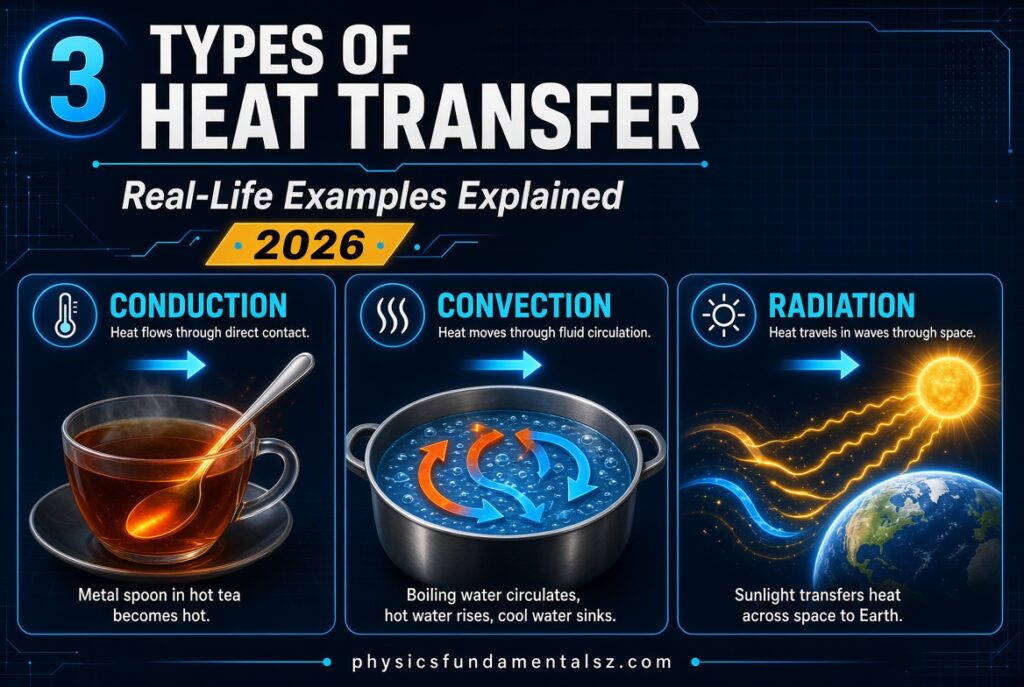
Conduction passes heat through direct contact. Convection carries heat inside a moving fluid like air or water. Radiation sends heat as electromagnetic waves, with no material needed at all.
Most everyday situations use all three at once. A campfire, a hot oven, a sunny car, and even your own body mix them together. Learning to spot each one makes ordinary life make more physical sense.
Table of Contents
Conduction, Convection, and Radiation Examples
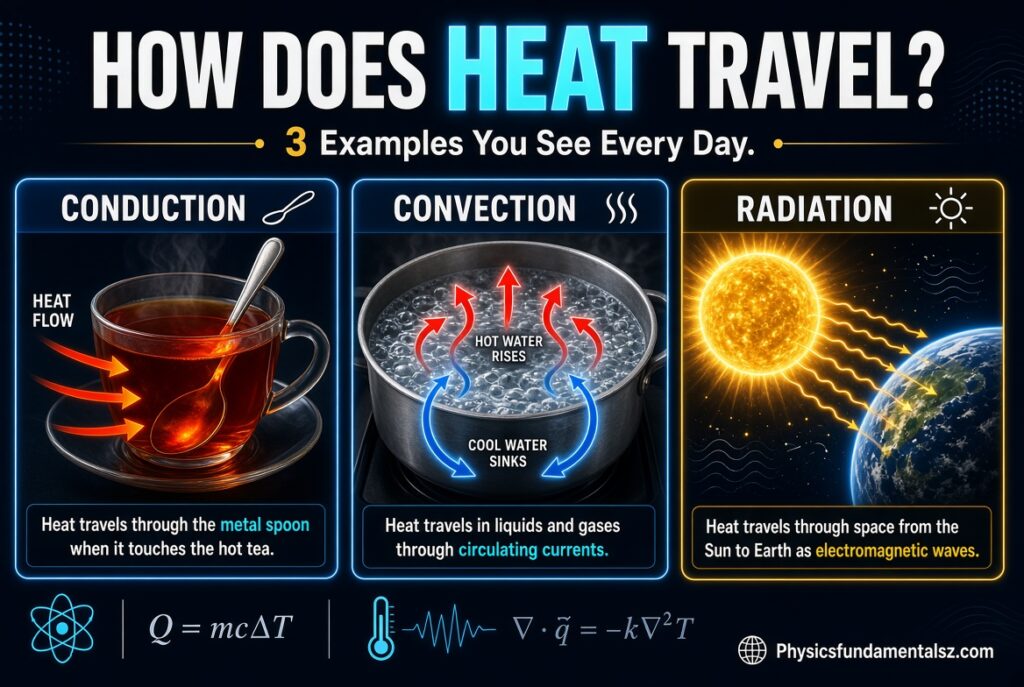
Definition box: Heat transfer is the movement of thermal energy from a hotter place to a cooler place. The three modes are conduction (through contact), convection (through moving fluids), and radiation (through electromagnetic waves).
- Conduction examples: a metal spoon heating in hot soup, a frying pan on a stove, a warm mug in your hands.
- Convection examples: boiling water, a hot air balloon, a room heater, sea breezes, weather.
- Radiation examples: sunlight warming your skin, a campfire on your face, a toaster glowing red, a heat lamp.
- Combined examples: a campfire, an oven, a car parked in the sun, a thermos flask, the human body.
What Is Heat Transfer?
Heat transfer is the flow of thermal energy because of a temperature difference. Energy always moves from the hotter object to the cooler one. It keeps moving until the temperatures even out.
That direction rule comes from the second law of thermodynamics. Heat never flows from cold to hot on its own. A cold drink does not send “cold” into your hand. Your hand sends heat into the drink.
Heat vs Temperature
Heat is energy in transit. Temperature measures the average kinetic energy of the particles in a substance. A bathtub of warm water holds more thermal energy than a cup of boiling water, even though the cup is hotter.
This difference explains many everyday puzzles. A big, mild object can store a lot of heat, while a small, hot one cannot.
What Drives Heat Flow
A temperature difference is the only requirement. The larger the difference, the faster the heat flows. That is why a hot drink cools quickly at first and slowly near room temperature.
Three things shape the rate: the temperature difference, the material, and the area or distance involved. Each mode of heat transfer has its own rules, which we will cover one at a time.
Why Three Modes?
Heat can move through solids, through fluids, or through empty space. Each situation needs a different mechanism. That gives us three distinct modes.
Solids mostly use conduction. Liquids and gases mostly use convection. Empty space allows only radiation.
Conduction, Convection, and Radiation: The Main Differences
Before the examples, here is a side-by-side view. It helps to keep the three modes straight.
| Feature | Conduction | Convection | Radiation |
|---|---|---|---|
| How heat moves | Particle collisions in contact | Bulk movement of a fluid | Electromagnetic waves |
| Medium needed? | Yes (solid, liquid, or gas) | Yes (liquid or gas only) | No, works in a vacuum |
| Particles move along with heat? | No, they vibrate in place | Yes | Not applicable |
| Typical speed | Slow in most materials | Moderate | Fastest, at the speed of light |
| Everyday example | Hot pan handle | Boiling water | Sunlight on your skin |
| Key law | Fourier’s law | Newton’s law of cooling | Stefan-Boltzmann law |
A Simple Memory Trick
Think touch, flow, and glow. Conduction needs touch. Convection needs flow. Radiation is the glow of energy traveling as light.
Conduction Explained
Conduction is the transfer of heat through direct contact between particles. Hot, fast-moving particles bump into cooler, slower neighbors. Each collision hands over some energy.
The material itself does not move. Only the energy travels. This is why conduction is the main mode of heat flow inside solids.
How Conduction Works at the Particle Level
In a solid, atoms vibrate around fixed positions. The hot end vibrates more strongly. Those vibrations pass along the atomic bonds like a wave of jostling.
In metals, free electrons add a second route. These electrons zip through the material and carry energy quickly. That is why metals conduct heat so well.
Fourier’s Law of Heat Conduction
Joseph Fourier described conduction mathematically in the early 1800s. His law gives the rate of heat flow through a material.
Q/t = k × A × ΔT ÷ L
Here Q/t is the heat flow in watts. The letter k is the thermal conductivity of the material. A is the cross-sectional area, ΔT is the temperature difference, and L is the thickness or length.
What the Formula Tells You
- A material with higher k conducts heat faster.
- A larger area lets more heat through.
- A bigger temperature difference drives more heat flow.
- A thicker layer slows heat flow down.
That last point is the secret behind insulation. More thickness means less heat loss.
Thermal Conductivity of Common Materials
Thermal conductivity tells you how well a material conducts heat. Values are in watts per meter per kelvin. These figures are approximate.
| Material | Thermal conductivity (W/m·K) | Conductor or insulator? |
|---|---|---|
| Copper | About 400 | Excellent conductor |
| Aluminum | About 235 | Excellent conductor |
| Carbon steel | About 45 to 50 | Good conductor |
| Stainless steel | About 15 | Moderate conductor |
| Glass | About 1 | Poor conductor |
| Concrete | About 1 | Poor conductor |
| Water | About 0.6 | Poor conductor |
| Wood | About 0.1 to 0.2 | Insulator |
| Fiberglass insulation | About 0.04 | Strong insulator |
| Air (still) | About 0.026 | Excellent insulator |
Notice how still air sits near the bottom. That fact powers winter jackets, double-pane windows, and foam cups.
Conductors and Insulators
A conductor lets heat pass easily. An insulator slows it down. Neither stops heat flow completely. They only change the speed.
Good conductors include copper, aluminum, and steel. Good insulators include wood, plastic, foam, fiberglass, and trapped air. Many tools combine both to get the best of each.
Real Life Examples of Conduction in Everyday Life
Conduction happens whenever two objects at different temperatures touch. You meet it in your kitchen, your home, your clothing, and your body. Here are the clearest cases.
A Metal Spoon in Hot Soup
Leave a metal spoon in a hot bowl and the handle soon feels warm. Heat travels up the metal by conduction. The faster-moving atoms at the hot end pass energy up the spoon.
A wooden spoon stays cool much longer. Wood has a much lower thermal conductivity, so heat moves along it slowly.
A Frying Pan on the Stove
The burner heats the base of the pan. Heat then conducts through the metal and into the food touching it. Cooks pick pan materials based on how evenly they conduct heat.
Copper and aluminum spread heat quickly across the pan. Cast iron conducts less quickly but stores a lot of heat. That is why it keeps a steady temperature for searing.
Hot Pan Handles
Many pans use plastic or wood handles. These materials are poor conductors. They keep heat from traveling from the pan body to your hand.
Handles that are metal often get hot enough to burn you. That is a plain example of conduction at work.
A Hot Cup of Tea in Your Hands
Your fingers warm up as they touch the mug. Heat flows from the hot ceramic into your skin. The ceramic cools slightly as it gives up heat.
You feel warmth because heat is entering your hand. Nothing “warm” is flowing as a substance. Only energy is moving.
Ironing Clothes
A hot iron presses against fabric. Heat conducts from the metal plate into the cloth, loosening wrinkles. The fabric heats up quickly in the area of contact.
The sole plate is usually metal because it needs to spread heat evenly over the whole surface.
Ice Melting in Your Hand
An ice cube melts in your palm because heat conducts from your skin into the ice. The ice absorbs that energy and changes from solid to liquid.
The coldness you feel is heat leaving your hand. It is not cold flowing in.
Walking Barefoot on a Hot Beach
Dark sand can reach very high temperatures in direct sun. When you step on it, heat conducts quickly into your feet. You feel pain because the surface is much hotter than your skin.
Wet sand feels cooler because water conducts heat and also carries energy off by evaporation.
Sitting on a Cold Metal Bench
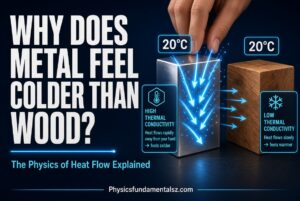
Metal benches feel colder than wooden ones at the same temperature. Metal conducts heat away from your body faster. Your skin senses that fast heat loss as cold.
Wood conducts heat slowly, so it feels closer to neutral. This is the same effect that makes tile floors feel cold under bare feet.
Touching a Doorknob on a Winter Day
Brass and steel doorknobs pull heat from your hand quickly. The knob feels like it is stinging cold, even if the air feels mild. It is the conduction rate you notice, not the temperature alone.
Warm Blankets and Bed Sheets
Your body heats the sheets next to you by conduction. Then the layers of fabric and trapped air slow further heat loss. That is why a bed feels cozy after a few minutes.
A pre-warmed blanket works because it starts at a higher temperature, so less heat leaves your body at first.
Heating Pads and Hot Water Bottles
A heating pad warms your skin by direct contact. Heat flows from the pad into your muscles. The effect lasts as long as the pad stays warmer than your skin.
A hot water bottle holds a lot of heat because water has a high heat capacity. It conducts that heat into your body slowly and steadily.
Cold Packs on an Injury
A cold pack pulls heat out of the skin by conduction. The tissue cools and swelling often goes down. The pack itself warms up as it absorbs heat.
This is the reverse of a heating pad, but the same physics.
Cooking on a Grill Grate
Hot grill bars sear marks onto steak through conduction. The meat touches the bars and heat flows directly into it. That contact is why the lines appear.
The rest of the cooking comes from convection and radiation, which we will see later.
Heat Sinks on Computers
A computer chip makes heat. A metal heat sink sits on top and pulls that heat away by conduction. Thermal paste fills tiny gaps so contact is better.
The sink then passes heat to the air. That step uses convection.
Ice Cream Scoops and Metal Utensils
Some ice cream scoops are filled with liquid that conducts heat from your hand into the scoop. That warm metal cuts through hard ice cream more easily. It is a clever use of conduction.
Heat Through a Wall or Window
Heat conducts through walls, roofs, and glass in every building. In winter, warmth flows outward. In summer, it flows inward.
Insulation exists to slow that conduction. Fiberglass, foam, and double glazing all lower the rate of heat flow.
Conduction in Your Own Body
Heat made deep inside your body reaches the skin partly by conduction through tissue. Most of it, however, moves by blood flow, which is a form of convection.
Skin then passes heat to clothing or air. At each boundary, conduction takes part.
A Worked Conduction Example
Numbers show how big the differences can be. Here is a simple comparison of three rods.
Imagine rods 15 cm long, with a cross-section of 1 square centimeter. One end sits in hot water at 90°C. The other end is at room temperature, 20°C. The temperature difference is 70°C.
Using Fourier’s law with A = 0.0001 m² and L = 0.15 m:
| Rod material | k (W/m·K) | Heat flow (approx.) |
|---|---|---|
| Copper | 400 | About 18.7 W |
| Steel | 45 | About 2.1 W |
| Wood | 0.15 | About 0.007 W |
The copper rod carries nearly 3,000 times more heat than the wooden rod. That huge gap explains why metal handles get hot and wooden ones do not.
Insulating a Wall
Now picture a wall with an area of 10 square meters, a thickness of 0.1 meter of fiberglass, and a 20°C difference between inside and outside.
Q/t = 0.04 × 10 × 20 ÷ 0.1 = 80 W
A single wall section loses about 80 watts. Without insulation, the loss would be far larger. This is why building codes care about insulation levels.
Why Thin Layers of Air Matter
Still air has a conductivity of only 0.026 W/m·K. Trapping air in small pockets is therefore very effective. Down jackets, wool sweaters, and foam all use this trick.
The air itself must not move. If it starts to flow, convection takes over and the insulation fails.
Convection Explained
Convection is the transfer of heat by the movement of a fluid. Liquids and gases both count as fluids. Warm fluid carries energy from one place to another as it flows.
Unlike conduction, convection moves the particles themselves. The heat travels along with the moving material. That makes convection much faster than conduction in liquids and gases.
Why Hot Fluids Rise
Heating a fluid makes it expand. Its particles spread out, so its density drops. Lighter, warm fluid floats upward while denser, cooler fluid sinks to take its place.
This up-and-down motion forms a loop called a convection current. It keeps going as long as there is a temperature difference.
Natural vs Forced Convection
Natural convection happens because of density differences alone. Forced convection uses a fan, pump, or wind to push the fluid. Forced flow usually moves heat much faster.
| Type | What drives the flow | Example |
|---|---|---|
| Natural convection | Density differences from heating | Hot air rising from a radiator |
| Forced convection | Fan, pump, or wind | A convection oven fan, a car radiator |
Newton’s Law of Cooling
Convective heat loss from a surface follows a simple rule.
Q/t = h × A × ΔT
Here h is the convection coefficient, A is the surface area, and ΔT is the temperature difference between the surface and the fluid. A bigger h means faster heat loss.
For still indoor air, h is around 3 to 10 watts per square meter per kelvin. With forced airflow, it can rise to tens or hundreds. Water carries heat away far better than air.
Real Life Examples of Convection in Everyday Life
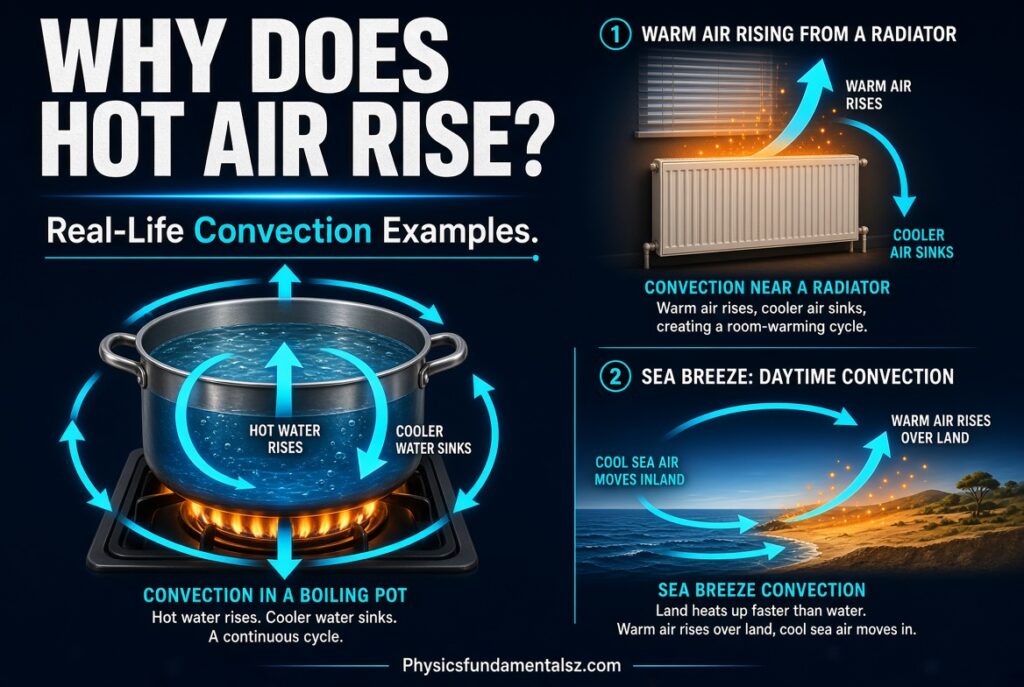
Convection shows up wherever a gas or liquid is heated or cooled. You can see it in your kitchen, your house, the weather, and the planet itself.
Boiling Water in a Pot
Water at the bottom of the pot heats first. It expands, becomes lighter, and rises. Cooler water from the top sinks to replace it.
This circulation spreads heat through the whole pot. Tiny bubbles and swirling motion show convection currents at work.
Steam Rising From a Cup of Coffee
Warm vapor and air rise above the cup. You may see wisps of steam curling upward. That upward flow is a small convection plume.
The air near the cup heats up, becomes lighter, and moves up. Cooler air from the sides flows in to take its place.
A Room Heater or Radiator
A radiator warms the air near it. That warm air rises toward the ceiling. Cool air flows in along the floor to take its place, creating a loop that spreads warmth around the room.
Despite its name, a household radiator transfers most of its heat by convection. Radiation adds only a smaller share.
Why Warm Air Collects Near the Ceiling
Heated air rises, so upper floors are usually warmer than lower ones. This is why basements feel cool and attics feel hot. Ceiling fans in winter can push warm air back down.
A Convection Oven
A convection oven uses a fan to circulate hot air around food. The moving air strips away the cooler layer near the surface of the food. Heat enters faster, so food cooks more evenly and quickly.
This is forced convection in a kitchen. It often lets cooks lower the temperature or shorten the time.
A Hair Dryer
A hair dryer heats air and blows it onto wet hair. The moving hot air boosts heat transfer and also carries off water vapor. That combination dries hair far faster than still air.
Hot Air Balloons
A burner heats air inside the balloon. Hot air is less dense than the cooler air outside, so the balloon floats. The difference is roughly 0.25 to 0.3 kilograms of lift for each cubic meter of heated air.
To go down, the pilot lets the air cool or opens a vent. It is a very visible example of convection and buoyancy.
Sea Breezes and Land Breezes
During the day, land heats faster than the sea. Air above the land warms, rises, and draws in cooler air from the water. You feel that as a sea breeze.
At night the pattern reverses. The land cools faster, and a breeze flows from land to sea. Coastal towns depend on this daily cycle.
Weather and Wind
Warm air rises and cool air sinks across the whole planet. These large-scale convection patterns create winds, storms, and rain. The National Weather Service and NOAA study these flows to make forecasts.
A summer thunderstorm is a giant convection engine. Rising warm, moist air builds towering clouds.
Ocean Currents
Warm surface water moves toward cooler regions. Cold, dense water sinks and flows back along the bottom. This global circulation spreads heat across the oceans and shapes climate.
The Gulf Stream, for example, carries warm water northward in the Atlantic. It is driven partly by temperature and density differences along with wind.
Convection Inside the Earth
The mantle beneath the crust flows very slowly. Hot rock rises, cooler rock sinks, and the motion drives plate tectonics. The movement is only a few centimeters per year, about as fast as fingernails grow.
In the liquid outer core, convection of molten iron helps generate Earth’s magnetic field.
Convection on the Sun
The Sun’s outer layers also use convection. Hot plasma rises, cools at the surface, and sinks. The resulting patches are called granulation, and they can be seen with solar telescopes.
Lava Lamps
The lamp heats wax at the bottom. The wax expands, becomes less dense, and rises. At the top it cools, contracts, and sinks again. The result is a slow, hypnotic convection show.
Soup and Milk Heating on a Stove
Stir a pot of soup and you speed up mixing. Without stirring, the bottom can overheat while the top stays cool. Stirring forces convection and spreads heat evenly.
The Cold Spot Near a Window
On a winter night, air next to a cold window cools and sinks. It spills across the floor as a draft. You feel the movement of air, even if the room is sealed.
That draft is convection in action. Heavy curtains or double glazing reduce it.
Wind Chill
A breeze makes you feel colder than the thermometer says. Moving air strips away the thin warm layer next to your skin. That boosts convective heat loss.
Wind chill describes how cold it feels on exposed skin. It does not change the actual air temperature.
Convection in Your Own Body
Blood carries heat from deep tissues to the skin. This is convection inside a fluid. When you exercise, skin blood flow rises so more heat can reach the surface.
Your breath also carries heat. Warm exhaled air leaves the lungs and cool air enters.
Car Engine Radiators
A pump pushes coolant through the engine and then through the radiator. Air flowing across the radiator fins removes heat. This is forced convection in two fluids.
Computer Fans
A fan pushes air across a heat sink. The air picks up heat and carries it away. Without that flow, chips could overheat within seconds.
Refrigerators
Coils on the back or underside release heat to the room. Air moving past them carries the heat away. Cooler air inside the fridge also circulates, keeping contents evenly chilled.
Convection in Heating and Cooling Homes
Homes use convection on purpose. Understanding it helps with comfort and energy bills.
Forced-Air Furnaces and Air Conditioners
A furnace heats air and a blower pushes it through ducts. An air conditioner cools air and blows it back into rooms. Both depend on forced convection.
Why Cold Air Sinks and Hot Air Rises Matters
Cool air from an air conditioner tends to sink. Warm air from a heater tends to rise. Vents are often placed to work with that tendency.
Installers also seal leaks so conditioned air does not escape to the outside.
Attic Ventilation
A hot attic drives up cooling costs. Vents allow hot air to escape and cooler air to enter. This natural convection helps keep the roof deck cooler in summer.
A Worked Convection Example
Take a bare adult in a room. Suppose skin temperature is 33°C and the air is 20°C. The body surface area is 1.8 square meters.
If h is about 4 W/m²K for still indoor air, then:
Q/t = 4 × 1.8 × 13 ≈ 94 W
That is about as much as a typical resting heat output. Wearing clothes cuts this value sharply because trapped air reduces h and adds insulation.
What a Breeze Does
Blow air across the skin and h can double or more. Heat loss then rises in proportion. That is why a breeze can feel chilly even in mild weather.
Radiation Explained
Thermal radiation is the transfer of heat by electromagnetic waves. Every object with a temperature above absolute zero emits it. Hot objects emit much more than cool ones.
Radiation needs no medium. It crosses empty space, which is how the Sun warms Earth across about 150 million kilometers of vacuum.
Radiation Here Does Not Mean Nuclear
In heat transfer, radiation usually means infrared light and visible light. It does not mean the harmful ionizing radiation from nuclear material. Thermal radiation from a campfire or a heater is ordinary and safe at normal levels.
The Electromagnetic Spectrum
Thermal radiation is part of the electromagnetic spectrum. This spectrum includes radio waves, microwaves, infrared, visible light, ultraviolet, X-rays, and gamma rays.
At everyday temperatures, objects emit mostly infrared. Very hot objects, like a glowing stove coil, also emit visible red light. The Sun, at about 5,770 K, peaks in visible light.
The Stefan-Boltzmann Law
The power an object radiates depends strongly on its temperature.
P = ε × σ × A × T⁴
Here ε is emissivity, σ is the Stefan-Boltzmann constant (5.67 × 10⁻⁸ W/m²K⁴), A is surface area, and T is absolute temperature in kelvin. The fourth power means small temperature rises produce large jumps in radiation.
Emissivity: Good and Poor Radiators
Emissivity measures how well a surface emits and absorbs radiation. It ranges from 0 to 1. Matte black surfaces are near 0.95. Polished silver or aluminum can be as low as 0.02 to 0.05.
| Surface | Approximate emissivity |
|---|---|
| Matte black paint | About 0.95 |
| Human skin | About 0.97 |
| Water | About 0.95 |
| Brick | About 0.9 |
| Polished aluminum | About 0.05 |
| Polished silver | About 0.02 |
Shiny surfaces reflect radiation and also emit little. That is why mirrored coatings are used to control radiant heat.
Wien’s Law: Color and Temperature
Hotter objects emit shorter wavelengths. A cool object glows in infrared. A hotter one adds red, then orange, then white. That is why a heating element goes from invisible to red-hot.
Real Life Examples of Radiation in Everyday Life
Radiation is the one that surprises people most. You feel it, but nothing seems to carry the heat. Here are many familiar cases.
Sunlight Warming Your Skin
Step outside on a sunny day and you feel warmth on your face. That warmth arrives as radiation from the Sun. The energy crossed space and air, but the air itself is not what heated you.
At the top of the atmosphere, the Sun delivers about 1,361 watts per square meter. On a clear day at noon, around 1,000 watts per square meter reach the ground.
A Campfire on Your Face
Stand near a fire and your front feels hot while your back stays cool. Infrared radiation travels straight from the flames to your skin. A blanket or even a hand can block it.
That sharp difference between front and back is the sign of radiant heat.
A Toaster
The glowing wires in a toaster emit infrared and visible light. Bread near them absorbs that radiation and browns. No contact or air flow is needed for the main heating.
A Grill or Broiler
An electric or gas broiler heats food with strong infrared radiation from above. That is why broiled food browns on top but stays pale underneath.
Heat Lamps
Restaurant heat lamps keep food warm and patios comfortable. They emit infrared radiation that warms people and objects directly. They work even in cool, windy air.
An Electric Stove Coil Glowing Red
A hot coil emits radiation you can feel before you touch it. Holding your palm a few inches above or beside it, you sense warmth. The coil also heats the air and the pan, which adds convection and conduction.
Incandescent Light Bulbs
Old-style bulbs wasted most of their energy as infrared radiation. Only a small fraction came out as visible light. That is why they feel hot to touch and why LEDs saved so much power.
Infrared Thermometers and Thermal Cameras
These devices detect the infrared radiation that every object emits. A forehead thermometer or a thermal camera turns that into a temperature reading. They work without touching the object.
Black vs White Clothes in the Sun
Dark clothes absorb more visible light and warm up faster. Light clothes reflect more and stay cooler. This is a direct use of emissivity and absorptivity ideas.
In very hot deserts, people often wear loose light-colored robes. They reflect sunlight and let air flow around the body.
Why a Black Car Gets Hotter
A dark car surface absorbs more sunlight than a white one. It heats up faster in direct sun. The difference can be many degrees.
The Greenhouse Effect
Sunlight passes through the atmosphere and warms the ground. The ground then emits infrared radiation. Gases like water vapor and carbon dioxide absorb part of that radiation and send some back down.
This natural process keeps Earth warm enough for life. Adding more greenhouse gases strengthens it. NASA and NOAA publish a lot of data on this topic.
Greenhouses and Parked Cars
Glass lets visible sunlight in but blocks much of the longer infrared coming back out. Heat builds up inside. A closed car in sunshine can warm by around 20°F in the first ten minutes, according to safety groups like NHTSA.
Never leave children or pets in a parked car, even for a short time.
Space Blankets and Reflective Insulation
Emergency blankets are coated with a thin metallic layer. That layer reflects radiant heat back toward the body. Attic radiant barriers use the same idea to keep summer sun from heating the house.
Spacecraft and Satellites
Space is almost a perfect vacuum. Conduction and convection are nearly absent. Radiation is the main way spacecraft gain and lose heat.
Engineers use multilayer insulation, reflective foil, and radiators to control temperatures. The International Space Station has large radiator panels that dump heat into space.
Moonlit Cold Nights and Clear Skies
On a clear night, the ground radiates heat to the cold sky. With no clouds to send some back, temperatures drop fast. Cloudy nights stay warmer because clouds return radiation.
Microwave Ovens: A Special Case
A microwave oven sends 2.45 GHz electromagnetic waves into food. Water molecules in the food absorb that energy and heat up. This is energy transfer by electromagnetic waves, but it is not thermal radiation from a hot object.
Many sources list microwaves as a radiation example. It is fair to include them, with the note that the waves are made by electronics and not by a hot source.
Radiation From Your Own Body
You emit infrared radiation all the time. A bare adult at skin temperature of about 33°C in a 20°C room can radiate and absorb a net of roughly 100 to 140 watts. Clothing cuts that value.
That is why you feel cold near a cold window even if the air is warm. Your body radiates heat toward the cold glass.
A Worked Radiation Example
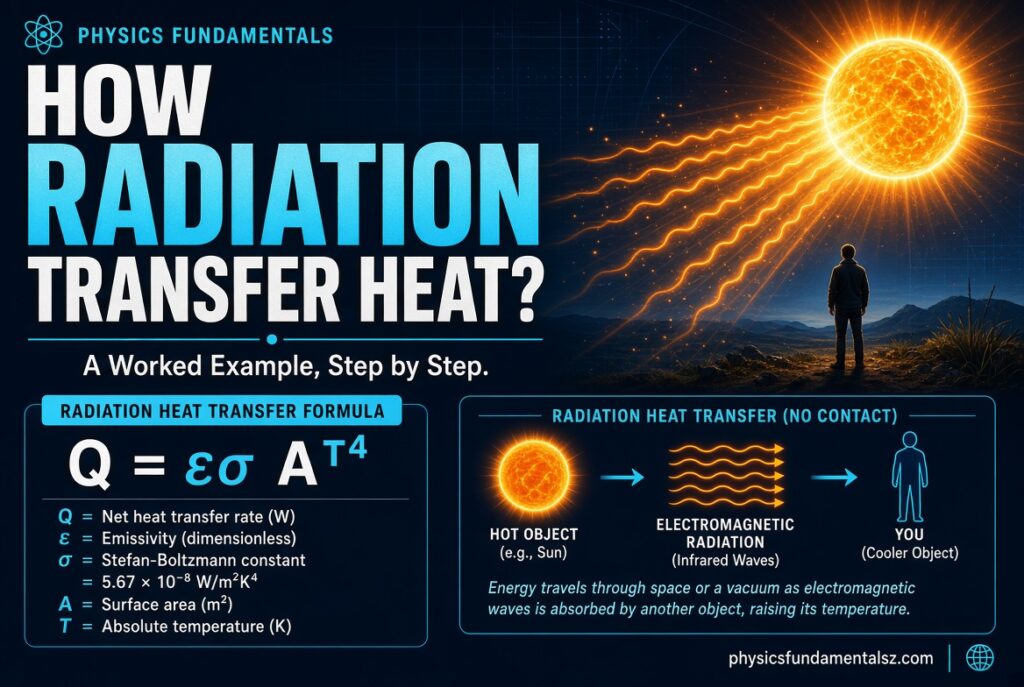
Compute the net radiation from a bare adult using the Stefan-Boltzmann law. Use ε = 0.97, A = 1.8 m², skin at 306 K, and walls at 293 K.
P_net = ε × σ × A × (T_skin⁴ − T_room⁴)
P_net ≈ 0.97 × 5.67 × 10⁻⁸ × 1.8 × (8.77 × 10⁹ − 7.37 × 10⁹) ≈ 138 W
This is an idealized number for bare skin. In real life, clothing and posture reduce it. The calculation still shows how large radiation losses can be indoors.
Why T⁴ Matters
Doubling absolute temperature raises radiated power sixteen times. That is why very hot objects glow so brightly. It also explains why the Sun, at nearly 5,800 K, radiates so much energy.
Examples Where Conduction, Convection, and Radiation Happen Together
Real situations rarely use only one mode. Most everyday heat flow blends all three. Spotting each part is a good test of your understanding.
A Campfire
Heat from a campfire reaches you in three ways at once. Radiation warms your face directly. Convection sends hot air and smoke upward. Conduction heats a metal pot or a roasting stick that touches the flames.
| Part of the campfire | Mode of heat transfer |
|---|---|
| Warmth on your face | Radiation |
| Smoke and hot air rising | Convection |
| Pot handle heating up | Conduction |
| Marshmallow browning near the flame | Radiation and convection |
| Hot rocks around the ring | Conduction and radiation |
A Conventional Oven
The heating element glows and sends radiation to the food. Hot air circulates inside the oven, which is convection. The tray and pan conduct heat into the bottom of the food.
When roasting a chicken, radiation browns the skin, convection moves hot air around it, and conduction carries heat toward the center.
A Thermos Flask
A vacuum flask is built to stop all three modes. A vacuum gap between two walls blocks conduction and convection. Silver coating on the walls reflects radiation. A sealed cap stops hot air and vapor from escaping.
Scottish scientist James Dewar invented the vacuum flask in 1892. It remains a perfect case study in beating all three heat transfer modes at once.
A Cup of Hot Coffee Cooling Down
A cup of hot coffee loses heat in several ways. Warm air rises from the surface, which is convection. Steam carries energy away through evaporation. The cup walls conduct heat to the table and the air. The cup also radiates infrared to the room.
A lid blocks convection and evaporation. That is why a covered mug stays hot far longer.
A Parked Car in the Sun
Sunlight arrives as radiation and heats seats and the dashboard. Hot surfaces warm the cabin air by conduction and convection. Glass traps some outgoing infrared, so heat builds up.
The metal seat belt buckle can then burn skin by conduction. Radiation heats it, and conduction hands the heat to you.
A House in Winter
Heat leaves through walls, windows, roof, and floors by conduction. Air leaks and drafts carry heat away by convection. Windows and walls also radiate infrared to the cold outdoors.
A good home reduces all three. Insulation stops conduction. Weatherstripping and sealing reduce convection. Low-emissivity window coatings cut radiation.
The Human Body
Your body makes heat all day. It loses that heat through conduction to anything you touch, through convection to the surrounding air, and through radiation to cooler surfaces. In hot weather, sweat evaporation adds a fourth route.
In a comfortable room, radiation is the largest of these losses. Convection comes second.
A Computer or Phone
The chip makes heat that conducts into a metal heat sink or the phone’s frame. Air or a fan carries heat away by convection. A small share leaves by radiation.
When a phone gets warm in your hand, that is conduction at work. You are feeling the heat flow into your skin.
A Hot Cup on a Table
The cup touches the table, so conduction takes place there. The warm air above the cup rises, which is convection. And the cup radiates faintly in all directions.
Put a coaster under it and you cut the conduction path. Put on a lid and you cut the convection path.
A Pot of Boiling Pasta
A flame or coil heats the base of the pot. Metal conducts that heat to the water. The water then circulates by convection, spreading heat evenly. The surface also radiates and loses steam.
Every part of the process uses a different mode.
Earth and the Sun
The Sun sends energy to Earth by radiation. The ground warms and passes heat into the air by conduction. Air moves heat around by convection, creating wind and weather. Earth then radiates infrared back into space.
Together these steps drive climate and weather on a global scale.
Comparing Examples Across Everyday Settings
Use this table as a quick reference. It maps many familiar items to the main heat transfer mode involved.
| Everyday situation | Main mode | Why |
|---|---|---|
| Spoon heating in soup | Conduction | Heat moves through solid metal |
| Frying an egg | Conduction | Pan touches the food |
| Boiling water | Convection | Heated water rises and circulates |
| Room heater warming air | Convection | Warm air moves through the room |
| Sun on your skin | Radiation | Energy crosses empty space |
| Toaster browning bread | Radiation | Infrared from glowing wires |
| Hair dryer | Forced convection | Fan pushes hot air |
| Heat sink on a chip | Conduction then convection | Metal pulls heat, air removes it |
| Sea breeze | Convection | Land and sea heat unevenly |
| Space blanket | Reflects radiation | Metal layer bounces infrared |
| Hot air balloon | Convection | Heated air is less dense |
| Ice melting in your hand | Conduction | Heat flows from palm into ice |
Heat Transfer in the Kitchen
Cooking is a great way to learn heat transfer. Every method relies on a specific mode or a mix.
Boiling, Simmering, and Steaming
Boiling uses conduction at the pot base and convection in the water. Steaming uses hot vapor, which carries energy and releases it when it condenses on food. Condensation delivers latent heat, which makes steam very effective.
Frying and Searing
Frying uses conduction through the pan and the oil. Oil improves contact between pan and food. Searing works best on very hot metal, because it drives a fast flow of heat into the surface.
Baking and Roasting
Baking uses radiation from the oven walls and convection from the hot air. Roasting adds direct infrared from the heating element. Dark pans absorb more radiation and brown the bottom faster than shiny ones.
Grilling
A grill uses radiation from hot coals or burners, convection from rising hot air, and conduction from the grate. Each mode contributes to the final flavor and texture.
Why Cast Iron Holds Heat
Cast iron has a high heat capacity and moderate conductivity. It stores a lot of thermal energy and releases it steadily. That keeps the pan hot when cold food goes in.
Choosing Cookware
| Cookware | Main strength | Why |
|---|---|---|
| Copper | Fast, even heating | Very high thermal conductivity |
| Aluminum | Light and responsive | High conductivity at lower cost |
| Stainless steel | Durable | Lower conductivity, often has an aluminum core |
| Cast iron | Heat retention | High heat capacity |
| Glass | Slow heating, even baking | Poor conductor but good radiation absorber |
Heat Transfer in Nature
Nature runs on heat transfer. Weather, oceans, and ecosystems all depend on the three modes.
Weather and Climate
Radiation from the Sun warms the surface. Conduction passes heat into the air near the ground. Convection lifts that warm air, forms clouds, and powers storms.
Ocean and Lake Mixing
Surface water warms in sunlight. Cold, dense water sinks. In lakes, this creates seasonal turnover where layers mix in spring and autumn.
Animals and Heat
Animals use all three modes. A lizard on a rock warms up by conduction and radiation. A bird fluffs feathers to trap air and cut conduction and convection. An elephant flaps its ears to boost convection.
Plants and Soil
Sunlight heats leaves by radiation. Wind cools them by convection. Soil conducts heat slowly, so deep soil stays at steady temperatures. This is why caves and cellars feel cool in summer and mild in winter.
Real Life Applications of Heat Transfer
Engineers use these three modes to design almost everything that heats or cools.
Insulation in Buildings
Insulation targets conduction by using materials with low thermal conductivity. The U.S. Department of Energy publishes guidance on insulation levels, called R-values, for different climates. A higher R-value means more resistance to heat flow.
Windows
Double- and triple-pane windows trap air or gas between panes. That gap cuts conduction and convection. Low-emissivity coatings cut radiation. Together they make windows far more efficient than single glass.
Clothing for Cold and Hot Weather
Layers trap air, which is a strong insulator. Wind-proof shells block convection. Reflective layers help with radiation. Wet clothes conduct heat away quickly, so staying dry matters.
In hot weather, light, loose, breathable fabric helps sweat evaporate and lets air move.
Electronics Cooling
Heat pipes, heat sinks, fans, and liquid cooling loops move heat from chips to the air. They use conduction, convection, and sometimes phase change. Good thermal design keeps devices fast and safe.
Power Plants and Engines
Engines and power plants turn heat into work and must reject waste heat. Radiators and cooling towers push that waste heat into the air. The second law of thermodynamics says some waste heat is unavoidable.
Solar Water Heaters
Dark panels absorb sunlight by radiation. Heat conducts into pipes and then into the water. The warmed water circulates by natural convection to a storage tank. All three modes are working in one device.
Cold Chain and Coolers
Insulated coolers slow conduction with foam walls. Ice absorbs heat through melting. Lids reduce convection. Light colors reduce solar radiation absorbed.
Common Misconceptions About Conduction, Convection, and Radiation
Some ideas about heat are widely believed but not accurate. Fixing them helps your intuition.
“Cold Flows Into You”
Not true. Heat always flows from hot to cold. When something feels cold, heat is leaving your body into it.
“Heat Rises”
Hot air and hot fluids rise because they are less dense. Heat itself flows in any direction, wherever there is a temperature difference. A hot stove heats your hand even when your hand is above it, or beside it, or below it.
“Metal Is Colder Than Wood”
At room temperature, both are the same temperature. Metal feels colder because it conducts heat from your hand faster. Your skin senses the rate of heat loss.
You can read more about this in the related article on metal and wood below.
“Radiators Radiate Most of Their Heat”
Most household radiators warm rooms mainly by convection. Radiation contributes a smaller part. The name is a historical habit.
“Radiation Is Always Dangerous”
Thermal radiation from the Sun, a fire, or a heater is normal and mostly harmless at everyday levels. Strong sunlight can still cause burns, so sunscreen and shade matter. Ionizing radiation is a separate topic.
“A Blanket Makes Heat”
A blanket does not generate heat. It slows the loss of your body’s heat by trapping warm air near your skin. It is insulation, not a heat source.
“A Vacuum Stops All Heat Transfer”
A vacuum stops conduction and convection. Radiation still works across it. That is exactly how sunlight reaches Earth.
“Sweat Cools Because It Is Cold”
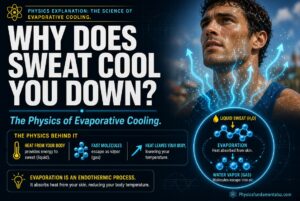
Sweat cools you through evaporation, which takes latent heat from your skin. It is a different process from the three main modes, but it often works alongside them.
Simple Experiments You Can Try at Home
Safe home tests make the ideas stick. Always use caution with hot water and flames, and ask an adult to supervise if you are young.
Conduction Test With Spoons
Place a metal spoon, a wooden spoon, and a plastic spoon in a mug of warm water. After a few minutes, feel the handles. The metal one warms first.
For a bigger effect, dab a bit of butter near the top of each handle and see which one melts first.
Ice Cube Race
Put one ice cube on a metal pan and another on a plastic plate. The cube on metal melts faster. The metal conducts heat from the room into the ice more quickly.
Convection in a Glass of Water
Fill a clear glass with room-temperature water. Add a drop of food coloring near the bottom, then gently warm one side of the glass with a safe heat source or place the glass in a shallow warm-water bath. Watch the color rise and circulate.
Paper Pinwheel Over a Warm Surface
Hold a lightweight paper pinwheel above a warm (not hot) radiator or a mug of hot water. The rising warm air spins it slowly. It shows an upward convection current.
Black vs White Radiation Test
Place two thermometers in direct sunshine. Wrap one bulb in black paper and the other in white paper. After 10 to 15 minutes, compare readings. The black one will be warmer because it absorbs more radiation.
Feel the Fire Without Touching
On a safe campfire or fireplace, hold your hand to the side and then above the flames from a safe distance. The sideways heat is mostly radiation. The heat above is mostly convection.
Never put your hand close to flames.
Reflective Shield Test
Hold a piece of aluminum foil between your hand and a warm lamp or sunny window. The warmth you feel on your hand drops quickly. The foil reflects much of the radiation.
How to Identify Each Mode Quickly
When you meet a new situation, ask three questions. They help sort the modes in seconds.
Is There Direct Contact?
If two objects touch and one gets warm, think conduction. A hot pan handle and a warm mug both qualify.
Is a Fluid Moving?
If air or liquid is flowing and carrying heat, think convection. Boiling water and wind both qualify.
Does Heat Cross Empty Space or a Gap?
If heat reaches you without contact or air flow, think radiation. Sunlight and a campfire on your face both qualify.
Typical Cases That Mix Modes
If you cannot decide, it is probably more than one. List which parts involve contact, flow, or light. Often all three apply.
Heat Transfer and Your Energy Bills
Understanding the three modes can lower heating and cooling costs. Each fix targets one path of heat loss or gain.
Reduce Conduction
Add insulation to attics, walls, and floors. Use thicker curtains and rugs. Choose double-pane windows. All of these lower the thermal conductivity of the barrier between inside and outside.
Reduce Convection
Seal gaps around doors, windows, and outlets. Close fireplace dampers when not in use. Draft-proof attic hatches. Stopping air leaks keeps conditioned air inside.
Reduce Radiation
Use blinds, reflective films, or low-emissivity glass to block summer sun. In attics, a radiant barrier reflects heat from the roof. Light-colored roofs reflect more sunlight than dark ones.
Match the Fix to the Season
| Season | Main problem | Best fix |
|---|---|---|
| Winter | Heat escaping by conduction and drafts | Insulation, sealing, double glazing |
| Summer | Sunlight heating the home by radiation | Shades, reflective films, light roofs |
| Both | Air leaks | Weatherstripping and caulking |
Heat Transfer Rates Compared
The three modes work at very different speeds. The numbers below give a rough feel for the scale. They are approximate and depend heavily on conditions.
| Situation | Typical rate (approx.) |
|---|---|
| Conduction through 10 m² of insulated wall, 20°C difference | About 80 W |
| Convection from a bare adult in still indoor air | About 90 W |
| Radiation from a bare adult at skin temperature in a 20°C room | About 140 W |
| Sunlight on a surface facing the Sun at noon (clear sky) | About 1,000 W per m² |
| Copper rod, 15 cm, 70°C difference, 1 cm² cross-section | About 19 W |
What These Numbers Show
A single square meter in direct sun receives about 1,000 watts. That is enough to run a small space heater. It explains why solar panels, solar water heaters, and black car seats all get so hot.
At the same time, the body’s own heat flows are only about 100 watts each. They balance carefully against the heat your metabolism makes.
Thermal Equilibrium and Why Objects Reach Room Temperature
Leave a hot drink on a table and it cools to room temperature. A cold drink warms up. Both stop changing when they reach the temperature of their surroundings. This state is thermal equilibrium.
How Fast Does a Drink Cool?
Early on, the temperature difference is large, so heat flows quickly. As the difference shrinks, the flow slows down. The result is a curve that drops fast and then levels off.
This behavior follows Newton’s law of cooling. All three modes help drive it, along with evaporation from the surface.
How to Keep a Drink Hot or Cold
Use a lid to cut convection and evaporation. Use an insulated or vacuum mug to cut conduction. Use a shiny surface to cut radiation. The best flasks do all three.
Key Takeaways: Conduction, Convection, and Radiation in Real Life
- Conduction passes heat through direct contact, with no bulk motion of material.
- Convection carries heat in moving liquids and gases, by natural or forced flow.
- Radiation transfers heat as electromagnetic waves and works across a vacuum.
- Metals conduct heat very well, while still air and wood conduct it poorly.
- Fourier’s law, Newton’s law of cooling, and the Stefan-Boltzmann law describe each mode.
- Most everyday situations combine all three modes at the same time.
- Insulation, double glazing, reflective coatings, and fans all control specific modes.
- Heat always flows from hot to cold, never the other way on its own.
- Metal feels colder than wood because it conducts heat away from your skin faster.
- A thermos beats all three modes with a vacuum, a reflective coating, and a sealed lid.
Also Read:
- Heat Transfer: Conduction, Convection and Radiation
- Why Does Metal Feel Colder Than Wood at Room Temperature? The Physics of Heat Flow Explained 2026
- Specific Heat Capacity
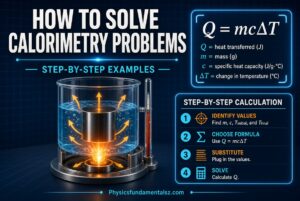
- Thermal Energy & Internal Energy: Heat, Temperature & Q = mcΔT
- The First Law of Thermodynamics
- The Second Law of Thermodynamics
- Entropy Explained for Beginners Easy Guide 2026
- Entropy Explained
- The Kinetic Theory of Gases
- Thermal Expansion: Formula ΔL = αL₀ΔT, Types & Worked Examples
- How Do Heat Engines Work Step by Step? Key Concepts Explained 2026
- Boyle’s, Charles’ & Gay-Lussac’s Gas Laws: Formulas & Examples
- Ideal Gas Law: PV = nRT
- Ideal Gas Law Calculator With Steps: PV = nRT Formula & Examples 2026
- Ideal Gas Law Practice Problems With Answers (2026 Study Guide)
- Stress, Strain & Young’s Modulus: E = sigma/epsilon Formula & Examples
- Physics Fundamentals: The Complete Guide to Core Concepts, Laws, and Equations
- The Doppler Effect
- How to Derive Wave Speed Formula? Full Derivation Guide 2026
- Wave Speed Calculator Frequency Wavelength: Formula, Steps & Worked Examples 2026
- Photoelectric Effect Equation Explained (2026 Simple Guide)
- Mass Energy Equivalence Real Life Examples (2026 Guide)
Frequently Asked Questions (FAQs)
What are real life examples of conduction, convection, and radiation?
Conduction: a hot pan handle or a warm mug. Convection: boiling water or a room heater. Radiation: sunlight on your skin or a campfire on your face. Many situations, such as an oven or a car in the sun, use all three.
What is the simplest difference between conduction, convection, and radiation?
Conduction moves heat through touch. Convection moves heat through flowing liquids or gases. Radiation moves heat as electromagnetic waves, and it needs no material at all.
What are 5 examples of conduction in everyday life?
A metal spoon heating in soup, a frying pan cooking an egg, ironing clothes, ice melting in your hand, and a heating pad warming your back. All involve direct contact between objects at different temperatures.
What are 5 examples of convection in everyday life?
Boiling water, a hot air balloon, a room radiator, a sea breeze, and a convection oven. In each, a heated fluid moves and carries thermal energy with it.
What are 5 examples of radiation in everyday life?
Sunlight warming your face, a toaster, a heat lamp, a campfire, and an electric stove coil glowing red. Each sends heat as infrared or visible light.
Can heat transfer happen without a medium?
Yes, but only by radiation. Conduction and convection need matter. Radiation crosses empty space, which is how sunlight reaches Earth.
Why does metal feel colder than wood?
Metal conducts heat away from your hand much faster than wood. Your skin senses that fast heat loss as cold. Both materials are actually at the same room temperature.
Is a radiator really a radiator?
Mostly it is not. A household radiator warms a room mainly by convection, as heated air rises and circulates. It does emit some radiation, but that is the smaller share.
Why does a campfire feel hot on your face but not your back?
Radiation travels in straight lines from the flames to your skin. Your front faces the fire and absorbs it. Your back does not, so it stays cooler.
How does a thermos keep drinks hot?
A vacuum gap blocks conduction and convection. A reflective coating reduces radiation. A sealed lid reduces convection and evaporation at the top.
What is natural convection?
Natural convection is fluid flow caused only by density differences from heating. Hot air rising from a radiator is an example. No fan or pump is involved.
What is forced convection?
Forced convection uses a fan, pump, or wind to move the fluid. A convection oven and a car radiator are examples. It usually transfers heat faster than natural convection.
What is Fourier’s law?
Fourier’s law gives the rate of conduction: Q/t = k × A × ΔT ÷ L. It says heat flow rises with conductivity, area, and temperature difference, and falls with thickness.
What is the Stefan-Boltzmann law?
It states that the power radiated by an object is proportional to the fourth power of its absolute temperature: P = εσAT⁴. Hotter objects radiate far more energy.
Why do dark clothes get hotter in the sun?
Dark fabrics absorb more visible light and convert it to heat. Light fabrics reflect more. The difference can be several degrees.
What is the greenhouse effect in terms of heat transfer?
The Sun’s radiation warms Earth. Earth emits infrared back. Greenhouse gases absorb part of it and send some back toward the ground, keeping the planet warmer than it would otherwise be.
Why does a car get so hot in the sun?
Sunlight enters through the glass and heats surfaces. The glass blocks much of the infrared coming back out. Heat builds up inside. Never leave children or pets in a parked car.
Is a microwave oven an example of radiation?
It uses electromagnetic waves, so many sources list it as radiation. Strictly, those waves are made by electronics, not emitted by a hot object. They heat food by being absorbed by water molecules.
How do insulators work?
Insulators have low thermal conductivity. They slow the flow of heat. Many, like foam and fiberglass, work by trapping still air in small pockets.
Why is air a good insulator?
Still air has a very low thermal conductivity of about 0.026 W/m·K. Its molecules are far apart, so they pass energy slowly. It only works if the air stays trapped and does not circulate.
Does heat rise?
Hot air and hot water rise because they are less dense. Heat itself flows from hot to cold in any direction. A hot stove can heat your hand whether it is above, below, or beside it.
Which mode of heat transfer is fastest?
Radiation, because it travels at the speed of light. In terms of heat delivered, though, the rates depend on temperature, material, and area. Conduction in metals can also be very effective.
Which mode of heat transfer works in a vacuum?
Only radiation. A vacuum has no particles for conduction or convection. That is why spacecraft rely on radiators to dump heat into space.
How does a convection oven work?
A fan circulates hot air around the food. Moving air removes the cooler layer around the food and boosts heat transfer. The food cooks faster and more evenly.
How do clothes keep you warm?
Clothes trap a layer of air, which is a strong insulator. They also block wind, which cuts convection. Reflective layers can reduce radiation. Dry clothes work far better than wet ones.
How does your body lose heat?
Through conduction to things you touch, convection to the surrounding air, radiation to cooler surfaces, and evaporation of sweat. In a comfortable room, radiation is the largest share.
Why do we feel cold near a window in winter?
Your body radiates heat toward the cold glass, and air near the window cools and sinks, creating a draft. Both effects increase heat loss, so you feel colder.
Can one situation involve all three modes?
Yes, and most do. A campfire, an oven, a house in winter, and a car in the sun all involve conduction, convection, and radiation together.
How do you cut heat loss in a home?
Add insulation to reduce conduction. Seal gaps to reduce convection. Use reflective films, shades, or low-emissivity windows to reduce radiation. Each fix targets one mode.
Is thermal radiation harmful?
Normal thermal radiation from the Sun, fire, or heaters is not the same as ionizing radiation. It is not harmful at everyday levels, though strong sunlight can burn skin and very hot sources can cause burns.
Conclusion
The best real life examples of conduction convection radiation come from ordinary moments: a hot pan handle, a boiling pot, and sunlight on your face. Conduction needs contact. Convection needs a moving fluid. Radiation needs nothing but a temperature difference.
Fourier’s law, Newton’s law of cooling, and the Stefan-Boltzmann law turn these ideas into numbers. They show why copper conducts so well, why a breeze chills you, and why a hot object glows so fiercely.
Real systems mix all three. Ovens, campfires, houses, cars, thermos flasks, and your own body all rely on the full set. Insulation, sealing, and reflective surfaces each target one mode.
Once you can name the mode at work, everyday heat flow becomes easy to read. Watch for contact, flow, and glow, and you will see the physics of heat transfer all around you.