Physics Fundamentals: The Complete Guide to Core Concepts, Laws, and Equations
Physics fundamentals are the core principles, laws, forces, and equations that describe how the universe behaves. They include classical mechanics, thermodynamics, electromagnetism, waves, optics, and modern physics (quantum mechanics and relativity). Mastering these foundational concepts is essential for all advanced study in science and engineering.
Physics is the bedrock of all natural science. Every technology you use, from the smartphone in your hand to the GPS guiding your car, exists because physicists understood the fundamental laws governing matter, energy, force, and motion. This complete guide covers every major branch of physics fundamentals, the key laws, equations, and concepts you need to know, and how they connect to the world around you.
Table of Contents
What Is Physics? (Definition and Scope)
Physics is the natural science that studies matter, its fundamental constituents, its motion and behavior through space and time, and the related concepts of energy and force. It is the most fundamental of all sciences because every other natural science, including chemistry, biology, and geology, operates according to the laws of physics.
The word “physics” comes from the Greek word phusika, meaning “natural things.” At its core, physics asks one question: how does the universe work? It answers that question by identifying universal laws, measuring physical quantities, and expressing relationships through mathematics.
Physics divides broadly into two major branches:
Classical Physics covers phenomena observable at everyday scales and speeds, including mechanics, thermodynamics, and electromagnetism. These theories were developed before 1900 and remain accurate for most real-world applications.
Modern Physics covers phenomena at atomic, subatomic, or near-light-speed scales where classical theories break down. It is built on two pillars: quantum mechanics and Einstein’s theory of relativity.
The 7 Fundamental Quantities and SI Units in Physics
The seven fundamental physical quantities are mass, length, time, electric current, temperature, amount of substance, and luminous intensity. Each has a defined SI (International System of Units) base unit used universally in scientific measurement.
Every measurement in physics is built from these seven base quantities. All other units (speed, force, energy, pressure) are derived from combinations of these seven.
| Fundamental Quantity | SI Unit | Symbol |
|---|---|---|
| Mass | Kilogram | kg |
| Length | Meter | m |
| Time | Second | s |
| Electric Current | Ampere | A |
| Temperature | Kelvin | K |
| Amount of Substance | Mole | mol |
| Luminous Intensity | Candela | cd |
Understanding SI units is not optional in physics; it is the universal language that makes all scientific communication consistent and comparable across the world.
The Four Fundamental Forces of Nature
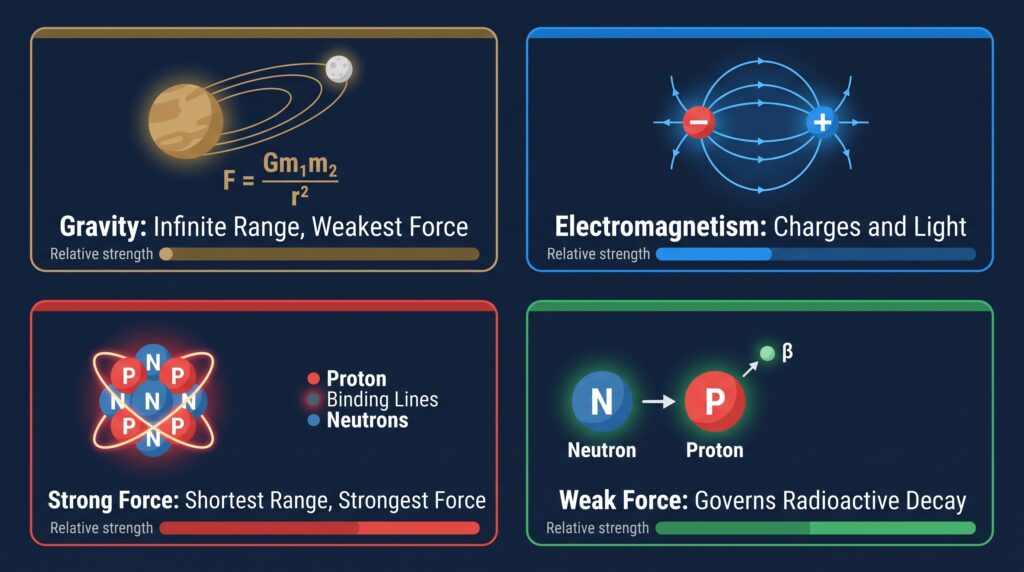
The four fundamental forces of nature are gravity, electromagnetism, the strong nuclear force, and the weak nuclear force. Every physical interaction in the universe, from planets orbiting stars to atoms bonding together, is governed by one or more of these four forces.
1. Gravitational Force
Gravity is the weakest of the four forces but has infinite range and acts on all objects with mass. It governs the motion of planets, stars, and galaxies. Newton described it with his Law of Universal Gravitation:
F = Gm₁m₂ / r²
where G is the gravitational constant, m₁ and m₂ are the masses of two objects, and r is the distance between them. Einstein later redefined gravity not as a force but as the curvature of spacetime caused by mass.
2. Electromagnetic Force
The electromagnetic force acts between electrically charged particles. It is responsible for chemical bonding, light, electricity, magnetism, and virtually every force you experience in daily life (pushing, pulling, friction) at the atomic level. James Clerk Maxwell unified electricity and magnetism into a single framework in the 1860s with his four Maxwell Equations.
3. Strong Nuclear Force
The strong force binds protons and neutrons together inside atomic nuclei. It is the most powerful of the four forces but operates only at extremely short distances (within the nucleus). Without it, no atoms heavier than hydrogen could exist and the universe would contain no chemistry, no stars, and no life.
4. Weak Nuclear Force
The weak force governs radioactive beta decay, the process by which a neutron transforms into a proton (or vice versa) by emitting particles. It plays a critical role in nuclear fusion inside stars and in the production of neutrinos. The weak and electromagnetic forces were unified into the electroweak force in the 1960s by Sheldon Glashow, Abdus Salam, and Steven Weinberg.
Classical Mechanics: The Foundation of Physics Fundamentals
Classical mechanics is the branch of physics that studies the motion of objects under the influence of forces. It is built on Newton’s three laws of motion and applies accurately to objects larger than atoms moving slower than the speed of light.
Classical mechanics is the starting point for all physics education because it is the most directly observable branch. You can see and feel every concept it describes.
Newton’s Three Laws of Motion
Newton’s laws of motion are the foundation of classical mechanics.
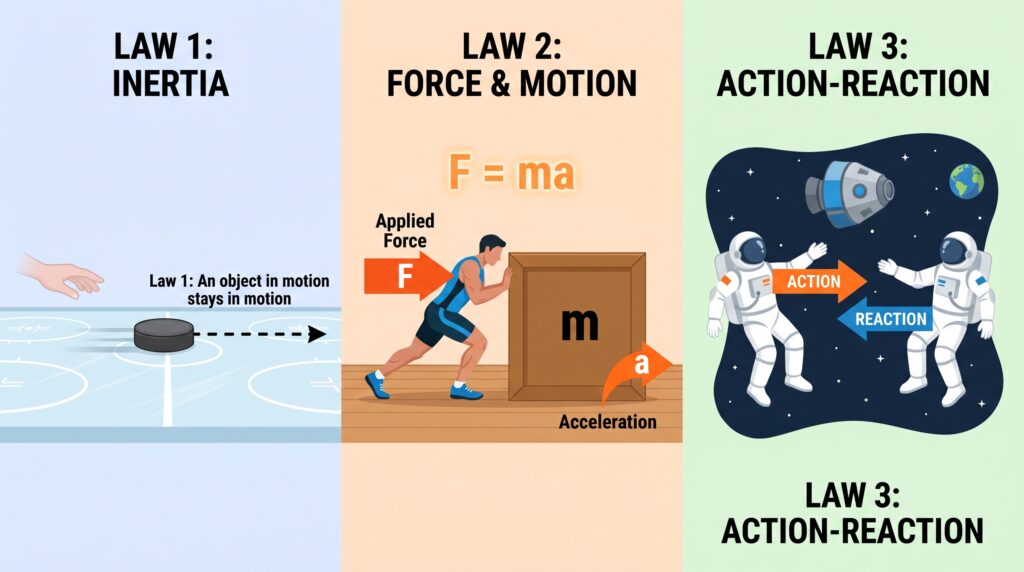
Newton’s First Law (Law of Inertia): An object at rest stays at rest and an object in motion stays in motion at constant velocity unless acted upon by a net external force. This defines inertia: the resistance of any object to changes in its state of motion.
Newton’s Second Law (Law of Acceleration): The net force acting on an object equals its mass multiplied by its acceleration:
F = ma
This is the most used equation in classical physics. It connects force (N), mass (kg), and acceleration (m/s²) in a single, universally applicable relationship.
Newton’s Third Law (Law of Action-Reaction): For every action there is an equal and opposite reaction. When you push against a wall, the wall pushes back with identical force in the opposite direction.
Key Kinematics Equations
Kinematics describes motion without asking what causes it. The four key kinematic equations for uniform acceleration are:
- v = u + at
- s = ut + ½at²
- v² = u² + 2as
- s = (u + v)t / 2
Where u = initial velocity, v = final velocity, a = acceleration, t = time, and s = displacement.
Conservation of Momentum
In a closed system with no external forces, the total momentum of all objects remains constant. This principle is fundamental to understanding collisions, explosions, and rocket propulsion.
p = mv (momentum = mass × velocity)
Work, Energy, and Power
Work is done when a force moves an object through a distance. Energy is the capacity to do work. Power is the rate at which work is done. These three concepts are connected through the work-energy theorem and the principle of conservation of energy.
The Work-Energy Theorem
W = Fd (Work = Force × distance, when force and displacement are parallel)
When net work is done on an object, its kinetic energy changes by exactly that amount. This is the work-energy theorem, one of the most powerful tools in mechanics.
Types of Energy
Energy takes many forms, all interconvertible:
- Kinetic Energy (KE): Energy of motion. KE = ½mv²
- Potential Energy (PE): Stored energy due to position. Gravitational PE = mgh
- Thermal Energy: Internal energy of particles due to temperature
- Electrical Energy: Energy of moving charges
- Nuclear Energy: Energy stored in atomic nuclei, released in fission or fusion
- Electromagnetic Energy: Energy carried by light and all electromagnetic waves
Conservation of Energy
Energy cannot be created or destroyed; it can only be converted from one form to another. The total energy of an isolated system always remains constant. This law, the First Law of Thermodynamics in its most general form, is one of the most universal truths in all of physics.
Thermodynamics: Heat, Temperature, and Entropy
Thermodynamics is the branch of physics that studies heat, temperature, and their relationship to energy and work. It is governed by four laws that describe how energy flows and why certain processes are irreversible.
The Four Laws of Thermodynamics
Zeroth Law: If two systems are each in thermal equilibrium with a third system, they are in thermal equilibrium with each other. This law defines temperature as a measurable quantity.
First Law: Energy is conserved. The change in internal energy of a system equals heat added to the system minus work done by the system:
ΔU = Q – W
Second Law: The total entropy (disorder) of an isolated system always increases over time. Heat flows spontaneously from hot to cold, never the reverse. This law defines the arrow of time and explains why you cannot unscramble an egg.
Third Law: As the temperature of a system approaches absolute zero (0 K = -273.15°C), its entropy approaches a minimum value. Absolute zero is theoretically unattainable.
Waves and Oscillations
A wave is a disturbance that transfers energy through a medium or through space without transferring matter. All waves are characterized by wavelength, frequency, amplitude, and wave speed, related by the universal wave equation v = fλ.
The Universal Wave Equation
Where v = wave speed (m/s), f = frequency (Hz), and λ = wavelength (m). This equation applies to every type of wave: sound, water, light, seismic waves, and all electromagnetic radiation.
Types of Waves
Waves are classified in two ways:
By medium:
- Mechanical waves (require a medium): sound waves, water waves, seismic waves
- Electromagnetic waves (need no medium): light, radio waves, X-rays, gamma rays
By particle motion:
- Transverse waves: Particles oscillate perpendicular to the direction of wave travel (light, water waves)
- Longitudinal waves: Particles oscillate parallel to the direction of wave travel (sound waves)
The Doppler Effect
The Doppler effect describes the change in observed frequency of a wave when the source and observer are moving relative to each other. A siren sounds higher-pitched as an ambulance approaches and lower-pitched as it recedes. This principle is used in radar, medical ultrasound, and astronomical measurements of galactic recession.
Electromagnetism and Electric Circuits
Electromagnetism is the physics of electric and magnetic fields and their interaction with charged matter. It is described by Maxwell’s four equations and governs everything from household electricity to wireless communication, light, and the structure of atoms.
Ohm’s Law
The most fundamental equation in electric circuits:
V = IR
Where V = voltage (volts), I = electric current (amperes), and R = resistance (ohms). Ohm’s Law describes the relationship between voltage, current, and resistance in a conductor and is the foundation of all circuit analysis.
Maxwell’s Equations (Summary)
James Clerk Maxwell’s four equations unified electricity and magnetism into a single theory and predicted the existence of electromagnetic waves, later confirmed to travel at the speed of light:
- Gauss’s Law for Electricity: Electric charges produce electric fields
- Gauss’s Law for Magnetism: There are no magnetic monopoles
- Faraday’s Law: Changing magnetic fields create electric fields
- Ampere’s Law (with Maxwell’s correction): Changing electric fields create magnetic fields
The interplay described by laws 3 and 4 produces self-sustaining electromagnetic waves, including visible light, radio waves, and X-rays, all traveling at c = 299,792,458 m/s in vacuum.
The Electromagnetic Spectrum
The electromagnetic spectrum is the full range of electromagnetic radiation ordered by frequency and wavelength. From lowest to highest frequency: radio waves, microwaves, infrared, visible light, ultraviolet, X-rays, and gamma rays. All obey c = fλ in vacuum.
Optics: The Physics of Light
Optics is the branch of physics that studies the behavior and properties of light, including reflection, refraction, diffraction, and interference. It divides into geometric optics (ray-based) and wave optics (wave-based).
Reflection and Refraction
Reflection: Light bouncing off a surface follows the law of reflection: the angle of incidence equals the angle of reflection. This governs how mirrors work.
Refraction: When light passes from one medium to another, it changes speed and bends. This is governed by Snell’s Law:
n₁ sin θ₁ = n₂ sin θ₂
where n₁ and n₂ are the refractive indices of the two media and θ₁ and θ₂ are the angles of incidence and refraction. Refraction explains lenses, eyeglasses, fiber optics, and rainbows.
Wave Properties of Light
Light also exhibits wave behavior including diffraction (bending around obstacles) and interference (waves combining constructively or destructively). These properties are the basis of technologies like anti-reflective coatings, holograms, and interferometers.
Modern Physics: Quantum Mechanics and Relativity
Quantum Mechanics
Quantum mechanics is the branch of physics that describes the behavior of matter and energy at atomic and subatomic scales. At this level, particles behave like waves, energy is quantized (comes in discrete packets called quanta), and measurement fundamentally disturbs the system being measured.
Key principles of quantum mechanics:
- Wave-particle duality: Every particle (electron, photon) exhibits both wave-like and particle-like properties depending on how it is observed
- Heisenberg Uncertainty Principle: It is fundamentally impossible to know both the exact position and exact momentum of a particle simultaneously: Δx · Δp ≥ ℏ/2
- Quantization of energy: Electrons in atoms can only occupy specific energy levels. Transitions between levels emit or absorb photons of specific frequencies (E = hf)
- Quantum entanglement: Two particles can be correlated such that measuring one instantly determines the state of the other, regardless of distance
Special and General Relativity
Albert Einstein’s special relativity (1905) is built on two postulates: the laws of physics are identical for all observers in uniform motion, and the speed of light is constant for all observers. Its consequences include:
- Time dilation: Moving clocks run slow
- Length contraction: Moving objects contract in the direction of motion
- Mass-energy equivalence: E = mc²
General relativity (1915) extends these ideas to acceleration and gravity, describing gravity not as a force but as the curvature of spacetime caused by mass and energy.
Frequently Asked Questions About Physics Fundamentals
What are the fundamentals of physics?
The fundamentals of physics are the core branches, laws, and concepts that form the foundation of all physical science. They include classical mechanics (Newton’s laws, kinematics, energy), thermodynamics (heat and entropy), electromagnetism (Maxwell’s equations, circuits), waves and optics, and modern physics (quantum mechanics and relativity).
What are the 4 fundamental forces in physics?
The four fundamental forces are gravity (governs large-scale structure of the universe), electromagnetism (governs light, chemistry, and electricity), the strong nuclear force (holds atomic nuclei together), and the weak nuclear force (governs radioactive decay and nuclear fusion in stars).
What are the 7 fundamental quantities in physics?
The seven fundamental physical quantities are mass (kg), length (m), time (s), electric current (A), thermodynamic temperature (K), amount of substance (mol), and luminous intensity (cd). All other physical quantities are derived from these seven.
What is the most important equation in physics?
There is no single most important equation, but the most widely cited candidates are F = ma (Newton’s Second Law), E = mc² (mass-energy equivalence), and the Schrodinger equation (quantum mechanics). Each is foundational within its domain.
What is the difference between classical and modern physics?
Classical physics describes macroscopic objects at everyday speeds using Newton’s laws, thermodynamics, and Maxwell’s equations. Modern physics describes behavior at atomic scales or near-light speeds, where classical theories break down and quantum mechanics and relativity are required.
Why is physics called the fundamental science?
Physics is called the fundamental science because its laws underpin all other natural sciences. Chemistry is governed by electromagnetic forces between atoms. Biology operates through chemical and physical processes. Geology relies on radioactive decay, heat transfer, and wave mechanics. Every natural science ultimately reduces to physics.
How do you learn physics fundamentals effectively?
Learn physics fundamentals effectively by starting with mathematical foundations (algebra and basic calculus), mastering classical mechanics first, building upward through waves, thermodynamics, and electromagnetism, then tackling modern physics. Solve problems daily, draw free-body diagrams, and always connect equations back to physical meaning rather than memorizing formulas in isolation.
Key Takeaways: Physics Fundamentals Summary
- Physics is the science of matter, energy, force, and motion, and it is the foundation of all natural science.
- The 7 SI base quantities (mass, length, time, current, temperature, amount, luminosity) form the measurement backbone of all physics.
- The 4 fundamental forces (gravity, electromagnetism, strong nuclear, weak nuclear) govern every interaction in the universe.
- Classical mechanics (Newton’s laws, kinematics, energy, momentum) describes the motion of everyday objects.
- Thermodynamics explains heat, energy conservation, and entropy through four fundamental laws.
- Waves (mechanical and electromagnetic) transfer energy through space and obey v = fλ.
- Electromagnetism unifies electricity and magnetism through Maxwell’s equations and explains light itself.
- Quantum mechanics governs the subatomic world with wave-particle duality, quantized energy, and the uncertainty principle.
- Relativity redefines space, time, and gravity and delivers E = mc².
- Every advanced field in physics, engineering, medicine, and technology is built on these fundamentals.