Speed of Light: The Ultimate Guide to c, the Cosmic Speed Limit
Light is the fastest thing in the universe. In just one second, it covers nearly 300,000 kilometers, circles the entire Earth more than seven times, and crosses a distance no human-made object has ever approached. But what exactly is the speed of light, why is it a constant, and what does it mean for physics, space, and time? This guide answers all of it.
Table of Contents
What Is the Speed of Light?
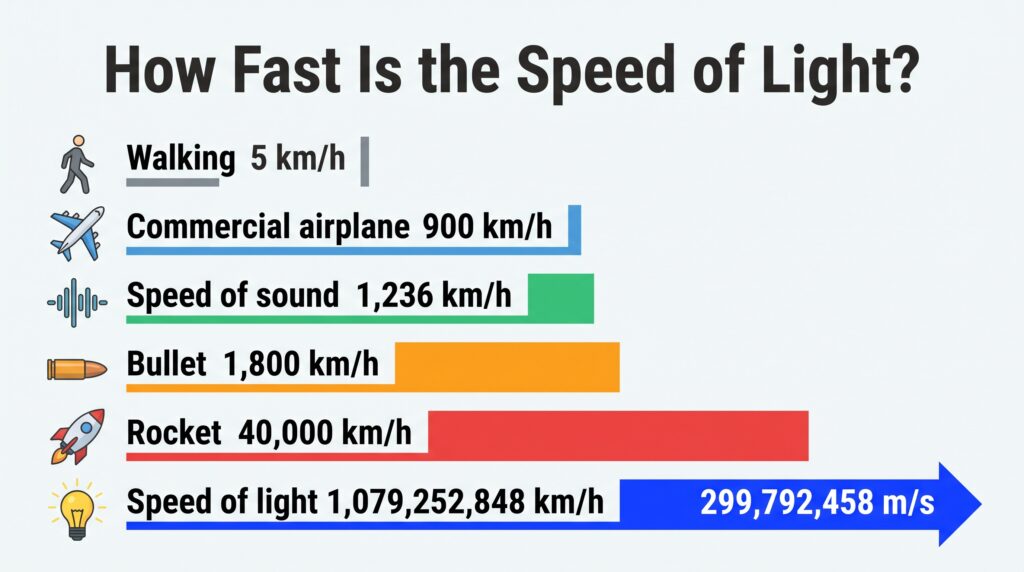
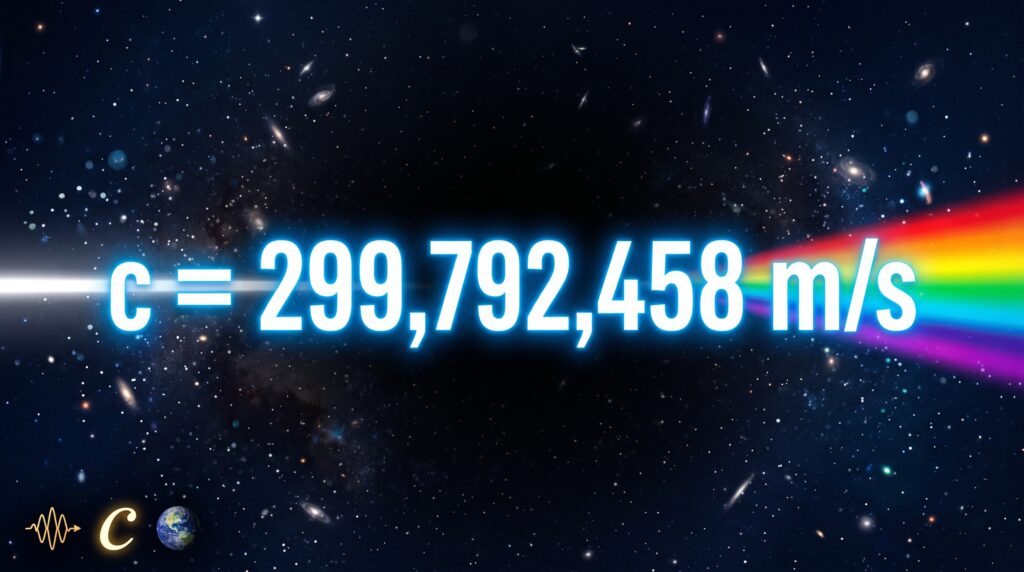
The speed of light in a vacuum is exactly 299,792,458 meters per second, universally denoted by the symbol c. It is not simply a property of light; it is a fundamental constant of the universe, the absolute upper speed limit for matter, energy, and information of any kind.
To make that number more tangible:
- 299,792,458 m/s (meters per second)
- ~300,000 km/s (kilometers per second)
- ~186,282 miles per second
- ~1,079,252,848 km/h (kilometers per hour)
- ~670,616,629 mph (miles per hour)
The value is so precisely defined that, since 1983, the international scientific community has used it to define the meter itself: one meter is the distance light travels in a vacuum in exactly 1/299,792,458 of a second.
Why Is c the Symbol for the Speed of Light?
The symbol c comes from the Latin word celeritas, meaning swiftness or speed. It was formally adopted into scientific notation in the early 1900s and standardized in Einstein’s papers by 1907. Today c appears in equations across electromagnetism, relativity, and quantum physics.
Speed of Light vs Speed of Sound
The speed of sound in air at room temperature is approximately 343 m/s. The speed of light is almost 874,000 times faster. This is why you see lightning before you hear thunder, and why the flash of a distant explosion reaches your eyes long before the sound reaches your ears.
Speed of Light in Different Media
The value c = 299,792,458 m/s applies strictly in a vacuum. When light enters a physical medium, it slows down. How much it slows depends on the medium’s refractive index (n), using the formula:
v = c / n
| Medium | Refractive Index (n) | Speed of Light |
|---|---|---|
| Vacuum | 1.0 | 299,792,458 m/s |
| Air | 1.0003 | ~299,702,547 m/s |
| Water | 1.33 | ~225,407,863 m/s |
| Glass | ~1.5 | ~199,861,638 m/s |
| Diamond | 2.42 | ~123,880,355 m/s |
Speed of Light in Water
In water, light travels at roughly 225,000 km/s, about 75% of its vacuum speed. This slowing is responsible for the bending of light at the water surface, the phenomenon we call refraction.
Speed of Light in Glass
In standard glass (n = 1.5), light slows to approximately 200,000 km/s. This property is the entire basis of how lenses, prisms, and optical fiber cables work.
Does Light Slow Down in a Medium Permanently?
No. When light exits the medium and re-enters a vacuum, it immediately returns to c. The frequency of the light stays constant throughout; only the wavelength and speed change inside the medium.
Speed of Light Formula and Key Equations
The speed of light connects to several core equations in physics. Here are the most important ones:
c = fλ (electromagnetic wave equation, where f = frequency and λ = wavelength)
v = c/n (speed of light in a medium, where n = refractive index)
E = mc² (mass-energy equivalence, Einstein’s most famous equation)
E = hf (photon energy, where h = Planck’s constant)
The equation c = fλ tells us that the electromagnetic spectrum, from radio waves to gamma rays, all travel at c in vacuum. Higher frequency means shorter wavelength; lower frequency means longer wavelength. The speed itself never changes in a vacuum regardless of the type of electromagnetic radiation.
History of Measuring the Speed of Light
Did Ancient Scientists Think Light Was Instantaneous?
For most of human history, the prevailing assumption was that light traveled instantaneously. Aristotle disagreed with Empedocles who suggested light takes time to travel, and even Descartes assumed light propagated without any time delay.
Ole Rømer: The First Measurement (1676)
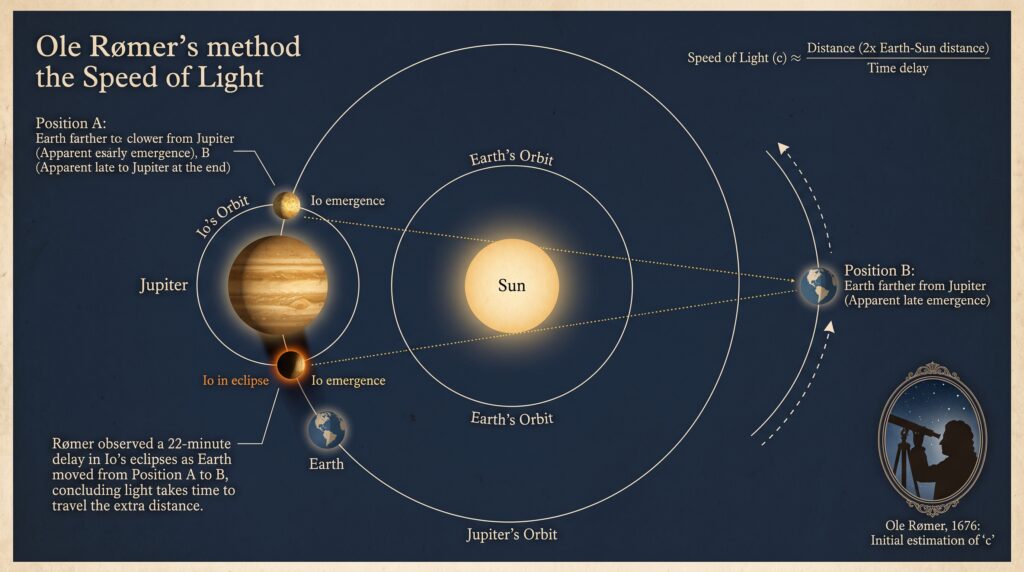
The first credible measurement of the speed of light came from Danish astronomer Ole Rømer in 1676. He observed that the timing of eclipses of Jupiter’s moon Io appeared to vary depending on whether Earth was moving toward or away from Jupiter. He correctly deduced that this discrepancy was caused by the extra (or reduced) distance light had to travel, and calculated a speed of approximately 200,000 km/s, roughly two-thirds of the actual value but a remarkable first estimate.
Galileo’s Lantern Experiment
Galileo attempted to measure the speed of light by having two observers with covered lanterns stand miles apart. One would uncover his lantern; the other would uncover his the moment he saw the first flash. Galileo could not detect any time delay, but correctly concluded that light travels at least ten times faster than sound.
James Bradley and Stellar Aberration (1728)
In 1728, English astronomer James Bradley measured the apparent shift in position of stars caused by Earth’s motion around the sun, a phenomenon called stellar aberration. His calculation produced a speed of roughly 301,000 km/s, very close to the modern value.
Michelson-Morley Experiment (1887)
The Michelson-Morley experiment was designed to detect the “luminiferous aether,” a hypothetical medium through which light was assumed to travel. The experiment famously failed to detect any aether, producing a result that shook the foundations of physics: the speed of light appeared identical in all directions regardless of Earth’s motion. This null result directly paved the way for Einstein’s special relativity.
Einstein’s Special Relativity (1905)
In 1905, Albert Einstein postulated that the speed of light is constant for all observers in all inertial reference frames, regardless of the motion of the light source or the observer. This single postulate, combined with the principle of relativity, led to the entire theory of special relativity, reshaping our understanding of space, time, and energy.
The Speed of Light and Einstein’s Theory of Relativity
Why Nothing Can Travel Faster Than Light
According to special relativity, as any object with mass accelerates toward c, the energy required to accelerate it further increases without limit. Reaching c would require infinite energy, making it physically impossible for any object with mass to reach the speed of light. This makes c the universal speed limit for matter, energy, and information.
Time Dilation and the Speed of Light
One of the most profound consequences of c being a constant is time dilation: clocks moving at high speeds tick more slowly relative to a stationary observer. The closer an object’s speed approaches c, the more severely time slows for it. At c itself (achievable only by massless particles), time stops entirely from the particle’s perspective.
Length Contraction
Similarly, objects moving at speeds close to c appear contracted in the direction of motion when measured from a stationary frame. This effect, called length contraction, is a direct consequence of spacetime geometry and the constancy of c.
E = mc² and the Speed of Light
Einstein’s famous mass-energy equivalence equation E = mc² places c at the heart of energy storage in matter. The c² term, a number of approximately 9 × 10¹⁶ m²/s², is so large that even a tiny amount of mass corresponds to an enormous amount of energy. This is the physical principle behind nuclear reactions and the energy output of stars.
Speed of Light in Astronomy and Space
What Is a Light-Year?
A light-year is the distance light travels in one year, approximately 9.461 trillion kilometers (5.879 trillion miles). It is the standard unit astronomers use to express vast cosmic distances. It is a unit of distance, not time.
How Long Does Light Take to Travel Key Distances?
| Journey | Time at Speed of Light |
|---|---|
| Around Earth (equator) | ~0.134 seconds |
| Earth to Moon | ~1.28 seconds |
| Earth to Sun | ~8 minutes 20 seconds |
| Earth to Mars (average) | ~12.5 minutes |
| Earth to Proxima Centauri | ~4.24 years |
| Across the Milky Way | ~100,000 years |
| Earth to Andromeda Galaxy | ~2.537 million years |
Looking Back in Time
Because light takes time to travel, every object we observe in space appears as it was when the light left it, not as it is now. A star 1,000 light-years away is seen as it looked 1,000 years ago. The most distant galaxies we observe appear as they were billions of years ago, shortly after the Big Bang.
Does the Universe Expand Faster Than Light?
Yes, in a limited sense. The expansion of spacetime itself is not subject to the c speed limit; it is space that is stretching, not objects moving through space. Galaxies beyond a certain boundary (the cosmological event horizon) recede from us faster than c due to this expansion, which is why they become permanently unobservable over time.
Real-World Applications of the Speed of Light
GPS and the Speed of Light
The Global Positioning System (GPS) depends critically on accounting for the finite speed of light. Signals from satellites travel at c, and the tiny time differences between signals from multiple satellites are used to triangulate your position. Without correcting for both special and general relativistic effects on time, GPS would drift by kilometers per day.
Fiber Optic Communications
Internet data travels through fiber optic cables as pulses of light. Because light in glass travels at roughly 200,000 km/s rather than c, engineers must account for this propagation delay in the design of global communications networks. The speed of light in fiber is literally the physical ceiling on how fast data can cross the planet.
Computing and Signal Delays
In microprocessors, the speed of light sets a hard limit on how fast signals can travel between components. As chips get smaller, this limit becomes more significant. Even at c, a signal can only travel about 30 cm in one nanosecond, which directly influences the design of modern processors.
Common Questions About the Speed of Light
Is the Speed of Light Always Constant?
In a vacuum, yes. c = 299,792,458 m/s is a defined constant. In a medium, light slows to v = c/n, but this is the phase velocity of the wave, not a violation of the universal constant c. The constant c remains fixed; what changes is how quickly the electromagnetic disturbance propagates through a given material.
Can Anything Travel Faster Than Light?
No physical object with mass can reach or exceed c. However, there are some phenomena that appear to exceed c without violating relativity. The expansion of the universe (as described above) is one. Another is the phase velocity of light in certain quantum experiments, and a third is the concept of “quantum entanglement,” which does not actually transmit information faster than light.
Why Is the Speed of Light 299,792,458 m/s and Not Some Other Number?
This specific value reflects the units we use (meters and seconds). In natural unit systems used by physicists, c is simply defined as 1. The numerical value 299,792,458 is not a deep cosmic fact; it is an artifact of how humans defined the meter and the second. The deep fact is that c is finite, constant, and universal.
How Do We Know the Speed of Light Is Constant Everywhere in the Universe?
Observations of light from quasars and gamma-ray bursts billions of light-years away show no dispersion or variation in c across cosmic distances or time. The consistency of atomic spectra from distant galaxies confirms that the fundamental constants, including c, have remained stable throughout the observable universe’s history.
Key Takeaways: Speed of Light Summary
- The speed of light in a vacuum is exactly 299,792,458 m/s, symbolized as c.
- In a medium, light slows to v = c/n, where n is the refractive index.
- c is the universal speed limit: no object with mass can reach or exceed it.
- The speed of light connects mass and energy through E = mc² and links frequency and wavelength through c = fλ.
- Ole Rømer made the first measurement in 1676; Einstein explained why it is constant in 1905.
- c governs GPS accuracy, fiber optic communications, astronomical distances, and the structure of spacetime itself.