The Second Law of Thermodynamics
Of all the laws of physics, the second law of thermodynamics is the one that knows about time. The other great laws run equally well forwards and backwards, but this one draws an arrow: it says the future looks different from the past. It is why coffee cools, why engines waste fuel, and why a broken glass never reassembles itself.
Entropy: the heart of the law
The second law is most precisely stated in terms of entropy, often given the symbol S. Entropy measures the number of microscopic arrangements consistent with what we see at the large scale — loosely, how many ways the atoms can be shuffled while looking the same. The law says that for an isolated system, entropy never decreases.
For a reversible process entropy stays constant; for any real, irreversible process it increases. There is no natural process that lowers the total entropy of the universe.
Why heat flows from hot to cold
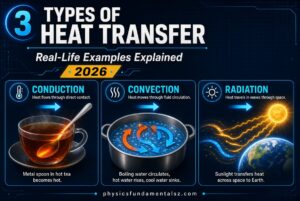
The most familiar face of the second law is the direction of heat flow. Heat always moves spontaneously from a hotter body to a colder one, never the reverse, until they reach the same temperature. The reverse — heat flowing from cold to hot on its own — would lower total entropy, so it simply never happens.
Entropy is not “disorder” in a vague, aesthetic sense. It counts microscopic possibilities. A spread-out, lukewarm room has vastly more atomic arrangements than a room with all the fast molecules bunched in one corner — so the spread-out state is overwhelmingly more likely, and that is the direction nature moves.
The statistical picture
Ludwig Boltzmann gave entropy its deepest meaning by connecting it to probability. His formula relates entropy S to W, the number of microscopic states corresponding to a given macroscopic condition.
Here k_B is Boltzmann’s constant. The lesson is profound: entropy increases not because of some mysterious force, but because high-entropy states are simply far more numerous than low-entropy ones. Shuffle a deck and it almost never comes out sorted, not because sorting is forbidden, but because there is only one sorted order among trillions of jumbled ones.
Heat engines and the price of work
The second law sets a hard limit on engines. No engine can convert heat entirely into work; some heat must always be dumped to a cold reservoir. The best possible efficiency, achieved only by an idealised Carnot engine, depends only on the two temperatures involved (measured in kelvin).
This is why power plants are more efficient with hotter steam and colder cooling water, and why a perpetual motion machine that runs on ambient heat alone is impossible. Some energy is always degraded into unusable, dispersed heat.
The arrow of time
Most fundamental laws — Newton’s equations, Maxwell’s equations — are time-symmetric: run a film of two colliding billiard balls backwards and it still obeys the rules. So why can we always tell when a film is running backwards? The answer is the second law. We see shattering, mixing, cooling, and spreading because those increase entropy. The thermodynamic arrow of time is the increase of entropy, and it is the deepest physical reason the past and future feel different.
- Cream stirred into coffee never unstirs.
- A dropped egg never leaps back together.
- Heat never spontaneously concentrates itself.
Does life break the rule?
A living organism builds exquisite order, which seems to lower entropy. But the law applies only to isolated systems. Life is not isolated: it pays for its internal order by exporting even more entropy to its surroundings — releasing heat, consuming structured food, radiating waste energy. The total entropy of the organism plus its environment still rises. Order can appear locally, as long as disorder grows more somewhere else.
Frequently asked questions
Does entropy ever decrease?
It can decrease locally — a refrigerator chills its interior, and a crystal forms ordered structure. But this always comes at the cost of a larger entropy increase elsewhere, so the total entropy of the universe never goes down. The fridge dumps more heat into your kitchen than it removes from inside.
Is entropy the same as disorder?
“Disorder” is a rough analogy. Precisely, entropy counts the number of microscopic states matching what we observe. States that look messy usually have more arrangements than states that look neat, which is why the disorder picture often works — but the real definition is about counting possibilities, not tidiness.
Why can’t an engine be 100% efficient?
Turning all incoming heat into work would leave the cold reservoir untouched and decrease total entropy, violating the second law. Some heat must always be expelled to a colder body. The Carnot limit, 1 − T_cold/T_hot, is the unbeatable ceiling, and real engines fall short of even that.