Specific Heat Capacity
Leave a metal spoon and a mug of water in the same hot oven and the spoon scorches your fingers long before the water gets dangerous. Both absorbed heat, yet they warmed at wildly different rates. The reason is specific heat capacity — a measure of how much energy it takes to raise a substance’s temperature.
Heat versus temperature
It is worth separating two ideas that everyday language blurs together. Temperature measures the average kinetic energy of the particles in a substance. Heat is the energy that flows from a hotter body to a cooler one. Adding heat usually raises temperature — but how much depends on the substance.
Specific heat capacity, c, quantifies exactly this: it is the energy needed to raise one kilogram of a material by one kelvin.
The defining equation
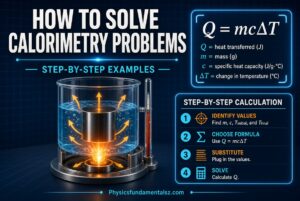
Here Q is the heat added, m the mass, c the specific heat capacity, and ΔT the temperature change. Rearranged, c = Q / (m·ΔT). A large c means the substance soaks up a lot of energy for only a small temperature rise — it is thermally “sluggish.”
The units of c are joules per kilogram per kelvin, J/(kg·K). Water’s value is famously high, about 4186 J/(kg·K), while most metals are far lower — copper is around 385, and iron about 450.
Specific heat capacity tells you how stubbornly a material resists changing temperature. High-c substances like water are thermal “shock absorbers”: they store enormous energy while barely warming, which is why oceans moderate climate and why your body, mostly water, holds a steady temperature.
Why water is special
Water’s unusually high specific heat capacity shapes the world around us. Because water can absorb and release vast amounts of heat with little temperature change:
- Coastal climates are mild — the sea warms and cools slowly, buffering the land.
- Water is an excellent coolant in car engines and power plants.
- Living organisms maintain stable internal temperatures despite changing surroundings.
The high value comes from the hydrogen bonds between water molecules. Much of the incoming energy goes into jostling those bonds rather than speeding the molecules up, so the temperature climbs only slowly.
Measuring specific heat: calorimetry
To find c, physicists use a calorimeter — an insulated container where energy is conserved. Drop a hot metal block into cool water and the heat lost by the metal equals the heat gained by the water:
Since you know everything except the metal’s c, you can solve for it. This conservation-of-energy bookkeeping is a direct application of the first law of thermodynamics. It also relates closely to the molecular picture behind the ideal gas law, where temperature again tracks particle energy.
Heat capacity versus specific heat
Two related terms are easy to confuse:
- Specific heat capacity (c): a property of the material, per kilogram. Water is always ~4186 J/(kg·K) regardless of how much you have.
- Heat capacity (C): a property of a specific object, C = m·c. A swimming pool has a far larger heat capacity than a teacup, even though both hold the same water with the same c.
Phase changes: a twist
The equation Q = m·c·ΔT only applies while a substance stays in one phase. During melting or boiling, added heat goes into breaking bonds rather than raising temperature, so the temperature pauses even as energy pours in. That extra energy is the latent heat, a separate quantity from specific heat. It explains why a pot of boiling water stays stubbornly at 100 °C no matter how high you turn the flame.
Frequently asked questions
Why does metal feel colder than wood at the same temperature?
It is not actually colder — both are at room temperature. Metal conducts heat away from your skin far faster, so it draws warmth from your hand quickly. This is about thermal conductivity rather than specific heat, though both describe how materials handle heat.
Does a higher specific heat mean a substance gets hotter?
The opposite. A higher specific heat means it takes more energy to raise the temperature, so for the same heat input the substance warms less. Water’s high c is why it warms so slowly.
Why doesn’t temperature rise while ice is melting?
During a phase change the absorbed energy goes into breaking the bonds holding the solid together rather than increasing molecular motion. This latent heat does not raise temperature, so the thermometer holds steady until the change is complete.