Work Done in Physics
In everyday speech, work means effort. In physics it means something far more specific: a force acting through a distance. Hold a heavy suitcase perfectly still and you will tire quickly, yet you do no mechanical work at all. Understanding why is the key to unlocking energy, the most powerful bookkeeping idea in all of science.
The definition of work
Work is done when a force moves its point of application through a displacement. If the force F is constant and points along the direction of motion, the work is simply force times distance.
The unit is the joule (J), where one joule equals one newton acting through one metre. Push a trolley with 10 N for 3 m and you have done 30 J of work on it. That work doesn’t vanish — it goes into the trolley’s kinetic energy, into heat from friction, or into lifting it against gravity.
When force and motion don’t line up
Forces rarely point exactly along the direction of travel. Pull a sled with a rope angled upward and only the horizontal part of your pull moves the sled forward. The general formula uses the angle θ between the force and the displacement.
This single cosine explains a lot:
- When θ = 0° (force along motion), cos θ = 1 and work is maximal.
- When θ = 90° (force perpendicular to motion), cos θ = 0 and no work is done.
- When θ = 180° (force opposing motion), cos θ = −1 and work is negative.
Only the component of force along the direction of motion does work. A force at right angles to the motion — like the tension keeping a ball in a circle, or the normal force from the floor — does no work at all, no matter how strong it is.
Why holding a weight does no work
Hold a suitcase motionless and your arm exerts an upward force, but the suitcase doesn’t move. With d = 0, the work is zero. You feel tired because your muscle fibres are constantly twitching and consuming chemical energy to stay tense, but none of that energy reaches the suitcase. Physics measures the energy delivered to the object, not the metabolic cost to you.
Likewise, carrying that suitcase horizontally across a level floor at steady speed does no work against gravity: your supporting force is vertical, the motion is horizontal, and cos 90° = 0.
Positive, negative, and zero work
Work has a sign, and the sign tells you which way energy flows. Positive work adds energy to an object; negative work removes it.
- Positive: an engine driving a car forward, speeding it up.
- Negative: friction or braking, slowing the car and draining its kinetic energy into heat.
- Zero: any force perpendicular to motion, such as gravity on a satellite in a circular orbit.
The work–energy theorem
The deepest reason work matters is its exact link to motion. The net work done on an object equals the change in its kinetic energy. This is the work–energy theorem, and it follows directly from Newton’s laws.
If the total work is positive, the object speeds up; if negative, it slows down; if zero, its speed is unchanged. This theorem lets you skip the messy details of how forces vary in time and jump straight from “how much work was done” to “how fast is it now.”
Power: the rate of doing work
Two engines can do the same total work, but one might do it in a second and the other in an hour. Power measures how fast work is done.
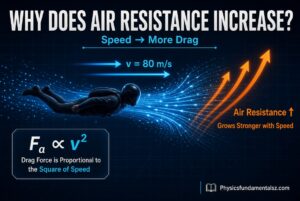
Power is measured in watts (W), where one watt is one joule per second. The form P = F·v is especially handy: a car needs more power to maintain high speed against air resistance, because the same opposing force is being overcome through more metres every second.
Frequently asked questions
Can work be negative?
Yes. When a force opposes motion — like friction, air resistance, or braking — it does negative work, removing energy from the object and usually turning it into heat. Negative work is why nothing keeps moving forever without a power source.
Why doesn’t carrying a box across a room count as work?
You support the box with a vertical force, but you move it horizontally. Since the force is perpendicular to the motion, cos 90° = 0 and the mechanical work is zero. Your muscles still burn energy holding the box up, but none of it is transferred to the box.
What is the difference between work and energy?
Energy is a stored capacity to cause change; work is the process of transferring energy from one form or object to another. Doing positive work on something increases its energy; doing negative work decreases it. They share the same unit, the joule, precisely because work is energy in transit.