Wave Speed Calculator Frequency Wavelength: Formula, Steps & Worked Examples 2026
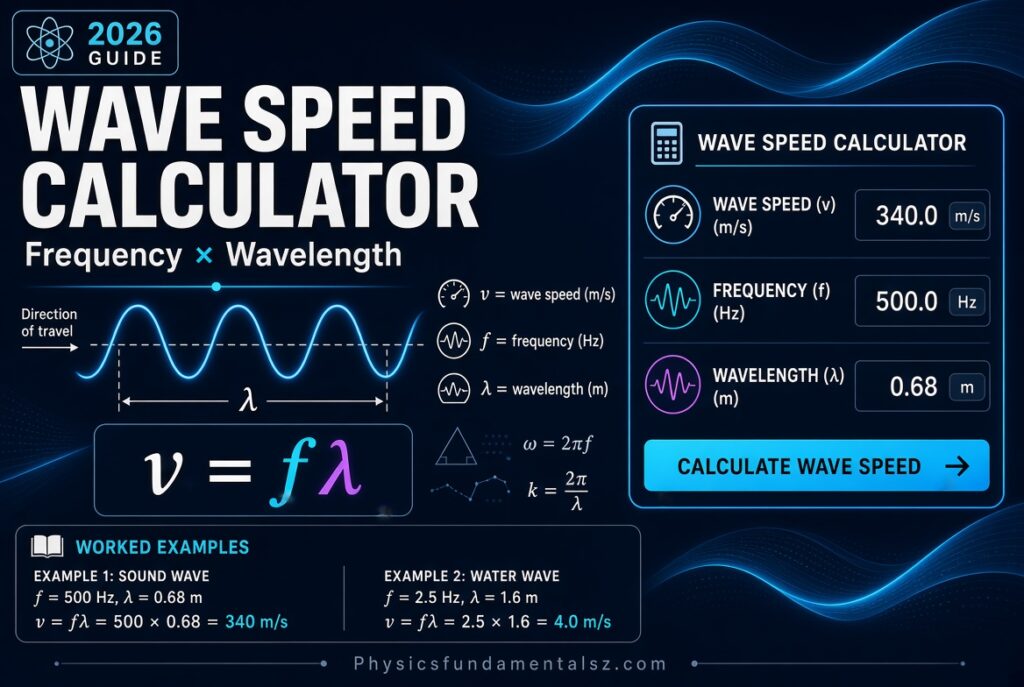
Every wave you have ever seen, from a guitar string to a beam of light, obeys one clean rule. Speed equals frequency times wavelength.
A wave speed calculator frequency wavelength tool turns that rule into an instant answer. You plug in two known values and it solves the third for you.
Table of Contents
Wave Speed Calculator Frequency Wavelength
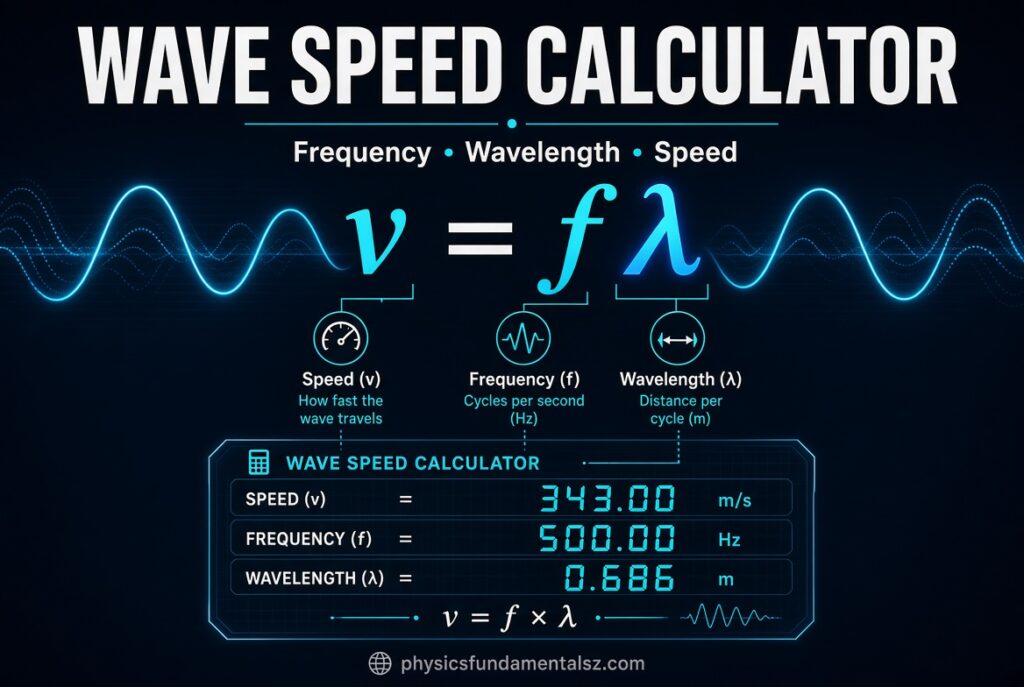
Wave speed equals frequency multiplied by wavelength: v = f × λ. Frequency is measured in hertz (Hz), wavelength in meters (m), and wave speed in meters per second (m/s).
What Is Wave Speed
Wave speed is how fast a disturbance travels through a medium or through space. It is measured in meters per second (m/s) or feet per second (ft/s).
Wave speed is not the same as the speed of the particles vibrating in the medium. It describes how quickly the wave pattern itself moves from one point to another.
Sound waves, water waves, radio waves, and light waves all have a measurable wave speed. The value depends on the wave type and the medium it travels through.
The Wave Speed Formula Explained
The core formula connecting these three quantities is:
v = f λ
- v = wave speed (m/s)
- f = frequency (Hz, or cycles per second)
- λ = wavelength (m, the distance between two matching points on the wave)
You can rearrange this same equation to solve for any missing variable.
| Solve For | Formula |
|---|---|
| Wave speed (v) | v = f × λ |
| Frequency (f) | f = v ÷ λ |
| Wavelength (λ) | λ = v ÷ f |
| Period (T) | T = 1 ÷ f |
How to Use a Wave Speed Calculator
Using a wave speed calculator frequency wavelength tool takes only a few steps. Here is the process.
- Identify the two values you already know (frequency, wavelength, or speed).
- Confirm both values use SI units — Hz for frequency, meters for wavelength.
- Enter the known values into the calculator fields.
- Select which variable you want the tool to solve for.
- Click calculate and read the result, including any unit conversion shown.
If your calculator does not auto-convert units, convert manually before entering numbers. Mixing MHz with meters, for example, gives a wrong answer instantly.
Worked Example 1: Finding Wave Speed
A wave has a frequency of 50 Hz and a wavelength of 3 meters. Find the wave speed.
Using v = f × λ, multiply 50 Hz by 3 m. The wave speed is 150 m/s.
Worked Example 2: Finding Wavelength
A sound wave travels at 343 m/s (speed of sound in air) with a frequency of 440 Hz. Find its wavelength.
Using λ = v ÷ f, divide 343 by 440. The wavelength is approximately 0.78 m.
Worked Example 3: Finding Frequency
A radio wave travels at the speed of light, 299,792,458 m/s, with a wavelength of 3 meters. Find its frequency.
Using f = v ÷ λ, divide 299,792,458 by 3. The frequency is approximately 99,930,819 Hz, or about 99.93 MHz.
Wave Speed in Different Media
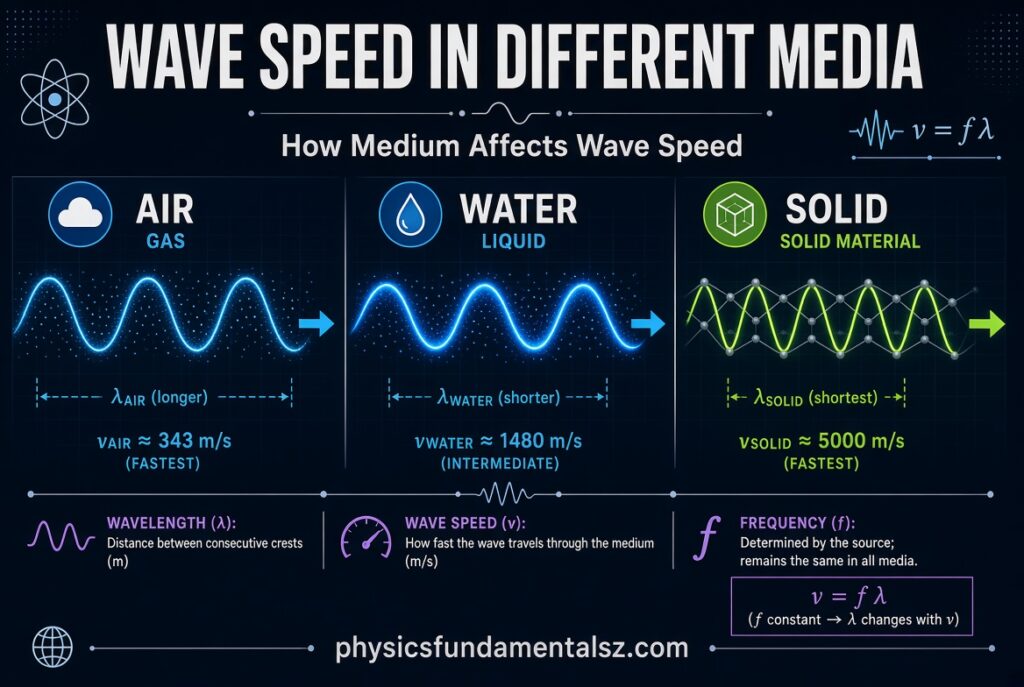
Wave speed changes depending on what the wave is traveling through. This table shows common approximate values.
| Wave Type | Medium | Approximate Speed |
|---|---|---|
| Sound | Air (20°C) | 343 m/s |
| Sound | Water | 1,480 m/s |
| Sound | Steel | 5,960 m/s |
| Light/Radio | Vacuum | 299,792,458 m/s |
| Light | Water | ~225,000,000 m/s |
| Light | Glass | ~200,000,000 m/s |
Frequency, Wavelength, and Period Compared
These three properties are closely linked but describe different things about a wave.
| Property | Symbol | Unit | What It Measures |
|---|---|---|---|
| Frequency | f | Hertz (Hz) | Cycles per second |
| Wavelength | λ | Meters (m) | Distance of one full cycle |
| Period | T | Seconds (s) | Time for one full cycle |
| Wave Speed | v | m/s | Distance traveled per second |
Why This Formula Matters
This single equation shows up across almost every branch of physics and engineering. It applies equally to sound engineering, optics, seismology, and telecommunications.
Audio engineers use it to calculate speaker wavelengths for room acoustics. Radio engineers use it to size antennas for specific frequencies.
Seismologists use wave-speed relationships to estimate the distance to an earthquake’s epicenter. Fiber-optic engineers use it to manage signal timing over long cables.
Common Mistakes to Avoid
- Mixing units, such as entering frequency in kHz while wavelength stays in meters.
- Forgetting that wave speed changes between mediums, even at the same frequency.
- Confusing frequency with period — they are reciprocals, not the same value.
- Assuming all waves travel at the speed of light — only electromagnetic waves in a vacuum do.
- Rounding too early in multi-step calculations, which compounds small errors.
Expert Tip
Always convert to base SI units first — hertz and meters — before running any calculation. Once you have a clean base-unit answer, converting to km/h, mph, or MHz afterward is simple and far less error-prone.
Real-World Applications
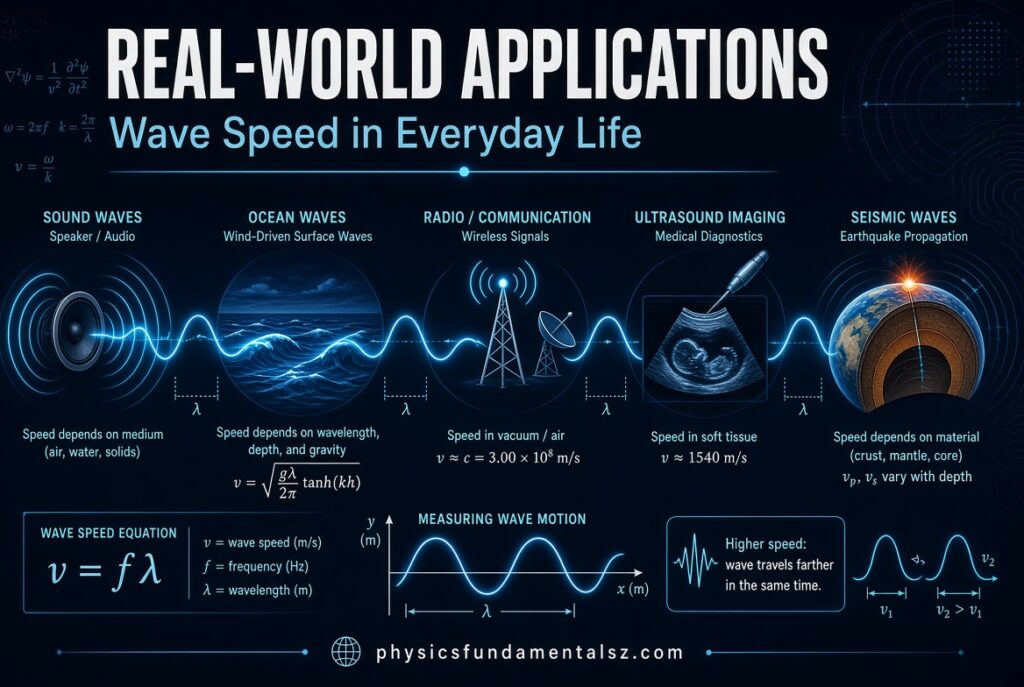
- Music and acoustics: tuning instruments and designing concert hall dimensions.
- Wi-Fi and radio: choosing antenna length for a target frequency band.
- Medical imaging: setting ultrasound frequency for the required tissue depth.
- Astronomy: measuring redshift by tracking wavelength shifts in starlight.
- Fiber optics: timing data pulses across long-distance internet cables.
Also Read:
- Wave Speed, Frequency and Wavelength
- Transverse Waves Explained
- Longitudinal Waves Explained
- The Doppler Effect
- The Electromagnetic Spectrum
- Reflection and Refraction
- Young’s Double-Slit Experiment
- Snell’s Law: Derivation & Total Internal Reflection
- Wave Superposition: Adding Waves, Phase & Interference
- Newton’s Laws of Motion
- What Is Energy?
- Projectile Motion: Complete Guide
- Conservation of Momentum
- Momentum Calculator Physics: Formula & Examples
- Ideal Gas Law Calculator With Steps
- Projectile Motion Calculator With Angle
- Heisenberg Uncertainty Principle Explained
- Bohr Model of the Atom
- De Broglie Wavelength: Formula & Derivation
- Half-Life Calculations Explained
- Mass-Energy Equivalence: E = mc²
- Nuclear Decay Equations Explained
- Photoelectric Effect Calculations
- Electric Potential Energy Explained
- Electric Current: Formula & Ohm’s Law Connection
Frequently Asked Questions (FAQs)
What is the formula for wave speed, frequency, and wavelength?
Wave speed equals frequency times wavelength: v = f × λ. This works for any wave type, as long as units stay consistent.
How do you calculate wave speed from frequency and wavelength?
Multiply the frequency in hertz by the wavelength in meters. The result is the wave speed in meters per second.
What units does a wave speed calculator use?
Most calculators use hertz for frequency, meters for wavelength, and meters per second for speed. Some tools also support MHz, kHz, feet, and mph.
Does wave speed depend on frequency?
No. In a given medium, wave speed stays constant. Frequency and wavelength adjust together so their product still equals that fixed speed.
What is the difference between wave speed and frequency?
Wave speed measures how fast the wave pattern travels through space. Frequency measures how many wave cycles pass a point each second.
What is the difference between frequency and wavelength?
Frequency counts cycles per second, while wavelength measures the physical distance of one complete cycle. They are inversely related at a fixed wave speed.
How do I find wavelength if I know speed and frequency?
Divide the wave speed by the frequency: λ = v ÷ f. Make sure both values are in matching base units first.
How do I find frequency if I know speed and wavelength?
Divide the wave speed by the wavelength: f = v ÷ λ. The result comes out in hertz.
What is the speed of sound used in wave calculations?
Sound travels at about 343 m/s in air at 20°C. This value changes with temperature and the medium the sound passes through.
What is the speed of light used in wave calculations?
Light and all electromagnetic waves travel at 299,792,458 m/s in a vacuum. This is the fastest speed physically possible.
Can wave speed be negative?
No. Wave speed is a scalar magnitude and is always reported as a positive value. Direction is described separately using velocity.
Why does wave speed change between different mediums?
Wave speed depends on the physical properties of the medium, such as density and elasticity. Sound moves faster through steel than through air, for example.
What is the relationship between period and frequency?
Period and frequency are reciprocals of each other: T = 1 ÷ f. A higher frequency always means a shorter period.
How is wavelength measured on a wave diagram?
Wavelength is the distance between two identical points on consecutive wave cycles. This is usually measured crest to crest or trough to trough.
What happens to wavelength if frequency increases?
If wave speed stays constant, wavelength decreases as frequency increases. The two values are inversely proportional.
Is the wave speed formula the same for all wave types?
Yes, v = f × λ applies to sound waves, water waves, and electromagnetic waves alike. Only the actual speed value changes based on wave type and medium.
How do you convert MHz to Hz for wave calculations?
Multiply the MHz value by 1,000,000 to get Hz. Radio and telecom frequencies are usually given in MHz or GHz.
What is a wavenumber and how does it relate to wavelength?
Wavenumber (k) equals 1 divided by wavelength, expressed in units of inverse meters. It is often used in more advanced wave equations.
Can I use this formula for water waves?
Yes. Water waves follow the same v = f × λ relationship, though their actual speed depends on water depth and other factors.
What is the wave speed of a 1500 Hz sound with a 0.221 m wavelength?
Multiply 1500 by 0.221 to get a wave speed of 331.5 m/s. This is close to the typical speed of sound in cooler air.
Why is unit consistency so important in these calculations?
Mixing units like kHz with meters gives results that are off by orders of magnitude. Always convert to base SI units before calculating.
What tools can check my wave speed calculation?
Any wave speed calculator frequency wavelength tool works well as a quick check. Compare its result against your manual v = f × λ calculation.
Does temperature affect wave speed?
Yes, particularly for sound. Sound speed in air increases as temperature rises, since warmer air molecules transmit vibrations faster.
What is an example of wave speed in everyday life?
A guitar string vibrating at a set frequency produces sound waves that travel through air at about 343 m/s. The wavelength is found using λ = v ÷ f.
Conclusion
Wave speed, frequency, and wavelength are locked together by one dependable formula: v = f × λ. Once you know any two values, finding the third takes a single calculation.
A wave speed calculator frequency wavelength tool speeds this up, but understanding the formula behind it means you can solve problems by hand too. Use the worked examples and tables above as a quick reference whenever you need to check your work.