How to Solve Doppler Effect Problems Step by Step: Formulas, Sign Rules, and Worked Examples 2026
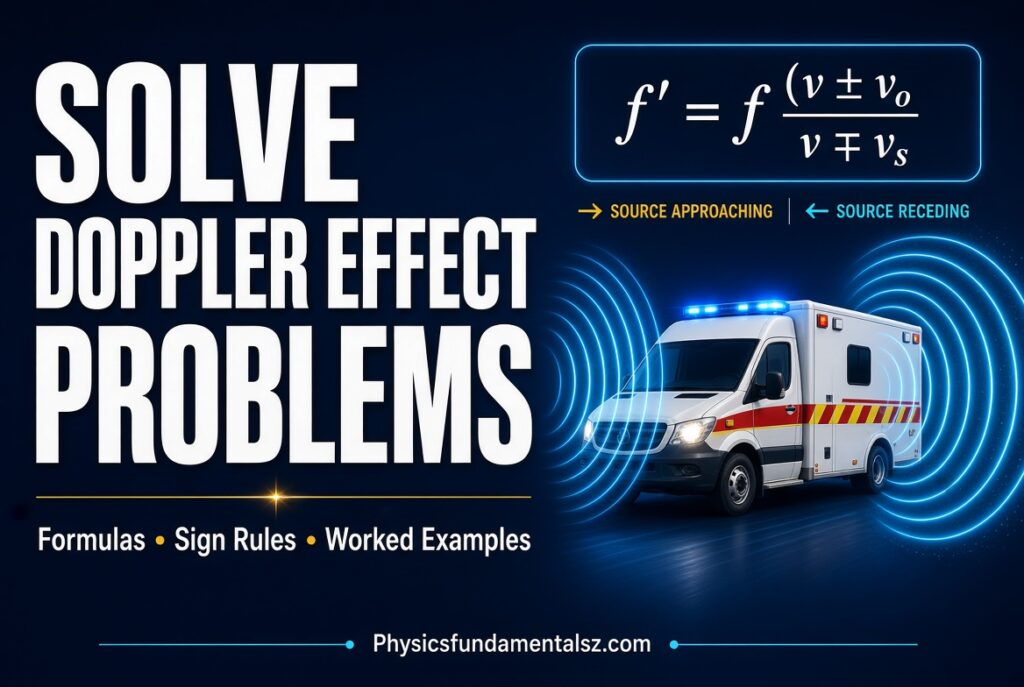
How to Solve Doppler Effect Problems Step by Step requires understanding how the relative motion between a sound source and an observer changes the frequency of the sound they perceive. The Doppler effect explains why a moving source, such as an approaching or passing ambulance, appears to produce a higher or lower pitch.
In physics, Doppler effect problems are solved using specific formulas that account for the motion of the source, the observer, or both.
The correct sign rules depend on whether the source and observer are moving toward or away from each other. These principles are used in sound-wave calculations, radar measurements, astronomy, and medical ultrasound.
Table of Contents
The Doppler Effect Formula for Sound
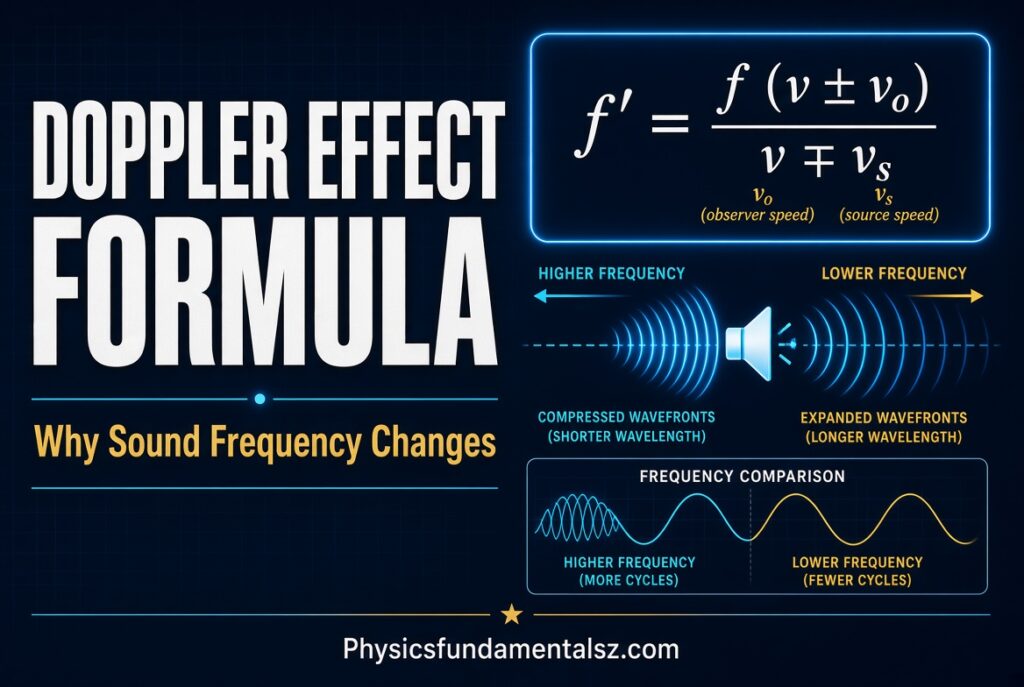
The general formula for sound is f' = f × (v ± vₒ) / (v ∓ vₛ). Here, f’ is the observed frequency, f is the source frequency, v is the speed of sound, vₒ is the observer’s speed, and vₛ is the source’s speed.
Use the upper signs when the observer moves toward the source or the source moves toward the observer. Use the lower signs when they move apart. Toward each other always raises the frequency, and away from each other always lowers it.
Key Takeaways
- Moving closer raises the observed frequency, and moving apart lowers it.
- The numerator belongs to the observer. The denominator belongs to the source.
- Observer toward source: use + in the numerator. Observer away: use −.
- Source toward observer: use − in the denominator. Source away: use +.
- Speeds must be in meters per second, and the speed of sound in air is about 343 m/s at 20 °C.
- Always check your answer. If the objects approach each other, f’ must be larger than f.
What Is the Doppler Effect?
The Doppler effect, also called the Doppler shift, is the apparent change in the frequency or wavelength of a wave caused by relative motion between the source of the wave and the observer. It applies to sound waves, light waves, water waves, and radio waves.
Christian Doppler described the idea in 1842. The effect has since become essential in medicine, weather forecasting, traffic enforcement, navigation, and astronomy.
A Simple Everyday Picture
Stand beside a road as a car with a loud horn drives past. As the car approaches, the horn sounds higher. At the moment it passes, the pitch drops. As the car moves away, the horn sounds lower.
The horn itself never changes. Only the frequency that reaches your ears changes.
Source Frequency vs. Observed Frequency
The source frequency is the frequency the source emits. The observed frequency is the frequency the observer actually detects. Doppler problems almost always ask you to find one of them from the other.
Keep the two clearly separated in your notes. Many students mix them up and place the values in the wrong positions.
Frequency, Pitch, and Wavelength
Frequency is the number of wave cycles per second, measured in hertz (Hz). Pitch is how we perceive frequency. A higher frequency sounds like a higher pitch.
Wavelength is the distance between two wave crests. For a fixed wave speed, higher frequency means shorter wavelength.
Why the Doppler Effect Happens
Understanding the physics helps you remember the formulas. It also helps you rebuild a formula from scratch if you forget it during an exam.
The cause is simple. Motion changes how many wave crests reach the observer each second.
A Moving Source Compresses and Stretches Waves
A source emits waves at a steady rate. If the source moves toward you, each new crest starts closer to you than the previous one. The crests bunch up in front of the source, so the wavelength becomes shorter.
Behind the source, the crests spread out, so the wavelength becomes longer. The speed of the wave in the medium does not change, because it depends on the medium.
A Moving Observer Meets Crests Faster or Slower
If you move toward a stationary source, you run into the crests more often. You count more crests per second, so the frequency you measure is higher.
If you move away, crests catch up with you less often. You count fewer crests per second, so the frequency is lower.
Why Sound Needs a Medium Reference
Sound travels through air, water, or solids. The speed of sound is measured relative to that medium. This is why the formula treats source motion and observer motion differently.
Light does not need a medium, so its Doppler effect depends only on the relative velocity between source and observer.
The Variables and Units in Doppler Effect Problems
Before solving anything, list every quantity the problem gives. A clear list prevents sign errors and unit mistakes.
| Symbol | Meaning | Common unit |
|---|---|---|
| f | Source frequency (emitted) | Hz |
| f’ | Observed frequency (detected) | Hz |
| v | Speed of the wave in the medium | m/s |
| vₒ | Speed of the observer | m/s |
| vₛ | Speed of the source | m/s |
| λ | Wavelength emitted by the source | m |
| λ’ | Observed wavelength | m |
The Speed of Sound in Air
If a problem does not give the speed of sound, use 343 m/s, which is the value at 20 °C. Some textbooks use 340 m/s or 331 m/s. Follow whatever your textbook or teacher specifies.
The speed of sound in dry air depends on temperature. A common approximation is v = 331 + 0.6 T, where T is the temperature in degrees Celsius.
| Temperature | Speed of sound in air |
|---|---|
| 0 °C | 331 m/s |
| 10 °C | 337 m/s |
| 20 °C | 343 m/s |
| 30 °C | 349 m/s |
Unit Conversions You Will Need
Many problems give speeds in kilometers per hour. Convert them to meters per second before substituting. Divide the value in km/h by 3.6.
- 36 km/h = 10 m/s
- 54 km/h = 15 m/s
- 72 km/h = 20 m/s
- 90 km/h = 25 m/s
- 108 km/h = 30 m/s
Miles per hour convert with a factor of 0.447. For example, 60 mph is about 26.8 m/s.
The Four Doppler Effect Formulas for Sound
There are four basic cases. Each one is a simplified version of the general formula. Learn them as a set.
| Case | Formula |
|---|---|
| Source moving toward a stationary observer | f’ = f × v / (v − vₛ) |
| Source moving away from a stationary observer | f’ = f × v / (v + vₛ) |
| Observer moving toward a stationary source | f’ = f × (v + vₒ) / v |
| Observer moving away from a stationary source | f’ = f × (v − vₒ) / v |
When both move, combine the observer’s numerator with the source’s denominator.
Moving Source Formula Derivation
Suppose a source emits waves of frequency f and moves toward you at speed vₛ. In one period T = 1/f, a crest travels a distance vT, and the source advances a distance vₛT.
The distance between neighboring crests is the new wavelength: λ' = (v − vₛ) / f. The observed frequency is the wave speed divided by that wavelength, so f' = v / λ' = f × v / (v − vₛ).
Moving Observer Formula Derivation
Now suppose the source is stationary and you move toward it at speed vₒ. The wavelength stays equal to v/f. The waves approach you at a relative speed of v + vₒ.
The observed frequency is f' = (v + vₒ) / λ = (v + vₒ) × f / v.
The Combined Formula
When both move, the source changes the wavelength and the observer changes the relative speed. Multiply both effects together: f' = f × (v ± vₒ) / (v ∓ vₛ).
This single formula covers every sound case, so you only need to memorize it once.
The Sign Convention: The Most Important Part of Every Problem
Almost every wrong answer in Doppler problems comes from the signs. Two reliable methods remove the guesswork.
Choose one method and use it every time. Consistency matters more than which method you pick.
Method 1: The “Toward Means Higher” Check
Decide in plain words whether the source and observer are getting closer or farther apart. If they approach, the observed frequency must be higher than the source frequency. If they separate, it must be lower.
Then choose the signs that produce that result. To raise the frequency, make the numerator larger (+) and the denominator smaller (−). To lower it, do the opposite.
Method 2: The Direction-Based Sign Table
Use this table for each moving object. The sign depends on the direction of motion relative to the other object.
| Who is moving | Direction of motion | Sign to use |
|---|---|---|
| Observer (numerator) | Toward the source | + |
| Observer (numerator) | Away from the source | − |
| Source (denominator) | Toward the observer | − |
| Source (denominator) | Away from the observer | + |
Notice the pattern. Motion that brings the two closer uses + in the numerator and − in the denominator. Both changes raise the frequency.
Method 3: The Positive-Direction Convention
Some textbooks define a positive direction from the source toward the observer. Then the formula becomes f' = f × (v − vₒ) / (v − vₛ), with velocities carrying their own signs.
In this system, a velocity pointing in the positive direction (from source to observer) is positive. A velocity pointing the other way is negative. The formula handles all cases automatically.
A Memory Trick for the Signs
Remember the phrase “Observer on top, source below.” The observer’s speed appears in the top of the fraction. The source’s speed appears in the bottom.
Then remember “Closer means a bigger answer.” If your result is smaller when the two are approaching, you used the wrong sign somewhere.
How to Solve Doppler Effect Problems Step by Step
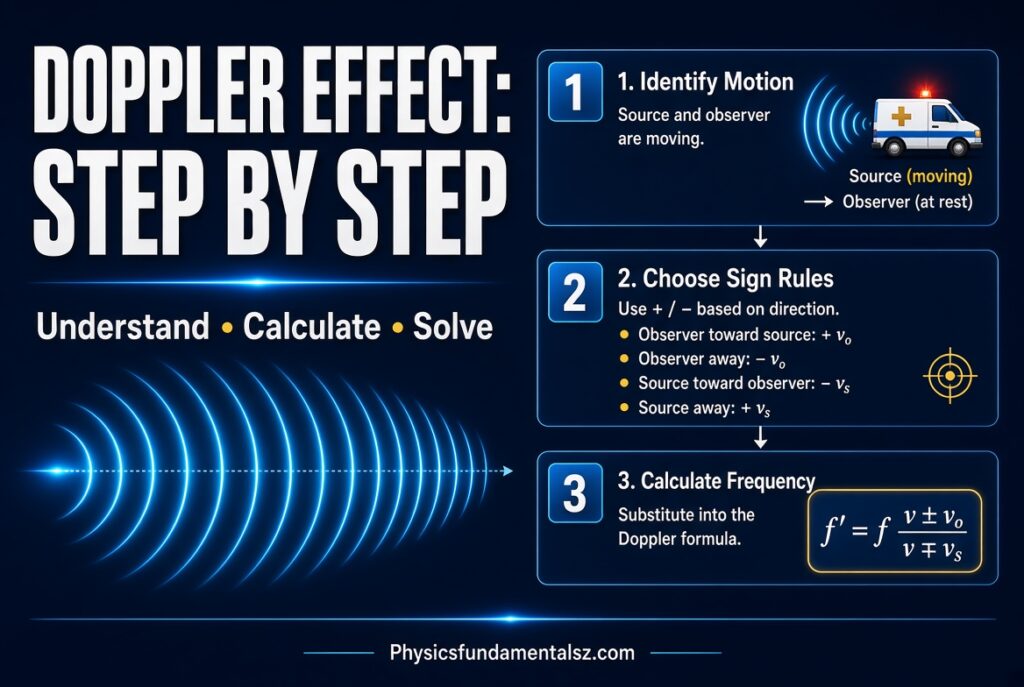
Follow these seven steps for every problem. This method works for sirens, trains, bats, and any other sound-based question.
Step 1: Read the Problem and Draw a Diagram
Sketch the source and the observer. Draw an arrow for each moving object. Mark which way the observer is located relative to the source.
A quick drawing prevents most direction mistakes. Even a rough sketch with two dots and two arrows is enough.
Step 2: List the Given Quantities and the Unknown
Write down f, v, vₛ, and vₒ. Mark any value that is zero. A stationary source has vₛ = 0, and a stationary observer has vₒ = 0.
Underline the quantity the problem asks for. It may be f’, f, vₛ, vₒ, or a wavelength.
Step 3: Convert All Units
Change km/h to m/s. Change kHz to Hz if needed. Make sure the speed of sound uses the same unit as the other speeds.
Step 4: Decide the Direction of Motion
Ask two questions. Is the source moving toward or away from the observer? Is the observer moving toward or away from the source?
Remember that “toward” and “away” refer to the line connecting the two. They do not refer to north, south, left, or right.
Step 5: Choose the Signs
Apply the sign table. Observer toward source gives +, away gives −. Source toward observer gives −, away gives +.
Predict the result before calculating. If the objects approach each other, you expect f’ to exceed f.
Step 6: Substitute and Calculate
Write the formula with the signs filled in. Substitute the numbers. Compute the numerator and the denominator separately, then divide.
Keep at least four significant figures during the calculation. Round only the final answer.
Step 7: Check the Answer
Compare the result with your prediction from Step 5. Check that the units are hertz. Confirm that the size of the change is reasonable.
A shift of a few percent is typical for vehicles. A shift of more than 50 percent for a car would signal an error.
Worked Examples: Moving Source and Stationary Observer
This is the most common problem type. A siren, horn, or whistle moves while the listener stands still.
Use f' = f × v / (v ∓ vₛ), with − when the source approaches and + when it recedes.
Example 1: Source Approaching a Stationary Observer
A source emits a 700 Hz tone and moves toward you at 30 m/s. The speed of sound is 340 m/s. Find the observed frequency.
The source approaches, so use the minus sign in the denominator. Then f’ = 700 × 340 / (340 − 30) = 238,000 / 310 = 767.7 Hz.
The frequency is higher than 700 Hz, which matches the expectation for an approaching source.
Example 2: The Same Source Moving Away
The same 700 Hz source now moves away from you at 30 m/s. The source recedes, so use the plus sign in the denominator.
Then f’ = 700 × 340 / (340 + 30) = 238,000 / 370 = 643.2 Hz. The frequency is lower, as expected.
Example 3: A Police Siren at 90 km/h
A police car travels at 90 km/h and sounds a 1,000 Hz siren. Find the frequency heard by a stationary pedestrian as the car approaches and as it moves away. Use v = 343 m/s.
First convert the speed: 90 km/h = 25 m/s. Approaching: f’ = 1,000 × 343 / (343 − 25) = 343,000 / 318 = 1,078.6 Hz. Receding: f’ = 1,000 × 343 / (343 + 25) = 343,000 / 368 = 932.1 Hz.
The difference between the two values is about 146.5 Hz, which is a clearly audible change in pitch.
Example 4: The Pitch Drop of a Passing Vehicle
A car horn emits 1,000 Hz and passes you at 20 m/s. Approaching, the observed frequency is 1,000 × 343 / 323 = 1,061.9 Hz. Receding, it is 1,000 × 343 / 363 = 944.9 Hz.
The total drop as the car passes is 1,061.9 − 944.9 = 117.0 Hz.
Why the Pitch Changes Suddenly When the Vehicle Passes
In a real pass, the pitch glides downward rather than jumping. That is because the line of sight changes direction as the car goes by. Textbook problems idealize the motion as straight toward or straight away.
Worked Examples: Moving Observer and Stationary Source
Here the source is fixed, such as a siren on a pole, and the listener moves. Use f' = f × (v ± vₒ) / v.
The source speed is zero, so the denominator is just v.
Example 5: Observer Moving Toward the Source
A stationary speaker emits 500 Hz. You walk toward it on a bicycle at 20 m/s. With v = 343 m/s, find the frequency you hear.
The observer approaches, so use + in the numerator. Then f’ = 500 × (343 + 20) / 343 = 500 × 363 / 343 = 529.2 Hz.
Example 6: Observer Moving Away from the Source
Now you ride away from the same speaker at 20 m/s. Use − in the numerator.
Then f’ = 500 × (343 − 20) / 343 = 500 × 323 / 343 = 470.9 Hz.
Example 7: Finding the Observer’s Speed
A stationary siren emits 600 Hz. A cyclist riding toward it hears 620 Hz. Find the cyclist’s speed, using v = 343 m/s.
Start with f’ = f × (v + vₒ) / v. Rearrange to get vₒ = v × (f’ / f − 1) = 343 × (620 / 600 − 1) = 343 × 0.03333 = 11.4 m/s.
That is about 41 km/h, which is a plausible cycling speed.
Worked Examples: Both Source and Observer Moving
When both move, use the full formula. Keep the observer in the numerator and the source in the denominator.
Choose each sign separately. The observer’s direction decides the numerator, and the source’s direction decides the denominator.
Example 8: Moving Toward Each Other
A source emits 1,000 Hz and moves at 25 m/s toward an observer. The observer moves at 15 m/s toward the source. Use v = 343 m/s.
Both motions bring them closer, so the numerator is v + vₒ and the denominator is v − vₛ. Then f’ = 1,000 × (343 + 15) / (343 − 25) = 1,000 × 358 / 318 = 1,125.8 Hz.
Example 9: Moving Away from Each Other
Use the same values, but now they move apart. The numerator is v − vₒ, and the denominator is v + vₛ.
Then f’ = 1,000 × (343 − 15) / (343 + 25) = 1,000 × 328 / 368 = 891.3 Hz.
Example 10: Moving in the Same Direction (Source Chasing Observer)
An ambulance emits 800 Hz and travels at 30 m/s. A car ahead of it travels in the same direction at 20 m/s. The ambulance is behind the car. Use v = 343 m/s.
The ambulance moves toward the car, so the source sign is −. The car moves away from the ambulance, so the observer sign is −. Then f’ = 800 × (343 − 20) / (343 − 30) = 800 × 323 / 313 = 825.6 Hz.
Example 11: Moving in the Same Direction (Observer Chasing Source)
A train horn emits 400 Hz while the train moves at 20 m/s. A car behind the train moves in the same direction at 30 m/s. Find the frequency heard in the car.
The car approaches the train, so the observer sign is +. The train moves away from the car, so the source sign is +. Then f’ = 400 × (343 + 30) / (343 + 20) = 400 × 373 / 363 = 411.0 Hz.
A Common Trap with Same-Direction Motion
Students often say that both are moving “forward,” so both signs should match. That is wrong. The sign depends on whether each object moves toward or away from the other, not on the compass direction.
Always ask who is moving toward whom.
Worked Examples: Finding the Source Frequency, Source Speed, or Observer Speed
Doppler problems are not always about the observed frequency. Often you must solve for another variable. The method stays the same. Write the formula, then rearrange.
Example 12: Finding the Source Frequency
An observer hears 1,200 Hz from a source that approaches at 20 m/s. Find the frequency emitted by the source. Use v = 343 m/s.
Start with f’ = f × v / (v − vₛ). Rearrange to get f = f’ × (v − vₛ) / v = 1,200 × 323 / 343 = 1,130.0 Hz.
Example 13: Finding the Source Speed
A train horn emits 400 Hz. An observer standing by the track hears 440 Hz as the train approaches. Find the train’s speed. Use v = 343 m/s.
Start with f’ = f × v / (v − vₛ). Rearrange to get vₛ = v × (1 − f / f’) = 343 × (1 − 400 / 440) = 343 × 0.0909 = 31.2 m/s, which is about 112 km/h.
Example 14: Finding the Source Speed from Two Frequencies
A source emits an unknown frequency. A stationary listener hears 1,350 Hz as it approaches and 1,200 Hz as it recedes. Find the source speed. Use v = 343 m/s.
Use the ratio of the two observations. Approaching: f’ = f × v / (v − vₛ). Receding: f” = f × v / (v + vₛ). Dividing gives f’ / f” = (v + vₛ) / (v − vₛ) = 1,350 / 1,200 = 1.125.
Solve for vₛ. Then vₛ = v × (1.125 − 1) / (1.125 + 1) = 343 × 0.125 / 2.125 = 20.2 m/s. The source frequency follows: f = 1,350 × (343 − 20.2) / 343, which is about 1,270 Hz.
Example 15: Finding the Unknown When Frequency Ratio Is Given
If the observed frequency is 5 percent higher than the source frequency and the source approaches a stationary observer, then v / (v − vₛ) = 1.05. Solve for vₛ.
The result is vₛ = v × (1 − 1 / 1.05) = 343 × 0.04762 = 16.3 m/s.
Worked Examples: Wavelength in Doppler Problems
Some problems ask for the wavelength instead of the frequency. The wavelength changes only when the source moves.
For a moving source, λ' = (v ∓ vₛ) / f. For a moving observer alone, the wavelength in the medium does not change.
Example 16: Wavelength Ahead of and Behind a Moving Source
A 700 Hz source moves at 30 m/s, with v = 340 m/s. The original wavelength is 340 / 700 = 0.4857 m.
Ahead of the source, λ’ = (340 − 30) / 700 = 0.4429 m. Behind the source, λ’ = (340 + 30) / 700 = 0.5286 m.
Why the Wavelength Does Not Change for a Moving Observer
When only the observer moves, the source keeps emitting crests at the same spacing in the medium. The observer simply meets them at a different rate. So the frequency changes, but the wavelength in the air stays at v / f.
Worked Examples: Doppler Effect with Reflection (Two-Step Problems)
When a wave reflects from a moving object, the Doppler shift happens twice. First, the object acts as a moving observer. Then it acts as a moving source.
Solve these problems in two clear stages. Never try to do both shifts in one step.
Example 17: A Bat Flying Toward a Wall
A bat emits a 40,000 Hz call while flying at 5 m/s toward a wall. Use v = 343 m/s. Find the frequency of the echo that the bat hears.
Stage 1: the wall is a stationary observer, and the bat is a source moving toward it. The wall receives f₁ = 40,000 × 343 / (343 − 5) = 40,591.7 Hz.
Stage 2: the wall reflects at f₁ and acts as a stationary source. The bat is now an observer moving toward the wall. The bat hears f₂ = 40,591.7 × (343 + 5) / 343 = 41,183 Hz.
The two stages combine into f₂ = f × (v + vₒ) / (v − vₛ), which is the same as the standard formula with both moving toward the wall.
Example 18: A Wall Moving Toward a Stationary Source
A stationary speaker emits 1,000 Hz toward a wall that moves toward it at 5 m/s. A microphone beside the speaker detects the echo. Use v = 343 m/s.
Stage 1: the wall is a moving observer. It receives f₁ = 1,000 × (343 + 5) / 343 = 1,014.6 Hz.
Stage 2: the wall is a moving source of f₁. The microphone hears f₂ = 1,014.6 × 343 / (343 − 5) = 1,029.6 Hz.
Example 19: Beat Frequency from a Reflected Wave
In Example 18, the microphone also hears the original 1,000 Hz tone directly. The two tones differ by 29.6 Hz, so you hear about 30 beats per second.
The beat frequency equals the difference between the two frequencies. This method is used in some speed-measuring instruments.
The Approximation for Small Speeds
For reflections from slow targets, the total shift is approximately Δf ≈ 2 × f × v_target / v. Check this with Example 18: 2 × 1,000 × 5 / 343 = 29.2 Hz, which is close to the exact value of 29.6 Hz.
Worked Examples: Motion Not Along the Line of Sight
In real life, objects rarely move straight toward or straight away. In that case, only the component of velocity along the line connecting the source and the observer matters.
Multiply the speed by the cosine of the angle between the velocity and the line of sight.
Example 20: A Source Moving at an Angle
A 700 Hz source moves at 30 m/s along a direction that makes a 60° angle with the line toward the observer. Use v = 340 m/s.
The component along the line of sight is 30 × cos(60°) = 15 m/s. Then f’ = 700 × 340 / (340 − 15) = 238,000 / 325 = 732.3 Hz.
Why the Perpendicular Component Has No Effect
Motion at a right angle to the line of sight does not bring the source closer or farther away at that instant. So it does not change the observed frequency at that instant.
This is why the pitch of a passing vehicle equals the source frequency at the moment of closest approach, in the ideal case of a stationary observer and a straight-line path.
Example 21: Pitch at the Moment of Closest Approach
A car passes a roadside observer at 20 m/s while sounding a 1,000 Hz horn. At the instant of closest approach, the velocity is perpendicular to the line of sight. The observer hears about 1,000 Hz.
Before this moment the pitch is higher, and after it the pitch is lower, which explains the smooth drop in pitch.
Doppler Effect in Moving Air: When Wind Matters
Wind changes the speed of sound relative to the ground. Most textbook problems ignore wind, but some include it.
If wind blows from source to observer at speed w, the effective speed of sound along that line is v + w. Substitute this value for v in the formula.
Example 22: A Tailwind
A stationary source emits 500 Hz toward an observer who moves toward the source at 10 m/s. A wind of 5 m/s blows from the source toward the observer, and v = 343 m/s.
The wind carries the waves toward the observer, so the effective wave speed along the line is 343 + 5 = 348 m/s. Use this value as v in the moving-observer formula.
Then f’ = 500 × (348 + 10) / 348 = 500 × 358 / 348 = 514.4 Hz.
Why Wind Rarely Matters in Exams
Most problems assume still air. When a problem does include wind, it usually says so explicitly. Check the wording before adding any wind term.
Doppler Effect Problems for Light and Electromagnetic Waves
Light also shows a Doppler shift, but the formulas differ from the sound formulas. Light needs no medium, so only the relative velocity between the source and the observer matters.
For speeds much smaller than the speed of light, a simple approximation works well. For speeds close to the speed of light, you must use the relativistic formula.
The Non-Relativistic Light Formula
For a relative speed v much smaller than c, use Δλ / λ = v / c or Δf / f = v / c. Here, c is the speed of light, about 3.00 × 10⁸ m/s.
If the source moves away, the wavelength increases. This is called redshift. If the source approaches, the wavelength decreases. This is called blueshift.
Example 23: Redshift of a Galaxy
A hydrogen spectral line has a laboratory wavelength of 656.3 nm. In the light from a distant galaxy, it appears at 658.5 nm. Find the recession speed.
The shift is Δλ = 658.5 − 656.3 = 2.2 nm. Then v = c × Δλ / λ = 3.00 × 10⁸ × 2.2 / 656.3 = 1.0 × 10⁶ m/s, which is about 1,000 km/s.
The wavelength increased, so the galaxy moves away from us.
Example 24: Blueshift of a Star
A star emits light at 500 nm, and you observe it at 499.5 nm. The shift is −0.5 nm. The speed is v = 3.00 × 10⁸ × 0.5 / 500 = 3.0 × 10⁵ m/s, directed toward you.
The Relativistic Doppler Formula
When the speed is a large fraction of c, use f_obs = f × √((1 − β) / (1 + β)) for a source moving directly away. Here, β = v / c.
For a source moving directly toward the observer, use f_obs = f × √((1 + β) / (1 − β)).
Example 25: A Source Receding at 0.6c
Let β = 0.6. Then (1 − β) / (1 + β) = 0.4 / 1.6 = 0.25, and the square root is 0.5. The observed frequency is half the emitted frequency.
If the same source approaches at 0.6c, the ratio is 1.6 / 0.4 = 4, and the square root is 2. The observed frequency is twice the emitted frequency.
Sound vs. Light: Key Differences
| Feature | Sound Doppler effect | Light Doppler effect |
|---|---|---|
| Medium needed | Yes (air, water, solids) | No |
| Source and observer motion | Treated differently | Only relative velocity matters |
| Speed limit | Can exceed the speed of sound | Cannot exceed c |
| Common formula | f × (v ± vₒ) / (v ∓ vₛ) | Δλ/λ = v/c for small speeds |
Doppler Effect Problems with Radar and Speed Guns
Police radar guns and weather radars send out a wave, receive its reflection from a moving target, and measure the frequency shift. This is a two-step Doppler shift, similar to the bat example.
For a target moving at speed v toward the radar, the total shift is approximately Δf ≈ 2 × f × v / c.
Example 26: A Radar Speed Gun
A speed gun emits microwaves at 24 GHz. A car approaches at 30 m/s (108 km/h). Find the frequency shift of the reflected signal.
Use Δf = 2 × f × v / c = 2 × 24 × 10⁹ × 30 / (3.00 × 10⁸) = 4,800 Hz.
Example 27: Finding the Speed from the Shift
If the gun reports a shift of 3,200 Hz for the same 24 GHz signal, rearrange the formula. Then v = Δf × c / (2 × f) = 3,200 × 3.00 × 10⁸ / (2 × 24 × 10⁹) = 20 m/s, or 72 km/h.
Why the Factor of Two Appears
The target first receives a shifted frequency as a moving observer. Then it re-emits that shifted frequency as a moving source. Each step contributes a shift of about f × v / c, so the total is about twice as large.
Doppler Effect Problems in Medical Ultrasound
Doppler ultrasound measures the speed of blood flow. A transducer sends sound waves into the body, and the blood cells reflect them. The frequency shift reveals the blood velocity.
Because the wave travels at an angle to the vessel, the formula includes a cosine factor.
The Doppler Ultrasound Formula
Δf = 2 × f × v × cos(θ) / c. Here, f is the transmitted frequency, v is the blood speed, θ is the angle between the beam and the flow, and c is the speed of sound in tissue, about 1,540 m/s.
Example 28: Blood Flow Speed Measurement
An ultrasound probe uses 5.0 MHz. Blood flows directly toward the probe at 0.50 m/s, so θ = 0°. Find the frequency shift.
Δf = 2 × 5.0 × 10⁶ × 0.50 / 1,540 = 3,247 Hz, or about 3.2 kHz. This falls in the audible range, which is why Doppler scanners can play the signal as sound.
Example 29: Effect of the Beam Angle
Keep the same values, but the beam makes a 60° angle with the flow. Then cos(60°) = 0.5, so Δf = 1,623 Hz.
If you want to find the blood speed from a measured shift, you must know the angle. An incorrect angle gives an incorrect speed.
Doppler Effect Problems in Astronomy and Weather Forecasting
Astronomers use the Doppler shift to measure how fast stars and galaxies move. They also detect planets by watching the small periodic wobble of a star’s spectral lines.
Meteorologists use Doppler radar to measure the motion of raindrops and wind inside storms. The shift tells them whether air moves toward or away from the radar.
Doppler Radar and Storm Rotation
A pair of regions in a storm, one moving toward the radar and one moving away, can reveal rotation. Forecasters use this pattern to issue tornado warnings.
The Planet-Detection Method
A planet and its star orbit a common center of mass. The star moves in a small circle, and its light is alternately redshifted and blueshifted by tiny amounts. Measuring those shifts reveals the planet’s presence.
When the Source Moves Faster Than Sound: Mach Cones and Sonic Booms
The Doppler formula for sound breaks down if the source speed equals or exceeds the speed of sound. In the formula, the denominator v − vₛ becomes zero or negative.
At supersonic speeds, the waves form a cone-shaped shock wave. You hear a sonic boom as the cone passes by.
Mach Number
The Mach number is the ratio of the source speed to the speed of sound: M = vₛ / v. A Mach number above 1 means the source is supersonic.
The Mach Cone Angle
The half-angle of the cone satisfies sin(θ) = v / vₛ = 1 / M. A faster source produces a narrower cone.
Example 30: A Supersonic Jet
A jet flies at 680 m/s where the speed of sound is 340 m/s. The Mach number is 680 / 340 = 2. Then sin(θ) = 0.5, so the half-angle of the cone is 30°.
Why the Standard Formula Does Not Apply
For a supersonic source, no observer hears a steady Doppler-shifted tone. The waves pile up into a shock front, and the observer hears a sudden boom instead. Do not apply the standard formula in this case.
Common Mistakes When Solving Doppler Effect Problems
Most lost marks come from a short list of avoidable errors. Check this list before submitting any answer.
Mistake 1: Mixing Up the Roles of Source and Observer
The observer’s speed goes in the numerator. The source’s speed goes in the denominator. Writing them the other way around is the most frequent mistake.
Mistake 2: Using the Wrong Sign
Always decide the signs by asking who is moving toward whom. Do not decide by compass direction or by which object seems to be “going forward.”
Mistake 3: Forgetting to Convert Units
A speed of 90 km/h is 25 m/s. Using 90 directly in the formula produces a meaningless result.
Mistake 4: Using the Wrong Speed of Sound
Check whether the problem gives a value or a temperature. If it gives a temperature, compute v = 331 + 0.6T.
Mistake 5: Adding the Speeds Incorrectly in Same-Direction Problems
When two objects travel in the same direction, do not add or subtract their speeds before using the formula. Use each speed in its own place in the formula.
Mistake 6: Treating the Medium as Moving
The speed of sound is measured relative to the air. If the air itself moves, adjust v as shown in the wind example. Otherwise, use the still-air value.
Mistake 7: Applying the Formula to a Supersonic Source
The standard formula is valid only when vₛ is less than v. For higher speeds, use the Mach cone relations.
Mistake 8: Forgetting That the Source Frequency Never Changes
The source emits the same frequency all the time. Only the observed frequency changes. If your answer changes the source frequency, review the setup.
Mistake 9: Ignoring the Angle
If motion is not along the line of sight, multiply the speed by cos(θ). Using the full speed overstates the shift.
Mistake 10: Rounding Too Early
Keep extra digits until the last step. Early rounding can move the answer by several hertz.
Quick Reference: Doppler Formula Cheat Sheet
Keep this table handy during revision. It lists every formula used in this guide.
| Situation | Formula |
|---|---|
| General sound case | f’ = f (v ± vₒ) / (v ∓ vₛ) |
| Source approaching | f’ = f v / (v − vₛ) |
| Source receding | f’ = f v / (v + vₛ) |
| Observer approaching | f’ = f (v + vₒ) / v |
| Observer receding | f’ = f (v − vₒ) / v |
| Wavelength, moving source | λ’ = (v ∓ vₛ) / f |
| Source speed (approaching) | vₛ = v (1 − f / f’) |
| Observer speed (approaching) | vₒ = v (f’ / f − 1) |
| Reflection from a slow target | Δf ≈ 2 f v_target / v |
| Light, small speeds | Δλ / λ = v / c |
| Light, relativistic (receding) | f_obs = f √((1 − β) / (1 + β)) |
| Mach cone angle | sin θ = v / vₛ |
Decision Guide: Which Case Does My Problem Fit?
Use these questions to pick the right approach quickly. They work as a mental flowchart.
Is the Wave Sound or Light?
If it is sound, use the sound formulas. If it is light or radio and the speeds are small compared with c, use Δλ/λ = v/c. If the speeds are close to c, use the relativistic formula.
Does the Wave Reflect from a Moving Object?
If yes, solve in two stages. First treat the object as an observer, then as a source. For slow targets, the approximate formula with the factor of 2 is acceptable.
Who Is Moving?
If only the source moves, use the moving-source formula. If only the observer moves, use the moving-observer formula. If both move, use the combined formula.
Is the Motion Along the Line of Sight?
If not, replace each speed with its component along the line of sight, v × cos(θ).
Practice Problems with Step-by-Step Answers
Try each problem on your own first. Then compare your work with the solution. Use v = 343 m/s unless stated otherwise.
Problem 1
A 440 Hz tuning source moves toward a stationary listener at 20 m/s. Find the observed frequency.
Solution: The source approaches, so use − in the denominator. f’ = 440 × 343 / (343 − 20) = 440 × 343 / 323 = 467.2 Hz.
Problem 2
The same 440 Hz source moves away at 20 m/s. Find the observed frequency.
Solution: The source recedes, so use +. f’ = 440 × 343 / 363 = 415.8 Hz.
Problem 3
A stationary 1,000 Hz source is approached by a runner at 10 m/s. What frequency does the runner hear?
Solution: The observer approaches, so use + in the numerator. f’ = 1,000 × (343 + 10) / 343 = 1,029.2 Hz.
Problem 4
A source emits 500 Hz and moves at 15 m/s toward an observer. The observer moves at 10 m/s in the same direction, away from the source. Find f’.
Solution: The source approaches, so the denominator is 343 − 15 = 328. The observer recedes, so the numerator is 343 − 10 = 333. Then f’ = 500 × 333 / 328 = 507.6 Hz.
Problem 5
A source emits 1,200 Hz. An observer hears 1,350 Hz as the source approaches. Find the source speed.
Solution: vₛ = v × (1 − f / f’) = 343 × (1 − 1,200 / 1,350) = 343 × 0.1111 = 38.1 m/s.
Problem 6
A train whistle emits 600 Hz as the train recedes at 25 m/s. What frequency does a stationary listener hear?
Solution: f’ = 600 × 343 / (343 + 25) = 600 × 343 / 368 = 559.2 Hz.
Problem 7
A 250 Hz source moves toward you at 10 m/s. What is the wavelength of the sound ahead of the source?
Solution: λ’ = (v − vₛ) / f = (343 − 10) / 250 = 1.332 m.
Problem 8
A star emits light at 500 nm and recedes at 3.0 × 10⁶ m/s. Find the observed wavelength.
Solution: v / c = 0.01, so Δλ = 500 × 0.01 = 5 nm. The observed wavelength is 505 nm.
Problem 9
An ultrasound beam of 3.0 MHz meets blood flowing toward the probe at 0.30 m/s along the beam. Use c = 1,540 m/s. Find the shift.
Solution: Δf = 2 × 3.0 × 10⁶ × 0.30 / 1,540 = 1,169 Hz.
Problem 10
An aircraft flies at Mach 2 in air where v = 340 m/s. Find its speed and the half-angle of the Mach cone.
Solution: vₛ = 2 × 340 = 680 m/s. Then sin θ = 1 / 2, so θ = 30°.
Study Tips for Mastering Doppler Effect Problems
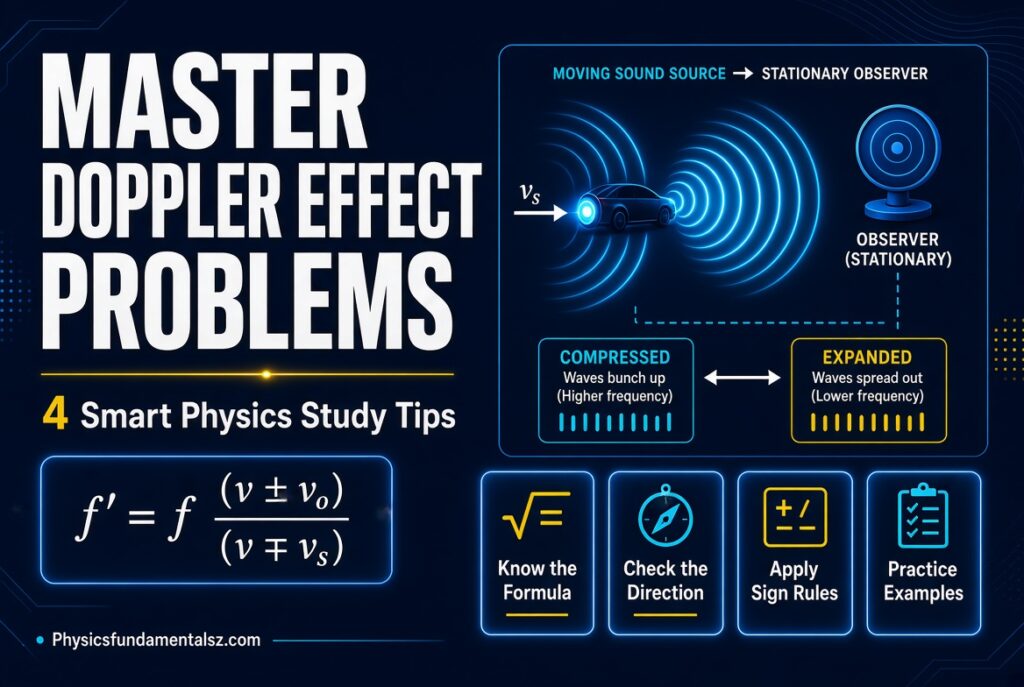
A few habits make these problems fast and reliable. They also help you in exams where time is limited.
Always Predict Before You Calculate
Decide whether the observed frequency should rise or fall. Then compare your calculated result with your prediction. This single habit catches most sign errors.
Write the Formula Before Substituting
Writing the general formula first makes it easy to see which terms drop out. A stationary observer removes vₒ. A stationary source removes vₛ.
Practice Reverse Problems
Many exams ask for the speed or the source frequency. Practice rearranging the formula so that you can handle every unknown.
Use Estimates to Check Answers
When the source speed is small compared with v, the shift is approximately Δf / f ≈ vₛ / v. A 10 m/s source gives a shift of about 3 percent. This quick estimate confirms that your answer is reasonable.
Learn the Real-World Connections
Linking the formulas to sirens, radar guns, ultrasound, and redshift makes them easier to remember. It also prepares you for application questions.
More Worked Examples: Two Sources, Walls, and Beats
Some of the most interesting exam questions combine the Doppler effect with beats or reflections. They test whether you can apply the same method several times in one problem.
Treat each wave path separately. Calculate each observed frequency first, then compare or subtract them.
Example 31: An Observer Between Two Identical Sources
Two stationary speakers, A and B, each emit 500 Hz. A listener walks from B toward A at 10 m/s. Use v = 343 m/s. Find the two frequencies heard and the beat frequency.
The listener moves toward A, so f_A = 500 × (343 + 10) / 343 = 514.6 Hz. The listener moves away from B, so f_B = 500 × (343 − 10) / 343 = 485.4 Hz.
The beat frequency is 514.6 − 485.4 = 29.2 beats per second.
Example 32: A Moving Source Between a Listener and a Wall
A source emits 600 Hz and moves at 20 m/s toward a wall. A stationary listener stands behind the source, on the opposite side from the wall. Use v = 343 m/s.
The direct sound comes from a source moving away from the listener. So f_direct = 600 × 343 / (343 + 20) = 566.9 Hz.
The reflected sound travels from the wall to the listener. The wall receives a shifted frequency from the approaching source, and the stationary wall re-emits that same frequency. The listener hears f_reflected = 600 × 343 / (343 − 20) = 637.2 Hz.
The beat frequency is 637.2 − 566.9 = 70.2 Hz.
Example 33: Equal Velocities in the Same Direction
A source emits 800 Hz and moves at 15 m/s. An observer ahead of it moves in the same direction at the same speed. Find the observed frequency.
The source moves toward the observer, so the denominator is 343 − 15. The observer moves away from the source, so the numerator is 343 − 15. Then f’ = 800 × 328 / 328 = 800 Hz.
There is no shift because the distance between the two does not change. This result is a useful sanity check for any same-direction problem.
Conceptual Doppler Effect Questions and How to Answer Them
Many tests include short conceptual questions with no calculation. A clear reasoning method gives correct answers quickly.
Always return to the same idea. The shift depends on whether the distance between the source and the observer is shrinking or growing.
Does the Pitch Change If the Source and Observer Move at the Same Velocity?
No. If both move in the same direction at the same speed, the distance between them stays constant. The observer receives crests at the same rate at which they are emitted.
Does a Faster Source Produce a Larger Shift?
Yes. The shift grows as the source speed approaches the speed of sound. For small speeds, the fractional shift is approximately vₛ / v.
Is the Shift Larger for a Moving Source or a Moving Observer at the Same Speed?
For the same speed, the moving-source shift is slightly larger when approaching. Compare 1,000 Hz at 30 m/s: a moving source gives 1,000 × 343 / 313 = 1,095.8 Hz, while a moving observer gives 1,000 × 373 / 343 = 1,087.5 Hz.
The two cases are not symmetric because the source changes the wavelength, while the observer only changes the relative speed.
Does the Loudness Change Because of the Doppler Effect?
The Doppler shift itself changes pitch, not loudness. However, loudness often changes in real situations because the distance to the source changes at the same time.
Does the Observer Hear a Different Speed of Sound?
For a moving observer, the speed of the waves relative to the observer changes. The speed relative to the air stays the same. That is the reason the frequency changes even though the wavelength in the air does not.
The Percentage Shift Estimate for Quick Checking
When the speeds are much smaller than the speed of sound, a quick estimate saves time. The fractional change in frequency is about the relative speed divided by the wave speed.
Use Δf / f ≈ v_rel / v, where v_rel is the speed at which the source and observer approach or separate.
Example 34: Estimating the Shift of a Car
A car moves at 20 m/s toward you. The estimate is 20 / 343 = 0.058, or about 5.8 percent. The exact value is 343 / 323 − 1 = 0.062, or 6.2 percent.
The estimate is close, so it is good enough for checking a calculated answer.
When the Estimate Fails
At speeds close to the speed of sound, the estimate becomes inaccurate. Use the exact formula in that case. The estimate also does not apply to light at speeds near c.
Real-World Systems That Rely on the Doppler Effect
Seeing how the formulas appear in technology helps you remember them. It also prepares you for application-based exam questions.
Sirens and Emergency Vehicles
Drivers use the pitch change to judge whether an ambulance is approaching or leaving. The pitch is higher while it comes closer and lower once it has passed.
Police Radar and Traffic Monitoring
Radar guns compare the frequency of the transmitted microwave with the reflected one. The size of the shift gives the speed of the vehicle.
Medical Flow Measurement
Doppler ultrasound shows the direction and speed of blood in vessels and in the heart. Clinicians use this information to detect narrowing or blockage.
Weather Radar
Radar records the shift in signals reflected from raindrops. The shift reveals how air moves toward or away from the radar, which helps forecasters study storms.
Satellite and Navigation Signals
Satellites move quickly relative to ground receivers, so their signals arrive with a small frequency shift. Receivers must account for it to lock onto the signal correctly.
Astronomy
The redshift and blueshift of spectral lines reveal motion along our line of sight. Astronomers use them to study binary stars, galaxy rotation, and the expansion of the universe.
A Final Checklist for Every Doppler Problem
Run through this list before you write your final answer. It takes less than a minute and prevents most errors.
- Did I draw a diagram and mark the direction of each velocity?
- Did I convert every speed to meters per second?
- Did I use the correct speed of sound for the stated conditions?
- Did I place the observer in the numerator and the source in the denominator?
- Did I choose each sign by asking who moves toward whom?
- Did I predict whether f’ should be higher or lower than f?
- Does my answer match that prediction?
- Did I include units, and are they hertz for frequency?
Frequently Asked Questions (FAQs)
How do you solve Doppler effect problems step by step?
Draw a diagram, list the known values, convert units to m/s, decide who moves toward or away from whom, choose the signs, substitute into f’ = f (v ± vₒ) / (v ∓ vₛ), and calculate. Then check that the result matches the expected rise or fall in frequency.
What is the Doppler effect formula?
For sound, the formula is f’ = f (v ± vₒ) / (v ∓ vₛ). The observer’s speed appears in the numerator, and the source’s speed appears in the denominator.
How do you know which sign to use in the Doppler formula?
Use + in the numerator if the observer moves toward the source, and − if the observer moves away. Use − in the denominator if the source moves toward the observer, and + if it moves away.
Does the observed frequency increase or decrease when the source approaches?
It increases. When the source and observer move closer together, more wave crests reach the observer each second, so the pitch is higher.
What speed of sound should I use in Doppler problems?
Use the value in the problem. If none is given, 343 m/s at 20 °C is standard, though some textbooks use 340 m/s. You can also use v = 331 + 0.6T for a given temperature T in °C.
How do you convert km/h to m/s for Doppler problems?
Divide the speed in km/h by 3.6. For example, 90 km/h equals 25 m/s.
What is the formula when both the source and observer are moving?
Use f’ = f (v ± vₒ) / (v ∓ vₛ), choosing each sign according to whether that object moves toward or away from the other.
What happens to the frequency when the observer moves toward a stationary source?
The observed frequency rises because the observer meets crests more often. The formula is f’ = f (v + vₒ) / v.
Why does the wavelength change in the Doppler effect?
A moving source emits each crest from a new position. In front of the source, crests are closer together, so the wavelength shortens. Behind it, crests spread apart, so the wavelength lengthens.
Does the Doppler effect change the source frequency?
No. The source keeps emitting the same frequency. Only the frequency detected by the observer changes.
How do you find the speed of the source from the Doppler shift?
For an approaching source and a stationary observer, use vₛ = v (1 − f / f’). Substitute the emitted and observed frequencies.
How do you find the source frequency from the observed frequency?
Rearrange the formula. For an approaching source, f = f’ (v − vₛ) / v.
What is the observed frequency at the moment a vehicle passes you?
At the instant of closest approach, the velocity is perpendicular to the line of sight. In the ideal case, you hear the true source frequency at that instant.
How do you solve Doppler problems when the motion is at an angle?
Replace each speed with its component along the line connecting source and observer, which is v × cos(θ). Then use the usual formula.
How do you solve a Doppler problem with a reflecting object?
Solve it in two stages. First treat the reflector as a moving observer and find the frequency it receives. Then treat it as a moving source emitting that frequency.
What is the Doppler effect formula for light?
For speeds much smaller than c, use Δλ / λ = v / c. For speeds close to c, use f_obs = f √((1 − β) / (1 + β)) for recession, where β = v / c.
What is redshift?
Redshift is the increase in the wavelength of light from a source that moves away from the observer. Astronomers use it to measure the speeds of galaxies and stars.
How does a radar speed gun use the Doppler effect?
It sends a microwave signal, receives the reflection from a moving car, and measures the shift. The shift is approximately 2 f v / c, so it gives the car’s speed.
How is the Doppler effect used in medicine?
Doppler ultrasound measures blood flow by detecting the frequency shift of sound reflected from moving blood cells. The shift is approximately 2 f v cos(θ) / c.
Does wind affect the Doppler effect?
Yes. Wind changes the speed of the wave relative to the ground. If wind blows from source to observer at speed w, replace v by v + w along that line.
Can the Doppler formula be used for a supersonic source?
No. The formula fails when the source speed reaches the speed of sound. A supersonic source creates a Mach cone and a sonic boom.
What is the Mach number?
The Mach number is the ratio of an object’s speed to the speed of sound in the surrounding medium. Mach 2 means twice the speed of sound.
What is the beat frequency in a Doppler problem?
It is the difference between two frequencies heard together, such as the direct sound and its Doppler-shifted reflection. Subtract the lower from the higher.
Is the Doppler effect the same for sound and light?
No. Sound depends on motion relative to the medium, so source and observer motion are treated differently. Light depends only on relative velocity between source and observer.
What is the easiest way to avoid sign mistakes?
Predict first whether the frequency should rise or fall. Then pick the signs that give that result, and check the final answer against your prediction.
Conclusion
Solving Doppler effect problems step by step becomes simple once you follow a fixed routine. Draw the situation, list the values, convert the units, decide who moves toward or away from whom, choose the signs, and calculate.
The general formula f’ = f (v ± vₒ) / (v ∓ vₛ) covers every sound problem. Keep the observer in the numerator, keep the source in the denominator, and let the direction of motion decide each sign.
For reflections, solve in two stages. For motion at an angle, use the component along the line of sight. For light, switch to the redshift formulas, and for supersonic motion, use the Mach cone relations.
With the worked examples, the cheat sheet, and the practice problems in this guide, you can handle sirens, trains, bats, radar guns, ultrasound scans, and distant galaxies with the same confident method.