Why Does a Straw Look Bent in Water Refraction? The Science Behind the Bent Straw Illusion 2026
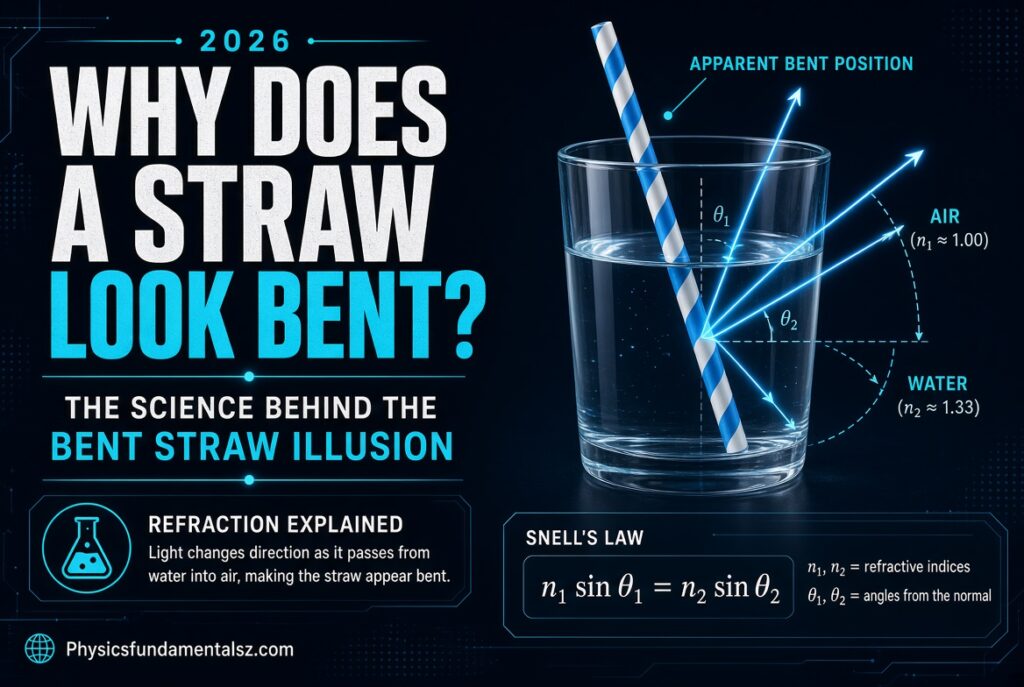
Why Does a Straw Look Bent in Water Refraction? This familiar optical illusion happens because light changes direction when it travels from water into air, making the submerged part of a straw appear shifted from its actual position.
This effect is caused by refraction, the bending of light as it passes between materials with different optical densities. Since our eyes trace light rays back in straight lines, the brain interprets the refracted rays as coming from a different location, creating the appearance of a bent or broken straw.
Understanding this simple phenomenon helps explain how light behaves at the boundary between air and water and connects to important concepts such as refractive index, apparent depth, and Snell’s law.
Table of Contents
Why Does a Straw Look Bent in Water Refraction?
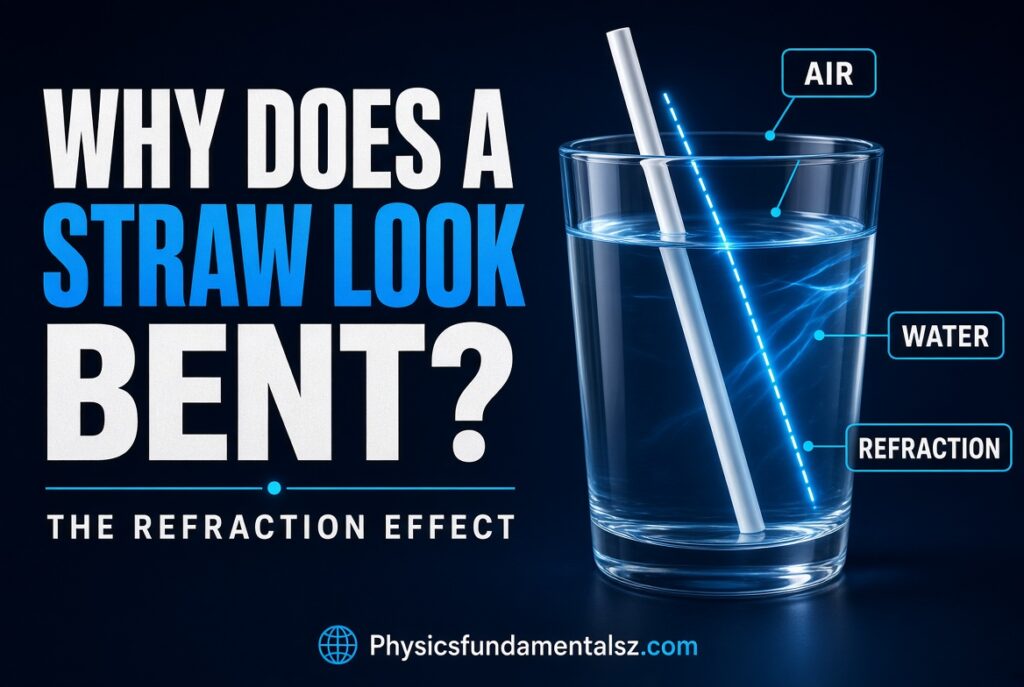
A straw looks bent in water because light rays from the submerged part bend (refract) when they leave the water and enter the air.
Light travels slower in water than in air, so it changes direction at the surface. Your brain traces these bent rays back in straight lines, so the underwater part seems to be in a different place than it really is.
| Question | Short Answer |
|---|---|
| Is the straw really bent? | No, it stays straight |
| What causes the bent look? | Refraction of light at the water-air boundary |
| Why does light bend? | Light changes speed between water and air |
| Which law describes it? | Snell’s law |
| Where does the bend appear? | At the water’s surface |
| Does the submerged part look deeper or shallower? | Shallower, about three-quarters of its real depth |
| Is it a trick of the brain? | Partly, but the cause is real bending of light rays |
Key Takeaways
- The bent straw is an optical illusion caused by refraction, not by any real change in the straw.
- Light moves faster in air than in water, so it changes direction at the surface.
- Light leaving water bends away from the normal line, so the submerged part looks raised.
- Your brain assumes light travels straight, so it misjudges where the underwater part is.
- Water has a refractive index of about 1.33, which makes submerged objects look about 25 percent shallower.
- The effect looks strongest when you view the straw from the side at an angle.
What Is Refraction of Light?
Refraction is the change in direction of a wave when it passes from one medium into another. Light refracts whenever it crosses a boundary between two transparent materials where it travels at different speeds, such as air and water.
The word comes from the Latin for “breaking,” which fits well, since the straw looks broken.
Definition of Refraction
Refraction is the bending of a light ray at the boundary between two media because the speed of light is different in each medium. The bending happens only when the ray hits the boundary at an angle.
If light hits the surface straight on, it still slows down but does not change direction.
The Two Laws of Refraction
Refraction follows two basic laws:
- The incident ray, the refracted ray, and the normal all lie in the same plane.
- The ratio of the sine of the angle of incidence to the sine of the angle of refraction is constant for a given pair of media (Snell’s law).
These two laws predict exactly where a refracted ray will go.
Key Terms You Need to Know
| Term | Meaning |
|---|---|
| Medium | The material light travels through, such as air, water, or glass |
| Interface | The boundary between two media, such as the water surface |
| Normal | An imaginary line perpendicular to the interface |
| Incident ray | The incoming ray that strikes the interface |
| Refracted ray | The ray that continues into the second medium |
| Angle of incidence | The angle between the incident ray and the normal |
| Angle of refraction | The angle between the refracted ray and the normal |
| Refractive index | A number showing how much a medium slows light |
| Optical density | How strongly a medium slows light, higher means slower |
Which Way Does Light Bend?
The direction of the bend depends on how the speed changes.
- Light entering a slower medium (such as air to water) bends toward the normal.
- Light entering a faster medium (such as water to air) bends away from the normal.
For the bent straw, the light travels from water to air, so it bends away from the normal.
What Is the Bent Straw Illusion?
The bent straw illusion is the apparent bending or breaking of a straw, pencil, or spoon where it enters water. It is one of the oldest and most familiar demonstrations of refraction.
Almost everyone has seen it while sipping a drink.
What You See
Place a straw at an angle in a glass of water and look from the side. The straw looks like it has a sharp kink or break exactly at the water’s surface.
The part above the water looks normal. The part below looks shifted and raised, as if it were attached at the wrong place.
What Is Actually Happening
The straw is straight the whole time. If you pull it out, it is perfectly straight. Only the light reaching your eyes has been altered.
That is the key idea: the illusion is not in the straw but in the path of the light.
Why It Is a Great Physics Demonstration
The bent straw is used in classrooms worldwide because it needs only a clear glass, water, and a straw. It shows refraction without any special equipment.
It also leads naturally to deeper topics such as refractive index, apparent depth, and total internal reflection.
Why Does a Straw Look Bent in Water? Step-by-Step Explanation
Here is the full chain of events, from the straw to your eye. Each step builds on the one before.
Step 1: Light Reflects Off the Straw
You see the straw because light from a lamp or window reflects off it and travels to your eyes. Every point on the straw sends light rays in many directions.
Both the part above the water and the part below the water send light to you.
Step 2: Light From the Dry Part Travels Straight to You
Light from the part of the straw above the surface travels only through air. It goes straight to your eye with no bending.
So you see the dry part of the straw in its true position.
Step 3: Light From the Wet Part Must Cross the Water Surface
Light from the submerged part first travels through water. Then it must pass through the water’s surface into the air before it can reach you.
The water surface is the boundary where refraction happens.
Step 4: Light Speeds Up and Bends Away From the Normal
When light leaves water and enters air, it speeds up. Because it hits the surface at an angle, it also changes direction.
It bends away from the normal, which means the ray becomes flatter relative to the surface.
Step 5: Your Eyes Trace the Rays Back in Straight Lines
Your eye catches the refracted ray, but it has no way to know the ray was bent. Your brain assumes the light came in a straight line.
It extends the ray backward in a straight line, and the point where the extended rays meet is where you think the object is.
Step 6: The Image Appears in the Wrong Place
The extended rays meet at a point that is shallower than the real point. So every point on the submerged part of the straw seems raised.
The raised underwater part does not line up with the dry part, so the straw looks bent at the surface.
Summary of the Process
| Step | What Happens |
|---|---|
| 1 | Light reflects off the straw |
| 2 | Light from the dry part goes straight to your eye |
| 3 | Light from the wet part must pass through the water surface |
| 4 | The light speeds up and bends away from the normal |
| 5 | Your brain traces the rays back in straight lines |
| 6 | The wet part appears raised, so the straw looks bent |
Why Does Light Bend? Speed of Light and Refractive Index
Light bends because its speed changes. In a vacuum, light travels at about 3.00 × 10⁸ meters per second. In any material, it travels more slowly.
The more the material slows light, the more the light bends when it enters at an angle.
What Is Refractive Index?
The refractive index (n) of a material is the ratio of the speed of light in a vacuum to the speed of light in that material. The formula is n = c / v.
Here c is the speed of light in a vacuum and v is the speed of light in the material. A higher refractive index means a slower speed and more bending.
Speed of Light in Air, Water, and Glass
| Medium | Refractive Index (n) | Approximate Speed of Light |
|---|---|---|
| Vacuum | 1.00 | 3.00 × 10⁸ m/s |
| Air | 1.0003 | 3.00 × 10⁸ m/s |
| Water | 1.33 | 2.26 × 10⁸ m/s |
| Glass (typical) | 1.50 | 2.00 × 10⁸ m/s |
| Diamond | 2.42 | 1.24 × 10⁸ m/s |
Water slows light to about three-quarters of its speed in air. That difference is what produces the bent straw.
Light Does Not Really Slow Forever
Light slows down only while it travels inside the material. When it leaves the water, it returns to its speed in air.
Its frequency never changes. Only its speed and wavelength change.
Wavelength Changes in Water
Because the speed drops while the frequency stays the same, the wavelength becomes shorter. The formula is λ in the medium = λ in air / n.
For example, red light of 600 nm in air has a wavelength of about 451 nm in water.
A Simple Way to Picture Why Light Bends
Imagine a marching band walking from pavement onto thick mud at an angle. The row that hits the mud first slows down, while the rest keep marching quickly.
The whole line swings around toward a new direction. A light wave’s wavefront does the same thing when one side enters a slower medium before the other.
Fermat’s Principle: Light Takes the Fastest Path
Another way to explain refraction is Fermat’s principle. Light follows the path that takes the least time between two points.
Since light is slower in water, the fastest path is not a straight line. The path bends at the surface to save time, just as a lifeguard runs farther on sand and swims a shorter distance in the water to reach a swimmer quickly.
Snell’s Law: The Formula for Refraction
Snell’s law gives the exact angle at which light bends. It is written as n₁ × sin θ₁ = n₂ × sin θ₂.
Here n₁ and n₂ are the refractive indices of the two media, θ₁ is the angle of incidence, and θ₂ is the angle of refraction. Both angles are measured from the normal.
How to Use Snell’s Law
- Identify the two media and look up their refractive indices.
- Measure or identify the angle in the first medium from the normal.
- Substitute into n₁ × sin θ₁ = n₂ × sin θ₂.
- Solve for the unknown angle using the inverse sine function.
Solved Example 1: Light Entering Water
Light travels from air into water at an angle of incidence of 45°. Find the angle of refraction. Use n for air = 1.00 and n for water = 1.33.
1.00 × sin 45° = 1.33 × sin θ₂, so sin θ₂ = 0.7071 / 1.33 ≈ 0.532.
θ₂ ≈ 32°. The ray bends toward the normal, as expected when entering a slower medium.
Solved Example 2: Light Leaving Water (The Bent Straw Case)
Light from the straw travels in the water and hits the surface at 30° from the normal. Find the angle in the air.
1.33 × sin 30° = 1.00 × sin θ₂, so sin θ₂ = 1.33 × 0.5 = 0.665.
θ₂ ≈ 41.7°. The ray bends away from the normal by almost 12°. This is the bend that creates the illusion.
Solved Example 3: Light Entering Glass
Light moves from air into glass (n = 1.50) at 60°. Find the angle of refraction.
sin θ₂ = sin 60° / 1.50 = 0.8660 / 1.50 ≈ 0.577.
θ₂ ≈ 35.3°. Glass bends light more than water, because its refractive index is higher.
Comparison of Bending in Different Materials
| Light Goes From | To | Bends | Reason |
|---|---|---|---|
| Air | Water | Toward normal | Slower medium |
| Water | Air | Away from normal | Faster medium |
| Air | Glass | Toward normal, more than water | Even slower medium |
| Glass | Air | Away from normal | Faster medium |
| Along the normal | Any | No bend | Hits the surface straight on |
Refractive Index of Common Materials
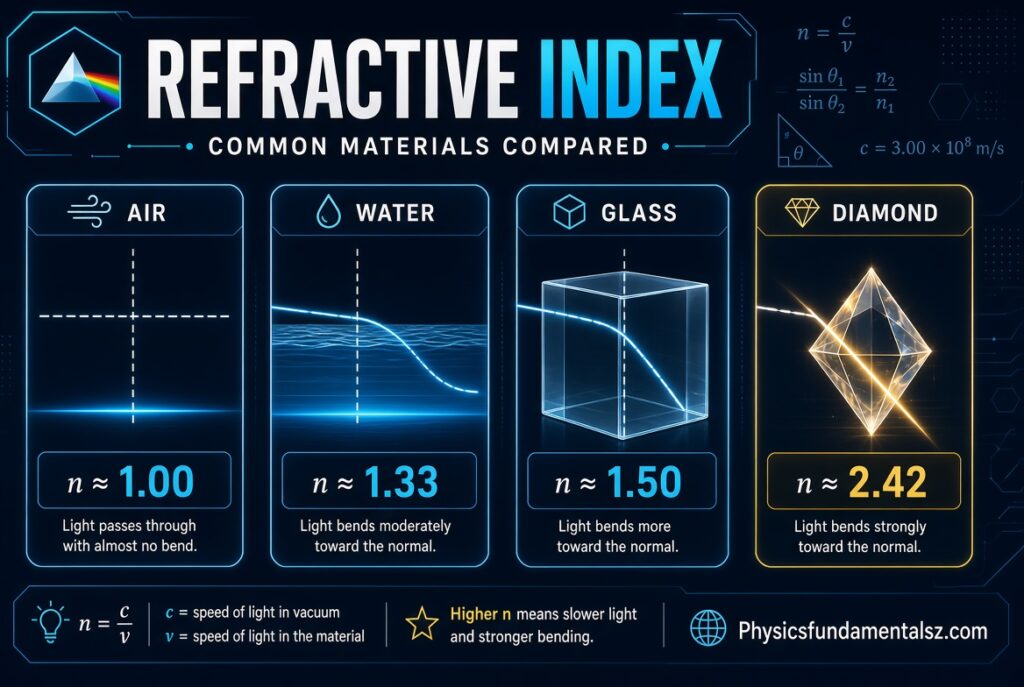
Different materials bend light by different amounts. This table helps you predict how strong the bent straw effect will be in different liquids.
| Material | Refractive Index (approx.) |
|---|---|
| Air | 1.0003 |
| Ice | 1.31 |
| Water | 1.33 |
| Ethanol | 1.36 |
| Glycerin | 1.47 |
| Vegetable oil | 1.47 |
| Acrylic | 1.49 |
| Crown glass | 1.52 |
| Diamond | 2.42 |
What Happens in Other Liquids
If you put a straw in oil instead of water, the bend looks stronger, because oil has a higher refractive index. The larger the difference from air, the larger the apparent shift.
Salty water has a slightly higher refractive index than fresh water, so the bend is slightly stronger.
Why Some Things Seem to Disappear in Liquids
If an object and the liquid around it have nearly the same refractive index, light barely bends at the boundary. The object becomes almost invisible.
A glass rod in a liquid with a similar refractive index seems to vanish, since no refraction marks its edges.
Apparent Depth: Why Submerged Objects Look Shallower
Apparent depth explains why the underwater part of a straw looks raised. It describes how deep an object seems when you view it through a surface from another medium.
The same effect makes swimming pools look shallower than they really are.
What Is Apparent Depth?
Apparent depth is the depth at which an underwater object appears to be when viewed from above. It is always less than the real depth when you look from air into water.
The difference comes from the bending of light rays as they leave the water.
Apparent Depth Formula
For viewing straight down (or nearly so), the formula is apparent depth = real depth × (n of the observer’s medium / n of the object’s medium).
Looking from air (n = 1.00) into water (n = 1.33), this becomes apparent depth = real depth / 1.33, or about 0.75 times the real depth.
Derivation of the Apparent Depth Formula
Take a point at real depth d under water. Two rays leave it: one goes straight up, and another goes up at a small angle θ₁ from the vertical.
The second ray refracts at the surface into air at an angle θ₂. Tracing it back, it appears to come from a point at depth d′.
For small angles, the geometry gives d′ × tan θ₂ = d × tan θ₁. Since the angles are small, tan is close to sin, and Snell’s law gives n₁ θ₁ ≈ n₂ θ₂.
Combining these gives d′ = d × (n₂ / n₁). With n₁ = 1.33 for water and n₂ = 1.00 for air, d′ = d / 1.33.
Solved Example 4: Depth of a Straw Tip
The tip of a straw is 12 cm below the water surface. How deep does it appear when viewed from directly above?
Apparent depth = 12 / 1.33 ≈ 9.0 cm.
The tip appears about 3 cm higher than it really is.
Solved Example 5: A Swimming Pool
A swimming pool is 2.0 m deep. How deep does it look from the edge when you look almost straight down?
Apparent depth = 2.0 / 1.33 ≈ 1.5 m.
The pool looks about 0.5 m shallower than it really is, which is a safety concern for people who judge depth by eye.
Solved Example 6: Finding Real Depth
A coin at the bottom of a tank appears to be 15 cm deep. Find the real depth of the water.
Real depth = apparent depth × 1.33 = 15 × 1.33 ≈ 20 cm.
The Apparent Depth Changes With Viewing Angle
The simple formula works only for viewing from directly above. When you look at an angle, the object seems even shallower.
This is why the bend in the straw looks sharper when you look from the side than when you look from above.
| Viewing Direction | Apparent Depth Compared With Real Depth |
|---|---|
| Straight down | About 75 percent of real depth |
| Slightly angled | Less than 75 percent |
| Very oblique (near the surface) | Much shallower |
Why the Straw Looks Bent, Broken, Shorter, or Thicker
Depending on how you hold the straw and where you look from, the illusion can take several forms. Each form has a clear explanation.
Why the Break Is at the Water Surface
The refraction happens only at the surface, where light passes from water to air. Above the surface, light from the straw is unaffected.
So the “kink” always appears at the surface, exactly where the straw crosses it.
Why the Submerged Part Looks Raised
Each point on the submerged part appears at a shallower depth. So the entire underwater section seems lifted toward the surface and displaced sideways.
The result is a straw that seems to bend upward at the surface.
Why a Tilted Straw Shows the Strongest Bend
A tilted straw has a long submerged section spread across many depths and angles. The lifting effect adds up across the whole length.
A straw tilted toward you looks the most dramatically bent when you look from the side.
Why a Vertical Straw Looks Shorter
If you hold a straw straight down and look from above, it looks shorter than it is. Every point on the submerged part is raised by about one-quarter of its depth.
A 12 cm submerged part seems only about 9 cm long.
Why You See No Bend Looking Along the Straw
If you look straight down along the straw’s axis, light travels along the normal. Light along the normal does not bend at the surface.
So the straw looks straight, though shorter. This is a good test that the straw is not truly bent.
Why the Straw Can Look Thicker Underwater
When viewed through the curved side of a glass, the submerged part may also look wider. A round glass of water acts like a cylindrical lens that magnifies horizontally.
That is why a straw can look both displaced and thicker in a drinking glass.
How the Glass Container Changes the Illusion
Most people see the straw through a glass, not through a flat surface. That adds more refraction.
Light now crosses several boundaries on the way to your eye.
The Path Through Air, Glass, and Water
Light from the submerged straw passes through water, then through the glass wall, then into the air. Each boundary can bend the light.
Because a typical drinking glass is thin, the glass wall itself changes the direction only slightly. The main effects come from the water and the curved shape.
The Glass as a Lens
A cylindrical glass full of water works like a cylindrical lens. It magnifies the straw sideways and can make the submerged part look wider and displaced.
A square glass or a rectangular tank has flat sides and shows less of this magnifying effect.
Flat vs Round Containers
| Container Shape | Main Effect on the Straw |
|---|---|
| Flat-sided tank | Mostly pure refraction at the water surface and flat walls, simple bend |
| Round glass | Bend plus sideways magnification |
| Wide bowl | Bend plus strong distortion from the curved sides |
| Tall narrow glass | Strong magnification across the narrow width |
Looking From the Top vs the Side
Looking down from the top, you see mostly the apparent depth effect. The straw looks shorter but not very broken.
Looking from the side through the glass wall, you see the full bend plus the effect of the curved glass.
How to Draw a Ray Diagram of the Bent Straw
A ray diagram shows exactly how refraction creates the illusion. Drawing one is a common exam question.
Follow these steps to draw it correctly.
Step-by-Step Ray Diagram Method
- Draw a horizontal line to represent the water surface, with water below and air above.
- Mark a point P under the water to represent a point on the straw.
- Draw a vertical dashed line (the normal) above P where the ray will hit the surface.
- Draw an incident ray from P up to the surface at an angle to the normal.
- At the surface, draw the refracted ray going into the air, bent away from the normal.
- Draw a second ray from P to the surface at a slightly different angle, also bent away from the normal.
- Extend each refracted ray backward into the water with dashed lines.
- Mark the point where the dashed lines meet. This is the apparent position P′.
What the Diagram Shows
P′ appears above P, closer to the surface. This shows why the point looks raised.
Repeating the process for several points along the straw gives a raised, shifted image of the whole submerged section.
Common Ray Diagram Mistakes
- Drawing the refracted ray bending toward the normal when light leaves water. It must bend away.
- Measuring angles from the surface instead of from the normal.
- Forgetting the dashed backward extensions.
- Drawing the apparent image deeper instead of shallower.
- Making the rays curve smoothly instead of bending at the boundary.
Does the Straw Really Bend? Physics vs the Brain
The straw does not bend, but the illusion is not just in your head. Real light rays really do bend.
Understanding both parts removes a common confusion.
What Is Physical
The refraction of light at the surface is physical and measurable. A camera also records the bent-looking straw, which proves the effect is not only in the brain.
Light really changes direction, and cameras, mirrors, and instruments all show it.
What Is Perceptual
Your brain’s assumption that light travels in straight lines is a perceptual shortcut. It works in almost every situation, but it fails here.
So the illusion comes from a mix of physics (bent rays) and perception (assuming straight rays).
Myths vs Facts
| Myth | Fact |
|---|---|
| The straw is really bent by the water | The straw is perfectly straight |
| Water pressure bends the straw | Water pressure has nothing to do with it |
| It is only a trick of the brain | Light rays physically bend, and cameras record the effect |
| Reflection causes the bend | Refraction causes it, not reflection |
| Light speed is the same in water | Light is slower in water, about 2.26 × 10⁸ m/s |
| The effect only happens with straws | Any object partly in water shows the effect |
| Only water causes it | Any transparent medium with a different refractive index does |
Total Internal Reflection and the Mirror Effect in a Glass
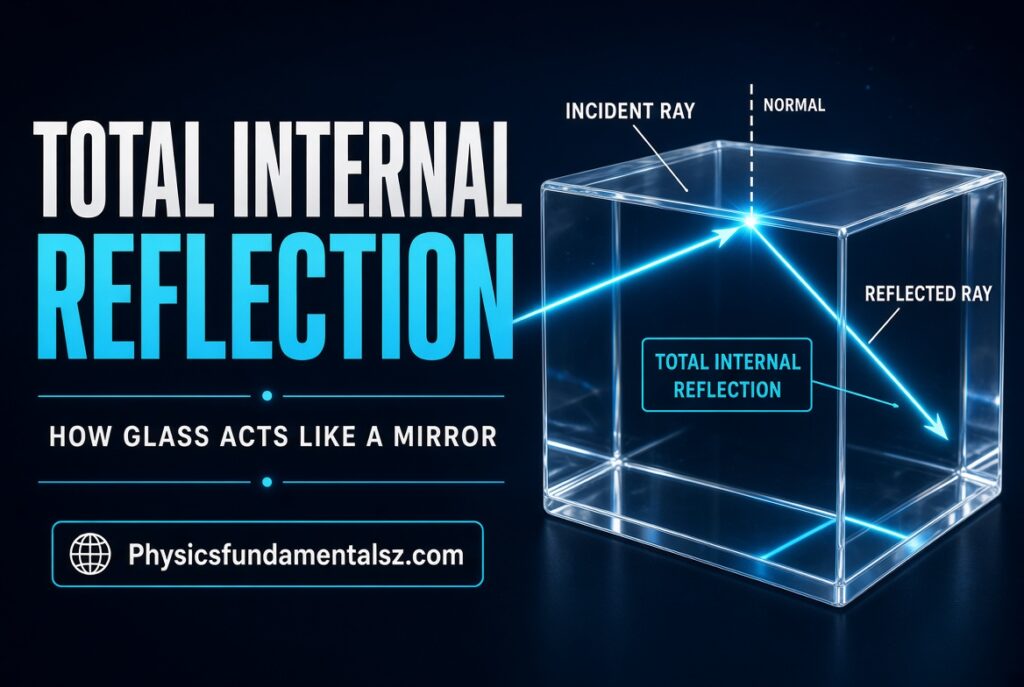
If you look at the straw from below the water surface, you can see another effect. At steep angles, the surface acts like a mirror.
This is called total internal reflection.
What Is Total Internal Reflection?
Total internal reflection happens when light tries to leave a slower medium at an angle larger than the critical angle. Instead of passing through, all the light reflects back.
It only happens when light travels from a higher refractive index to a lower one, such as water to air.
Critical Angle Formula
The critical angle is given by sin θc = n₂ / n₁, where n₁ is the higher index and n₂ is the lower index.
For water to air, sin θc = 1.00 / 1.33 ≈ 0.752, so θc ≈ 48.8°.
Critical Angles of Common Materials
| Boundary | Critical Angle (approx.) |
|---|---|
| Water to air | 48.8° |
| Glass (n = 1.50) to air | 41.8° |
| Diamond to air | 24.4° |
How It Shows Up in a Glass of Water
If you look up at the water surface from underneath through the side of a glass, the surface can look like a silver mirror. You may also see a reflection of the straw in it.
This is the same physics that makes diamonds sparkle and makes fiber optic cables carry light.
Dispersion: Why the Edges of the Straw May Show Color
Water bends different colors of light by slightly different amounts. This is called dispersion.
It can add faint colored fringes to the bent straw.
Why Colors Bend Differently
The refractive index of water is slightly higher for blue light than for red light. So blue bends a little more than red.
For water, the difference is small, which is why the effect on a straw is faint.
Where You Might See It
Look at the edge of the straw near the water surface in bright light. A thin blue or red edge may appear.
A bigger version of the same effect creates rainbows and the colors from a prism.
Easy Experiments to See the Bent Straw Effect at Home
You can explore refraction with items from your kitchen. These experiments are simple and safe.
Experiment 1: The Classic Bent Straw
Materials: a clear glass, water, and a straw or pencil.
- Fill the glass about three-quarters full.
- Place the straw in the glass at an angle.
- Look from the side at the water surface and note the bend.
- Look from above and compare.
Experiment 2: Change the Viewing Angle
Move your head slowly from a high position to a low position. Watch how the bend changes.
You will see that the break becomes more obvious as your view gets more oblique.
Experiment 3: Compare Water and Oil
Put one straw in a glass of water and another in a glass of cooking oil. Compare the bends.
The oil usually shows a stronger effect, since its refractive index is higher.
Experiment 4: The Disappearing Coin
Place a coin in an opaque cup, then step back until the coin just disappears behind the rim. Keep your head still while a helper slowly pours water into the cup.
The coin comes back into view. Refraction bends the light from the coin over the rim to your eye.
Experiment 5: Look Along the Straw
Hold the straw vertically in the glass and look straight down from above. Then tilt your head to the side.
Looking along the axis, the straw looks straight. Looking from the side, the bend appears.
Experiment 6: Measure the Apparent Depth
Place a ruler vertically in a tall container so that its zero mark sits at the bottom. Fill with water, look from above, and read the mark that seems to be at the bottom.
You will find it is about three-quarters of the true depth.
Safety Tips
- Use unbreakable containers if children are doing the experiment.
- Wipe up spilled water so no one slips.
- Do not point a laser at anyone’s eyes if you use one for measuring angles.
Real-World Examples of Refraction Like the Bent Straw
The same physics appears all around you. Once you understand the bent straw, you can explain many other things.
Fish Look Closer to the Surface Than They Are
When you look at a fish from the shore, the fish appears shallower and closer. A spear aimed at the visible image passes above the real fish.
Experienced spearfishers aim below the image to hit the fish.
Archerfish Compensate for Refraction
Archerfish spit water at insects above the surface. They have to account for the bending of light at the surface, and they do so remarkably well.
Legs Look Shorter in a Pool
When you stand in a pool, your legs look shorter and wider. Light from your submerged legs refracts as it leaves the water.
Pools Look Shallower Than They Are
Because of apparent depth, a pool seems about one-quarter shallower than it really is. Pool safety guidelines warn about this for this reason.
Mirages
On hot days, the air near the road is hotter and less dense, so it has a slightly lower refractive index. Light bends gradually and creates the illusion of water on the road.
Rainbows
Rainbows form when sunlight refracts in raindrops, reflects inside, and refracts again as it leaves. The different colors bend by slightly different amounts.
Eyeglasses, Cameras, and Magnifiers
Lenses use refraction to focus light. A convex lens bends parallel rays toward a point, forming an image.
Your own eye does the same thing, with the cornea and lens focusing light on the retina.
Fiber Optics
Fiber optic cables carry light by repeated total internal reflection. They send internet data across oceans using the same principle you saw in the glass.
Twinkling and Shimmering
Heat rising from a hot surface creates layers of air with different densities. Light bends through them, so objects seem to shimmer.
Refraction vs Reflection vs Diffraction
Students often mix up these three wave behaviors. This table shows the differences.
| Feature | Refraction | Reflection | Diffraction |
|---|---|---|---|
| Definition | Bending of light between media | Bouncing back from a surface | Spreading around obstacles or through gaps |
| Cause | Change in speed | Light cannot enter the surface | Wave nature of light |
| Medium change needed | Yes | No | No |
| Example | Bent straw | Mirror image | Light fanning out through a narrow slit |
| Governing rule | Snell’s law | Angle of incidence equals angle of reflection | Depends on wavelength and gap size |
Which One Explains the Bent Straw?
Only refraction explains the bent straw. Reflection and diffraction are different effects.
If a question asks why a straw looks bent in water, the correct answer is refraction.
The Bent Straw in Different Liquids: What Changes and Why
The strength of the illusion depends on the liquid. A bigger gap between the refractive index of the liquid and that of air gives a stronger bend.
Testing different liquids is a simple way to see refractive index at work.
How Refractive Index Controls the Bend
When light leaves a liquid with a high refractive index into air, it bends away from the normal by a larger amount. The submerged part of the straw is then lifted by a bigger fraction of its depth.
For viewing from directly above, the apparent depth is real depth divided by the refractive index of the liquid.
Apparent Depth in Different Liquids
| Liquid | Refractive Index (approx.) | Apparent Depth of a Point 10 cm Deep |
|---|---|---|
| Water | 1.33 | About 7.5 cm |
| Ethanol | 1.36 | About 7.4 cm |
| Glycerin | 1.47 | About 6.8 cm |
| Vegetable oil | 1.47 | About 6.8 cm |
The differences are small, but they are enough to measure with a ruler. Oil and glycerin give a visibly stronger lift than water.
Salt Water vs Fresh Water
Dissolving salt raises the refractive index of water slightly. Saturated salt water has a refractive index a little above that of pure water.
The change is small, so you need a careful setup to notice it. It still follows the same rule: more optical density gives more bending.
When the Straw Seems to Vanish
If you place a clear glass rod in a liquid with nearly the same refractive index, the rod becomes almost invisible. Light barely bends at its boundary, so the eye has nothing to detect.
This shows that the bent straw effect depends on the difference in refractive index, not on the liquid alone.
Measuring the Refractive Index of Water Using a Straw or Pin
You can turn the bent straw into a real measurement. The method uses apparent depth and works well in a school lab.
It needs a tall transparent container, a ruler, and a pin or pencil.
What You Need
- A tall, clear container with straight sides
- A ruler or measuring tape
- A pin or the tip of a pencil
- Water
- A second pin to act as a reference
Step-by-Step Method
- Place a pin at the bottom of the container, and note the real depth of the water after you fill it.
- Hold a second pin above the water, and move it up and down until it appears to line up with the image of the bottom pin. Keep your eye level fixed and look nearly straight down.
- Measure the height of the second pin above the water surface. Add that to find the apparent depth, which is the distance from the surface down to the image position.
- Divide the real depth by the apparent depth to get the refractive index.
Worked Example
The water is 18.0 cm deep. The image of the bottom pin appears 13.5 cm below the surface.
Refractive index = real depth / apparent depth = 18.0 / 13.5 = 1.33. This matches the accepted value for water.
Ways to Improve Accuracy
- Look straight down, so the small-angle approximation holds.
- Use a deep container, so that small reading errors matter less.
- Repeat three or more times and take the average.
- Remove parallax by moving your eye slightly side to side until the two pins stay lined up.
Why the Bent Straw Looks Different Through a Camera or Phone
Many people photograph a bent straw and are surprised that the picture looks exactly like what they saw. Others find that a photo from directly above shows almost no bend.
Both results follow from the physics.
A Camera Records Refracted Light
A camera lens focuses the light that reaches it. Since the light from the straw is already bent by the water surface, the camera records the same bent image your eye sees.
This is strong proof that the bend is real light behavior and not a trick of perception.
Camera Angle Changes the Result
A camera held at the side at a low angle shows a strong bend. A camera held straight above shows a shorter but nearly straight straw.
Photographers can change the apparent bend simply by moving the camera.
Tips for a Clear Photo of the Illusion
- Use a clear glass with a plain background.
- Tilt the straw at a clear angle.
- Place the camera at the water level, or slightly above it.
- Keep the surface calm so ripples do not blur the break.
- Use bright, even light from the side or behind the glass.
Teaching and Learning Tips for the Bent Straw Experiment
The bent straw is often a student’s first real contact with refraction. A few simple habits make the lesson stick.
For Students
Always describe the experiment in three parts: what you see, what causes it, and how the light travels. Add a ray diagram to complete the explanation.
For Teachers and Parents
Ask learners to predict what will happen before showing the result. Prediction makes the surprise memorable and shows hidden assumptions.
Then change one variable at a time, such as the liquid, the angle, or the glass shape, and ask what changed and why.
Questions That Build Understanding
- What would you see if the glass were empty?
- What happens if you look straight down along the straw?
- Would a thicker liquid make the bend stronger or weaker?
- Where would the straw look bent if it were fully underwater?
- Why does the break always appear at the surface?
Fully Submerged Straw
If the straw is entirely under the water, there is no break at the surface. The whole straw looks raised and slightly shorter, but it still looks like one straight piece.
This test shows that the visible break comes from comparing the dry part and the wet part.
Refraction Beyond Light: Sound and Water Waves
Light is not the only wave that refracts. Any wave that changes speed between two media can bend.
Seeing this helps you understand that refraction is a general wave property, not something special to light.
Refraction of Sound
Sound travels faster in warm air than in cold air. On a cool evening, sound can bend downward toward the ground, so distant noises seem louder.
During the day, when the ground is hot, sound tends to bend upward and distant sounds seem fainter.
Refraction of Water Waves
Ocean waves slow down as the water gets shallower. That causes them to bend toward the shore and line up almost parallel to the beach.
This is why waves nearly always roll in toward the coast at a gentle angle.
Why This Matters for the Straw
The same rules apply in each case: a change in wave speed makes the wave change direction. The bent straw is just the version we can see.
A Short History of the Discovery of Refraction
People have studied the bending of light for almost two thousand years. The bent straw and bent oar in water were among the first clues.
Knowing a bit of history shows how the idea developed.
Early Observations
Ancient scholars noticed that oars and sticks look bent in water. The Greek astronomer Ptolemy recorded measurements of angles of refraction in the second century.
The Law of Refraction
The Persian scientist Ibn Sahl described the law of refraction around 984 CE while studying lenses. In 1621, Willebrord Snellius (Snell) found the relationship again in the Netherlands.
René Descartes published the law in the form using sines in 1637, which is why it is called Snell’s law in some countries and the Snell-Descartes law in others.
Modern Understanding
Today, we understand refraction through the wave nature of light and electromagnetic theory. Light slows because it interacts with the electrons in the material.
The refractive index is now a central quantity in optics, materials science, and engineering.
Applications of Refraction in Technology
Refraction is not just a curiosity. Engineers and scientists rely on it every day.
Eyeglasses and Contact Lenses
Corrective lenses use refraction to bend light so that it focuses correctly on the retina. Concave lenses fix nearsightedness, and convex lenses fix farsightedness.
Cameras and Telescopes
Camera lenses combine several glass elements to focus light onto a sensor. Telescopes and binoculars use lenses to collect and focus light from distant objects.
Microscopes
A microscope uses lenses to bend light from a tiny specimen so that it forms a large, clear image. Immersion oil with a high refractive index is sometimes used to improve resolution.
Prisms and Spectrometers
Prisms use refraction and dispersion to split white light into its colors. Scientists use this to study the light from stars and chemical samples.
Fiber Optic Communication
Fibers use a core with a high refractive index surrounded by a cladding with a lower index. Light stays trapped inside by total internal reflection.
Underwater Photography and Diving
Divers see objects about one-quarter closer and one-third larger underwater through a flat mask. Refraction at the mask causes this effect, and camera housings use special ports to correct it.
Application Summary
| Technology | Role of Refraction |
|---|---|
| Eyeglasses | Bend light to focus on the retina |
| Camera lens | Focuses light on the sensor |
| Microscope | Magnifies small objects |
| Prism | Splits light into colors |
| Fiber optics | Guides light by total internal reflection |
| Diving mask | Changes apparent size and distance underwater |
Bent Straw Scenarios at a Glance
Different setups give different results. This table sums up what to expect.
| Scenario | What You See | Why |
|---|---|---|
| Tilted straw viewed from the side | Sharp bend at the surface | Light bends away from the normal leaving water |
| Straw viewed from directly above | Looks shorter, little bend | Apparent depth is about 75 percent of real depth |
| Looking along the straw’s axis | Straight but shorter | Light travelling along the normal does not bend |
| Straw in a round glass | Bend and sideways magnification | Glass and water act like a cylindrical lens |
| Straw in oil | Stronger bend | Higher refractive index |
| Straw in a flat-sided tank | Clean bend with less distortion | Flat walls add little extra refraction |
| Straw and water at the same refractive index | Almost no bend | No change in light speed at the boundary |
Common Mistakes When Explaining the Bent Straw
Students lose marks on this topic for a handful of predictable reasons.
Mistake 1: Saying the Straw Is Really Bent
The straw is straight. The illusion comes from light, not from any change in the straw.
Mistake 2: Confusing Refraction With Reflection
Reflection is bouncing off a surface. Refraction is bending as light passes through. The bent straw is refraction.
Mistake 3: Bending Toward the Normal When Leaving Water
Light leaving water bends away from the normal. Light entering water bends toward it.
Mistake 4: Measuring Angles From the Surface
Angles in Snell’s law are always measured from the normal, not from the surface.
Mistake 5: Saying Light Speeds Up in Water
Light slows down in water. It speeds up when it leaves the water and enters air.
Mistake 6: Forgetting the Role of the Brain
A complete answer mentions that the brain traces the rays back in straight lines. This is what places the image in the wrong location.
Mistake 7: Mixing Up Real and Apparent Depth
Real depth is greater than apparent depth when you look from air into water. Apparent depth is the smaller one.
Exam Tips for Refraction Questions
These habits help in school and university exams.
Name the Phenomenon First
Start with the word refraction. Then explain that light changes speed and direction at the boundary.
Draw a Neat Ray Diagram
Include the normal, labeled angles, the real position, the apparent position, and arrows on the rays. A good diagram earns easy marks.
State the Direction of the Bend
Say clearly that light bends away from the normal going from water to air. Then explain the result: the object looks raised.
Use Numbers in Calculations
Write the refractive indices you use, and keep units consistent. Show each substitution step in Snell’s law.
Check the Answer
Light entering a slower medium must give a smaller angle. If your answer goes the other way, recheck the order of n₁ and n₂.
Practice Problems on Refraction and Apparent Depth
Try these before checking the answers. Use n = 1.00 for air and n = 1.33 for water unless told otherwise.
Problem Set
- Find the speed of light in water.
- Light goes from air into water at an angle of incidence of 45°. Find the angle of refraction.
- A straw tip is 20 cm below the surface. Find its apparent depth from directly above.
- Light goes from water into air with an angle of 30° in water. Find the angle in air.
- Find the critical angle for water and air.
- Find the speed of light in glass with n = 1.50.
- A pool looks 1.2 m deep from above. Find its real depth.
- The bottom end of a straw appears 6 cm below the surface. Find its real depth.
- Find the wavelength in water of light that has a wavelength of 500 nm in air.
- Which bends light more when it enters from air, water or glass, and why?
Answers and Short Solutions
| Problem | Answer | Short Solution |
|---|---|---|
| 1 | 2.26 × 10⁸ m/s | v = c / n = 3.00 × 10⁸ / 1.33 |
| 2 | About 32° | sin θ₂ = sin 45° / 1.33 = 0.532 |
| 3 | About 15 cm | 20 / 1.33 ≈ 15.0 |
| 4 | About 41.7° | sin θ₂ = 1.33 × sin 30° = 0.665 |
| 5 | About 48.8° | sin θc = 1 / 1.33 = 0.752 |
| 6 | 2.00 × 10⁸ m/s | v = 3.00 × 10⁸ / 1.50 |
| 7 | About 1.6 m | 1.2 × 1.33 ≈ 1.6 |
| 8 | About 8 cm | 6 × 1.33 ≈ 8.0 |
| 9 | About 376 nm | 500 / 1.33 ≈ 376 |
| 10 | Glass | Higher refractive index means a larger change in speed |
Refraction and the Bent Straw Cheat Sheet
Use this table as a quick revision guide.
| Topic | Key Fact |
|---|---|
| Cause of the bent straw | Refraction of light at the water-air boundary |
| Reason for bending | Light changes speed between media |
| Speed in water | About 2.26 × 10⁸ m/s |
| Refractive index of water | About 1.33 |
| Refractive index formula | n = c / v |
| Snell’s law | n₁ sin θ₁ = n₂ sin θ₂ |
| Water to air | Bends away from the normal |
| Air to water | Bends toward the normal |
| Apparent depth | Real depth / 1.33 for viewing from above |
| Wavelength in a medium | λ in air / n |
| Critical angle for water | About 48.8° |
| Is the straw bent? | No, only its image appears bent |
Frequently Asked Questions (FAQs)
Why does a straw look bent in water?
It looks bent because of refraction. Light from the submerged part changes direction as it leaves the water, and your brain traces it back in a straight line to the wrong position.
Is the straw really bent in water?
No. The straw stays perfectly straight. Only the image formed by refracted light appears bent.
What is refraction?
Refraction is the bending of a wave when it passes between two media in which its speed is different. For light, it happens at boundaries such as air and water.
Why does light bend when it goes from water to air?
Light travels faster in air than in water. When it hits the surface at an angle, one side of the wave speeds up first, and the ray turns away from the normal.
Why does light slow down in water?
Light interacts with the electrons in water molecules as it passes through, which reduces its effective speed. In water, it travels at about 2.26 × 10⁸ m/s.
What is the refractive index of water?
The refractive index of water is about 1.33. It means light travels about 1.33 times slower in water than in a vacuum.
What is Snell’s law?
Snell’s law states that n₁ sin θ₁ = n₂ sin θ₂. It relates the angles of incidence and refraction to the refractive indices of the two media.
Why does the straw look bent exactly at the water surface?
Refraction happens at the boundary between water and air. Light from the dry part is unaffected, so the mismatch appears at the surface.
Why does the submerged part of the straw look raised?
Refracted rays appear to come from a shallower point than the real one. Every point on the submerged part therefore looks lifted.
What is apparent depth?
Apparent depth is the depth an underwater object seems to have when you view it from above. It is about three-quarters of the real depth for water.
How do you calculate apparent depth?
Divide the real depth by the refractive index of water: apparent depth = real depth / 1.33. This applies when you look almost straight down.
Why does a pool look shallower than it is?
Light from the bottom bends away from the normal as it leaves the water. Your eyes trace it straight back, so the bottom seems closer to the surface.
Does the straw look bent when viewed from directly above?
Not much. Looking straight along the straw, the light does not bend, so it looks straight but shorter.
Why does the straw look thicker in a glass of water?
A round glass full of water acts like a cylindrical lens. It magnifies the straw sideways, making it look wider.
Does the straw look more bent in oil than in water?
Yes. Oil has a higher refractive index than water, so light bends more at its surface.
Does the bent straw happen with a pencil or spoon too?
Yes. Any object partly submerged in a transparent liquid shows the same effect.
Is the bent straw illusion caused by reflection?
No. Reflection is bouncing, while the bent straw comes from the bending of light known as refraction.
Does a camera also see the straw as bent?
Yes. A camera records the refracted rays, so photographs show the same bend. That confirms that the effect is physical and not only in the brain.
What is total internal reflection?
It is the complete reflection of light at a boundary when light tries to pass from a denser to a rarer medium above the critical angle. For water and air, the critical angle is about 48.8°.
Why do fish look closer to the surface than they are?
Light from the fish bends away from the normal as it leaves the water. Your eyes place the fish at a shallower depth than its real position.
Do different colors of light bend by different amounts in water?
Yes. Blue light bends slightly more than red light, so the edges of the straw may show faint color fringes.
How can I demonstrate the bent straw at home?
Place a straw or pencil in a clear glass of water at an angle and look from the side. Try different viewing angles and liquids to see how the effect changes.
Conclusion
A straw looks bent in water because of refraction. Light from the submerged part bends away from the normal as it leaves the water, and your brain traces the rays back in straight lines to a shallower, shifted position.
The cause is the change in the speed of light between water and air. Water has a refractive index of about 1.33, which slows light to about three-quarters of its speed in air.
Snell’s law predicts the exact angle, and the apparent depth formula shows that submerged points seem about one-quarter shallower. Viewing angle, glass shape, and the liquid itself all change how strong the illusion looks.
The straw never actually bends. The same physics explains pools that look shallow, fish that seem closer to the surface, rainbows, lenses, and fiber optic cables. Once you understand the bent straw, you understand one of the central ideas of optics.