Momentum Calculator Physics: Formula, Steps & Worked Examples
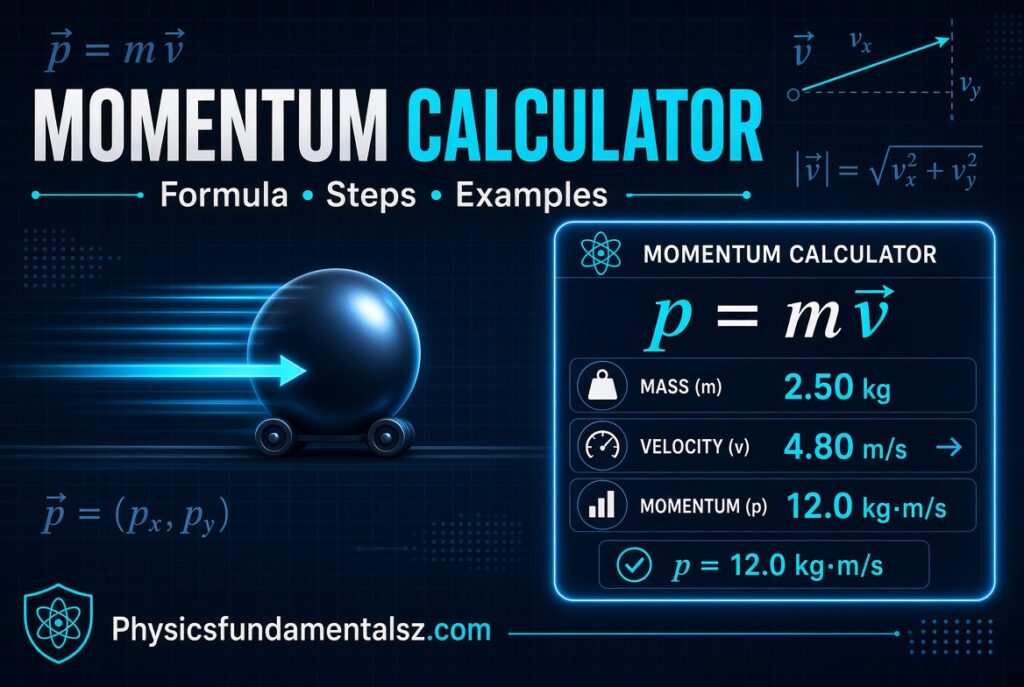
A momentum calculator physics tool solves one simple equation, p = mv, but knowing when and why to use it is what actually helps you pass a test or check real-world motion.
You will also learn how to solve backward for mass or velocity, how momentum behaves as a vector, and how it connects to impulse and collisions.
Table of Contents
What Does a Momentum Calculator Do?
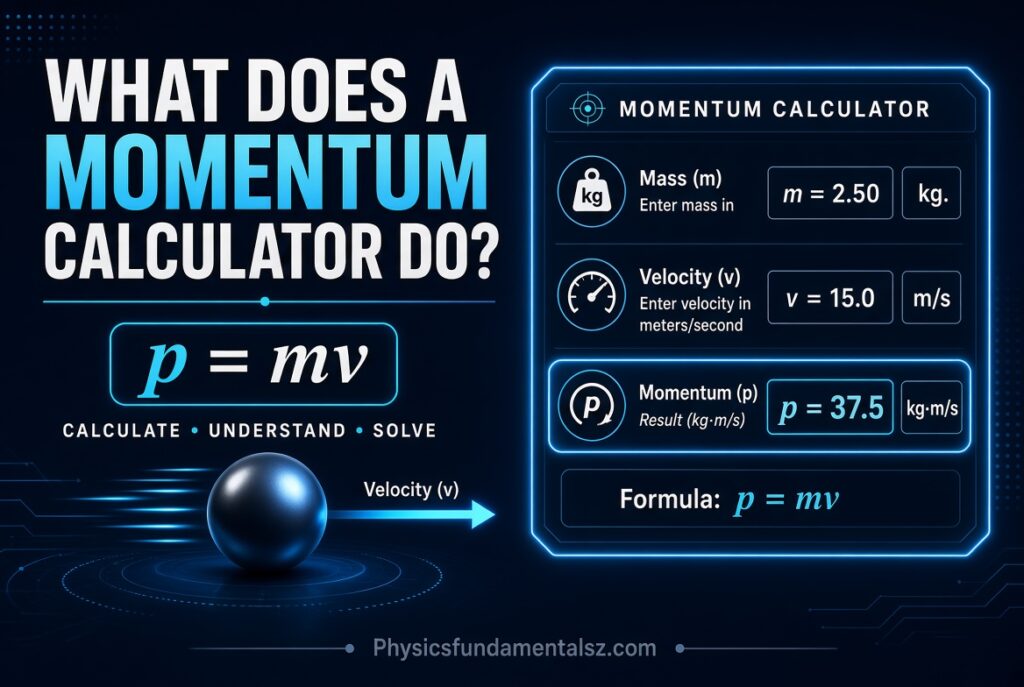
A momentum calculator multiplies an object’s mass by its velocity to find linear momentum, measured in kilogram-meters per second (kg·m/s). Enter any two of the three values (mass, velocity, or momentum) and it solves for the missing one.
Momentum is a vector, so direction matters as much as size. A positive or negative sign in your answer simply tells you which way the object is moving.
The Momentum Formula Explained
The core physics formula is:
p = m × v
- p = momentum, measured in kg·m/s
- m = mass, measured in kilograms (kg)
- v = velocity, measured in meters per second (m/s)
This equation says momentum grows with both mass and speed. A heavy truck moving slowly can carry the same momentum as a light motorcycle moving fast.
Rearranging the Formula
Sometimes you know the momentum and need to find mass or velocity instead. A momentum calculator physics tool typically rearranges the equation both ways:
- To find velocity: v = p ÷ m
- To find mass: m = p ÷ v
Any calculator worth using should let you solve for all three variables, not just momentum itself.
How to Use a Momentum Calculator Physics Tool
Using the tool takes only a few seconds once you know which two values you already have.
Step 1: Identify What You Know
Check your problem for the mass and velocity of the object. If either value is missing, look for the momentum instead paired with one of the other two.
Step 2: Enter the Values in Correct Units
Mass should be in kilograms and velocity in meters per second. Most calculators also accept other units and convert automatically, but it helps to double-check.
Step 3: Click Calculate
The tool applies p = mv (or the rearranged version) and returns the momentum, mass, or velocity depending on what you were solving for.
Step 4: Check the Sign and Units
A negative result means the object is moving in the direction you defined as negative. Always confirm your answer carries the correct kg·m/s unit.
Worked Examples of Momentum Calculations
Seeing the formula in action makes it far easier to trust your own calculations.
Example 1: Finding Momentum
A 1,200 kg car travels at 25 m/s down a straight road. Its momentum is:
p = m × v = 1,200 × 25 = 30,000 kg·m/s
Example 2: Finding Velocity
A 5 kg bowling ball has a momentum of 15 kg·m/s. Solving for velocity:
v = p ÷ m = 15 ÷ 5 = 3 m/s
Example 3: Finding Mass
An object moving at 8 m/s has a momentum of 96 kg·m/s. Solving for mass:
m = p ÷ v = 96 ÷ 8 = 12 kg
Example 4: Negative Momentum
A 2 kg ball moving left at 4 m/s (defined as negative direction) has momentum:
p = 2 × (-4) = -8 kg·m/s
The negative sign shows direction, not a smaller quantity of motion.
Momentum vs Related Physics Quantities
Momentum often gets confused with kinetic energy and velocity. This table clears up the differences.
| Quantity | Formula | Unit | Vector or Scalar |
|---|---|---|---|
| Momentum | p = mv | kg·m/s | Vector |
| Kinetic Energy | KE = ½mv² | Joules (J) | Scalar |
| Velocity | v = d/t | m/s | Vector |
| Impulse | J = FΔt | N·s (= kg·m/s) | Vector |
Momentum and kinetic energy both depend on mass and velocity, but energy scales with the square of velocity while momentum scales linearly.
Units of Momentum
The SI unit for momentum is the kilogram-meter per second (kg·m/s). This is equivalent to a newton-second (N·s), which is why impulse and momentum share the same units.
If mass is given in grams or velocity in km/h, convert to kilograms and meters per second first. Skipping unit conversion is the single most common source of wrong answers.
Momentum, Impulse, and Collisions
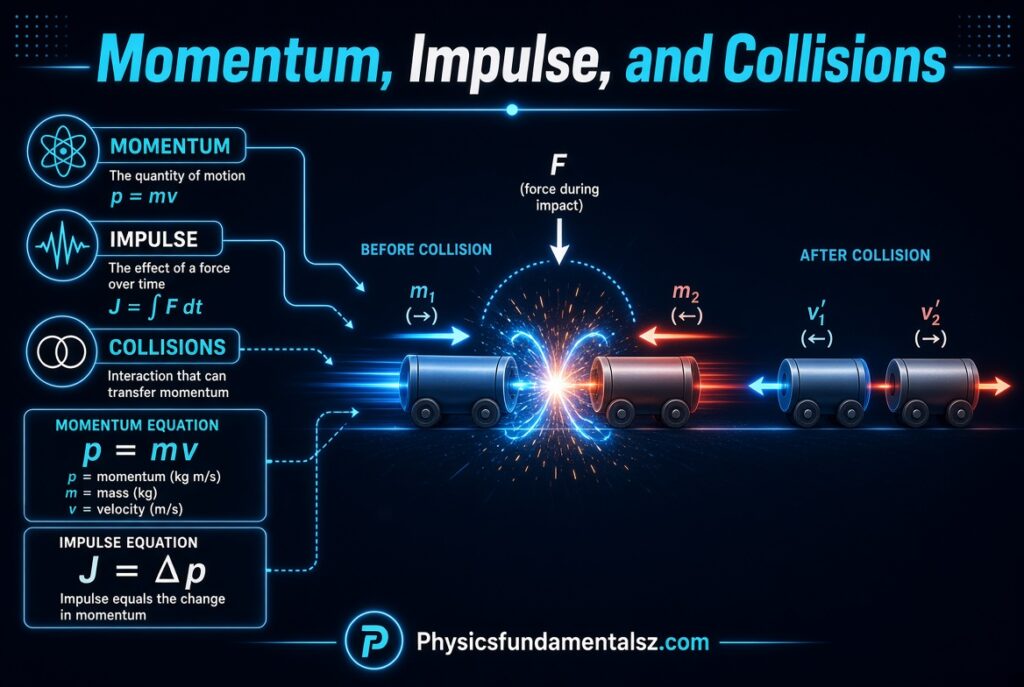
Momentum connects directly to force through the impulse-momentum theorem:
J = FΔt = Δp
This means a force applied over time changes an object’s momentum by exactly that impulse. Airbags, padded gloves, and bending your knees on landing all work by stretching Δt to reduce the force felt.
Conservation of Momentum
In any closed system with no external force, total momentum before a collision equals total momentum after it. This single rule is why physicists can predict outcomes of car crashes, billiard ball collisions, and rocket propulsion without needing every internal detail of the impact.
Elastic vs Inelastic Collisions
- Elastic collisions conserve both momentum and kinetic energy.
- Inelastic collisions conserve momentum but lose some kinetic energy to heat, sound, or deformation.
- Perfectly inelastic collisions end with both objects moving together as one mass.
Common Mistakes When Calculating Momentum
Avoiding these errors will save you the most points on homework and exams.
- Forgetting that momentum is a vector and ignoring direction or sign.
- Mixing units, such as entering velocity in km/h without converting to m/s.
- Confusing momentum with kinetic energy or force.
- Treating momentum in a multi-object system as additive without accounting for direction.
- Rounding too early in multi-step problems, which compounds small errors.
Real-World Applications of Momentum
Momentum is not just a classroom formula. Engineers, athletes, and safety designers rely on it constantly.
- Vehicle safety: Crumple zones extend collision time to lower peak force on passengers.
- Sports: A batter’s follow-through increases contact time, boosting the impulse delivered to the ball.
- Rocketry: Rockets gain forward momentum by expelling exhaust gas backward, conserving total system momentum.
- Ballistics: Recoil in a fired gun is the direct result of momentum conservation between the bullet and the firearm.
Best Practices for Using a Momentum Calculator Physics Tool

- Always convert units before entering values.
- Define a positive direction first, then apply consistent signs.
- Use the calculator to check hand calculations rather than replace understanding of the formula.
- Cross-check results against a rough estimate, such as rounding mass and velocity to simple numbers.
Also Read:
- Conservation of Momentum
- Momentum and Impulse
- Momentum and Impulse Collisions: Conservation Laws & Examples
- Angular Momentum
- Newton’s Laws of Motion
- Kinetic Energy
- Net Force: Definition, Formula & Newton’s Second Law Applied
- Work Done in Physics
- Power in Physics
- Mechanical Energy: KE + PE, Conservation & Energy Transformations
- Potential Energy: Gravitational, Elastic & Electric Forms Explained
- Torque in Physics
- Circular Motion and Centripetal Force
- Friction Force Explained
- Hooke’s Law and Springs
- Simple Harmonic Motion
- Projectile Motion: Complete Guide
- Projectile Motion Calculator With Angle: Formulas & Worked Examples
- Projectile Motion Range: R = v²sin2θ/g & Optimum Angle 45°
- Vectors and Scalars: Definitions, Examples & Vector Addition
- Acceleration in Physics
- Velocity vs Speed
- Free Fall and Terminal Velocity
- Escape Velocity: Formula, Derivation & Worked Examples
Frequently Asked Questions (FAQs)
What is momentum in physics?
Momentum is the product of an object’s mass and velocity, written as p = mv. It measures how hard it is to stop a moving object.
What is the formula for a momentum calculator?
The formula is p = m × v, where p is momentum in kg·m/s, m is mass in kilograms, and v is velocity in meters per second.
What units does momentum use?
Momentum is measured in kilogram-meters per second (kg·m/s), which is equivalent to a newton-second (N·s).
Is momentum a vector or scalar quantity?
Momentum is a vector quantity. It has both magnitude and direction, so the sign of your answer matters.
How do you calculate momentum with only velocity?
You cannot calculate momentum with velocity alone. You always need mass as well, since p = mv requires both values.
Can momentum be negative?
Yes. A negative momentum simply shows the object is moving in the direction you defined as negative, not that it has less motion.
What is the difference between momentum and force?
Force causes a change in momentum over time. Momentum itself describes an object’s current quantity of motion.
What is the difference between momentum and impulse?
Impulse is the change in momentum caused by a force acting over time, expressed as J = FΔt. Momentum is the quantity being changed.
How is momentum related to kinetic energy?
Both depend on mass and velocity, but kinetic energy uses velocity squared (KE = ½mv²) while momentum uses velocity to the first power.
What is the law of conservation of momentum?
It states that the total momentum of a closed system stays constant unless an external force acts on it, both before and after a collision.
How do you find mass using a momentum calculator?
Rearrange the formula to m = p ÷ v, then enter the known momentum and velocity into the calculator.
How do you find velocity using a momentum calculator?
Rearrange the formula to v = p ÷ m, then enter the known momentum and mass into the calculator.
What is an example of high momentum?
A loaded freight train moving at even a modest speed has extremely high momentum because of its enormous mass.
Does a heavier object always have more momentum?
Not necessarily. Momentum depends on both mass and velocity, so a lighter but faster object can have more momentum than a heavier, slower one.
What is angular momentum and how does it differ from linear momentum?
Angular momentum applies to rotating objects and depends on moment of inertia and angular velocity, while linear momentum applies to objects moving in a straight line.
Why do airbags reduce injury using momentum principles?
Airbags extend the time over which a passenger’s momentum changes, which lowers the force experienced during a crash.
What happens to momentum in an elastic collision?
Both momentum and kinetic energy are conserved, meaning no energy is lost to heat, sound, or deformation.
What happens to momentum in an inelastic collision?
Momentum is still conserved, but some kinetic energy converts into heat, sound, or deformation of the objects involved.
Can you use a momentum calculator for 2D motion?
Yes, advanced calculators split momentum into x and y components and calculate each direction separately before combining them.
Why does recoil happen when a gun is fired?
Recoil is a direct result of momentum conservation. The bullet gains forward momentum while the gun gains equal and opposite backward momentum.
Is momentum conserved in an explosion?
Yes. Even though an object separates into pieces, the total momentum of all fragments equals the original momentum before the explosion.
What is the SI unit symbol for momentum?
Momentum does not have its own named unit, so it is expressed directly as kg·m/s.
How accurate are online momentum calculators?
They are accurate as long as correct units are entered, since the tool simply applies the standard p = mv formula without rounding errors.
Why is momentum important in real life?
Momentum explains vehicle safety design, sports techniques, rocket propulsion, and any situation involving moving objects and collisions.
Conclusion
A momentum calculator physics tool turns the simple equation p = mv into instant, reliable answers, but the real value comes from understanding what those numbers mean. Once you know how mass, velocity, and direction interact, you can solve for any missing variable with confidence.
Keep the formula, its rearranged forms, and the idea of conservation of momentum close at hand, and you will handle everything from textbook problems to real-world motion scenarios with ease.