Projectile Motion Range: R = v²sin2θ/g & Optimum Angle 45°
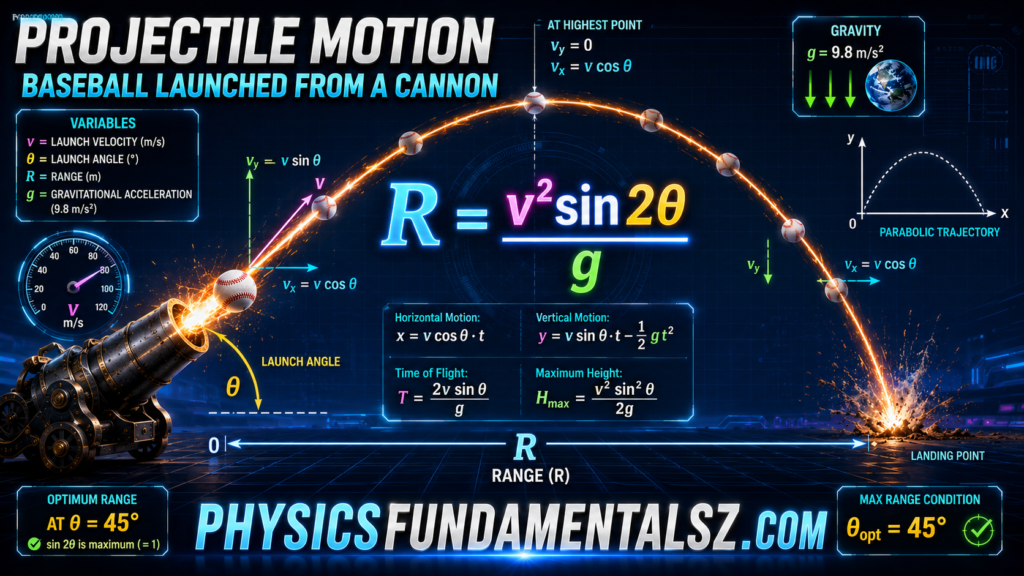
Projectile motion range is the horizontal distance a projectile covers from its launch point to the point where it lands at the same height. It depends on three factors only: initial velocity, angle of projection, and gravity.
Understanding this concept is essential for solving problems in kinematics, sports physics, and ballistics.
Table of Contents
What Is Projectile Motion Range?
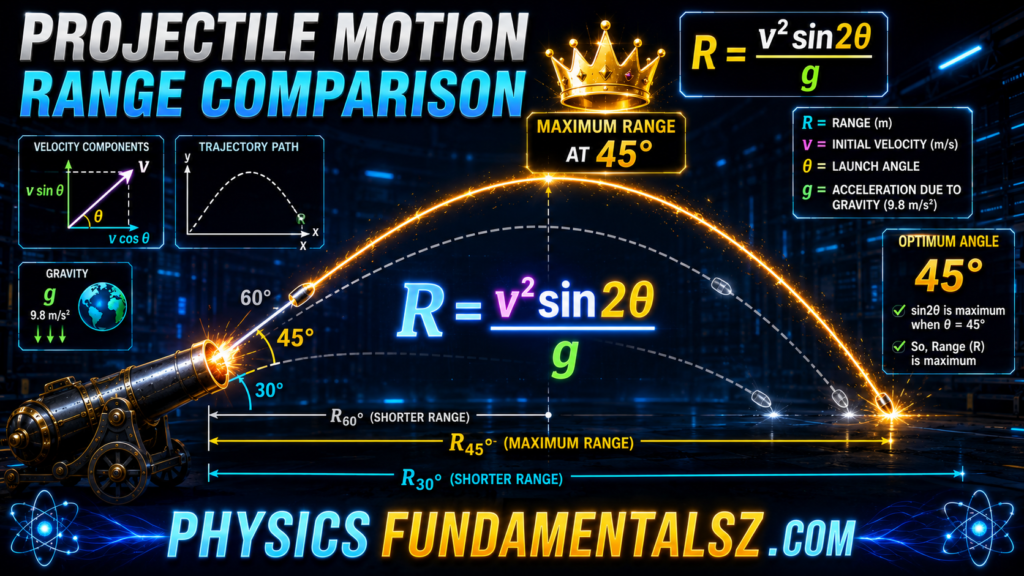
The range of a projectile is simply how far it travels horizontally before it returns to its starting height. It is one of the three key outputs of projectile motion, along with maximum height and time of flight.
If you are new to the topic, our full breakdown of projectile motion basics explains how horizontal and vertical motion work independently of each other.
Since gravity only acts in the vertical direction, horizontal velocity stays constant throughout the flight. This constant horizontal speed, combined with the total time in the air, is what determines the range.
Projectile Motion Range Formula
The standard formula used to calculate horizontal range is:
R = u² sin(2θ) / g
Where R is the range, u is the initial velocity, θ is the angle of projection, and g is the acceleration due to gravity.
Variables in the Range Formula
Each variable in the formula plays a specific role in determining the final distance.
| Symbol | Meaning | Common Unit |
|---|---|---|
| R | Horizontal range | meters (m) |
| u | Initial velocity | m/s |
| θ | Angle of projection | degrees or radians |
| g | Acceleration due to gravity | 9.8 m/s² |
For a deeper look at how velocity splits into components, check our guide on the angle of projection and how it affects trajectory shape.
How to Derive the Range of Projectile Motion
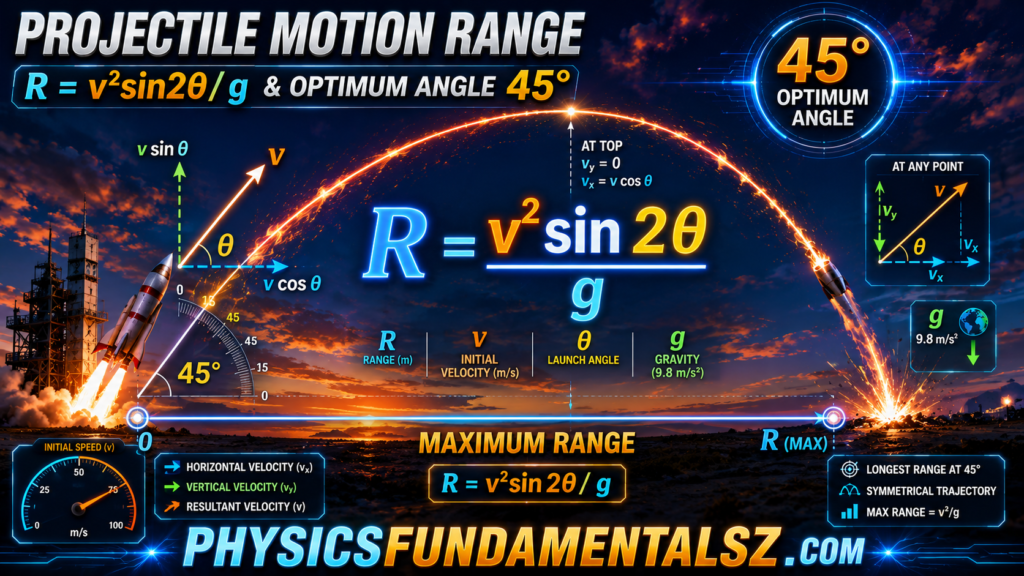
The range formula is not arbitrary. It comes directly from combining horizontal displacement with the total time of flight.
Step 1: Split Initial Velocity
The initial velocity u is split into two components using basic trigonometry. The horizontal component is u cos θ, and the vertical component is u sin θ.
This step connects directly with the kinematics equations used across all motion problems, not just projectiles.
Step 2: Find Time of Flight
Time of flight is the total time the projectile stays in the air. Since vertical motion is symmetrical, the formula is:
T = 2u sin θ / g
You can find a full worked explanation of this in our article on the time of flight formula.
Step 3: Calculate Horizontal Range
Once time of flight is known, horizontal range is found using distance equals speed multiplied by time:
R = (u cos θ) × T = (u cos θ) × (2u sin θ / g)
Simplifying this using the identity 2 sin θ cos θ = sin 2θ gives the final formula:
R = u² sin(2θ) / g
This derivation is closely tied to the trajectory equation, which maps the full parabolic path of the object.
Maximum Range and the 45 Degree Angle
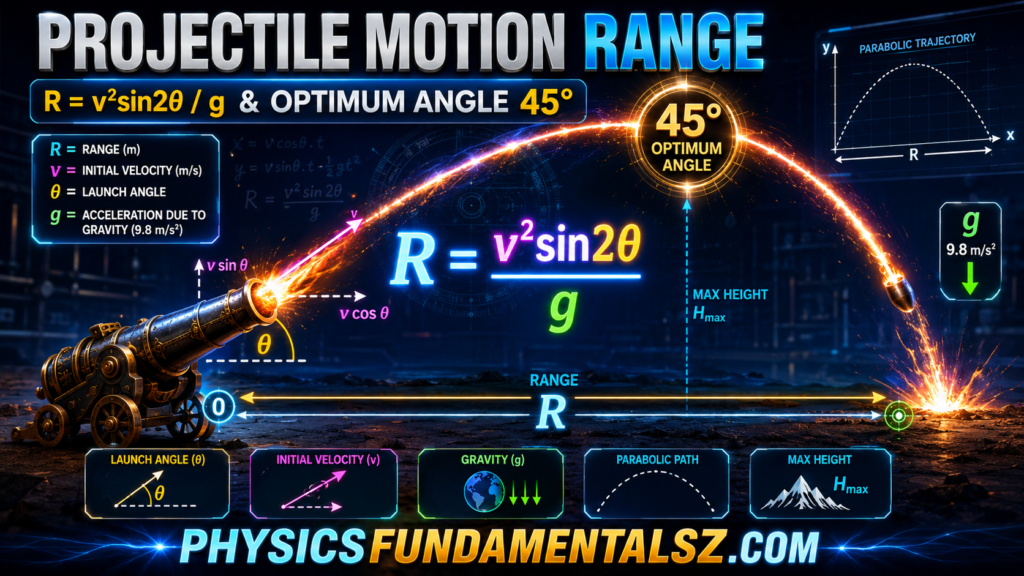
The horizontal range depends heavily on the launch angle. Since sin(2θ) reaches its highest value of 1 when 2θ equals 90 degrees, maximum range always occurs at a 45 degree launch angle.
At 90 degrees, the projectile goes straight up and range becomes zero. At 0 degrees, there is no vertical lift and range is also zero.
Interestingly, two different angles that add up to 90 degrees, such as 30 and 60 degrees, produce the same range. This is a common exam question tied to the maximum height formula.
Range Table: Angle vs Horizontal Range
To make this easier to visualize, here is how range changes with angle when initial velocity is fixed at 30 m/s and g is 9.8 m/s².
| Angle (θ) | sin(2θ) | Approximate Range (m) |
|---|---|---|
| 15° | 0.50 | 45.9 |
| 30° | 0.87 | 79.6 |
| 45° | 1.00 | 91.8 |
| 60° | 0.87 | 79.6 |
| 75° | 0.50 | 45.9 |
| 90° | 0.00 | 0.0 |
Notice the symmetry between 15/75 and 30/60. This pattern holds true for every velocity value, not just this example.
Projectile Motion Range from a Height
Not every projectile launches from ground level. When an object is thrown from a height, such as a cliff or a building, the range formula changes slightly because the object spends more time in the air.
In this case, you cannot use the simple R = u² sin(2θ) / g formula directly. Instead, you must first calculate the total time of flight using the quadratic equation for vertical displacement, then multiply it by the horizontal velocity component.
This scenario is common in real exam problems and is explained in more detail alongside projectile motion on inclined and elevated surfaces on our main projectile motion page.
Real World Applications of Projectile Range
Understanding projectile range is not just an academic exercise. It applies directly to several real world fields.
Sports like javelin, shot put, and basketball rely on optimizing launch angle for maximum distance or accuracy. Athletes and coaches use these same physics principles, often without realizing it.
Military and ballistics engineering use range calculations to predict artillery and missile trajectories. Even video game developers use these formulas to simulate realistic projectile physics.
Common Mistakes When Calculating Range
Students often make small errors that lead to incorrect range values. Being aware of these mistakes can save a lot of confusion during problem solving.
| Mistake | Why It Happens | Fix |
|---|---|---|
| Using degrees in calculator set to radians | Calculator mode mismatch | Always check angle mode first |
| Forgetting to double the angle | Confusing θ with 2θ in sin | Apply sin(2θ), not sin(θ) |
| Ignoring launch height | Assuming ground level launch | Use adjusted time of flight formula |
| Mixing units | Combining m/s with km/h | Convert all values to SI units first |
Avoiding these errors ensures your range calculations match textbook and exam answer keys.
Frequently Asked Questions (FAQs)
1. What is the formula for projectile motion range?
The standard formula is R = u² sin(2θ) / g. It applies when the projectile launches and lands at the same height.
2. At what angle is projectile range maximum?
Maximum range occurs at a 45 degree launch angle. This is because sin(2θ) equals 1 when θ is 45 degrees.
3. Does mass affect projectile range?
No, mass does not affect range in ideal projectile motion. Only velocity, angle, and gravity determine the outcome.
4. Why do 30 and 60 degree angles give the same range?
Because sin(2θ) produces equal values for complementary angles that add up to 90 degrees. This creates matching range results.
5. How does launch height affect range?
Launching from a height increases time of flight, which increases horizontal range. The standard ground level formula no longer applies directly.
6. What is the range at a 90 degree launch angle?
The range is zero at 90 degrees. The projectile moves straight up and comes straight back down.
7. How is time of flight related to range?
Range is calculated by multiplying horizontal velocity by total time of flight. Longer flight times generally increase range.
8. Is air resistance included in the range formula?
No, the standard formula assumes no air resistance. Real world range is usually shorter due to drag.
9. Can two different angles give the same range?
Yes, any two angles that are complementary, such as 20 and 70 degrees, produce identical range values. This only applies to ground level launches.
10. What units are used for projectile range?
Range is typically measured in meters (m) in SI units. In imperial systems, it may be measured in feet.
Conclusion
Projectile motion range depends on three simple factors: initial velocity, launch angle, and gravity. The formula R = u² sin(2θ) / g works reliably for any object launched and landing at the same height, while elevated launches require an adjusted approach using full time of flight calculations.
Maximum range always occurs at a 45 degree angle, and complementary angles produce matching results, a pattern that shows up constantly in physics problems and real world applications like sports and ballistics.
Once you understand how horizontal and vertical motion work independently, calculating range becomes a straightforward process rather than a memorization exercise. For a complete picture of how range connects to trajectory, time of flight, and maximum height, explore the related topics linked throughout this guide.