Power in Physics
Lifting a heavy box onto a shelf takes the same amount of work whether you do it slowly or quickly. What changes is the power: how rapidly that work is done. Power is one of the most practical quantities in physics, because the real world cares deeply about timing, not just totals.
Defining power
Power is the rate at which work is done, or equivalently the rate at which energy is transferred or transformed. If you do an amount of work W in a time t, the average power is:
The SI unit of power is the watt (W), named after James Watt. One watt is one joule per second. A 60-watt light bulb converts 60 joules of electrical energy into light and heat every second. A kettle might draw 2000 watts, and a small car engine can deliver tens of thousands of watts.
Work, energy, and the link to power
Power only makes sense alongside work and energy. Work is force applied over a distance, and it equals the energy transferred. Since power is work divided by time, it tells you how quickly energy moves through a system. A powerful machine is not one that does more total work; it is one that does work faster. For the underlying ideas, see kinetic energy and the work-energy theorem.
Two athletes who climb the same staircase do identical work against gravity. The faster one is more powerful, because power measures the rate of doing work, not the amount.
Power, force, and velocity
There is a second, very useful way to express power. If a constant force F pushes an object moving at velocity v, then because work is force times distance and velocity is distance over time, the power becomes:
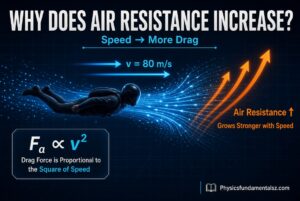
This formula explains a lot about vehicles. At a steady highway speed, the engine power simply overcomes drag and friction. To go faster, drag rises sharply, so far more power is needed for a small gain in top speed. It also explains why a car has more pulling force in low gear: at lower speed, the same engine power delivers a larger force.
Instantaneous versus average power
The formula P = W/t gives the average power over a stretch of time. But power often varies moment to moment, surging during acceleration and easing during cruising. The instantaneous power is the power at a single instant, found in calculus as the derivative of energy with respect to time. For most everyday estimates, average power is all you need.
Horsepower and other units
Engineers and the public often use units other than the watt.
- Horsepower (hp): One mechanical horsepower equals about 746 watts, originally defined by Watt to compare engines with draught horses.
- Kilowatt (kW): 1000 watts, common for appliances and electric motors.
- Kilowatt-hour (kWh): This is a unit of energy, not power. It is the energy used by a one-kilowatt device running for one hour, equal to 3.6 million joules, and it is what your electricity meter counts.
Efficiency: power in versus power out
No machine delivers all the power it consumes as useful output. Some is always lost, usually as heat from friction or electrical resistance. Efficiency is the ratio of useful output power to total input power:
A typical petrol engine is only about 25 to 35 percent efficient, while a large electric motor can exceed 90 percent. Improving efficiency means getting the same useful work from less input energy, which saves fuel and money and reduces waste heat.
Frequently asked questions
What is the difference between work and power?
Work is the total energy transferred when a force moves an object. Power is how fast that work is done. You can do the same work with low power over a long time or high power over a short time.
Why is a kilowatt-hour a unit of energy, not power?
Because it multiplies power by time. Power times time equals energy, so a kilowatt sustained for an hour is a fixed amount of energy, three point six million joules, regardless of how the hour was spent.
Can power be negative?
Yes, in the sense of direction. If a force opposes motion, such as brakes slowing a car, the power is negative because energy is being removed from the object’s motion rather than added to it.