Mechanical Energy: KE + PE, Conservation & Energy Transformations
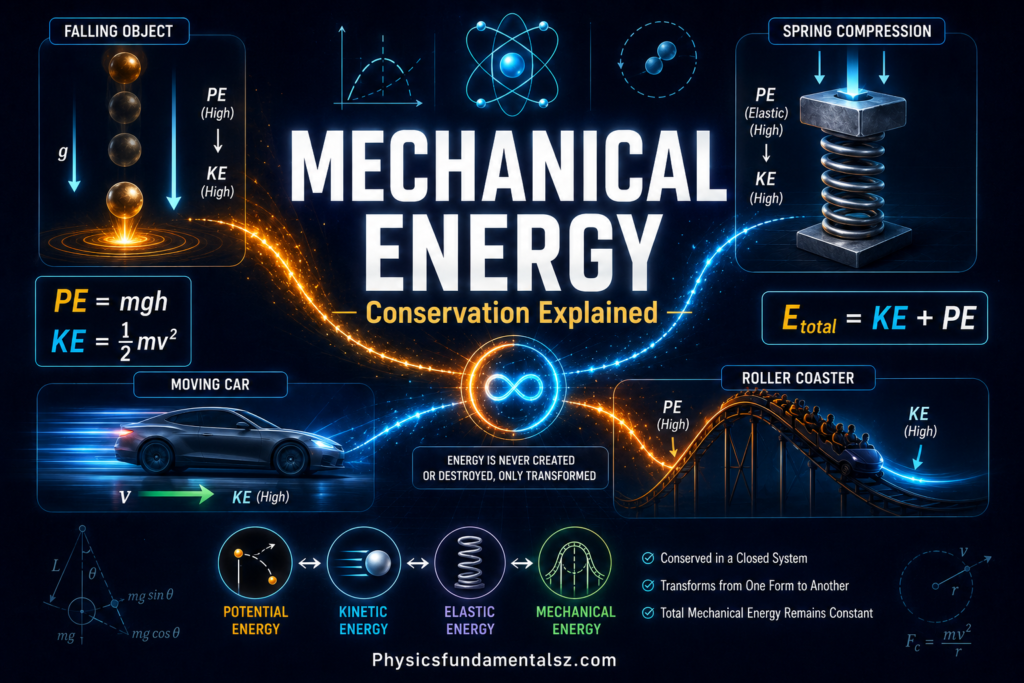
Mechanical energy is one of the first ideas that ties motion and position together into a single, usable number.
Every time a ball rolls down a hill, a pendulum swings, or a roller coaster climbs and drops, mechanical energy is quietly shifting between two forms while its total stays the same.
Understanding mechanical energy gives you a shortcut for solving motion problems without tracking every force at every instant.
Before going further, it helps to be comfortable with the basics covered in our guide on What Is Energy?, since mechanical energy is really just one specific category within that broader concept.
Table of Contents
What Is Mechanical Energy?
Mechanical energy is the energy an object possesses because of its motion, its position, or both. It is defined as the sum of two forms of energy: kinetic energy, the energy of motion, and potential energy, the stored energy of position.
Any object that has mechanical energy is capable of doing work, since it can apply a force to another object and cause it to move.
A moving car has mechanical energy because it is in motion. A book resting on a high shelf has mechanical energy because of its position above the ground.
A baseball flying through the air has mechanical energy from both its speed and its height at the same time. This dual nature is what makes mechanical energy such a useful quantity across kinematics, dynamics, and engineering.
Mechanical Energy Formula
The mechanical energy formula is written as:
ME = KE + PE
Where ME is total mechanical energy, KE is kinetic energy, and PE is potential energy, all measured in joules (J), the standard SI unit of energy.
Expanded using the individual formulas for kinetic and gravitational potential energy, this becomes:
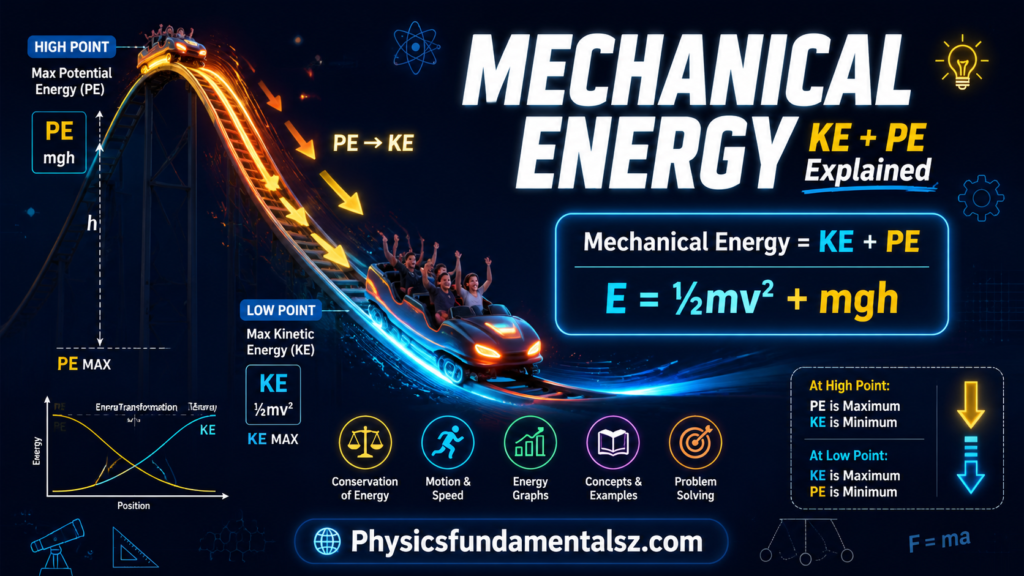
ME = ½mv² + mgh
Where m is mass in kilograms, v is velocity in meters per second, g is the acceleration due to gravity (9.8 m/s² near Earth’s surface), and h is height above a chosen reference point.
Kinetic Energy: The Energy of Motion
Kinetic energy is the portion of mechanical energy that comes from an object’s motion. The formula for kinetic energy is:
KE = ½mv²
Because velocity is squared in this equation, doubling an object’s speed quadruples its kinetic energy, not just doubles it. This is why small increases in speed cause large increases in stopping distance and impact force, a concept explored in more depth in our dedicated guide to Kinetic Energy.
Potential Energy: The Energy of Position
Potential energy is the portion of mechanical energy that comes from an object’s position or configuration rather than its motion. The most common type covered in introductory mechanics is gravitational potential energy:
PE = mgh
A rock sitting at the top of a hill has gravitational potential energy because of its height relative to the ground. It has not done any work yet, but it has the capacity to do work once it starts moving. Other types of potential energy exist as well, including elastic potential energy stored in a stretched spring and electric potential energy associated with charged objects, but gravitational potential energy is the form most closely tied to everyday mechanical energy problems.
The Law of Conservation of Mechanical Energy
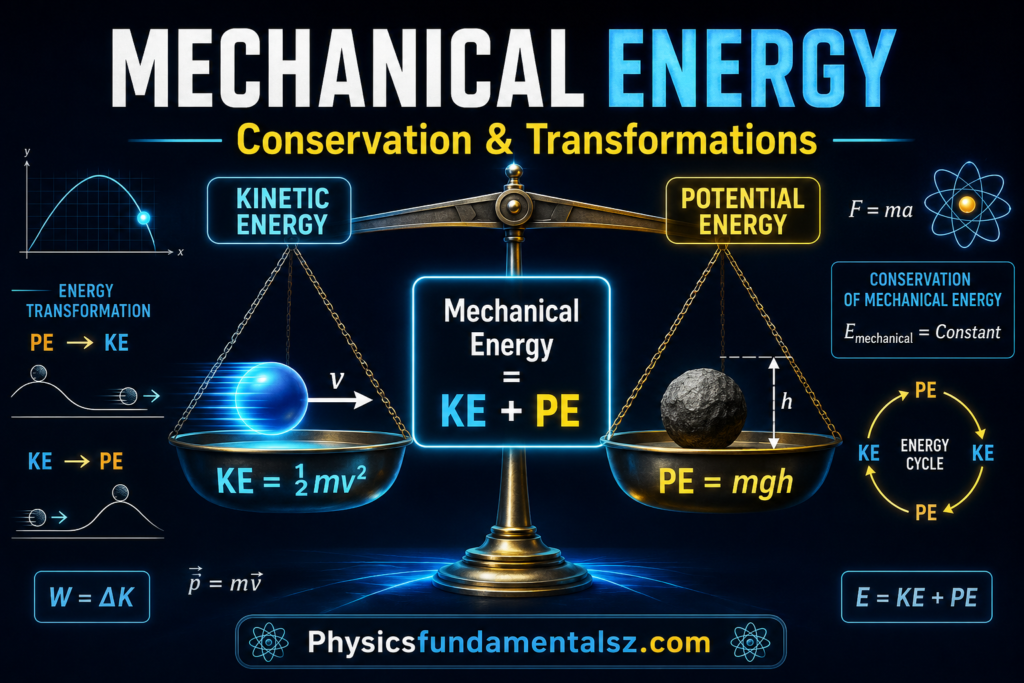
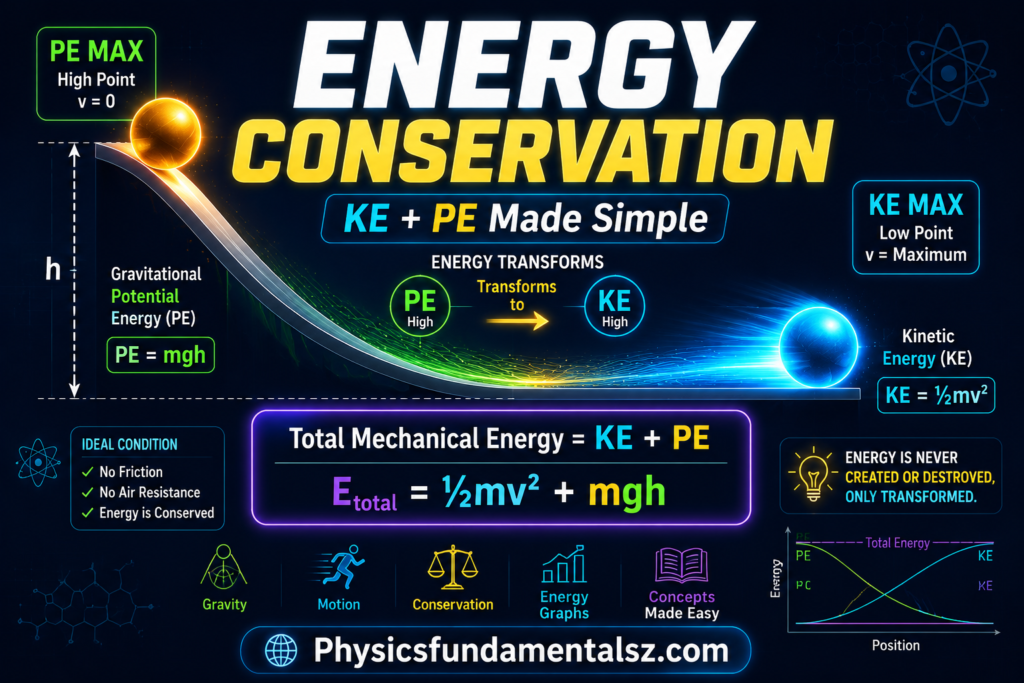
The law of conservation of mechanical energy states that in an isolated system where only conservative forces act, such as gravity, the total mechanical energy remains constant. As an object loses potential energy, it gains an equal amount of kinetic energy, and vice versa, so the sum never changes.
ME (initial) = ME (final)
KE₁ + PE₁ = KE₂ + PE₂
This principle is a direct extension of the broader law described in our article on Conservation of Momentum, since both laws describe quantities that stay constant in an isolated system as long as no external or non conservative forces interfere.
Conservative Forces vs Non Conservative Forces
Conservative forces, like gravity and the elastic force in an ideal spring, do work that depends only on an object’s initial and final position, not on the path taken. When only conservative forces act on a system, mechanical energy is perfectly conserved.
Non conservative forces, such as friction and air resistance, remove mechanical energy from a system and convert it into heat or sound. This is why mechanical energy is only approximately conserved in most real situations, and perfectly conserved only in idealized, frictionless scenarios used in textbook problems.
Worked Example: The Pendulum
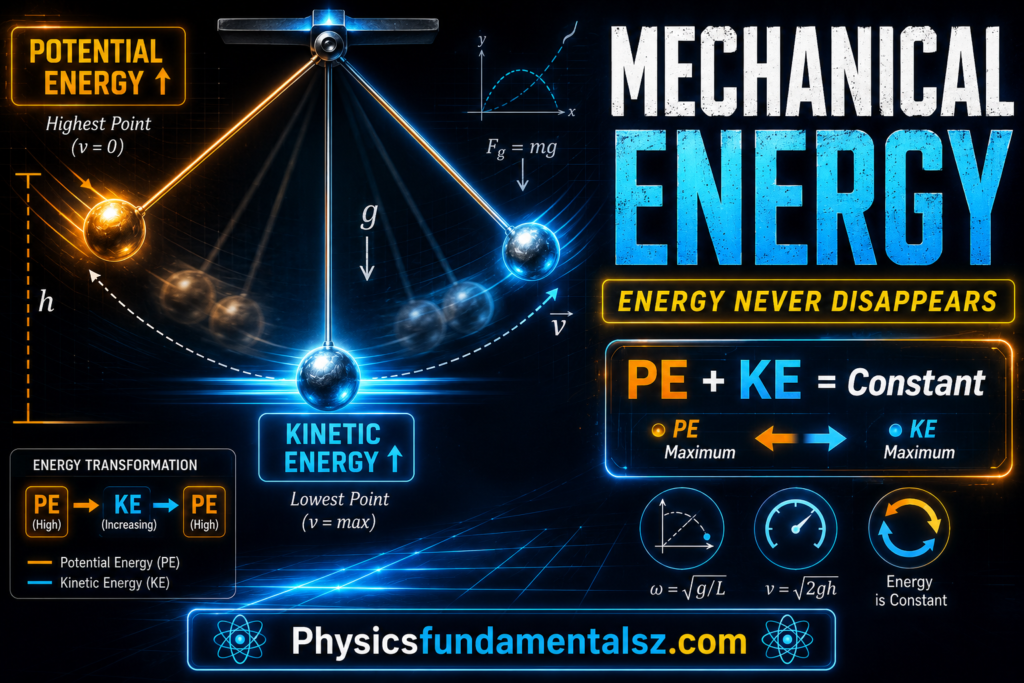
A swinging pendulum is one of the clearest demonstrations of mechanical energy conservation. At the highest point of its swing, the pendulum momentarily stops moving, so all of its mechanical energy is potential energy. At the lowest point of its swing, the pendulum is at its minimum height but moving at its maximum speed, so all of its mechanical energy is kinetic energy.
At the top of the swing: ME = PE (maximum) + KE (zero)
At the bottom of the swing: ME = KE (maximum) + PE (minimum)
Because only gravity acts on an ideal pendulum, neglecting air resistance and friction at the pivot, its total mechanical energy stays constant throughout the motion, even though the split between kinetic and potential energy changes continuously. For a full mathematical treatment of this motion, including the time period formula, see our guide on the Simple Pendulum.
Worked Example: A Falling Object
Consider a 2 kg object dropped from a height of 10 meters, with air resistance ignored.
Step 1: Calculate the initial mechanical energy, which is entirely potential energy since the object starts at rest. PE = mgh = (2)(9.8)(10) = 196 J ME (initial) = 196 J
Step 2: Since mechanical energy is conserved, the total energy remains 196 J at every point during the fall.
Step 3: Find the velocity just before the object hits the ground, where all mechanical energy has converted to kinetic energy. KE = ½mv² = 196 J v² = 196 / (0.5 × 2) = 196 v = 14 m/s
This example shows how the mechanical energy formula lets you solve for a final velocity without ever calculating acceleration or time directly, a technique closely related to the Work-Energy Theorem.
Elastic Potential Energy and Springs
Gravitational potential energy is not the only form that contributes to mechanical energy. When a spring is stretched or compressed, it stores elastic potential energy, which is calculated using the formula:
PE (elastic) = ½kx²
Where k is the spring constant, measured in newtons per meter, and x is the displacement from the spring’s natural, unstretched length. A drawn bow, a compressed spring in a pogo stick, and a stretched bungee cord all store mechanical energy in this elastic form rather than in gravitational form.
For a system involving a spring, the total mechanical energy formula expands further:
ME = ½mv² + mgh + ½kx²
This version of the equation is essential for analyzing systems like spring loaded launchers, vertical oscillators, and any device where an elastic component interacts with gravity. Just as with gravitational potential energy, elastic potential energy converts into kinetic energy as the spring releases its stored energy, and the total mechanical energy of the system remains constant as long as the spring behaves ideally and no energy is lost to internal friction within the material.
How Mechanical Energy Relates to Work
Mechanical energy and work are closely connected concepts. Work is defined as the transfer of energy that occurs when a force causes an object to move through a distance. Whenever work is done on an object by an external force, the object’s mechanical energy changes by an amount equal to that work.
W = ΔME = ME (final) − ME (initial)
This relationship is what allows engineers and physicists to calculate how much energy a machine must supply to lift an object, launch a projectile, or accelerate a vehicle to a target speed. It also explains why lifting a heavy object to a greater height requires more work, since the change in gravitational potential energy increases directly with height. The connection between force, work, and energy is explored in complete detail in our guide to the Work-Energy Theorem, which derives this relationship starting from Newton’s second law.
Mechanical Energy in Simple Machines
Simple machines such as levers, pulleys, and inclined planes do not create energy. Instead, they redistribute the mechanical energy already present in a system, trading force for distance or distance for force while keeping the total work done approximately constant, aside from small losses to friction.
An inclined plane, for example, allows a person to raise an object to the same final height using less force than lifting it straight up, but the object must travel a longer distance along the ramp. The final gravitational potential energy gained by the object is identical either way, since potential energy depends only on height, not on the path taken to reach it. This principle connects directly to the ideas of force and motion introduced in Newton’s Laws of Motion.
Mechanical Energy in Everyday Life
Roller Coasters
A roller coaster car at the top of the first hill has maximum potential energy and minimal kinetic energy. As it descends, potential energy converts into kinetic energy, which is why the car reaches its highest speed at the lowest point of the track. Small losses from friction and air resistance mean each successive hill must be slightly lower than the one before it, since some mechanical energy is lost as heat along the way.
Hydropower and Wind Energy
Mechanical energy is also central to renewable energy generation. Falling water in a dam converts gravitational potential energy into kinetic energy, which then spins a turbine connected to a generator. Wind turbines work similarly, converting the kinetic energy of moving air into rotational mechanical energy, then into electrical energy.
Sports and Machines
A weightlifter raising a barbell above their head increases the barbell’s potential energy through the work they perform. A drawn bow stores elastic potential energy that converts almost entirely into the kinetic energy of the arrow the instant it is released. A hammer swung toward a nail converts its potential energy into kinetic energy on the way down, then transfers that energy to the nail on impact, driving it into a board.
Mechanical Energy vs Total Energy
It is important not to confuse mechanical energy with the total energy of a system. Mechanical energy specifically refers to kinetic energy plus potential energy due to position. Other forms of energy, such as thermal energy, chemical energy, nuclear energy, and electrical energy, are not part of mechanical energy, even though the total energy of an isolated system, including all these forms, is always conserved according to the broader law of conservation of energy.
When friction converts some mechanical energy into heat, mechanical energy decreases, but the total energy of the system, mechanical plus thermal, remains unchanged. This distinction is one of the most commonly misunderstood points in introductory physics.
Common Mistakes Students Make
- Forgetting that mechanical energy includes both kinetic and potential energy, not just one or the other. Many students only track motion and forget the stored energy of position.
- Assuming mechanical energy is always conserved. It is only conserved when non conservative forces like friction and air resistance are negligible or explicitly ignored.
- Confusing mechanical energy with total energy. Mechanical energy can decrease in a real system even though the total energy, including heat, never disappears.
- Choosing an inconsistent reference height for potential energy calculations. Since potential energy depends on height relative to a reference point, switching reference points midway through a problem produces incorrect results.
- Forgetting that kinetic energy depends on the square of velocity. A common error is treating kinetic energy as directly proportional to speed rather than proportional to speed squared.
Frequently Asked Questions (FAQs)
What is mechanical energy in simple terms?
Mechanical energy is the energy an object has because it is moving, because of its position, or both. It is the sum of kinetic energy and potential energy.
Is mechanical energy always conserved?
Mechanical energy is conserved only in an isolated system where solely conservative forces, such as gravity, act on the object. If friction, air resistance, or other non conservative forces are present, mechanical energy decreases as it converts into heat or sound.
What is the difference between mechanical energy and kinetic energy?
Kinetic energy is only the energy of motion. Mechanical energy is a broader quantity that includes both kinetic energy and potential energy combined.
What is the SI unit of mechanical energy?
Mechanical energy is measured in joules (J), the same SI unit used for kinetic energy, potential energy, work, and all other forms of energy.
Can mechanical energy be negative?
Kinetic energy can never be negative since it depends on velocity squared, but potential energy can be negative depending on the chosen reference point. Because of this, total mechanical energy can be a negative value in some coordinate systems, even though this does not indicate a physically meaningless result.
Conclusion
Mechanical energy ties together two of the most fundamental physics concepts, kinetic energy and potential energy, into a single conserved quantity whenever only conservative forces are at play.
Whether you are analyzing a swinging pendulum, a falling object, a roller coaster, or a hydropower plant, the same core formula, ME = KE + PE, lets you solve for unknown velocities, heights, and energy transformations without tracking every force in detail.
To build a complete picture of how mechanical energy fits into the wider study of motion and energy, continue with our guides on What Is Energy?, Kinetic Energy, and the Work-Energy Theorem to see how these ideas connect across the rest of classical mechanics.