Simple Pendulum: Definition, Formula, Time Period, and Derivation
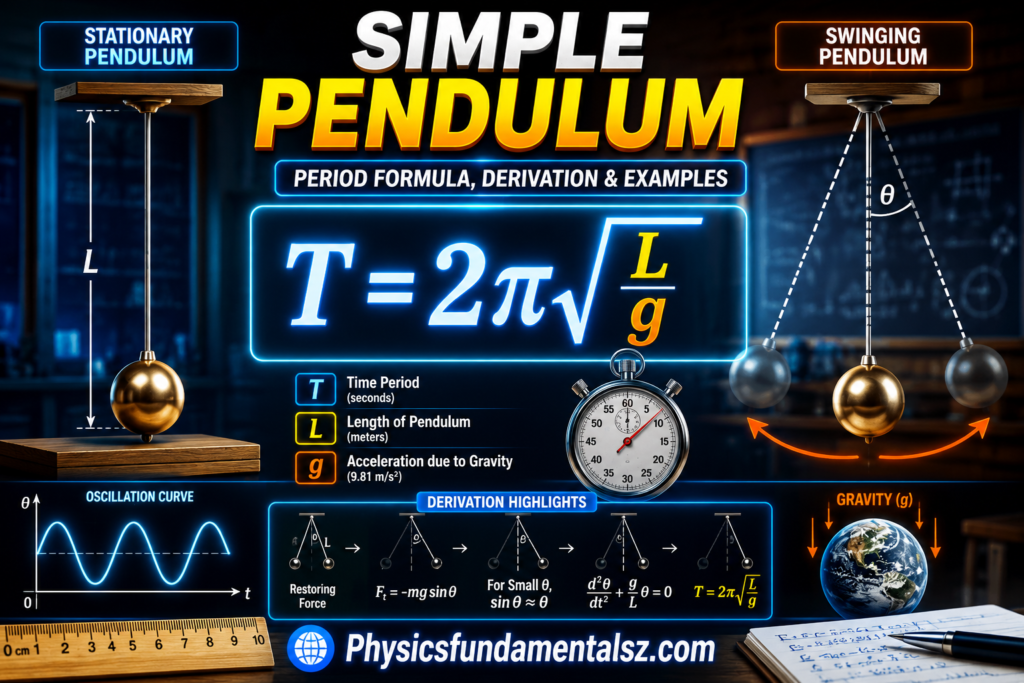
A simple pendulum is one of the oldest and most elegant demonstrations in classical mechanics, and it still forms the backbone of how physics students learn oscillatory motion.
From clock towers to laboratory experiments that measure the acceleration due to gravity, the simple pendulum shows up everywhere because its motion follows a remarkably clean mathematical rule.
If you have not yet covered the broader pattern behind repetitive motion, it helps to start with Simple Harmonic Motion, since a simple pendulum is one of the clearest real-world examples of that concept in action.
Table of Contents
What Is a Simple Pendulum?

A simple pendulum is defined as a point mass, called the bob, suspended from a fixed support by a light, inextensible string or rod. The string is assumed to have no mass of its own, and the bob is treated as a single point rather than an object with size or shape.
When the bob is pulled to one side and released, it swings back and forth in a vertical plane under the influence of gravity. This back-and-forth swinging motion is what physicists call oscillation, and for small angles it closely matches simple harmonic motion.
Key Assumptions of an Ideal Simple Pendulum
To keep the mathematics manageable, a simple pendulum model relies on a few idealized assumptions:
- The string or rod is massless and does not stretch.
- The bob is a point mass with negligible size.
- Air resistance and friction at the pivot are ignored.
- The angular displacement from the vertical is small, generally under about fifteen degrees.
Real pendulums never fully satisfy these conditions, but the approximation is accurate enough for most classroom and laboratory purposes.
The Restoring Force in a Simple Pendulum
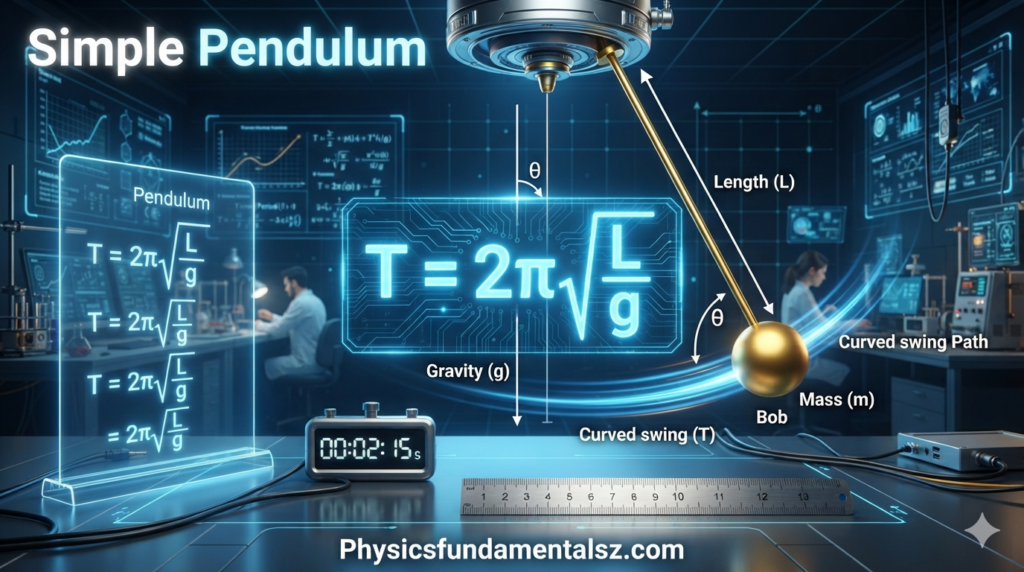
Every oscillating system needs a restoring force, a force that always pushes the object back toward its equilibrium position. In a simple pendulum, gravity provides this restoring force.
When the bob is displaced by an angle theta from the vertical, the weight of the bob can be split into two components: one along the string, which is balanced by tension, and one perpendicular to the string, which pulls the bob back toward the lowest point. This perpendicular component is given by:
Restoring Force = -mg sin(θ)
The negative sign shows that the force always acts opposite to the direction of displacement, which is exactly what makes the bob swing back rather than fly off in a straight line. This is the same restoring force principle you will recognize from Hooke’s Law and Springs, where a stretched spring pulls back toward its natural length.
The Small Angle Approximation
For angles less than about fifteen degrees, sin(θ) is very close in value to θ itself when θ is measured in radians. This is called the small angle approximation, and it transforms the pendulum’s motion into a simple harmonic oscillator with a clean, solvable equation.
Under this approximation, the restoring force becomes:
Restoring Force ≈ -mgθ
This linear relationship between force and displacement is precisely the condition required for simple harmonic motion, which is why the simple pendulum is often the very first physical system used to introduce the concept.
Time Period of a Simple Pendulum
The time period of a simple pendulum is the time it takes to complete one full oscillation, meaning one complete swing from one side back to the same side. The formula for the time period is:
T = 2π√(L / g)
where T is the time period in seconds, L is the length of the pendulum in metres, and g is the acceleration due to gravity, approximately 9.8 metres per second squared on Earth.
What the Time Period Formula Tells Us
This formula reveals several important and somewhat surprising facts about pendulum motion:
- The period depends only on length and gravity. Mass has no effect whatsoever on the time period of a simple pendulum, a result that often surprises students the first time they encounter it.
- A longer pendulum swings more slowly. Since T is proportional to the square root of L, doubling the length increases the period by a factor of about 1.4, not by a factor of two.
- Stronger gravity means a faster swing. Since g appears in the denominator inside the square root, a pendulum on the Moon, where gravity is weaker, would swing with a longer period than the same pendulum on Earth.
Deriving the Simple Pendulum Formula
The derivation of the time period formula begins with Newton’s second law applied to rotational motion around the pivot point. For a deeper foundation in how forces produce motion, revisit Newton’s Laws of Motion before working through the steps below.
Step 1: Write the equation of motion.
Using the small angle approximation, the net torque on the bob leads to the differential equation:
d²θ/dt² = -(g/L)θ
Step 2: Recognize the simple harmonic motion form.
This equation has the same mathematical structure as the general simple harmonic motion equation, where the angular frequency ω is given by:
ω = √(g/L)
Step 3: Convert angular frequency into the time period.
Since the time period and angular frequency are related by T = 2π/ω, substituting the expression for ω gives:
T = 2π√(L / g)
This is the same formula introduced earlier, now derived directly from the underlying physics rather than simply stated.
Frequency of a Simple Pendulum

The frequency of a simple pendulum is the number of complete oscillations it makes per second, and it is simply the reciprocal of the time period:
f = 1 / T = (1 / 2π)√(g / L)
Frequency is measured in Hertz (Hz), and a pendulum with a shorter length or a stronger gravitational field will oscillate at a higher frequency.
Worked Example: Finding the Time Period
Consider a simple pendulum with a string length of 1 metre, swinging on Earth where g equals 9.8 metres per second squared.
Step 1: Identify known values.
L = 1 m, g = 9.8 m/s²
Step 2: Apply the time period formula.
T = 2π√(1 / 9.8)
T = 2π√(0.102)
T = 2π(0.319)
T ≈ 2.006 seconds
This means a one metre pendulum takes just over two seconds to complete a full swing, a result you can verify yourself with nothing more than a string, a small weight, and a stopwatch.
Using a Simple Pendulum to Measure Gravity
One of the most practical applications of the simple pendulum formula is measuring the local acceleration due to gravity. By rearranging the time period formula to solve for g, you get:
g = 4π²L / T²
To use this method, measure the length of the pendulum, time several oscillations with a stopwatch, divide by the number of swings to find the average period, and then plug the values into the formula above. This classic experiment is still performed in physics labs around the world because it demonstrates how a purely theoretical formula can produce a real, measurable result.
You can practice this same style of calculation using the physics calculators, which solve for any variable in a formula and display every step used along the way.
Simple Pendulum vs Compound Pendulum
It is worth distinguishing a simple pendulum from a compound pendulum, since both terms appear frequently in physics coursework.
- Simple pendulum: the mass is concentrated at a single point, and the string is assumed massless. All of the motion can be described using just the length of the string and the acceleration due to gravity.
- Compound pendulum: also called a physical pendulum, this is a rigid body of any shape that oscillates about a pivot point. Because the mass is distributed rather than concentrated at a point, its period depends on the object’s moment of inertia as well as its length and gravity.
A simple pendulum is essentially an idealized special case that makes the mathematics far more approachable, which is why it is almost always taught before the compound pendulum.
Simple Pendulum and Circular Motion
Although a pendulum swings back and forth rather than travelling in a full circle, its motion along the arc shares some conceptual overlap with circular motion, since the bob is constantly changing direction under a centrally directed force component. If you want to explore how a continuously changing direction of motion is analyzed more generally, the article on Circular Motion and Centripetal Force covers the same underlying idea of a restoring or centrally directed force from a different angle.
Energy in a Simple Pendulum

As a simple pendulum swings, energy continuously converts between two forms: gravitational potential energy at the extremes of the swing, and kinetic energy at the lowest point of the swing. In an idealized system with no air resistance or friction, the total mechanical energy remains constant throughout the motion.
At the highest point of the swing, the bob momentarily stops and all of its energy is potential. At the lowest point, the bob moves at its maximum speed and all of its energy is kinetic. For a closer look at how motion and energy relate to one another, see the articles on Kinetic Energy and What Is Energy.
Factors That Affect the Motion of a Simple Pendulum
Several real-world factors can cause a pendulum’s actual behavior to deviate from the ideal formula.
- Amplitude: for angles larger than about fifteen degrees, the small angle approximation breaks down, and the true period becomes slightly longer than the formula predicts.
- Air resistance: friction with the air gradually removes energy from the system, causing the amplitude to decrease over time, a process known as damping.
- Mass distribution of the bob: if the bob is not truly point-like, some of its mass is distributed away from the center, shifting it slightly toward compound pendulum behavior.
- String elasticity: a string that stretches slightly under tension will effectively change the pendulum’s length during the swing, introducing small errors.
- Location on Earth: since g varies slightly with latitude and altitude, a pendulum will show a marginally different period at the equator compared to the poles.
Real-World Applications of the Simple Pendulum
The simple pendulum is far more than a classroom curiosity. Its predictable, mass-independent time period has made it useful across several fields.
- Timekeeping: pendulum clocks used the consistent time period of a swinging weight to keep accurate time for centuries before quartz and electronic timekeeping took over.
- Seismometers: some early seismograph designs used a pendulum’s resistance to sudden motion to detect and record earthquakes.
- Geophysics: precise pendulum measurements have historically been used to map small variations in gravitational acceleration across different regions of the Earth.
- Physics education: the simple pendulum remains one of the most common introductory laboratory experiments for demonstrating simple harmonic motion and measuring g.
Common Mistakes When Learning About the Simple Pendulum
A few misunderstandings come up repeatedly when students first study the simple pendulum, so it is worth addressing them directly.
- Assuming heavier bobs swing slower or faster. Mass cancels out of the time period formula entirely, so a heavier or lighter bob makes no difference to the period.
- Using the formula for large angle swings. The formula T = 2π√(L/g) is only accurate for small angles. Beyond about fifteen degrees, the true period becomes noticeably longer than predicted.
- Confusing period and frequency. Period is the time for one oscillation, while frequency is the number of oscillations per second. The two are reciprocals of each other, not the same quantity.
- Forgetting that length must be measured to the center of the bob. For accurate calculations, the length should be measured from the pivot point to the center of mass of the bob, not just to the top of the bob.
Frequently Asked Questions (FAQs)
What is the formula for the time period of a simple pendulum?
The time period is given by T = 2π√(L/g), where L is the length of the pendulum and g is the acceleration due to gravity.
Does the mass of the bob affect the period of a simple pendulum?
No. The time period of a simple pendulum depends only on its length and the local acceleration due to gravity, not on the mass of the bob.
Why does a simple pendulum only work accurately for small angles?
The formula relies on the small angle approximation, where sin(θ) is approximately equal to θ in radians. Beyond about fifteen degrees, this approximation loses accuracy and the true period becomes longer than the formula suggests.
How can a simple pendulum be used to find the value of g?
By rearranging the time period formula to g = 4π²L/T², you can calculate the local acceleration due to gravity by measuring the pendulum’s length and timing its oscillations.
What is the difference between a simple pendulum and a compound pendulum?
A simple pendulum treats the bob as a single point mass on a massless string, while a compound pendulum is a rigid body of any shape whose period also depends on its moment of inertia.
Final Thoughts
The simple pendulum turns one of the simplest possible setups, a mass on a string, into a powerful demonstration of simple harmonic motion, restoring forces, and energy conservation.
Once you understand the time period formula and the small angle approximation behind it, you can predict and measure real oscillatory motion with remarkable precision using nothing more than basic tools.
To continue building your understanding of oscillatory and restoring-force systems, explore Simple Harmonic Motion and Hooke’s Law and Springs, or browse the full Classical Mechanics topic hub for more related concepts.