Difference Between Alpha Beta Gamma Radiation: Properties, Penetration, Dangers and Shielding Explained 2026
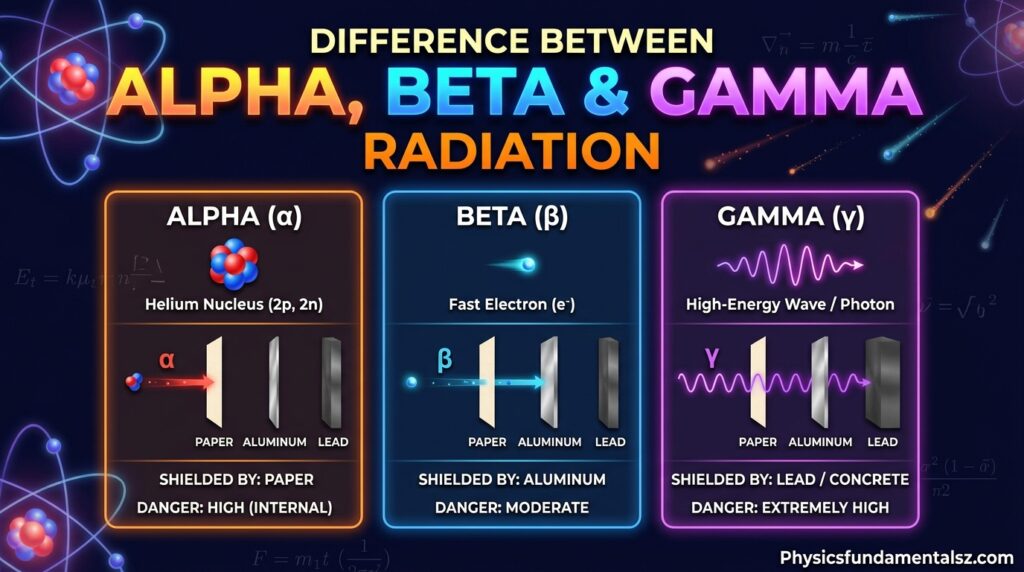
A sheet of paper can stop one kind of radiation cold. A thin slab of aluminum stops another. And a wall of lead barely slows down the third. Same nucleus, same moment of decay, three wildly different outcomes.
That puzzle sits at the heart of the difference between alpha beta gamma radiation. All three come from unstable atomic nuclei, yet they behave like completely different characters: one is heavy and clumsy, one is light and fast, and one is pure energy.
Understanding why they differ is the key to nuclear physics, radiation safety, medical imaging, and even the smoke detector on your ceiling.
Table of Contents
Difference Between Alpha Beta Gamma Radiation at a Glance
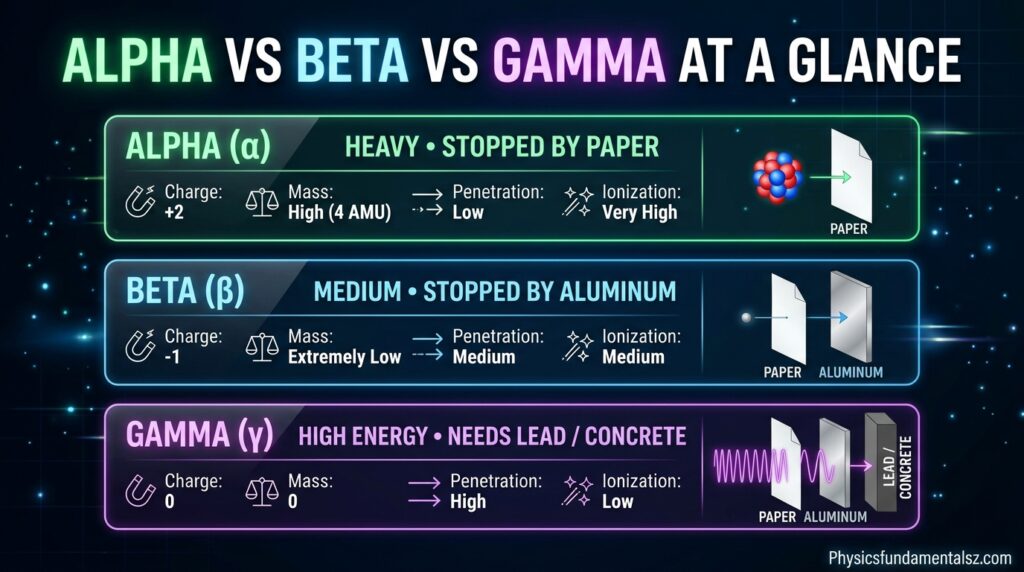
Alpha radiation is a helium nucleus (two protons and two neutrons) with a +2 charge. Beta radiation is a fast electron or positron. Gamma radiation is a high-energy electromagnetic photon with no mass and no charge.
Alpha is the least penetrating and most ionizing. Gamma is the most penetrating and least ionizing. Beta sits in the middle on both counts.
Quick Comparison Table
| Property | Alpha (α) | Beta (β) | Gamma (γ) |
|---|---|---|---|
| What it is | Helium-4 nucleus (2 protons + 2 neutrons) | Electron (β⁻) or positron (β⁺) | Electromagnetic wave (photon) |
| Symbol | ⁴₂He or α | ⁰₋₁e or β⁻ | γ |
| Charge | +2 | −1 (or +1 for positron) | 0 |
| Relative mass | About 4 atomic mass units | About 1/1836 of a proton | 0 |
| Typical speed | Up to about 5% of light speed | Up to about 99% of light speed | Speed of light |
| Penetration | Stopped by paper or skin | Stopped by a few mm of aluminum | Reduced by thick lead or concrete |
| Range in air | A few centimeters | Up to a few meters | Very long, no fixed range |
| Ionizing power | Very high | Moderate | Low |
| Deflected by magnetic field | Yes (small deflection) | Yes (large deflection, opposite direction) | No |
| Main danger | Internal exposure | Skin and eye burns, internal exposure | External whole-body exposure |
| Typical source | Uranium-238, radium-226, americium-241 | Carbon-14, strontium-90, tritium | Cobalt-60, cesium-137, technetium-99m |
What Is Radiation in Physics?
In physics, radiation means energy or particles that travel outward from a source. Light, radio waves, and heat are all forms of radiation.
The kind discussed here is nuclear radiation. It comes from the nucleus of an unstable atom as it settles into a more stable state.
Do not confuse it with heat transfer. Our guide to real life examples of conduction, convection, and radiation covers thermal radiation, which is a different topic.
Ionizing vs Non-Ionizing Radiation
Ionizing radiation carries enough energy to knock electrons off atoms. This creates charged ions and can damage molecules such as DNA.
Alpha, beta, and gamma are all ionizing. Visible light, radio waves, and microwaves are non-ionizing.
Why Do Nuclei Emit Radiation?
Some nuclei have too many protons, too many neutrons, or too much energy. They are unstable.
To become stable, the nucleus changes. It may eject a particle or release energy, and each route produces a different type of radiation.
A Short History
Henri Becquerel discovered radioactivity in 1896. Ernest Rutherford later sorted the rays by how far they penetrated and named two of them alpha and beta.
Paul Villard identified the third, gamma, in 1900. Rutherford and Thomas Royds showed that alpha particles are helium nuclei.
What Is Alpha Radiation?
Alpha radiation is a stream of alpha particles. Each one is identical to a helium-4 nucleus: two protons and two neutrons bound together.
It is the heaviest and slowest of the three. It also carries the largest charge, which is why it interacts so strongly with matter.
Alpha Particle Properties
An alpha particle has a charge of +2 and a mass of about 6.64 × 10⁻²⁷ kg. That is roughly 7,300 times the mass of an electron.
Typical alpha energies range from about 4 to 9 MeV. Even so, the particle usually travels at only around 5% of the speed of light.
Alpha Decay Explained
Alpha decay happens mostly in very heavy nuclei, such as uranium, thorium, radium, and plutonium. The nucleus ejects an alpha particle to shed mass and charge.
The atomic number drops by 2 and the mass number drops by 4. The atom becomes a different element.
For a deeper look at the equations, see our guide on nuclear decay equations for alpha, beta, and gamma decay.
Alpha Decay Equation
The general form is:
ᴬ_Z X → ᴬ⁻⁴_(Z−2) Y + ⁴₂He
A classic example is uranium-238 decaying into thorium-234:
²³⁸₉₂U → ²³⁴₉₀Th + ⁴₂He
Common Alpha Emitters
- Uranium-238 and uranium-235.
- Radium-226.
- Radon-222.
- Polonium-210.
- Americium-241, used in ionization smoke detectors.
- Plutonium-239.
How Far Does Alpha Radiation Travel?
In air, alpha particles travel only a few centimeters. A sheet of paper or the outer layer of dead skin stops them.
In tissue, they travel a fraction of a millimeter. That tiny range is the reason they are harmless outside the body but dangerous inside it.
What Is Beta Radiation?
Beta radiation is a stream of beta particles, which are high-speed electrons or positrons. They come from the nucleus, not from the electron cloud around it.
They are far lighter than alpha particles and travel much faster. That gives them greater range but less ionizing power.
Beta Minus (β⁻) Decay
In beta-minus decay, a neutron inside the nucleus turns into a proton. The nucleus emits an electron and an antineutrino.
The atomic number goes up by 1, while the mass number stays the same. This happens in nuclei with too many neutrons.
Beta Minus Decay Equation
The general form is:
ᴬ_Z X → ᴬ_(Z+1) Y + ⁰₋₁e + antineutrino
Carbon-14 turning into nitrogen-14 is the classic example:
¹⁴₆C → ¹⁴₇N + ⁰₋₁e + antineutrino
Beta Plus (β⁺) Decay
In beta-plus decay, a proton turns into a neutron. The nucleus emits a positron and a neutrino.
The atomic number drops by 1 and the mass number stays the same. This occurs in proton-rich nuclei. Fluorine-18 decaying into oxygen-18 is used in PET scans.
Why Is the Beta Energy Spread Out?
Beta particles do not all leave with the same energy. They show a continuous range up to a maximum value.
The antineutrino carries away the rest. This puzzle led Wolfgang Pauli to propose the neutrino in 1930.
Beta Particle Properties
A beta particle has a charge of −1 (or +1 for a positron) and a mass of about 9.11 × 10⁻³¹ kg. Energetic beta particles can reach speeds close to the speed of light.
If you want to understand why speeds near light behave strangely, read our guide to special relativity explained.
Common Beta Emitters
- Carbon-14.
- Tritium (hydrogen-3).
- Strontium-90.
- Phosphorus-32.
- Potassium-40.
- Iodine-131.
- Fluorine-18 (positron emitter).
How Far Does Beta Radiation Travel?
Beta particles travel up to a few meters in air, depending on energy. A few millimeters of aluminum or about a centimeter of plastic stops most of them.
They can penetrate the outer layers of skin. Strong sources can cause beta burns and damage the lens of the eye.
What Is Gamma Radiation?
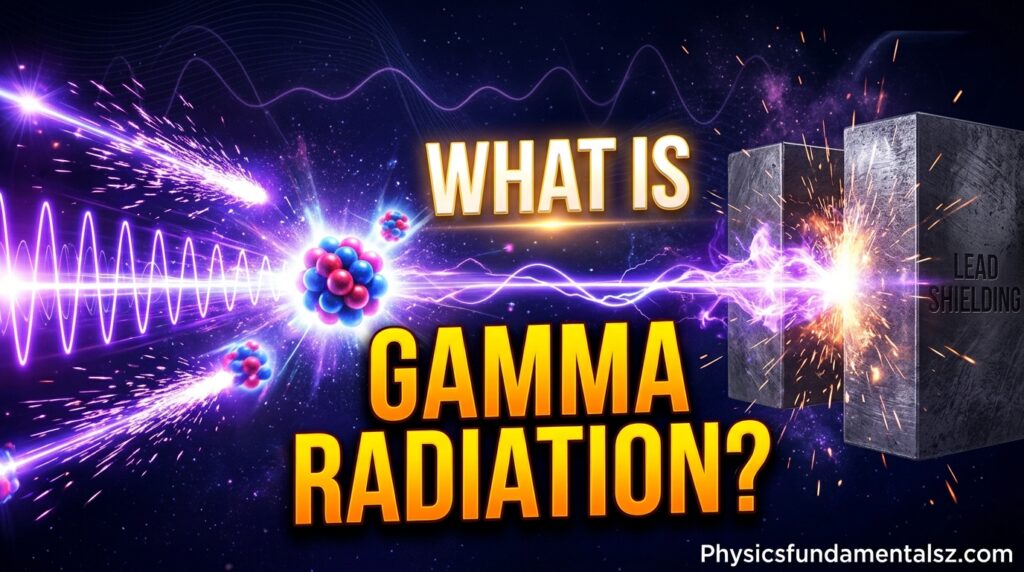
Gamma radiation is high-energy electromagnetic radiation emitted by the nucleus. It is made of photons, with no mass and no charge.
Gamma rays sit at the top of the electromagnetic spectrum. Their wavelengths are typically shorter than about 10 picometers.
How Gamma Rays Are Produced
After alpha or beta decay, the daughter nucleus often remains in an excited state. It releases the extra energy as a gamma photon and drops to a lower energy state.
The number of protons and neutrons does not change during gamma emission. Only the energy of the nucleus changes.
Gamma Emission Equation
An excited nucleus is marked with an asterisk:
ᴬ_Z X* → ᴬ_Z X + γ
Technetium-99m, widely used in medical imaging, shows the process:
⁹⁹ᵐ₄₃Tc → ⁹⁹₄₃Tc + γ
Gamma Ray Properties
Gamma rays travel at the speed of light and carry typical energies from tens of keV to several MeV. They obey the wave relation covered in our guide to wave speed, frequency, and wavelength.
They are also best understood as particles of light. The idea links directly to the photoelectric effect, where photon energy equals Planck’s constant times frequency (E = hf).
Common Gamma Sources
- Cobalt-60, which emits 1.17 and 1.33 MeV gamma rays.
- Cesium-137, through its daughter barium-137m.
- Technetium-99m.
- Iridium-192.
- Iodine-131.
- Cosmic and natural sources such as potassium-40.
Gamma Rays vs X-Rays
Both are electromagnetic waves, and their energy ranges overlap. The difference is origin.
Gamma rays come from the nucleus. X-rays come from electron transitions or from electrons slowing down outside the nucleus.
Penetrating Power of Alpha, Beta, and Gamma Radiation
Penetrating power describes how deeply radiation can pass through matter. It is the most tested difference in school physics.
The ranking is simple. Gamma penetrates most, beta penetrates a moderate amount, and alpha penetrates least.
Why Alpha Is Stopped So Easily
An alpha particle is heavy and carries a double charge. It interacts with many atoms along a short path and loses its energy quickly.
Think of a bowling ball rolling through a crowded room. It crashes into everything and stops soon.
Why Beta Goes Further
A beta particle is light and carries a single charge. It interacts less often per unit distance, so it travels farther.
Think of a ping-pong ball moving fast through the same crowd. It slips through more gaps, though it scatters easily.
Why Gamma Is Hardest to Stop
Gamma rays have no charge and no mass. They do not interact continuously with the electrons they pass.
Instead, they are absorbed or scattered in individual events. A beam is weakened gradually but never reaches zero.
Penetration at a Glance
| Material | Alpha | Beta | Gamma |
|---|---|---|---|
| Sheet of paper | Stopped | Passes | Passes |
| A few mm of aluminum | Stopped | Stopped | Passes (reduced slightly) |
| Thick lead or dense concrete | Stopped | Stopped | Greatly reduced |
| Human skin | Stopped by outer layer | Penetrates some depth | Passes through the body |
Ionizing Power of Alpha, Beta, and Gamma Radiation
Ionizing power is how strongly radiation strips electrons from atoms. It runs in the opposite direction to penetration.
Alpha is the strongest ionizer, beta is moderate, and gamma is the weakest.
Why the Two Trends Are Opposite
A strong ionizer loses energy quickly because each collision costs energy. That is why alpha stops fast.
A weak ionizer loses energy slowly, so it travels farther. That is why gamma goes deepest.
What Ionization Does
When radiation ionizes atoms, it can break chemical bonds and damage DNA. Cells may repair the damage, die, or mutate.
The amount of harm depends on dose, type, exposure time, and the tissue involved.
Charge and Mass of Alpha, Beta, and Gamma Radiation
Charge and mass explain almost every other difference. They set how each type interacts with matter and with fields.
Charge Comparison
Alpha has +2, beta-minus has −1, and gamma has 0. A beta-plus particle has +1.
Charged particles ionize directly. Gamma ionizes indirectly, by releasing fast electrons when it is absorbed.
Mass Comparison
An alpha particle is about 7,300 times heavier than a beta particle. Gamma has no rest mass.
This huge mass difference is why alpha tracks are short and thick, while beta tracks are long and thin.
Deflection in Electric and Magnetic Fields
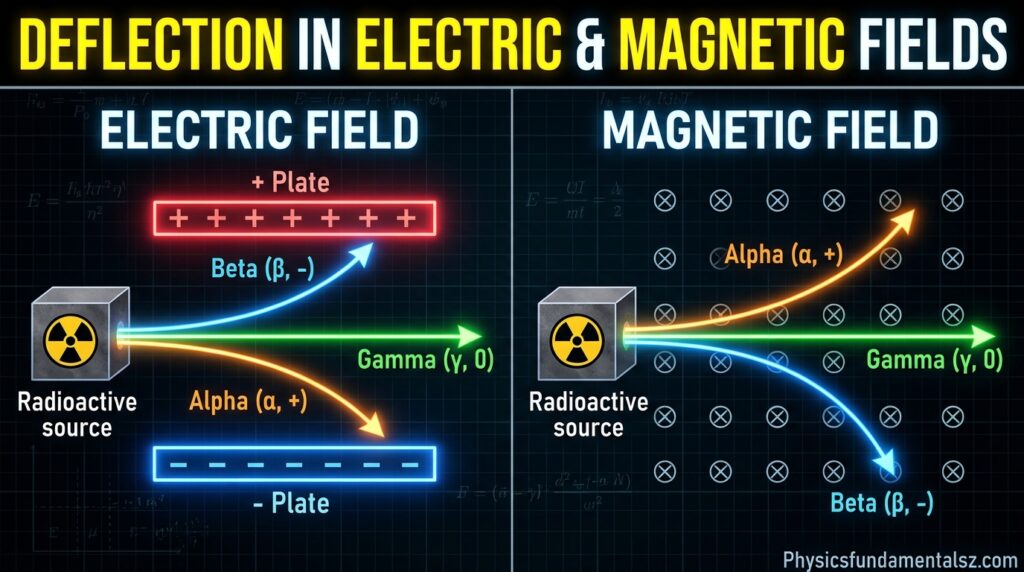
Charged particles bend in electric and magnetic fields. Uncharged radiation does not.
This is a favorite exam topic, so it helps to know the pattern.
Magnetic Field Deflection
Alpha and beta bend in opposite directions because their charges are opposite. Use Fleming’s left-hand rule to find each direction.
Alpha bends much less than beta, even though it has a larger charge. Its large mass makes it far harder to turn.
Electric Field Deflection
Between two charged plates, alpha is pulled toward the negative plate. Beta-minus is pulled toward the positive plate.
Gamma passes straight through, undeflected. This is the simplest way to show it carries no charge.
Deflection Summary
| Type | Magnetic Field | Electric Field |
|---|---|---|
| Alpha | Small deflection | Toward negative plate |
| Beta (β⁻) | Large deflection, opposite to alpha | Toward positive plate |
| Gamma | None | None |
Shielding: What Blocks Alpha, Beta, and Gamma Radiation?
Shielding must match the radiation. The wrong material wastes money and can even make things worse.
The goal is to absorb as much energy as possible before it reaches people.
Shielding Alpha Radiation
A sheet of paper, a few centimeters of air, or the skin’s outer layer is enough. Ordinary clothing and gloves also work for external exposure.
The real challenge is preventing alpha emitters from being inhaled or swallowed.
Shielding Beta Radiation
Use a few millimeters of aluminum, glass, or about a centimeter of plastic. Low-density materials are best.
Dense metals such as lead can produce secondary X-rays called bremsstrahlung when fast electrons slow down inside them. Professionals often use plastic first, then add a dense layer behind it.
Shielding Gamma Radiation
Gamma needs dense, thick material such as lead, steel, or concrete. Water also works in large depths, as seen in spent fuel pools.
Shielding does not stop gamma completely. It reduces intensity in a predictable way.
Half-Value Layer
The half-value layer (HVL) is the thickness of material that cuts a gamma beam to half its intensity. Each extra HVL halves it again.
The formula is I = I₀ × (½)ⁿ, where n is the number of HVLs. The HVL depends on both the gamma energy and the material.
Time, Distance, and Shielding
Radiation workers follow three simple rules. Spend less time near the source, stay farther away, and use shielding.
Distance matters a lot for gamma. For a point source, doubling the distance cuts the intensity to one quarter, following the inverse square law.
Range of Alpha, Beta, and Gamma Radiation in Air
Range is how far radiation travels before it stops. It is a practical way to measure how penetrating each type is.
| Type | Approximate Range in Air |
|---|---|
| Alpha | A few centimeters |
| Beta | Up to a few meters, depending on energy |
| Gamma | Tens to hundreds of meters, falling off with distance |
Gamma intensity never hits a hard stop. It simply becomes weaker until it blends into background levels.
Which Is the Most Dangerous: Alpha, Beta, or Gamma?
There is no single answer. The danger depends on whether the source is outside the body or inside it.
Many textbooks simplify this, but real safety work treats each case separately.
External Exposure
For a source outside the body, gamma is the main hazard. It passes through skin and reaches internal organs.
Beta can burn skin and damage the eyes. Alpha is blocked by the skin and poses almost no external risk.
Internal Exposure
If a source is swallowed, inhaled, or enters a wound, the ranking flips. Alpha becomes the most damaging.
It deposits all its energy in a tiny volume of tissue. That concentrated damage is why internal alpha emitters are so serious.
Radiation Weighting Factors
Scientists use a radiation weighting factor to compare biological harm. The International Commission on Radiological Protection assigns photons and electrons a factor of 1, and alpha particles a factor of 20.
The equivalent dose in sieverts equals the absorbed dose in grays times this factor.
| Radiation | Radiation Weighting Factor (w_R) |
|---|---|
| Gamma photons | 1 |
| Beta particles (electrons) | 1 |
| Alpha particles | 20 |
Dangerous in Context: Radon Gas
Radon-222 is a natural alpha emitter that seeps from soil into buildings. When inhaled, its decay products can lodge in the lungs.
The U.S. Environmental Protection Agency recommends fixing homes at or above 4 picocuries per liter. A simple home test kit is the usual starting point.
Examples of Alpha, Beta, and Gamma Sources
Radiation is not only a lab topic. Natural and man-made sources surround us every day.
Natural Sources
- Radon gas from soil and rock.
- Potassium-40 in food and the human body.
- Carbon-14 in living tissue.
- Cosmic rays from space.
- Uranium and thorium in rocks.
According to estimates from the U.S. National Council on Radiation Protection and Measurements, natural sources give an average American roughly 3 millisieverts per year. Radon is the largest share.
Man-Made Sources
- Medical imaging and therapy.
- Nuclear power plants.
- Industrial gauges and radiography.
- Smoke detectors.
- Research isotopes.
Source-by-Source Table
| Source | Main Radiation | Common Use or Location |
|---|---|---|
| Americium-241 | Alpha | Ionization smoke detectors |
| Radon-222 | Alpha | Natural gas in basements |
| Polonium-210 | Alpha | Static eliminators, research |
| Carbon-14 | Beta | Radiocarbon dating |
| Strontium-90 | Beta | Thickness gauges, fallout |
| Fluorine-18 | Beta plus | PET scans |
| Cobalt-60 | Gamma (with beta) | Radiotherapy, sterilization |
| Technetium-99m | Gamma | Medical imaging |
| Cesium-137 | Beta and gamma | Industrial gauges |
Uses of Alpha, Beta, and Gamma Radiation
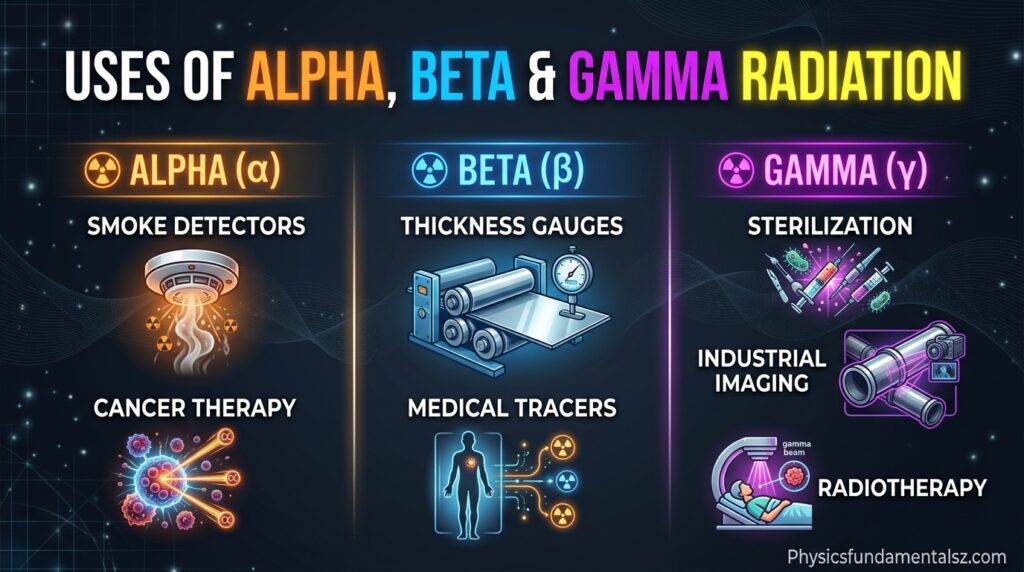
Radiation is useful as well as risky. Each type fits different jobs because of its properties.
Uses of Alpha Radiation
Alpha particles power ionization smoke detectors. They ionize the air between two electrodes, and smoke disrupts the current to trigger the alarm.
They also appear in static eliminators and in some targeted cancer treatments using radium-223.
Uses of Beta Radiation
Beta sources monitor thickness in paper, plastic, and metal foil. The more material between source and detector, the fewer beta particles pass through.
Medical uses include iodine-131 for thyroid treatment and PET scans using positron emitters. Carbon-14 allows radiocarbon dating of organic material up to tens of thousands of years old.
Uses of Gamma Radiation
Gamma rays sterilize medical equipment and some foods. They also power radiotherapy machines that target tumors.
In industry, gamma radiography checks welds and pipelines for hidden defects. In medicine, technetium-99m is the workhorse of nuclear imaging.
Uses at a Glance
| Radiation | Typical Uses |
|---|---|
| Alpha | Smoke detectors, static control, targeted therapy |
| Beta | Thickness gauging, PET imaging, radiocarbon dating, thyroid therapy |
| Gamma | Sterilization, radiotherapy, medical imaging, weld inspection |
How Alpha, Beta, and Gamma Radiation Are Detected
Human senses cannot detect radiation. Instruments do the work.
Each detector responds differently to the three types, so the choice of detector matters.
Geiger-Müller Counter
A Geiger-Müller tube detects ionizing radiation and clicks for each event. A thin mica window is needed to detect alpha, because it cannot pass through thicker walls.
Most Geiger counters also detect beta and gamma. They show how many counts occur, not what energy the radiation has.
Cloud Chamber
A cloud chamber shows tracks of condensed vapor along the paths of charged particles. Alpha tracks are short, thick, and straight. Beta tracks are thin and wiggly.
Gamma rays leave no direct track. They are revealed only by the electrons they knock loose.
Scintillation Detectors
These detectors flash with light when radiation hits them. They are especially good for measuring gamma energy.
Medical gamma cameras use this principle to image where a tracer collects in the body.
Units of Radiation
| Quantity | Unit | Meaning |
|---|---|---|
| Activity | Becquerel (Bq) | Decays per second |
| Absorbed dose | Gray (Gy) | Energy absorbed per kilogram |
| Equivalent dose | Sievert (Sv) | Dose weighted for biological effect |
Half-Life and Decay Rates for Alpha, Beta, and Gamma Emitters
Half-life is the time for half of the radioactive nuclei in a sample to decay. It does not depend on the type of radiation.
An alpha emitter and a beta emitter can have the same half-life or very different ones.
Example Half-Lives
| Isotope | Radiation | Approximate Half-Life |
|---|---|---|
| Uranium-238 | Alpha | 4.5 billion years |
| Radium-226 | Alpha | 1,600 years |
| Americium-241 | Alpha | 432 years |
| Carbon-14 | Beta | 5,730 years |
| Strontium-90 | Beta | About 29 years |
| Cesium-137 | Beta and gamma | About 30 years |
| Cobalt-60 | Beta and gamma | About 5.3 years |
| Technetium-99m | Gamma | About 6 hours |
Why Half-Life Matters for Safety
A short half-life means a source is intense but fades quickly. A long half-life means it is weaker per second but stays around for ages.
To practice the math, try our guide to half-life calculations.
Where Does the Energy Come From?
Every decay releases energy because the products have slightly less mass than the starting nucleus. That missing mass becomes kinetic energy and radiation.
This follows Einstein’s famous relation, explained in our guide to mass-energy equivalence.
Connection to Fission and Fusion
Radioactive decay is a spontaneous, small-scale process. Nuclear fission and fusion are much larger energy changes.
See the difference between fission and fusion to compare them with simple decay.
Worked Examples: Alpha, Beta, and Gamma Decay
Practice makes the differences stick. Try these before checking the answers.
Example 1: Alpha Decay of Polonium-210
Write the equation for polonium-210 (atomic number 84) undergoing alpha decay.
Subtract 4 from the mass number and 2 from the atomic number. The daughter has mass number 206 and atomic number 82, which is lead.
²¹⁰₈₄Po → ²⁰⁶₈₂Pb + ⁴₂He
Example 2: Beta Decay of Strontium-90
Write the equation for strontium-90 (atomic number 38) undergoing beta-minus decay.
The mass number stays at 90 and the atomic number rises to 39, which is yttrium.
⁹⁰₃₈Sr → ⁹⁰₃₉Y + ⁰₋₁e + antineutrino
Example 3: Gamma Shielding
A gamma beam has a half-value layer of 1.2 cm in lead. How much intensity remains after 3.6 cm?
Divide the thickness by the HVL: 3.6 ÷ 1.2 = 3 half-value layers. The intensity is (½)³ = ⅛, or 12.5% of the original.
Example 4: Identify the Radiation
A source passes through paper but is stopped by 3 mm of aluminum. It bends strongly in a magnetic field.
Passing through paper rules out alpha. Stopping at aluminum rules out gamma. The strong deflection confirms beta.
Example 5: Electric Field Test
A radioactive beam passes between charged plates. One part bends toward the negative plate, one bends toward the positive plate, and one goes straight.
The part bending toward the negative plate is alpha. The part bending toward the positive plate is beta-minus. The undeflected part is gamma.
Common Misconceptions About Alpha, Beta, and Gamma Radiation
A few myths cause repeated mistakes in exams and in everyday conversations.
“Lead Completely Stops Gamma Rays”
Lead reduces gamma intensity but never removes it entirely. Each layer absorbs a fixed fraction.
“Alpha Radiation Is Harmless”
Alpha is harmless only outside the body. Inside the body, it is the most biologically damaging type.
“Beta Particles Are Electrons From the Atom’s Shell”
Beta particles are created in the nucleus when a neutron turns into a proton. They do not come from the orbiting electrons.
“Radiation Makes Objects Radioactive”
Exposure to radiation does not usually make an object radioactive. Contamination, which means radioactive material on or in an object, is a different issue.
“Gamma Is Just Strong X-Rays”
Both can have the same energy. The real difference is their origin: nucleus versus electrons.
Memory Tricks to Remember the Difference
A few simple hooks make the facts easy to recall in an exam.
Order of Penetration
Remember the order A, B, G. Penetration increases from alpha to beta to gamma, just like the alphabet.
Ionizing power runs in the opposite direction: G, B, A.
Alpha Equals Heavy and Positive
Think of alpha as a helium nucleus. It is heavy, positive, slow, and stopped by paper.
Beta Equals Electron
Think of beta as an electron that came from the nucleus. It is light, negative, fast, and stopped by aluminum.
Gamma Equals Light
Think of gamma as the most energetic light. It has no charge, no mass, and needs lead or thick concrete.
Radiation Safety Basics
Radiation is part of daily life, but sensible rules keep exposure low. Professionals follow the ALARA principle, which means keeping doses as low as reasonably achievable.
Nothing here replaces training or official guidance. If you work with sources, follow your radiation safety officer’s rules.
Practical Rules
- Limit time spent near any source.
- Increase distance wherever possible.
- Use the right shielding for the right radiation.
- Never eat, drink, or apply cosmetics where radioactive materials are handled.
- Use gloves and wash hands after handling sources.
- Store sources in labeled, shielded containers.
Authoritative Sources for Further Reading
For official guidance, consult the U.S. Nuclear Regulatory Commission, the U.S. Environmental Protection Agency, the Centers for Disease Control and Prevention, the International Atomic Energy Agency, and the International Commission on Radiological Protection. These organizations publish dose limits, safety standards, and public information.
Alpha vs Beta vs Gamma Radiation: Final Side-by-Side Summary
Use this table as a last-minute revision sheet.
| Feature | Alpha | Beta | Gamma |
|---|---|---|---|
| Nature | Particle (helium nucleus) | Particle (electron or positron) | Electromagnetic wave |
| Charge | +2 | −1 or +1 | 0 |
| Mass | Heavy | Very light | None |
| Speed | Slowest | Fast | Light speed |
| Ionizing power | Highest | Medium | Lowest |
| Penetration | Lowest | Medium | Highest |
| Stopped by | Paper, skin | Aluminum sheet | Thick lead or concrete |
| Deflection | Small | Large, opposite | None |
| Atomic number change | Decreases by 2 | Increases by 1 (β⁻) | No change |
| Mass number change | Decreases by 4 | No change | No change |
Also Read:
- Nuclear Decay Equations: Alpha, Beta & Gamma Decay Explained
- Half-Life Calculations: Formula & Worked Examples Explained
- Mass-Energy Equivalence: E = mc² Derivation & Nuclear Applications
- Difference Between Fission and Fusion With Examples: How Splitting and Joining Atoms Release Energy 2026
- Bohr Model of the Atom: Energy Levels, Emission & Absorption Spectra
- Quantum Numbers: n, l, m_l, m_s and Electron Configuration
- Photoelectric Effect Calculations: hf = work-function + KE_max
- De Broglie Wavelength: λ = h/mv Formula, Derivation & Examples
- How to Calculate De Broglie Wavelength of an Electron: Formulas, Steps and Worked Examples 2026
- Heisenberg Uncertainty Principle: ΔxΔp ≥ ℏ/2 — Explained Simply
- Special Relativity Explained
- Real Life Examples of Conduction Convection Radiation: Everyday Heat Transfer Explained 2026
- Wave Speed, Frequency & Wavelength
- Transverse Waves Explained
- What Is Energy?
- Conservation of Momentum
- Newton’s Laws of Motion
- Work-Energy Theorem: Complete Guide with Formula, Derivation, and Examples
- How to Calculate Decibel Levels from Sound Intensity: Formula, Steps, and Worked Examples 2026
- How to Solve Doppler Effect Problems Step by Step: Formulas, Sign Rules, and Worked Examples 2026
- Real Life Examples of Total Internal Reflection: Everyday Life, Nature, Technology, and Medicine 2026
- How to Find Equivalent Capacitance in Series and Parallel: Formulas, Steps, and Solved Examples 2026
Frequently Asked Questions (FAQs)
What is the main difference between alpha, beta, and gamma radiation?
Alpha is a helium nucleus, beta is a fast electron or positron, and gamma is an electromagnetic photon. They differ in charge, mass, penetration, and ionizing power.
Which radiation is the most penetrating?
Gamma radiation is the most penetrating. It passes through paper and aluminum and needs thick lead or concrete to reduce it significantly.
Which radiation is the most ionizing?
Alpha radiation is the most ionizing. Its large mass and +2 charge let it strip electrons from atoms very strongly over a short distance.
What stops alpha radiation?
A sheet of paper, a few centimeters of air, or the outer layer of dead skin stops alpha particles.
What stops beta radiation?
A few millimeters of aluminum or about a centimeter of plastic stops most beta particles.
What stops gamma radiation?
Thick lead, steel, or dense concrete reduces gamma rays. No thickness stops them entirely, but each layer cuts the intensity by a fixed fraction.
Is alpha, beta, or gamma radiation the most dangerous?
It depends. Gamma is the most dangerous from outside the body, while alpha is the most dangerous if the source is inhaled or swallowed.
Why is alpha radiation dangerous inside the body?
Alpha particles deposit all their energy in a tiny volume of tissue. That concentrated damage is much more harmful to cells than the same energy spread over a larger area.
Is gamma radiation the same as X-rays?
No, though both are electromagnetic waves. Gamma rays come from the nucleus, while X-rays come from electrons.
Are beta particles the same as electrons?
Beta-minus particles are electrons, but they are created inside the nucleus when a neutron turns into a proton. They do not come from the atom’s electron shells.
What is a beta-plus particle?
A beta-plus particle is a positron, the antimatter partner of the electron. It is emitted when a proton turns into a neutron.
What happens to the atomic number in alpha decay?
The atomic number decreases by 2 and the mass number decreases by 4. The atom becomes a different element.
What happens to the atomic number in beta decay?
In beta-minus decay, the atomic number increases by 1 and the mass number stays the same.
Does gamma emission change the element?
No. Gamma emission changes only the energy of the nucleus. The proton and neutron numbers stay the same.
Why does alpha radiation bend less than beta in a magnetic field?
Alpha particles are about 7,300 times heavier than beta particles. Their large mass makes them much harder to deflect, even though their charge is larger.
Which radiation is not affected by electric or magnetic fields?
Gamma radiation. It has no charge, so it passes through fields without bending.
What is the order of penetrating power?
From least to most penetrating: alpha, beta, gamma.
What is the order of ionizing power?
From most to least ionizing: alpha, beta, gamma.
What is a smoke detector’s radiation source?
Ionization smoke detectors use a tiny amount of americium-241, an alpha emitter. The alpha particles are blocked by the casing, so the device is safe in normal use.
How do you detect alpha, beta, and gamma radiation?
Use a Geiger-Müller counter, a cloud chamber, or a scintillation detector. Alpha detection requires a very thin window, because alpha particles do not penetrate thick walls.
What are the units of radiation?
Activity is measured in becquerels, absorbed dose in grays, and equivalent dose in sieverts.
Can radiation be useful?
Yes. It is used for medical imaging, cancer treatment, sterilization, industrial inspection, smoke detection, and radiocarbon dating.
What is the radiation weighting factor?
It is a number used to convert absorbed dose into equivalent dose. Alpha particles have a factor of 20, while beta particles and gamma photons have a factor of 1.
Is natural background radiation dangerous?
Natural background radiation is a normal part of life and is generally low. Radon in homes is the main natural source worth testing for.
Conclusion
The difference between alpha beta gamma radiation comes down to what each one is. Alpha is a heavy helium nucleus, beta is a light and fast electron, and gamma is a pure packet of electromagnetic energy.
That single difference explains everything else: why alpha stops at paper, why beta needs aluminum, why gamma demands thick lead, and why they bend differently in magnetic fields.
It also explains why safety depends on context. Gamma is the main external hazard, while alpha becomes the most serious threat once it gets inside the body.
Keep the key patterns in mind: penetration rises from alpha to gamma, and ionizing power falls. Use the worked examples and comparison tables to test yourself, and you will handle any exam question or real-world scenario with confidence.