Quantum Numbers: n, l, m_l, m_s and Electron Configuration
No two electrons in the same atom are ever in exactly the same state — not even the two crammed into the same orbital.
Physicists describe that state with a set of four quantum numbers, and once you understand what each one means, the entire structure of the periodic table stops looking arbitrary and starts looking inevitable.
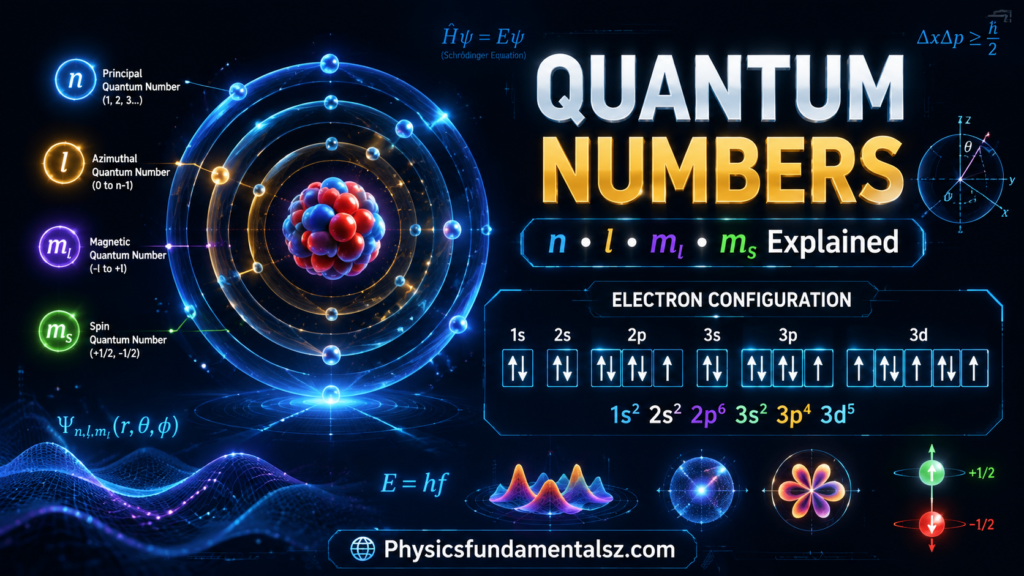
Quantum numbers are a set of four values — the principal quantum number (n), the azimuthal quantum number (l), the magnetic quantum number (mₗ), and the spin quantum number (mₛ) — that together uniquely describe the energy, shape, orientation, and spin of an electron in an atom.
Table of Contents
What Are Quantum Numbers?
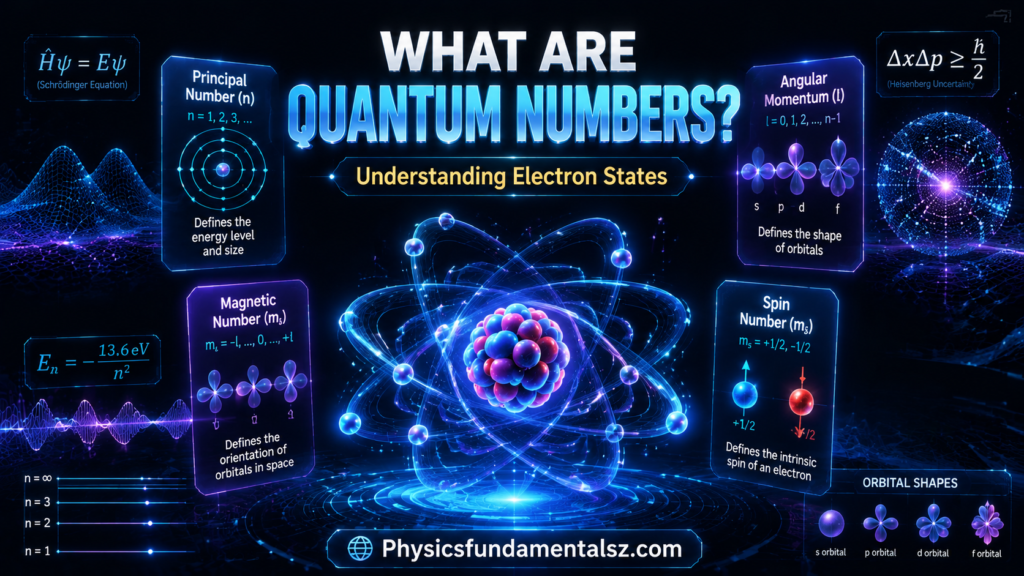
Quantum numbers emerge directly from solving the Schrödinger equation for an electron bound to an atom’s nucleus. Each valid solution — each wavefunction — corresponds to one unique combination of n, l, and mₗ, describing where the electron is likely to be found. A fourth number, mₛ, was added afterward to account for electron spin, a property with no classical analogue.
Together, these four numbers act like a complete address for an electron: which floor (shell), which shape of room (subshell), which specific room (orbital), and which “bunk” (spin) it occupies.
The Principal Quantum Number (n)
What n Tells You
The principal quantum number describes an electron’s main energy level, or shell, and correlates directly with its average distance from the nucleus. A larger n means a higher energy level and, generally, a larger orbital.
Allowed Values of n
n can be any positive integer: 1, 2, 3, 4, and so on. The energy gap between consecutive shells shrinks as n increases — the jump from n = 1 to n = 2 is far larger than the jump from n = 5 to n = 6.
The Azimuthal (Angular Momentum) Quantum Number (l)
The azimuthal quantum number, also called the orbital angular momentum quantum number, describes the shape of an electron’s orbital and determines its orbital angular momentum.
Allowed Values of l for a Given n
For any given n, l can take integer values from 0 up to n − 1:
$$l = 0, 1, 2, \ldots, (n-1)$$
So for n = 3, l can be 0, 1, or 2 — three possible subshells.
Subshell Notation: s, p, d, f
Each value of l is traditionally labeled with a letter rather than a number, following the mnemonic “spiny dogs find fury” for the order s, p, d, f.
| l value | Subshell letter | Orbital shape |
|---|---|---|
| 0 | s | Spherical |
| 1 | p | Dumbbell-shaped |
| 2 | d | Cloverleaf-shaped |
| 3 | f | Complex, multi-lobed |
The Magnetic Quantum Number (mₗ)
The magnetic quantum number describes the orientation of an orbital in space, particularly how it would align relative to an external magnetic field.
Allowed Values of mₗ for a Given l
mₗ ranges over integers from −l to +l, including zero:
$$m_l = -l, -l+1, \ldots, 0, \ldots, l-1, l$$
This gives (2l + 1) possible orientations for any given l. For example, a p subshell (l = 1) has three orientations: mₗ = −1, 0, +1 — matching the three p orbitals you’d see labeled pₓ, p_y, and p_z.
The Spin Quantum Number (mₛ)
Unlike n, l, and mₗ, the spin quantum number doesn’t come from the position-based Schrödinger equation — it was proposed in 1925 by George Uhlenbeck and Samuel Goudsmit to explain fine splitting observed in atomic spectral lines.
Why mₛ Is Always ±1/2
Every electron has a fixed spin value of s = 1/2, and its spin projection quantum number mₛ can only be +1/2 (“spin up,” ↑) or −1/2 (“spin down,” ↓). This isn’t a literal spinning motion — it’s an intrinsic quantum property — but the “spin up/spin down” language has stuck because the mathematics behaves like angular momentum.
Key idea: Because mₛ has only two possible values, any single orbital (one fixed n, l, mₗ) can hold at most two electrons, and those two electrons must have opposite spins.
Quantum Numbers Comparison Table
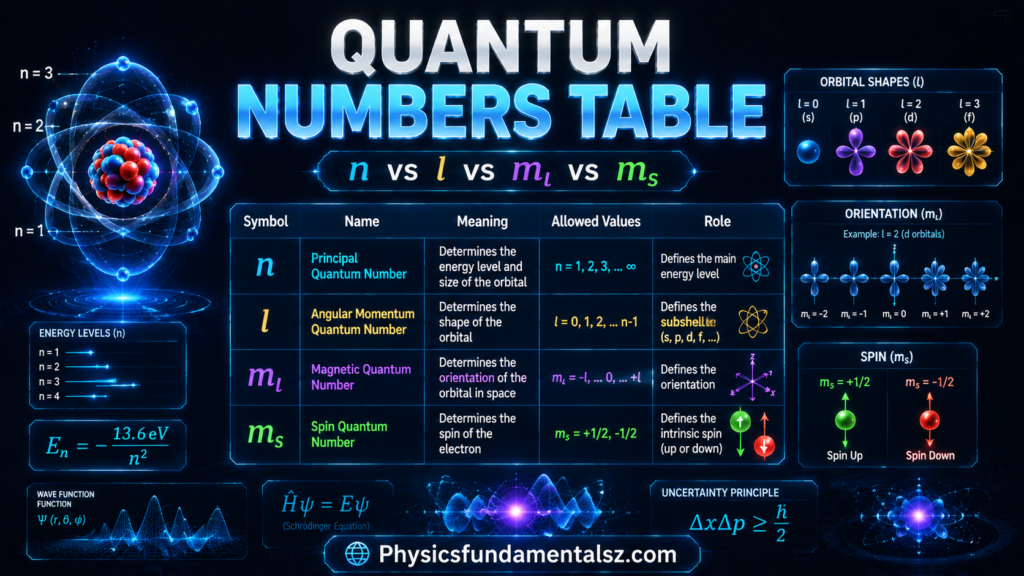
| Quantum Number | Symbol | Describes | Allowed Values |
|---|---|---|---|
| Principal | n | Energy level / shell size | 1, 2, 3, … (any positive integer) |
| Azimuthal (angular momentum) | l | Orbital shape / subshell | 0 to (n − 1) |
| Magnetic | mₗ | Orbital orientation | −l to +l (integers, including 0) |
| Spin | mₛ | Electron spin direction | +1/2 or −1/2 |
How to Check If a Set of Quantum Numbers Is Valid
Steps to validate any (n, l, mₗ, mₛ) set:
- Confirm n is a positive integer (1, 2, 3, …).
- Confirm l is an integer between 0 and n − 1 inclusive.
- Confirm mₗ is an integer between −l and +l inclusive.
- Confirm mₛ is either +1/2 or −1/2.
- If every check passes, the set is valid; if any single rule is broken, the entire set is invalid.
Worked Example 1 — Valid Set
Check (n = 3, l = 2, mₗ = −1, mₛ = +1/2). n = 3 is a valid positive integer. l = 2 is within 0 to (3−1) = 2. mₗ = −1 is within −2 to +2. mₛ = +1/2 is allowed. This set is valid — it describes an electron in a 3d orbital, spin up.
Worked Example 2 — Invalid Set
Check (n = 2, l = 2, mₗ = 0, mₛ = +1/2). l = 2 is not allowed for n = 2, since l can only go up to n − 1 = 1. This set is invalid.
The Pauli Exclusion Principle and Quantum Numbers
In 1926, Wolfgang Pauli discovered that no two electrons in the same atom can share the exact same set of all four quantum numbers.
Two electrons can share the same n, l, and mₗ (meaning they occupy the same orbital), but they must then have opposite mₛ values — one spin up, one spin down. This single rule is what limits every orbital to a maximum of two electrons and directly shapes how electrons fill up an atom.
Quantum Numbers and the Periodic Table
The structure of the periodic table is a direct visual map of quantum numbers. Each period (row) corresponds to a new value of n. Each block (s, p, d, f) corresponds to which subshell is being filled, matching the l value. Hund’s rule and the Aufbau principle then describe the order in which orbitals fill as atomic number increases, always respecting the Pauli exclusion principle along the way.
Real-World Applications
- Atomic spectroscopy: the fine splitting of spectral lines is explained by the spin quantum number, since electrons with different mₛ values have very slightly different energies in the presence of other electrons.
- The Zeeman effect: applying an external magnetic field splits spectral lines further, because the magnetic quantum number mₗ affects how an orbital’s energy shifts in a field.
- Predicting electron configurations: quantum number rules are exactly what determine how many electrons fit in each shell and subshell, which is the basis of writing electron configurations like 1s² 2s² 2p⁶.
- Understanding chemical bonding: valence electrons — those in the outermost shell — determine how atoms bond, and their behavior traces directly back to their quantum numbers.
- Semiconductor and materials design: engineers rely on quantum number-based orbital theory to predict how electrons behave in different materials.
Common Mistakes When Working With Quantum Numbers
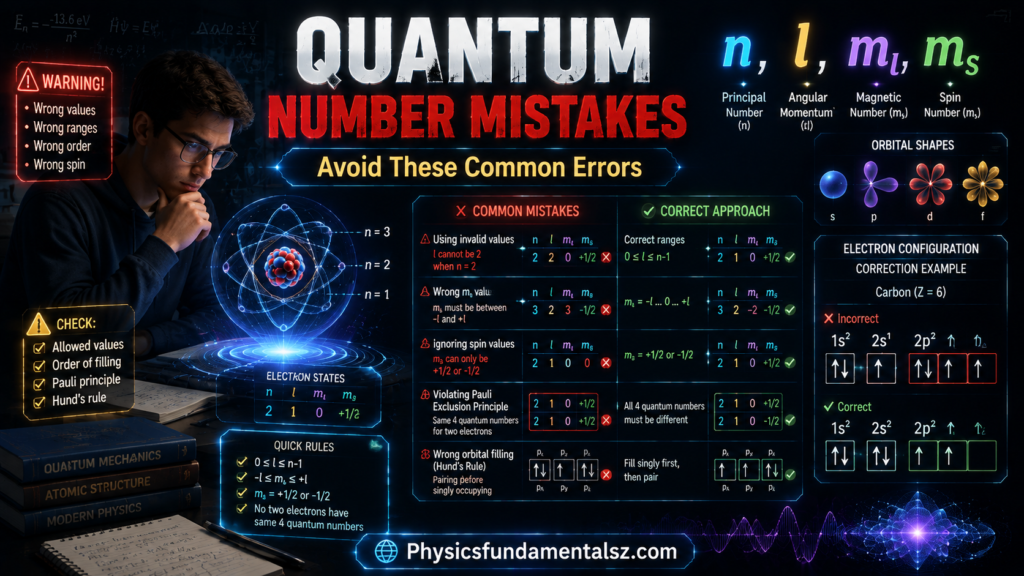
- Assuming l can equal n — remember, l only goes up to n − 1, never up to n itself.
- Forgetting mₗ can be negative or zero — it ranges symmetrically from −l to +l, not just 0 to l.
- Treating mₛ as having more than two values — it is always exactly +1/2 or −1/2, nothing else.
- Confusing quantum numbers with electron configuration notation — electron configuration (like 2p⁴) summarizes filled subshells, while quantum numbers describe one specific electron’s exact state.
- Assuming n alone determines energy in multi-electron atoms — for atoms beyond hydrogen, both n and l influence energy ordering (this is why 4s often fills before 3d).
Related Articles
Keep building your physics foundations with these guides from Physics Fundamentals:
- Coulomb’s Law Calculations: F = kQ1Q2/r² Formula & Examples
- Capacitors and Capacitance: C = Q/V Formula, Energy Storage & Examples
- Electric Potential Energy: E = kQq/r, Work Done & Worked Examples
- Electric Current: I = Q/t, Drift Velocity & Ohm’s Law Connection
- Magnetic Field of a Current-Carrying Wire: B = μ0I/2πr
- Electric Circuits & Kirchhoff’s Laws: KCL, KVL & Worked Examples
- Kirchhoff’s Laws Advanced: Solving Multi-Loop Circuits Step by Step
- Lenz’s Law: The Direction of Induced Current Explained
- Magnetic Flux and Faraday’s Law: Formula, Examples & Applications
- Ohm’s Law and Temperature: How Resistance Really Changes With Heat
- Young’s Double-Slit Experiment: Fringe Formula, Proof & Applications
- Diffraction: Single Slit, Diffraction Gratings & dsinθ = nλ Explained
- Electromagnetic Waves: Speed, Spectrum & Wave Properties
- Interference of Waves: Constructive, Destructive & Superposition Explained
- Standing Waves & Resonance: Nodes, Antinodes & Harmonics Explained
- Polarisation of Light: Malus’s Law I = I₀cos²θ & Applications
- Snell’s Law: n₁sinθ₁ = n₂sinθ₂, Derivation & Total Internal Reflection
- Wave Superposition: Adding Waves, Phase & Interference Patterns
- Boyle’s, Charles’ & Gay-Lussac’s Gas Laws: Formulas & Examples
- Thermal Energy & Internal Energy: Heat, Temperature & Q = mcΔT
- Free Fall and Terminal Velocity
- Magnetic Fields and Forces
- Terminal Velocity: Why Objects Stop Accelerating & Calculations
- Vectors and Scalars: Definitions, Examples & Vector Addition
- Physics Fundamentals: The Complete Guide to Core Concepts, Laws, and Equations
Frequently Asked Questions (FAQs)
1. What are quantum numbers in simple words?
Quantum numbers are a set of four values that describe the exact state of an electron in an atom — its energy, orbital shape, orbital orientation, and spin direction.
2. What are the four quantum numbers?
The principal quantum number (n), the azimuthal quantum number (l), the magnetic quantum number (mₗ), and the spin quantum number (mₛ).
3. What does the principal quantum number tell you?
It tells you the electron’s main energy level (shell) and roughly how far, on average, the electron is from the nucleus.
4. What values can n take?
Any positive integer: 1, 2, 3, 4, and so on, with no upper limit in principle.
5. What does the azimuthal quantum number represent?
It represents the shape of the electron’s orbital, ranging in integer values from 0 to n − 1, and corresponds to the s, p, d, f subshell labels.
6. Why does l range only from 0 to n − 1?
This range comes directly from solving the Schrödinger equation for an electron in an atom; higher l values aren’t mathematically allowed for a given n.
7. What is the magnetic quantum number?
It describes the orientation of an orbital in space, taking integer values from −l to +l, including zero.
8. How many orbitals exist for a given value of l?
There are (2l + 1) orbitals for any given l — for example, three orbitals for l = 1 (p subshell).
9. What is the spin quantum number?
It describes the intrinsic spin direction of an electron, which can only be +1/2 (“spin up”) or −1/2 (“spin down”).
10. Why is the spin quantum number always ±1/2?
Because every electron has a fixed spin value of s = 1/2; the projection of that spin along any axis can only be positive or negative one-half.
11. What is the Pauli exclusion principle?
It states that no two electrons in the same atom can have an identical set of all four quantum numbers — meaning two electrons in the same orbital must have opposite spins.
12. How many electrons can fit in one orbital?
A maximum of two electrons, and they must have opposite spin quantum numbers.
13. How do you check if a set of quantum numbers is valid?
Confirm n is a positive integer, l falls between 0 and n − 1, mₗ falls between −l and +l, and mₛ is either +1/2 or −1/2 — if any rule fails, the set is invalid.
14. How are quantum numbers related to electron configuration?
Electron configuration notation (like 2p⁴) summarizes how many electrons occupy each subshell, while quantum numbers describe the exact state of one individual electron within that subshell.
15. What is the difference between a shell, a subshell, and an orbital?
A shell corresponds to a value of n, a subshell corresponds to a value of l within that shell, and an orbital corresponds to a specific mₗ value within that subshell.
16. Do quantum numbers apply only to hydrogen?
The four quantum numbers apply to electrons in any atom, though the way they determine energy ordering becomes more complex in multi-electron atoms.
17. What is the Zeeman effect and how does it relate to quantum numbers?
The Zeeman effect is the splitting of spectral lines when an atom is placed in an external magnetic field; it occurs because the magnetic quantum number affects how an orbital’s energy shifts in that field.
18. Why was the spin quantum number added later than the other three?
Because it doesn’t emerge from the position-based Schrödinger equation the way n, l, and mₗ do — it was proposed separately in 1925 by Uhlenbeck and Goudsmit to explain observed spectral line splitting.
19. What is degeneracy in the context of quantum numbers?
Degeneracy refers to multiple distinct orbitals (different mₗ values) sharing the same energy level for a given n and l, at least in the absence of an external field.
20. How many total electrons can a given principal shell hold?
A shell with principal quantum number n can hold a maximum of 2n² electrons, once all its subshells and orbitals are filled according to quantum number rules.
21. Can l be equal to n?
No. l can only range from 0 to n − 1, so it is always strictly less than n.
22. What is Hund’s rule and how does it use quantum numbers?
Hund’s rule states that electrons fill degenerate orbitals (same n and l, different mₗ) singly, with parallel spins, before any orbital gets a second electron.
23. Are quantum numbers used in chemistry or physics?
Both. Chemistry courses use them to explain electron configuration and periodic trends, while physics courses use them to explain atomic spectra, angular momentum, and quantum mechanics more broadly.
24. What mnemonic helps remember the subshell order?
A common mnemonic is “spiny dogs find fury” for the order s, p, d, f, corresponding to l = 0, 1, 2, 3.
25. Why do quantum numbers matter for understanding the periodic table?
Because the rows (periods) of the periodic table correspond to principal quantum number n, and the blocks (s, p, d, f) correspond to which subshell is being filled — the whole table is a map of quantum number rules in action.
Key Takeaways
- Quantum numbers are a set of four values — n, l, mₗ, and mₛ — that together uniquely describe an electron’s state in an atom.
- The principal quantum number (n) sets the energy level; the azimuthal quantum number (l) sets the orbital shape; the magnetic quantum number (mₗ) sets the orbital orientation; the spin quantum number (mₛ) sets the spin direction.
- l ranges from 0 to n − 1; mₗ ranges from −l to +l; mₛ is always +1/2 or −1/2.
- The Pauli exclusion principle forbids any two electrons in the same atom from sharing an identical set of all four quantum numbers.
- Quantum numbers directly explain the structure of the periodic table, atomic spectra, and phenomena like the Zeeman effect.