Quantum Tunneling Explained Simply (With Real Examples) 2026
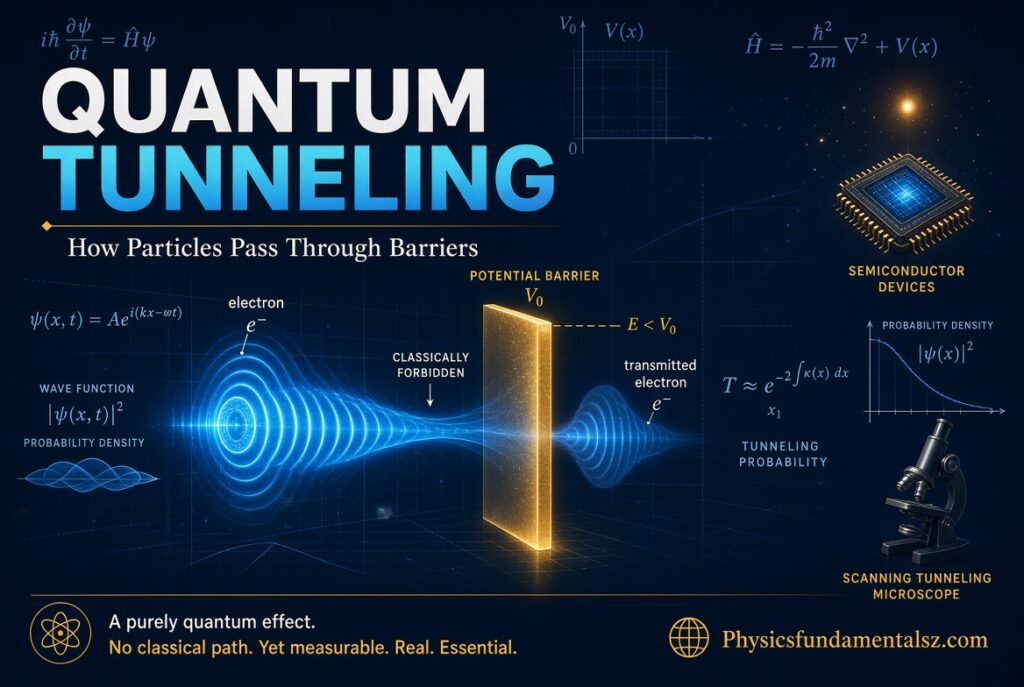
Quantum Tunneling Explained Simply reveals one of the strangest effects in quantum physics: a particle can sometimes pass through an energy barrier that, according to classical physics, it should not be able to cross.
At the quantum level, particles such as electrons behave like waves, which means there is a small probability of finding them on the other side of a barrier—even when they do not have enough energy to go over it. This surprising phenomenon is known as quantum tunneling.
Quantum tunneling plays an important role in many real-world processes and technologies. It helps explain nuclear fusion inside stars, radioactive alpha decay, scanning tunneling microscopes, semiconductor devices, and tunnel diodes. Without tunneling, several important physical processes and modern technologies would work very differently.
Table of Contents
What Is Quantum Tunneling?
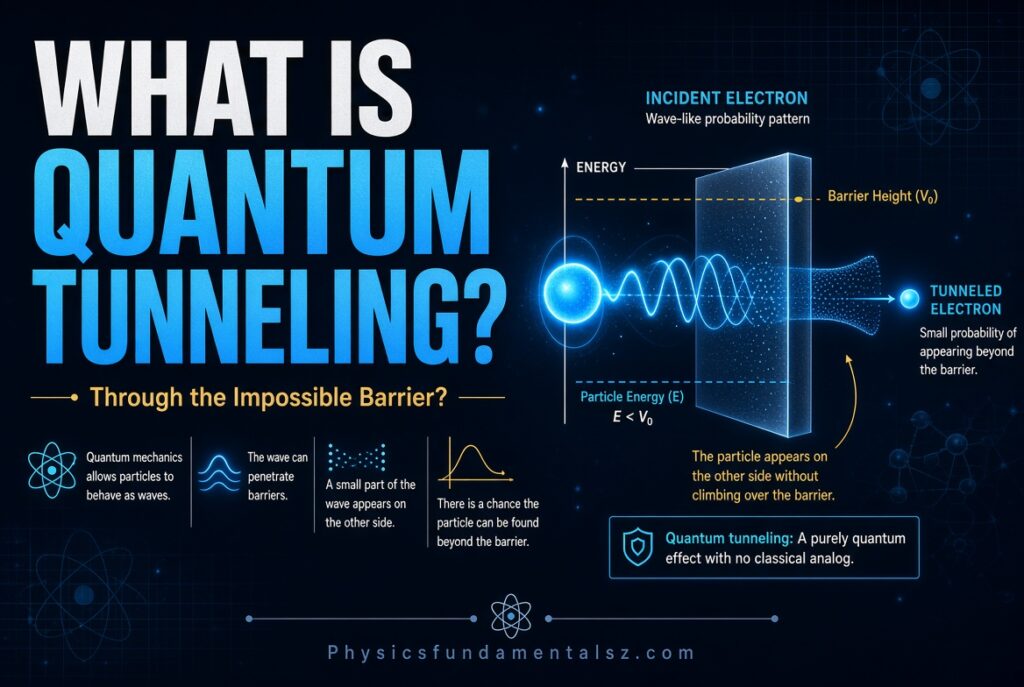
Quantum tunneling is a phenomenon where a particle passes through an energy barrier even though it doesn’t have enough energy to go over it, according to classical physics.
It happens because particles like electrons behave as waves, not just solid balls, and their wave function can “leak” through barriers instead of stopping dead at them.
The Everyday Analogy
Imagine throwing a ball at a hill. If the ball doesn’t have enough speed, it rolls back down instead of reaching the other side.
In the quantum world, that same “ball” sometimes ends up on the other side of the hill anyway, without ever having enough energy to climb over it. That’s tunneling.
Why Classical Physics Says It’s Impossible
In classical mechanics, an object needs energy equal to or greater than a barrier’s height to cross it. No exceptions.
If a ball doesn’t have enough kinetic energy, it simply cannot appear on the other side of a wall. This is the intuition tunneling breaks.
How Quantum Mechanics Makes It Possible
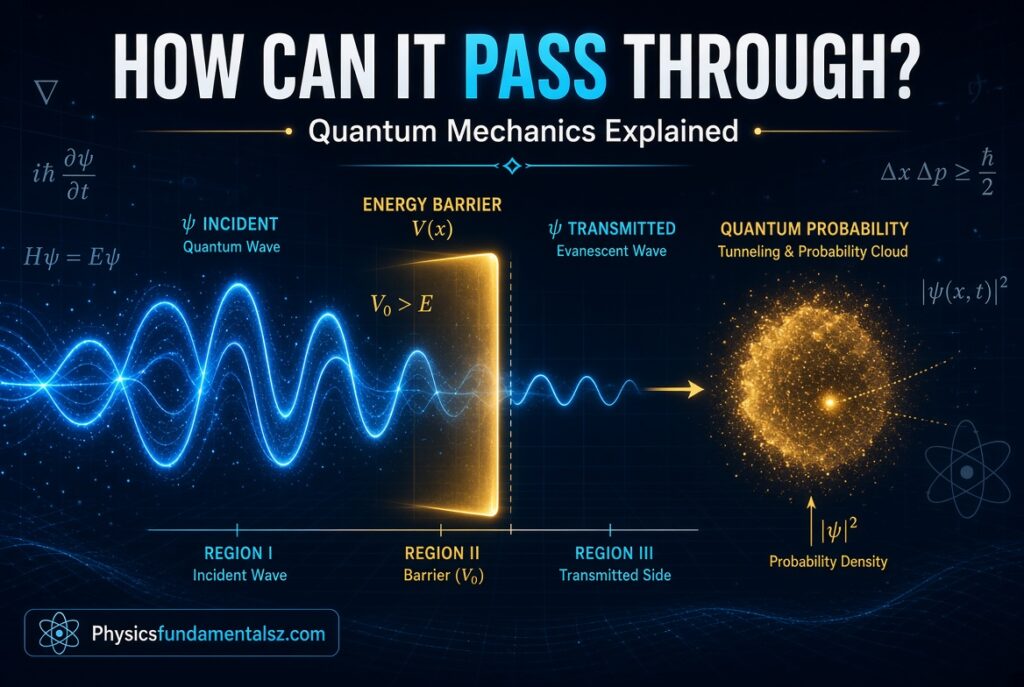
Quantum particles are described by a wave function, which represents the probability of finding a particle at a given location.
When this wave hits a barrier, it doesn’t vanish instantly. Instead, it decays exponentially inside the barrier and can still have a small, non-zero value on the other side.
That leftover probability is exactly what allows the particle to “tunnel” through, even without classical energy to spare.
What Affects Tunneling Probability
| Factor | Effect on Tunneling |
|---|---|
| Barrier width | Thinner barriers allow more tunneling |
| Barrier height | Lower barriers allow more tunneling |
| Particle mass | Lighter particles tunnel more easily |
| Particle energy | Closer to barrier height increases probability |
Step-by-Step: How Tunneling Happens
- A particle approaches a potential energy barrier taller than its own energy.
- Its wave function doesn’t stop at the barrier edge; it extends inward.
- Inside the barrier, the wave amplitude decays exponentially with distance.
- If the barrier is thin enough, some wave amplitude survives to the far side.
- That surviving amplitude means a real, measurable chance the particle appears there.
Real-World Examples of Quantum Tunneling
- Nuclear fusion in the sun — protons tunnel through repulsive electric barriers to fuse, powering starlight.
- Radioactive decay — alpha particles tunnel out of atomic nuclei, causing certain elements to decay.
- Tunnel diodes — electronic components that use tunneling for fast switching in circuits.
- Scanning tunneling microscopes — image individual atoms by measuring tunneling current between a tip and a surface.
- Flash memory — some memory chips use tunneling to move electrons and store data.
Quantum Tunneling vs Classical Motion
| Aspect | Classical Motion | Quantum Tunneling |
|---|---|---|
| Barrier crossing | Requires enough energy | Can occur with insufficient energy |
| Particle behavior | Solid, point-like | Wave-like, probabilistic |
| Outcome | Certain (predictable) | Probabilistic (a chance, not a guarantee) |
| Depends on | Speed and mass only | Barrier width, height, and particle mass |
Common Misconceptions
- Tunneling doesn’t mean the particle “breaks” the barrier; it never physically touches the full barrier energy.
- It’s not guaranteed to happen every time; it’s a probability, sometimes a very small one.
- It isn’t limited to tiny particles in theory, but the effect becomes negligible for large, heavy objects.
Why This Matters Beyond Physics Class
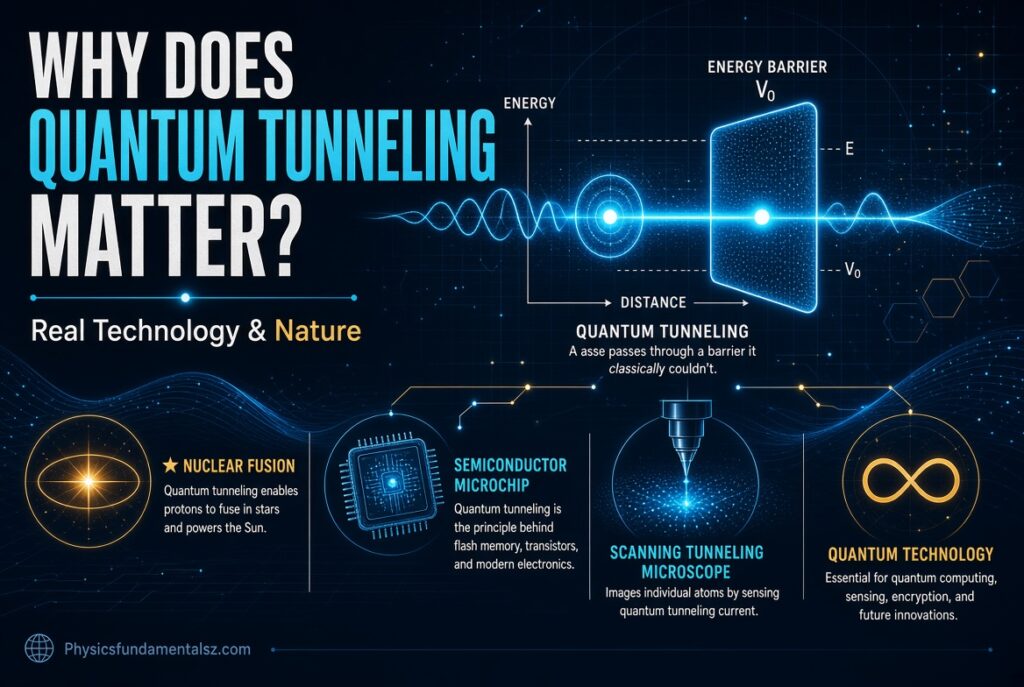
Quantum tunneling isn’t just a textbook curiosity. It directly explains how stars produce energy and how certain modern electronics function.
Without tunneling, nuclear fusion in the sun would be far too rare to sustain the energy output that powers life on Earth.
Frequently Asked Questions (FAQs)
What is quantum tunneling explained simply?
It’s when a particle passes through a barrier it doesn’t have enough energy to overcome, because it behaves as a wave rather than a solid object. This wave can partially “leak” through thin barriers.
Why does quantum tunneling happen?
It happens because particles are described by wave functions, not fixed points. These wave functions don’t drop to zero at a barrier, leaving a real chance the particle appears on the other side.
Is quantum tunneling proven or just theoretical?
It’s experimentally proven and used in real devices like tunnel diodes and scanning tunneling microscopes. It’s also confirmed through nuclear decay measurements.
Can quantum tunneling happen to large objects like humans?
Technically the probability is nonzero, but it’s so astronomically small for large objects that it’s effectively impossible. Tunneling is only significant at atomic and subatomic scales.
What factors increase the chance of tunneling?
A thinner barrier, a lower barrier height, and a lighter particle all increase tunneling probability. Higher particle energy close to the barrier height also helps.
How is quantum tunneling used in technology?
It’s used in tunnel diodes, flash memory, and scanning tunneling microscopes. These devices rely on controlled tunneling currents to function.
Does quantum tunneling violate the law of energy conservation?
No, energy is still conserved throughout the process. The particle doesn’t gain extra energy; it simply has a probability of being found beyond the barrier.
What is the role of the wave function in tunneling?
The wave function describes the probability of a particle’s location. Its ability to extend into and past a barrier is what makes tunneling mathematically possible.
How does quantum tunneling relate to the sun’s energy?
Protons in the sun’s core don’t have enough energy to overcome electric repulsion classically. Tunneling lets them fuse anyway, which is essential for the sun to shine.
What is a scanning tunneling microscope?
It’s an instrument that images individual atoms by measuring the tunneling current between a sharp tip and a material’s surface. It relies entirely on the tunneling effect to work.
Is quantum tunneling instantaneous?
The exact timing of tunneling is still debated in physics research. Most models treat it as extremely fast, though not necessarily infinite in speed.
Why don’t we see quantum tunneling in everyday life?
Everyday objects are far too massive and the barriers too wide for any measurable tunneling probability. The effect only becomes noticeable at atomic scales.
What is the difference between tunneling and simply going over a barrier?
Going over a barrier means having enough energy to classically overcome it, like a ball fully clearing a hill. Tunneling means passing through despite not having that energy.
Can electrons tunnel through insulators?
Yes, electrons can tunnel through very thin insulating layers. This is the basis for some semiconductor devices and memory technologies.
Who discovered quantum tunneling?
The concept emerged from early quantum mechanics work in the 1920s, with physicists like George Gamow applying it to explain radioactive alpha decay. It became a foundational part of quantum theory soon after.
Conclusion
Quantum tunneling explained simply comes down to one core idea: particles behave as waves, and waves don’t stop dead at barriers.
That wave-like leakage is what allows electrons, protons, and other particles to appear on the far side of barriers they technically shouldn’t cross.
From powering the sun to enabling modern electronics, this “impossible” quantum behavior turns out to be essential to how the universe actually works.