Thermal Energy & Internal Energy: Heat, Temperature & Q = mcΔT
Touch a hot stove and you feel pain instantly. Hold an ice cube and your fingers go numb within seconds. Both experiences come from the same underlying physics: the movement of atoms and molecules inside matter.
This movement is the foundation of thermal energy, and understanding it unlocks three ideas that students constantly mix up: heat, temperature, and internal energy.
By the end of this guide, you will know exactly what thermal energy is, how it connects to internal energy, why the formula Q = mcΔT works, and how to use it to solve real problems.
Table of Contents
What Is Thermal Energy?
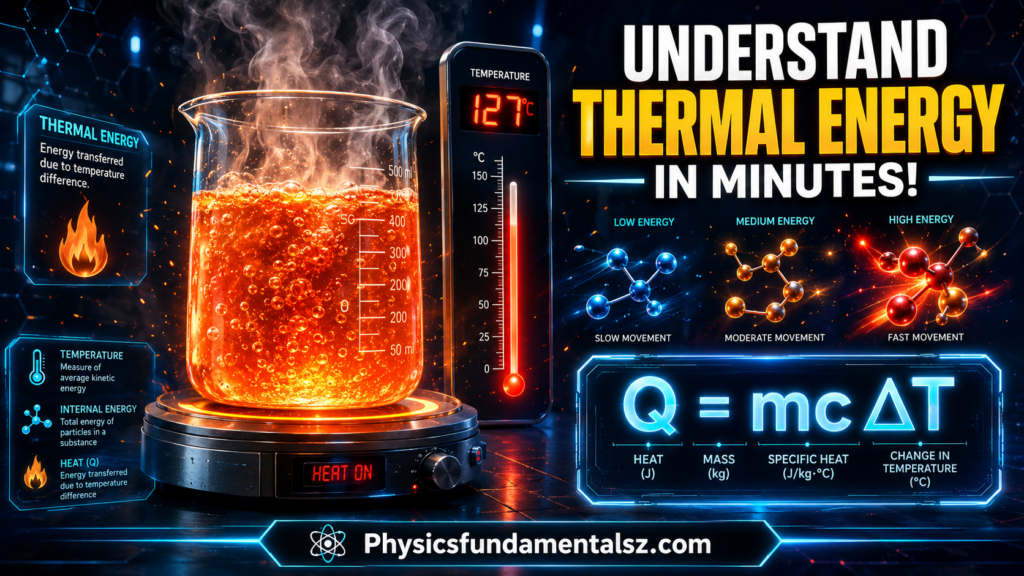
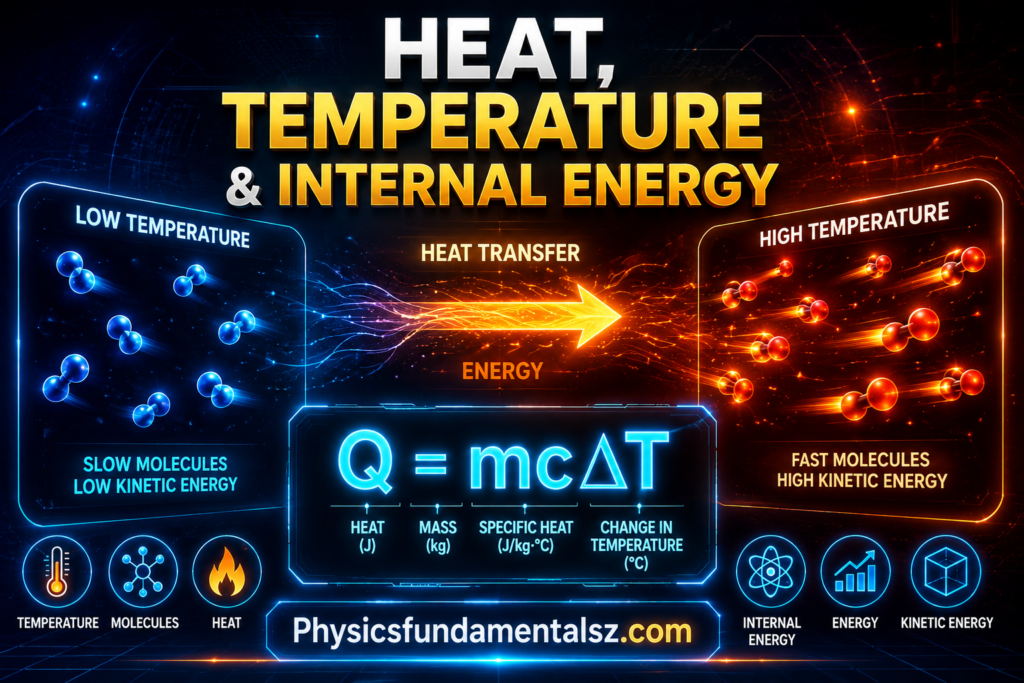
Thermal energy is the energy a substance has because of the random motion of its atoms and molecules. Every particle in a solid, liquid, or gas is constantly vibrating, rotating, or moving in a straight line, and each of these tiny motions carries kinetic energy. Add up all that microscopic kinetic energy across every particle in an object, and you get its thermal energy.
The faster the particles move, the more thermal energy the object has. This is why a pot of boiling water burns you instantly while lukewarm water barely feels warm. Same substance, same amount of matter, but wildly different particle speeds.
Thermal energy explains everyday phenomena you already know from other physics topics. It is the reason metal rods expand when heated, a process explored in detail in thermal expansion. It also explains why gas pressure rises when you heat a sealed container, which connects directly to the ideal gas law.
Thermal Energy vs Heat vs Temperature
These three words get used interchangeably in casual conversation, but in physics they mean very different things.
Temperature is a number. It tells you the average kinetic energy of the particles in a substance, nothing more. A thermometer measures temperature, not thermal energy.
Thermal energy is the total kinetic energy stored across all the particles in an object. A bathtub of lukewarm water can have more thermal energy than a cup of boiling water simply because it contains far more particles, even though its temperature is lower.
Heat is not a stored quantity at all. Heat is energy in transit, the thermal energy that flows from a hotter object to a colder one until both reach the same temperature. Once the flow stops, we stop calling it heat.
Key idea
Temperature measures how energetic the particles are on average. Thermal energy measures the total kinetic energy of all the particles combined. Heat is the transfer of that energy from one object to another.
What Is Internal Energy?
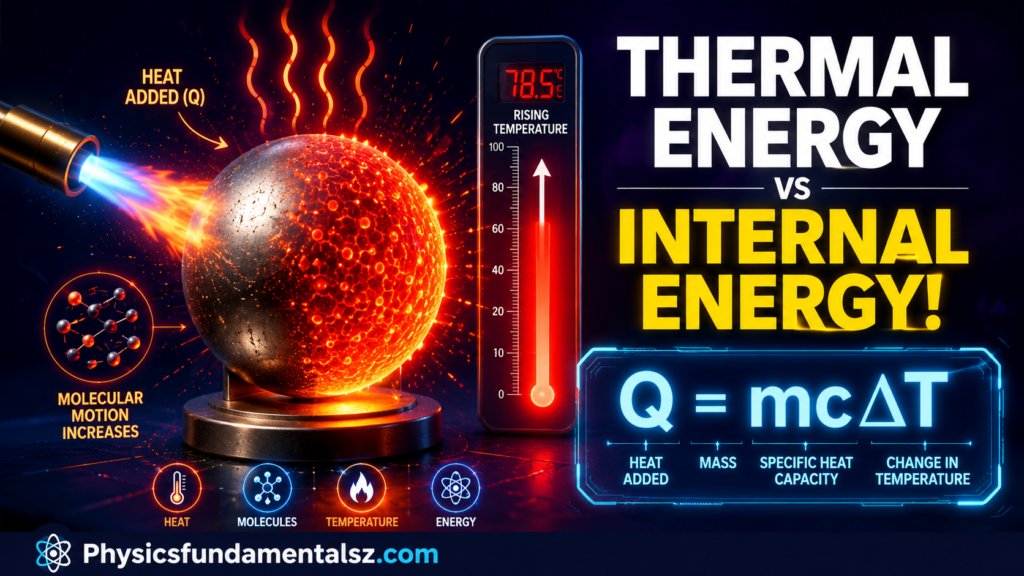
Internal energy takes the idea of thermal energy and expands it. Internal energy is the sum of two things inside a system: the kinetic energy of every particle (thermal energy) plus the potential energy stored in the bonds and forces between those particles.
For an ideal gas, where particles do not interact through intermolecular forces, internal energy and thermal energy are essentially the same thing. But for a real solid or liquid, internal energy also accounts for the potential energy locked in molecular bonds, which becomes important during phase changes like melting or boiling.
Internal Energy Formula and the First Law of Thermodynamics
Internal energy is central to the first law of thermodynamics, which states that the change in a system’s internal energy equals the heat added to the system minus the work done by the system:
ΔU = Q − W
Here ΔU is the change in internal energy, Q is heat added, and W is work done by the system on its surroundings. This single equation is the reason engines, refrigerators, and even your own body can be analyzed using energy bookkeeping. Nothing is created or destroyed, energy simply moves between heat, work, and internal energy.
How Are Heat and Temperature Related?
Heat flows naturally from a region of higher temperature to a region of lower temperature. It never spontaneously flows the other way, a fact tied to the second law of thermodynamics and the concept of entropy.
Thermal Equilibrium Explained
When two objects at different temperatures are placed in contact, heat flows from the hotter object to the colder one. Over time, both objects approach the same temperature. Once no more net heat flows between them, they have reached thermal equilibrium.
This is the principle behind a hot cup of coffee cooling to room temperature, or a metal spoon left in warm soup gradually heating up. Thermal equilibrium is also the foundation of calorimetry, the technique used to measure heat transfer experimentally.
The Q = mcΔT Formula Explained
The most practical tool for working with thermal energy is the equation:
Q = mcΔT
- Q is the heat energy added or removed, measured in joules
- m is the mass of the substance, measured in kilograms
- c is the specific heat capacity of the substance
- ΔT is the change in temperature, calculated as final temperature minus initial temperature
This formula tells you exactly how much heat energy is required to raise or lower the temperature of a given mass of material by a certain amount.
What Is Specific Heat Capacity (c)?
Specific heat capacity is the amount of energy needed to raise the temperature of one kilogram of a substance by one degree Celsius (or one Kelvin). It is a property of the material itself, and it varies enormously between substances.
Water has an unusually high specific heat capacity of about 4186 J/(kg·K), while metals like aluminum sit around 900 J/(kg·K) and iron around 450 J/(kg·K). This is why a metal spoon heats up almost instantly in soup while the soup itself takes much longer to change temperature. For a deeper breakdown of this property and how it varies across materials, see the full guide on specific heat capacity.
Worked Example Using Q = mcΔT
Suppose you want to heat 2 kg of water from 20°C to 80°C. Using the specific heat capacity of water, c = 4186 J/(kg·K):
Q = mcΔT Q = (2 kg)(4186 J/(kg·K))(80°C − 20°C) Q = (2)(4186)(60) Q = 502,320 J
So roughly 502 kilojoules of heat energy are needed to raise the temperature of that water by 60 degrees. This same formula is used in calorimetry problems, where the heat lost by a hot object equals the heat gained by a cooler one in an insulated system.
Here is a second example that shows how Q = mcΔT scales down to smaller, everyday situations. Imagine heating a 0.5 kg aluminum pan from 25°C to 200°C, using the specific heat capacity of aluminum, c = 900 J/(kg·K):
Q = mcΔT Q = (0.5 kg)(900 J/(kg·K))(200°C − 25°C) Q = (0.5)(900)(175) Q = 78,750 J
Notice how much less energy this takes compared to heating water, even across a larger temperature range. That is the direct result of aluminum’s much lower specific heat capacity. This is also why a frying pan can reach cooking temperature within a minute or two, while a pot of water on the same burner takes far longer to boil.
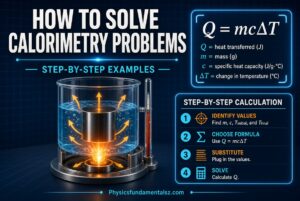
Calorimetry: Using Q = mcΔT for Two Objects
When a hot object is placed in contact with a cooler one inside an insulated system, no energy escapes to the surroundings. This means the heat lost by the hot object exactly equals the heat gained by the cold object:
m₁c₁(T_final − T₁) = −m₂c₂(T_final − T₂)
This equation is the backbone of calorimetry, the experimental method scientists use to measure specific heat capacities and heat transfer. A common example is dropping a heated piece of metal into a container of cool water and measuring the final equilibrium temperature. Because the metal cools rapidly while the water barely changes temperature, the calculation directly reveals just how large the gap in specific heat capacity between metals and water really is.
Why Different Materials Heat Up Differently
Specific heat capacity explains why sand at the beach becomes scorching hot in the sun while nearby ocean water stays relatively cool. Sand has a low specific heat capacity, so a small amount of absorbed thermal energy produces a large temperature increase. Water, with its high specific heat capacity, absorbs far more energy before its temperature rises noticeably.
This behavior is rooted in molecular structure and particle motion, concepts explained more fully in the kinetic theory of gases, which describes how temperature and pressure emerge from countless microscopic collisions.
How Thermal Energy Moves: Conduction, Convection and Radiation
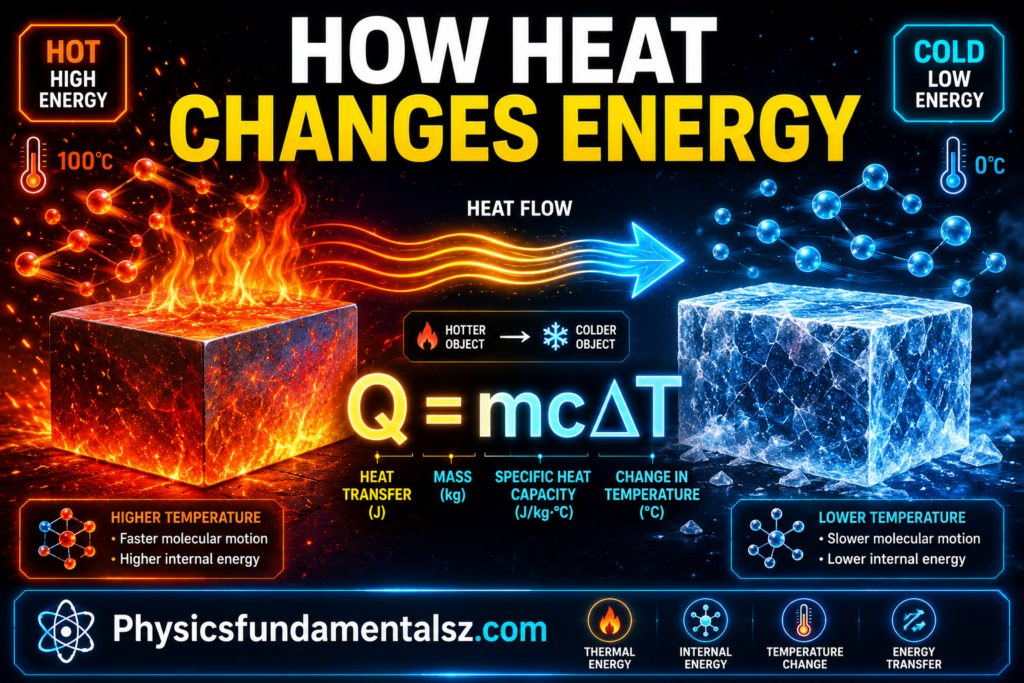
Once thermal energy exists in a system, it does not stay still. It moves through three distinct mechanisms.
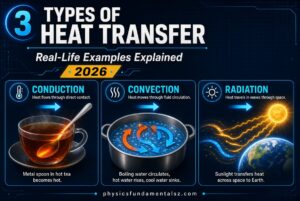
Conduction transfers thermal energy through direct contact between particles, such as heat traveling along a metal rod. Convection transfers thermal energy through the bulk movement of a fluid, such as warm air rising in a room. Radiation transfers thermal energy through electromagnetic waves and requires no medium at all, which is how the sun heats the Earth across empty space.
Each of these mechanisms follows different rules and different rates of transfer. A complete breakdown of all three, along with real world examples and formulas, is available in heat transfer: conduction, convection and radiation.
Thermal Energy and the Kinetic Theory of Gases
At the microscopic level, thermal energy in a gas comes entirely from the translational, rotational, and vibrational motion of its molecules. The kinetic theory of gases models a gas as a huge number of particles in constant random motion, colliding elastically with each other and the walls of their container.
This model directly explains temperature as a measure of average molecular kinetic energy, and it connects seamlessly to the ideal gas law, PV = nRT, which relates pressure, volume, temperature, and the number of gas particles. Together, these ideas show that thermal energy, temperature, and pressure are all expressions of the same underlying particle motion.
Real World Applications of Thermal Energy
Thermal energy is not just a textbook concept. It governs how car engines convert fuel into motion, how power plants generate electricity from steam, and how your body regulates its own temperature through sweat and blood flow. It explains why metal train tracks include small gaps to allow for thermal expansion, why thermometers work at all, and why a thermos flask keeps drinks hot by slowing conduction, convection, and radiation simultaneously.
Engineers use Q = mcΔT constantly when designing cooling systems, choosing building materials, and calculating how much energy a heating system needs to warm a room to a target temperature.
Frequently Asked Questions (FAQs)
Is thermal energy the same as heat?
No. Thermal energy is the total kinetic energy stored in the particles of a substance. Heat is the energy that flows between two objects because of a temperature difference. Once that flow stops, it is no longer called heat, but the object retains thermal energy.
What is the difference between internal energy and thermal energy?
Thermal energy refers only to the kinetic energy of particles due to their motion. Internal energy includes that kinetic energy plus the potential energy stored in molecular bonds and intermolecular forces. For simple ideal gases the two are nearly identical, but for real substances undergoing phase changes, internal energy accounts for more.
What is Q = mcΔT used for?
Q = mcΔT calculates how much heat energy is needed to change the temperature of a known mass of a substance by a known amount. It is used in calorimetry, engineering, cooking, climate science, and countless engineering calculations involving heating or cooling.
Why does water have a high specific heat capacity?
Water molecules form hydrogen bonds that require significant energy to disrupt. This means a large amount of heat can be absorbed with only a small rise in temperature, which is why oceans and lakes moderate climate temperatures and why water is used as a coolant in engines and power plants.
Can an object have zero thermal energy?
An object would have zero thermal energy only at absolute zero, 0 Kelvin, the theoretical temperature at which particle motion stops entirely. In practice, absolute zero has never been reached in any laboratory, and even at extremely low temperatures near it, particles retain a small amount of residual motion due to quantum effects. Every object you interact with in daily life has some nonzero thermal energy simply because its particles are always moving to some degree.
Bringing It All Together
Thermal energy, internal energy, heat, and temperature are four closely related but distinct ideas. Temperature measures average particle energy. Thermal energy measures the total kinetic energy of all particles combined.
Internal energy adds in stored potential energy between particles. Heat is simply energy moving from hot to cold. The formula Q = mcΔT ties all of this into a single practical tool for calculating exactly how much energy is involved whenever something heats up or cools down.
To keep building your understanding of thermodynamics, explore the first law of thermodynamics for energy conservation, the second law of thermodynamics for why heat only flows one way, and entropy explained for the deeper reason behind that one way flow.