Lenz’s Law: The Direction of Induced Current Explained
If you’ve ever wondered why a magnet dropped through a copper pipe falls in slow motion, you’ve already witnessed Lenz’s law in action.
This single principle explains why induced currents always fight back against the change that creates them — and it’s the reason generators, induction cooktops, and train brakes all work the way they do.
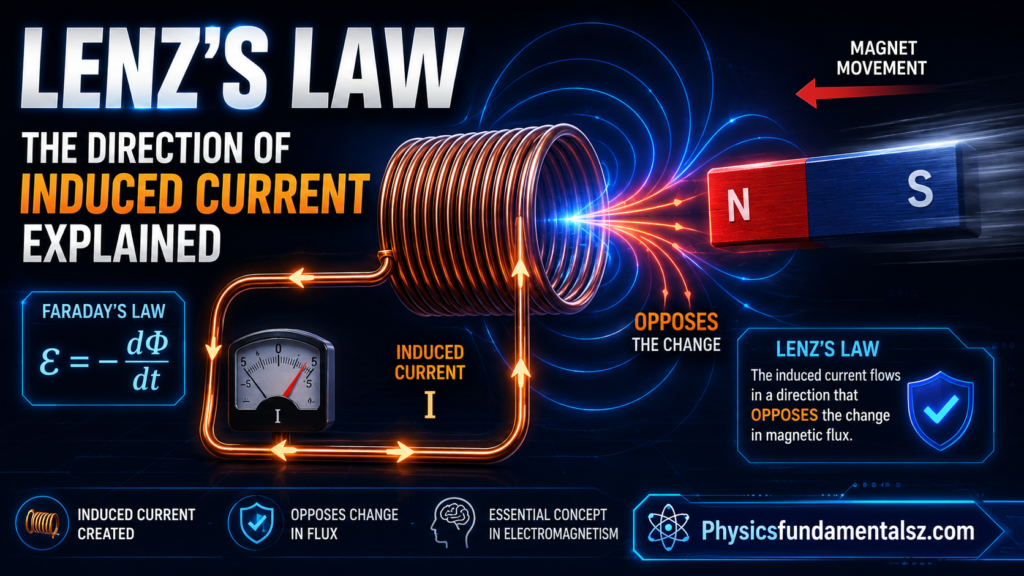
Lenz’s Law states that the direction of an induced current in a conductor is always such that the magnetic field it creates opposes the change in magnetic flux that produced it.
It was formulated in 1834 by Baltic German physicist Heinrich Friedrich Emil Lenz and is a direct consequence of the law of conservation of energy.
Table of Contents
What Is Lenz’s Law?
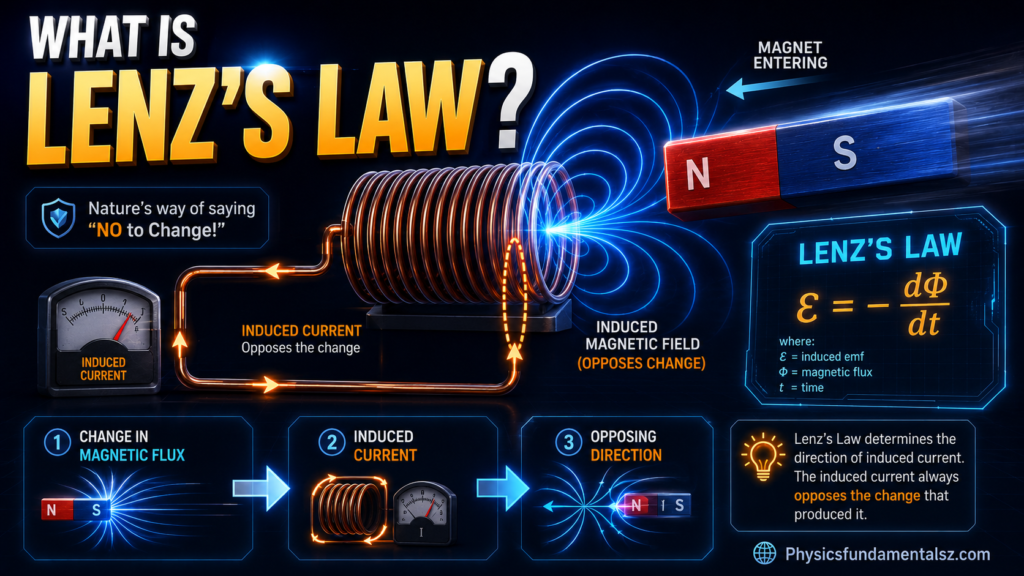
Definition: Lenz’s law states that when a magnetic flux through a circuit changes, the current induced in that circuit flows in a direction such that its own magnetic field opposes the original change in flux.
In plain terms, nature resists change. If a magnetic field through a loop of wire increases, the induced current will flow in the direction that creates an opposing magnetic field — one that pushes back against that increase. If the flux decreases, the induced current flows the opposite way, trying to keep the flux from dropping.
This opposition isn’t arbitrary. It’s the reason induction doesn’t run away with itself — without it, a magnet approaching a coil could theoretically induce a current that pulls the magnet in faster and faster, creating energy from nothing. Lenz’s law rules that out.
Who Discovered Lenz’s Law?
Lenz’s law is named after Heinrich Friedrich Emil Lenz, a Baltic German physicist who formulated the law in 1834, building on the electromagnetic induction work of Michael Faraday. Lenz’s careful, systematic experiments with induced currents earned the law his name, distinguishing his directional rule from Faraday’s broader discovery that a changing magnetic field induces a current in the first place.
Lenz’s Law Formula
Lenz’s law is expressed mathematically within Faraday’s law of induction:
ε = −N (dΦ/dt)
Where:
| Symbol | Meaning |
|---|---|
| ε (epsilon) | Induced electromotive force (EMF), measured in volts |
| N | Number of turns (loops) in the coil |
| Φ (Phi) | Magnetic flux through one loop, measured in webers |
| dΦ/dt | Rate of change of magnetic flux over time |
| − (negative sign) | Represents Lenz’s law — the induced EMF opposes the change in flux |
The negative sign is the mathematical signature of Lenz’s law. Faraday’s law tells you the magnitude of the induced EMF; the negative sign, which is Lenz’s contribution, tells you the induced current always opposes the change that caused it.
How Lenz’s Law Relates to Faraday’s Law
Quick answer: Faraday’s law tells you that a changing magnetic field induces a current. Lenz’s law tells you which direction that current flows.
Think of them as a two-part answer to one question. Faraday’s law of electromagnetic induction establishes that a changing magnetic flux through a circuit generates an electromotive force and therefore a current. But Faraday’s original formulation doesn’t specify direction on its own — that’s where Lenz’s law comes in, supplying the directional rule and the negative sign in the formula.
Why Lenz’s Law Matters: Conservation of Energy
Lenz’s law is a direct application of the law of conservation of energy to electromagnetism. Because the induced current opposes the change producing it, extra mechanical work must be done to keep that change happening — and that extra work is exactly what gets converted into electrical energy.
Example: Pushing a magnet into a coil takes more force than moving it through empty space, because the induced current’s magnetic field pushes back against the magnet. The additional effort you exert becomes the electrical energy carried by the induced current — energy isn’t created from nothing; it’s converted from the mechanical work you put in.
Finding the Direction of Induced Current
The most common tool for finding the direction of an induced current is the right-hand rule, sometimes shown as Fleming’s right-hand rule in some textbooks.
- Point your right thumb in the direction of the conventional magnetic field.
- Curl your fingers — they show the direction of the induced current needed to oppose the change in flux.
- Alternatively, use the “opposition” shortcut: figure out which way the flux is changing (increasing or decreasing), then apply the current direction that would create a magnetic field working against that change.
A simpler mental checklist:
- Flux increasing → induced current opposes the increase, creating a field in the opposite direction of the original field.
- Flux decreasing → induced current tries to maintain the flux, creating a field in the same direction as the original field.
Worked Examples
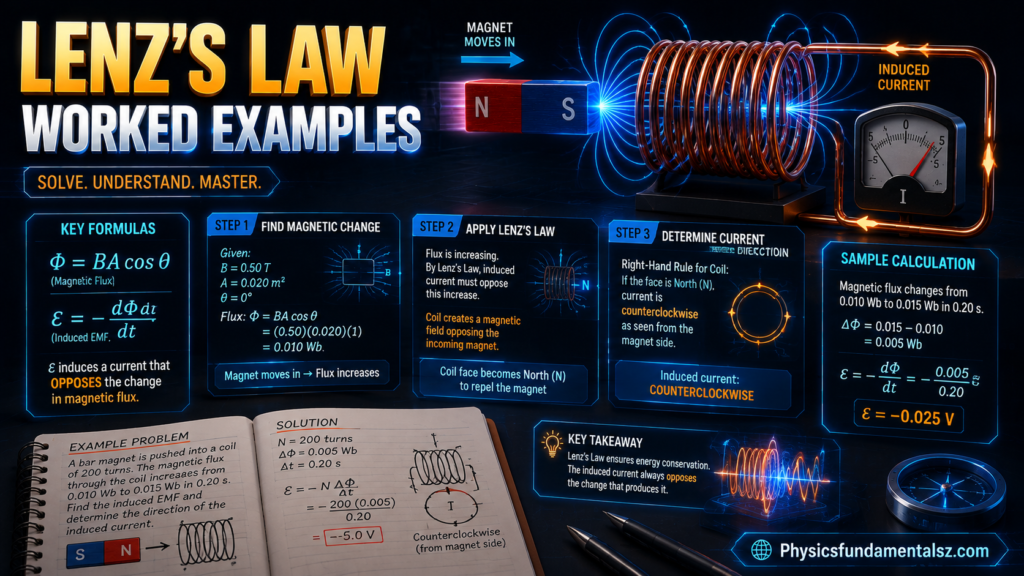
Example 1: Bar Magnet Approaching a Coil
As a bar magnet’s north pole moves toward a coil, the magnetic flux through the coil increases. By Lenz’s law, the induced current flows in the direction that creates a magnetic field opposing that increase — which means the coil effectively presents a north pole toward the approaching magnet, repelling it.
Example 2: Bar Magnet Moving Away from a Coil
As the same magnet is pulled away, the flux through the coil decreases. The induced current reverses direction, now creating a field that attracts the magnet back — resisting its departure, just as it resisted its approach.
Example 3: A Magnet Falling Through a Conducting Tube
Drop a strong magnet through a copper or aluminum pipe and it falls noticeably slower than it would in free fall. As it moves, it induces eddy currents in the pipe wall, and by Lenz’s law those currents create magnetic fields that oppose the magnet’s motion — producing a braking effect with no physical contact at all.
Eddy Currents and Lenz’s Law
Quick answer: Eddy currents are loops of electric current induced within a solid conductor by a changing magnetic field, and Lenz’s law governs the direction they flow.
Unlike the induced current in a simple wire loop, eddy currents circulate within the bulk of a conductor — in a metal plate, disk, or pipe — flowing in closed loops perpendicular to the changing magnetic field. Their opposing magnetic fields, dictated by Lenz’s law, are what make them useful for contact-free braking and heating.
| Eddy Current Effect | Result |
|---|---|
| Opposes relative motion between conductor and field | Used for braking (eddy current brakes) |
| Generates resistive heating in the conductor | Used for induction heating and cooking |
| Alters a coil’s electrical impedance near metal | Used in metal detectors |
| Damps oscillation in a moving conductor | Used in galvanometers and some sensors |
Real-World Applications
Lenz’s law isn’t just theoretical — it’s built into everyday technology.
| Application | How Lenz’s Law Is Used |
|---|---|
| Electric generators | The induced current opposes the coil’s rotation, so mechanical energy input is required to keep generating electricity |
| Induction cooktops | An oscillating magnetic field induces eddy currents in the cookware, and the metal’s resistance to those currents produces heat |
| Eddy current brakes (trains, roller coasters) | A moving conductive plate through a magnetic field generates opposing eddy currents that slow it with no physical contact |
| Metal detectors | Eddy currents induced in a nearby metal object change the detector coil’s electrical behavior, triggering a signal |
| Transformers | Induced currents and their opposing fields help regulate energy transfer between coils |
| Wireless chargers | Changing magnetic fields induce current in a receiving coil, following the same opposition principle |
| Magnetic damping (galvanometers, sensitive instruments) | Eddy currents slow a moving needle or component smoothly, without mechanical friction |
Lenz’s Law vs. Faraday’s Law
| Aspect | Faraday’s Law | Lenz’s Law |
|---|---|---|
| What it explains | That a changing magnetic flux induces an EMF | The direction of the induced current |
| Formula role | Gives the magnitude of induced EMF | Supplies the negative sign showing opposition |
| Type of law | Quantitative | Qualitative (directional) |
| Discovered by | Michael Faraday | Heinrich Lenz |
| Year | 1831 | 1834 |
Common Mistakes and Misconceptions
- Confusing Lenz’s law with Faraday’s law. Faraday’s law gives you the size of the induced EMF; Lenz’s law gives you the direction. They work together, not separately.
- Assuming the induced current opposes the magnetic field itself. It actually opposes the change in flux, not the field as a whole — this distinction matters when the flux is decreasing rather than increasing.
- Forgetting the negative sign’s meaning. The negative sign in the formula isn’t just a mathematical formality; it’s the direct expression of Lenz’s law.
- Overlooking eddy currents as an application. Many real-world uses of Lenz’s law, like induction cooktops and brakes, come from eddy currents rather than currents in a simple wire loop.
Lenz’s Law and Newton’s Third Law
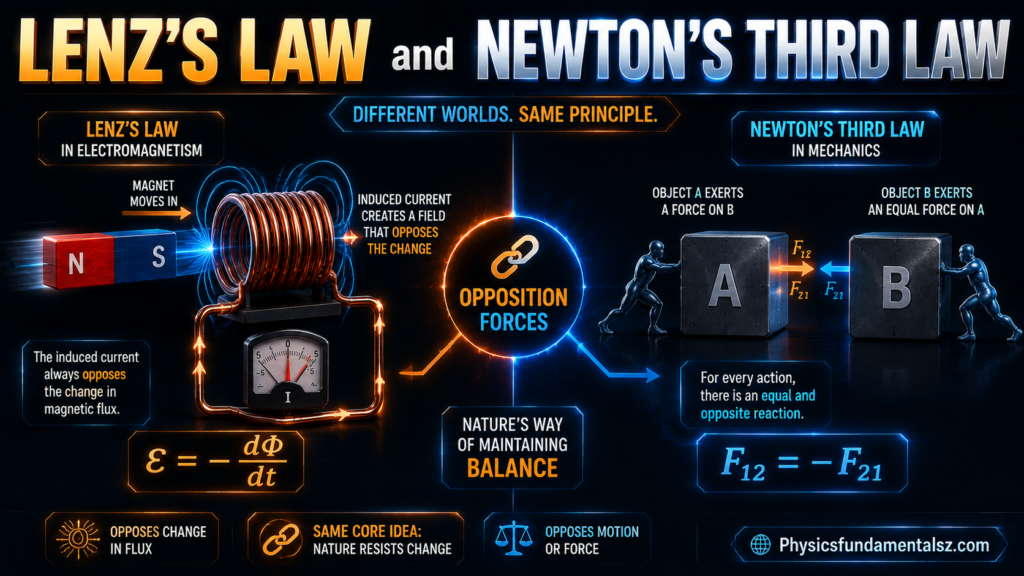
Lenz’s law is often compared to Newton’s third law of motion — for every action, there is an equal and opposite reaction. In electromagnetic terms, the “action” is the changing magnetic flux, and the “reaction” is the induced current’s opposing magnetic field. This parallel is also echoed in chemistry’s Le Chatelier’s principle, where a system shifts to counteract an imposed change — all three describe systems that resist disturbance to maintain equilibrium.
Frequently Asked Questions (FAQs)
1. What is Lenz’s law in simple terms?
Lenz’s law says that an induced electric current always flows in a direction that opposes the change in magnetic field that created it.
2. Who discovered Lenz’s law and when?
Heinrich Friedrich Emil Lenz, a Baltic German physicist, formulated the law in 1834.
3. What is the formula for Lenz’s law?
ε = −N (dΦ/dt), where the negative sign represents the opposition described by Lenz’s law.
4. What does the negative sign in Lenz’s law mean?
It shows that the induced EMF and current act in the direction opposite to the change in magnetic flux that produced them.
5. How is Lenz’s law different from Faraday’s law?
Faraday’s law explains that a changing magnetic flux induces an EMF and gives its magnitude; Lenz’s law specifies the direction of that induced current.
6. Why does Lenz’s law matter for energy conservation?
Because the induced current opposes its cause, extra mechanical work is required to sustain the change, and that work is converted into electrical energy rather than created from nothing.
7. What is the right-hand rule in Lenz’s law?
It’s a technique where pointing your thumb along the magnetic field direction and curling your fingers shows the direction of the induced current needed to oppose the flux change.
8. What are eddy currents?
Eddy currents are closed loops of electric current induced within a solid conductor by a changing magnetic field, governed by the same opposition principle as Lenz’s law.
9. How does Lenz’s law apply to electric generators?
As a coil rotates in a magnetic field inside a generator, the induced current opposes the rotation, meaning mechanical energy must be continuously supplied to keep the generator turning.
10. How do induction cooktops use Lenz’s law?
A coil under the cooktop creates a rapidly changing magnetic field, which induces eddy currents in the metal cookware; the cookware’s resistance to those currents produces heat.
11. How do eddy current brakes work?
A conductive plate or wheel moving through a magnetic field generates eddy currents whose magnetic fields oppose the motion, producing smooth, contact-free braking.
12. Is Lenz’s law the same as Newton’s third law?
They’re not identical, but Lenz’s law is often compared to Newton’s third law because both describe a system producing an equal and opposite reaction to an applied change.
13. Does Lenz’s law apply to AC and DC circuits?
Yes. Lenz’s law applies whenever magnetic flux through a circuit changes, whether that change comes from an alternating current, a moving magnet, or a varying DC source.
14. What happens if there were no opposition described by Lenz’s law?
Without it, an induced current could theoretically reinforce the change that created it, leading to runaway energy gain — which would violate the conservation of energy.
15. What is magnetic flux?
Magnetic flux is a measure of the total magnetic field passing through a given area, and it’s the changing value of this flux that induces current according to Faraday’s and Lenz’s laws.
16. Can Lenz’s law be demonstrated with a simple experiment?
Yes — dropping a strong magnet through a non-magnetic conductive tube, like copper or aluminum, shows visible braking caused by eddy currents opposing the magnet’s fall.
17. Why do metal detectors use Lenz’s law?
A metal detector’s oscillating magnetic field induces eddy currents in nearby metallic objects, and those currents alter the detector coil’s electrical properties enough to be sensed.
18. Is Lenz’s law used in transformers?
Yes. Induced currents and their opposing magnetic fields play a role in how transformers transfer and regulate energy between coils.
19. What is the difference between induced EMF and induced current?
Induced EMF is the voltage generated by a changing magnetic flux, while induced current is the actual flow of charge that results when that EMF drives current through a closed circuit.
20. Why is Lenz’s law considered a qualitative law?
Because it specifies only the direction of the induced current, not its magnitude — the magnitude comes from Faraday’s law.
Key Takeaways
- Lenz’s law states that induced current always flows in a direction that opposes the change in magnetic flux that created it.
- It was formulated in 1834 by physicist Heinrich Lenz and is expressed by the negative sign in the formula ε = −N (dΦ/dt).
- Lenz’s law is a direct consequence of the conservation of energy and is often compared to Newton’s third law.
- The right-hand rule is the standard technique for determining the direction of an induced current.
- Real-world applications include electric generators, induction cooktops, eddy current brakes, metal detectors, and transformers.