Interference of Waves: Constructive, Destructive & Superposition Explained
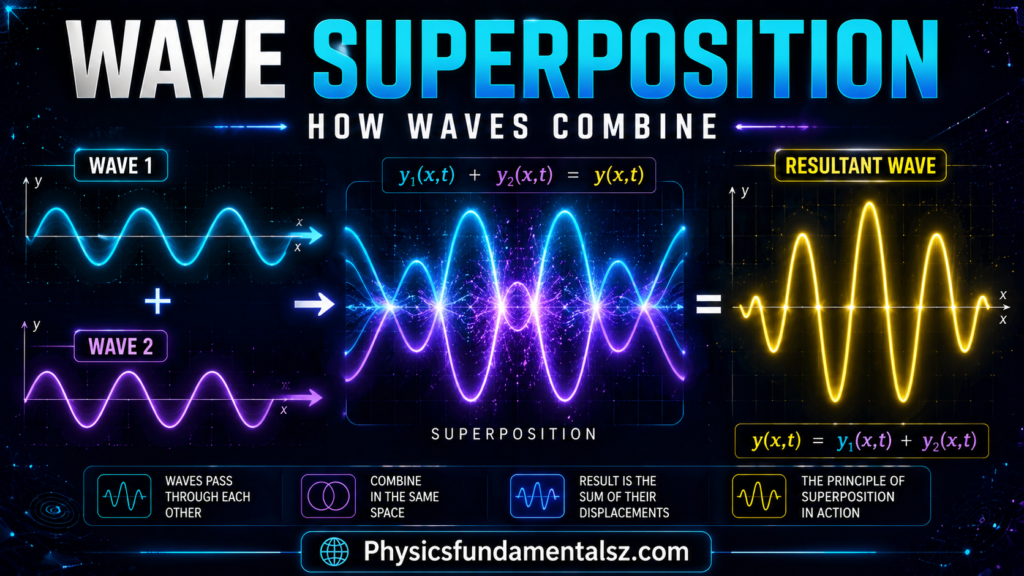
When two waves meet at the same point in space, they do not bounce off each other like billiard balls. Instead, they combine, and the result depends entirely on how the two waves line up.
This combining effect is called Interference of Waves, and it is one of the most far reaching ideas in physics.
It explains the colors in a soap bubble, the silence inside noise cancelling headphones, and the pattern of bright and dark fringes that first convinced scientists light behaves as a wave.
Table of Contents
What Is Interference of Waves?
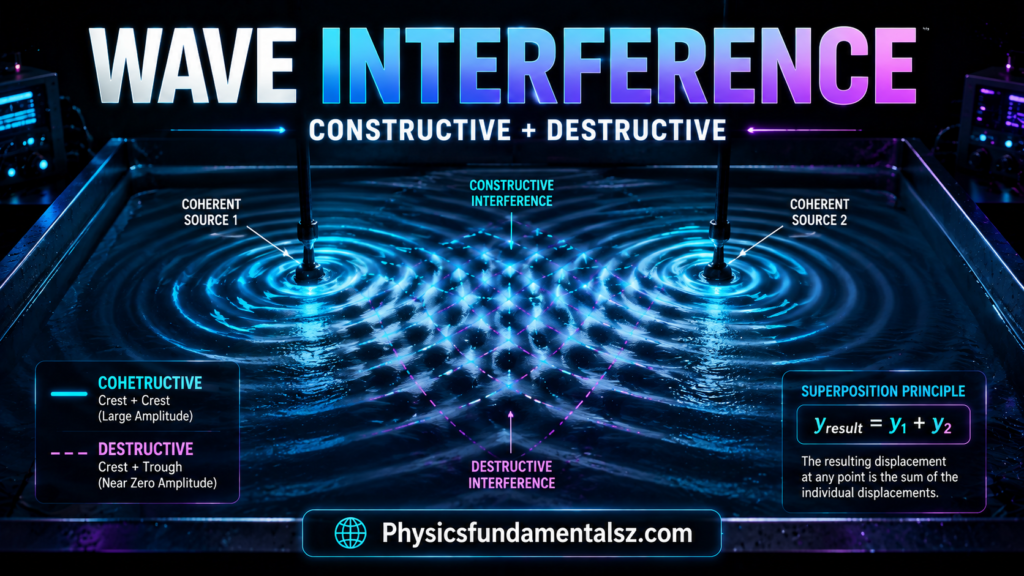
Interference of waves is what happens when two or more waves overlap in the same region of a medium at the same time. Each wave keeps traveling as if the other were not there, but at every point where they overlap, their effects add together. Once the waves pass through each other, they continue on unchanged, carrying no permanent trace of the encounter.
This only produces a clear, steady pattern when the two waves are coherent, meaning they have the same frequency and a constant phase relationship. Two independent light bulbs, for example, produce light waves that shift phase randomly relative to each other thousands of times per second, so no stable interference pattern ever forms. A laser, or two slits fed by a single source, keeps that phase relationship locked, which is why interference experiments rely on coherent sources.
Sound waves, water waves, and light waves are all linear waves, and interference of waves is a property shared by all of them. Whether it is ripples spreading from two pebbles dropped in a pond or two beams of laser light crossing on a screen, the underlying rule is identical.
The Principle of Superposition
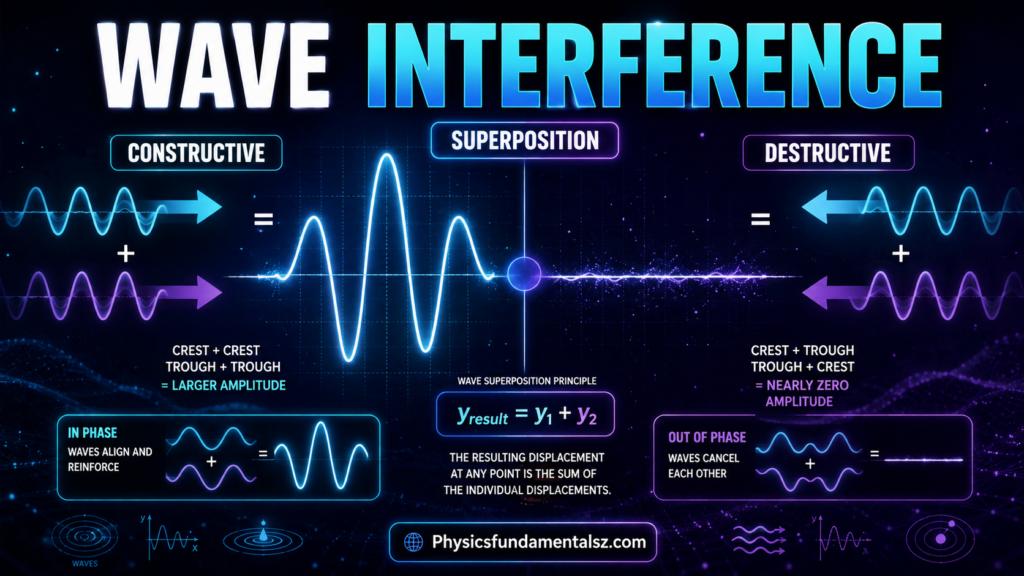
The principle of superposition is the mathematical foundation behind everything in this article. It states that when two or more waves overlap at a point, the resultant displacement at that point is simply the algebraic sum of the individual displacements each wave would have produced on its own.
y_total = y1 + y2
This sounds simple, but it has a powerful consequence. It means you never need to solve a new, complicated equation for what happens when waves collide. You just add the individual wave functions together, point by point, instant by instant. The superposition principle applies equally to mechanical waves traveling through a rope or a spring, sound waves moving through air, and electromagnetic waves such as light.
Where the waves happen to line up crest to crest, the addition produces a bigger wave. Where a crest lines up with a trough, the addition produces a smaller wave, or none at all. These two extreme outcomes are called constructive interference and destructive interference.
Constructive Interference: When Waves Add Up
Constructive interference happens when two waves meet in phase, meaning their crests align with crests and their troughs align with troughs. Because the displacements point the same way at every instant, superposition adds them together and the resulting wave has a larger amplitude than either original wave.
For constructive interference to occur, the path difference between the two waves, meaning the extra distance one wave travels compared to the other before reaching a given point, must equal a whole number of wavelengths.
Path difference = nλ, where n = 0, 1, 2, 3…
Here λ (lambda) is the wavelength and n is any integer. When this condition is met, the waves arrive perfectly in step, and their amplitudes reinforce one another. In light, this shows up as a bright fringe. In sound, it shows up as a louder point. In water, it shows up as an unusually tall ripple where two wavefronts cross.
Destructive Interference: When Waves Cancel
Destructive interference is the opposite case. It happens when two waves meet completely out of phase, meaning the crest of one wave arrives exactly where the trough of the other wave arrives. Superposition still applies, but now the two displacements point in opposite directions, so they subtract from each other rather than add. If the two waves have equal amplitude, they cancel out entirely and the medium stays flat.
Destructive interference occurs when the path difference between the two waves equals a half integer number of wavelengths.
Path difference = (n + 1/2)λ, where n = 0, 1, 2, 3…
This condition produces a dark fringe in light experiments, a quiet spot in sound, or a flat point on a water surface where two ripples meet exactly out of step. Noise cancelling headphones use this principle directly: a microphone detects incoming ambient sound, and the headphones generate an inverted version of that same waveform. The two combine through destructive interference and the sound is effectively cancelled before it ever reaches your ear.
Young’s Double Slit Experiment: Interference of Waves in Action
The clearest demonstration of interference of waves is Young’s double slit experiment, first performed in 1801. A single coherent light source shines through two narrow, closely spaced slits. Each slit acts as a new source of circular wavefronts, and because both sets of wavefronts came from the same original source, they stay perfectly coherent with each other as they spread out and overlap.
On a screen placed beyond the slits, this overlap produces an alternating series of bright and dark bands, called fringes. The bright fringes appear wherever the path difference from the two slits satisfies the constructive interference condition, and the dark fringes appear wherever it satisfies the destructive interference condition.
This experiment was historically significant because it gave strong evidence that light behaves as a wave, at a time when many physicists still pictured light purely as a stream of particles. For the full derivation of the fringe spacing formula and how the slit geometry determines the pattern, see our detailed breakdown of Young’s double slit experiment.
Coherence, Phase Difference, and Path Difference
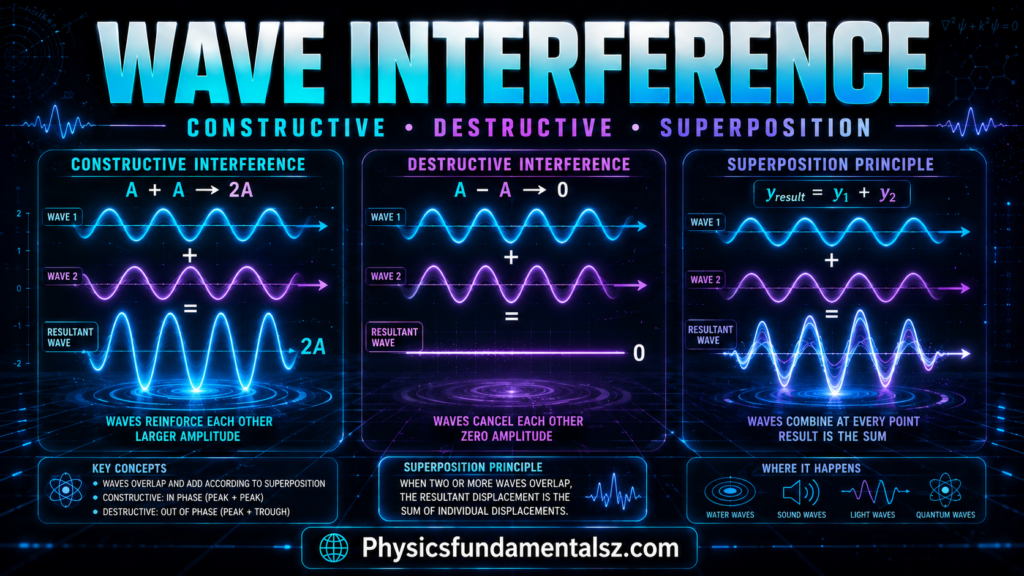
Three terms come up constantly when discussing interference of waves, and it helps to keep them distinct.
Coherence describes whether two sources maintain a constant, predictable phase relationship over time. Only coherent sources produce a stable, observable interference pattern. Incoherent sources still technically interfere at every instant, but the pattern shifts so rapidly that it averages out to nothing visible.
Phase difference describes how far out of step two waves are at a given point, usually measured in degrees or radians. A phase difference of zero means the waves are perfectly in phase, and a phase difference of 180 degrees (or π radians) means they are perfectly out of phase.
Path difference describes the actual physical distance one wave travels beyond the other to reach a point. Path difference and phase difference are directly linked: a path difference of one full wavelength always corresponds to a phase difference of 360 degrees, or one complete cycle. This relationship is what allows the constructive and destructive interference formulas to be written either in terms of wavelength or in terms of phase angle.
Interference of Waves in Light
Interference of light waves relies on the same superposition rules as any other wave, but the very short wavelength of visible light, roughly 400 to 700 nanometers, makes the fringe spacing extremely fine. This is why interference in light usually requires carefully controlled setups, such as double slits or thin films, rather than being visible in ordinary daylight.
Thin film interference is one of the most familiar everyday examples. When light reflects off both the top and bottom surfaces of a thin film, such as a soap bubble or a layer of oil on water, the two reflected waves travel slightly different path lengths and then recombine. Because the path difference depends on the thickness of the film and the wavelength of light, different colors satisfy the constructive interference condition at different thicknesses, which is why soap bubbles display shifting rainbow swirls as the film thickness changes across their surface.
Interference of light waves is closely tied to the concepts of reflection and how light behaves at a boundary between two materials. If you want the background on how light bends and bounces before it interferes, our article on reflection and refraction covers the underlying rules.
Interference of Sound Waves
Sound is a mechanical wave, and it interferes exactly according to the same superposition principle as light, just with pressure variations in air instead of electric and magnetic fields. When two speakers play the same tone, certain spots in a room will sound noticeably louder, where constructive interference boosts the pressure wave, and other spots will sound quieter or almost silent, where destructive interference cancels it out. Anyone who has walked around a room with stereo speakers playing a single test tone has likely noticed these “dead spots” without realizing they were standing in a zone of destructive interference.
This is also the operating principle behind active noise cancelling technology, and it connects closely to standing waves, which form when interference happens between a wave and its own reflection traveling back in the opposite direction. For a full explanation of how these reflected interference patterns create fixed nodes and antinodes in musical instruments, see our guide to standing waves and resonance.
Interference and Polarisation
Interference effects in light are also connected to polarisation, since only light waves that share the same polarisation direction interfere in the simple way described above. Two coherent light waves with perpendicular polarisations do not produce visible bright and dark fringes in the usual sense, because their electric field oscillations do not align to reinforce or cancel each other the same way. To understand how polarisation direction affects the intensity of light passing through different materials, see our article on polarisation of light.
Real World Applications of Wave Interference
Interference of waves is not just a classroom demonstration. It underlies a surprising number of real technologies and natural phenomena.
- Noise cancelling headphones generate an inverted sound wave that destructively interferes with ambient noise.
- Anti-reflective coatings on camera lenses and eyeglasses use thin film interference to cancel out reflected light at specific wavelengths, letting more light through the lens.
- Radio and Wi-Fi signal strength varies from room to room partly because reflected signals interfere constructively or destructively with the direct signal.
- Soap bubbles and oil slicks display shifting rainbow colors due to thin film interference of light waves.
- Musical instruments rely on interference between traveling waves and their own reflections to create standing waves and produce specific musical notes.
- Radio telescopes and interferometry combine signals from multiple antennas using interference of waves to achieve far sharper resolution than any single antenna could produce alone.
Frequently Asked Questions (FAQs)
What is the difference between constructive and destructive interference?
Constructive interference occurs when two waves meet in phase, so their amplitudes add together and produce a larger resultant wave. Destructive interference occurs when two waves meet completely out of phase, so their amplitudes subtract and the resultant wave is smaller, or cancels entirely if the original amplitudes were equal.
Why do interference patterns require coherent waves?
A stable interference pattern requires the phase relationship between the two waves to stay constant over time. If the sources are incoherent, meaning their relative phase drifts randomly, the pattern of reinforcement and cancellation shifts too fast to observe, and the visible result averages out to uniform brightness or loudness instead of distinct fringes.
Does interference of waves violate conservation of energy?
No. In regions of constructive interference, the energy is not created from nothing. It is redistributed from the regions of destructive interference, where energy is reduced. Averaged across a complete interference pattern, the total energy always matches what the two waves carried individually.
Is interference of waves only relevant to light?
No. Interference of waves applies to any type of wave, including sound waves, water waves, and radio waves. Light interference is simply the most commonly studied case because it is the basis of experiments like Young’s double slit experiment, which historically proved that light behaves as a wave.
Key Idea
Superposition is the rule, and constructive and destructive interference are simply its two extreme outcomes. Waves that meet in phase add up to something bigger.
Waves that meet in exact opposition cancel out. Everything in between produces a partial reinforcement or partial cancellation, which is why real interference patterns show a smooth gradient of brightness or loudness rather than a sudden jump between fully bright and fully dark.