Diffraction: Single Slit, Diffraction Gratings & dsinθ = nλ Explained
Have you ever noticed how you can hear someone talking around a corner before you can see them? That’s diffraction at work.
Diffraction is the bending and spreading of waves — light, sound, water, or radio waves — as they pass around obstacles or through narrow openings. It happens most noticeably when the size of the opening or obstacle is close to the wave’s wavelength.
Table of Contents
What Is Diffraction? (Quick Definition)
Quick Answer: Diffraction is a wave phenomenon in which waves bend around obstacles and spread out after passing through narrow openings. It occurs with light, sound, water waves, radio waves, X-rays, and even particles like electrons.
Diffraction in Simple Terms
Imagine dropping a stone into a pond next to a wooden post. The ripples don’t stop dead at the post — they curve around it and keep spreading on the other side. That’s diffraction with water waves, and the same principle applies to light and sound.
Formal Physics Definition
In physics, diffraction refers to the apparent bending of waves around small obstacles and the spreading of waves after they pass through small openings (apertures). It’s a direct consequence of the wave nature of light and other forms of radiation, and it happens because every point on a wavefront acts as a source of new, secondary waves — a concept known as Huygens’ principle.
One key consequence: diffraction means sharp, perfectly clean shadows don’t actually exist. Look closely at any shadow edge, and you’ll find a faint blur — that blur is diffraction.
The History of Diffraction
Understanding where diffraction came from helps explain why it’s such a foundational concept in physics.
- Francesco Maria Grimaldi (1665) — First observed and named the phenomenon after noticing light didn’t cast perfectly sharp shadows.
- Christiaan Huygens (1678) — Proposed that every point on a wavefront generates its own spherical wavelet, laying the mathematical groundwork for wave theory.
- Thomas Young (1801) — Conducted the famous double-slit experiment, proving light behaves as a wave by showing interference patterns.
- Augustin-Jean Fresnel (early 1800s) — Combined Huygens’ idea with the principle of interference, creating the Huygens–Fresnel principle that still underlies modern diffraction theory.
- William Henry Bragg and William Lawrence Bragg (1912–1913) — Applied diffraction to X-rays, developing Bragg’s law, which enabled scientists to determine crystal structures — including, decades later, the structure of DNA.
This progression — from a simple observation to a rigorous mathematical theory used in modern crystallography — is a good example of how foundational physics concepts evolve into powerful scientific tools.
How Diffraction Works (The Physics Explained)
The Huygens–Fresnel Principle
Every point on a wavefront can be treated as a source of new secondary wavelets. These wavelets spread out and combine (interfere) with each other. Where they combine constructively, you get bright bands or reinforced signal; where they cancel out (destructive interference), you get dark bands or weakened signal.
This is why a diffraction pattern isn’t just “spread light” — it’s a structured pattern of bright and dark bands, created by constructive interference and destructive interference.
Why Wavelength and Aperture Size Matter
Diffraction becomes noticeable when the wavelength of the wave is comparable to or larger than the size of the obstacle or opening it passes through.
- Long wavelengths (like sound or radio waves) diffract easily around everyday objects — doors, walls, buildings.
- Short wavelengths (like visible light) only show strong diffraction through very narrow openings, such as a slit a fraction of a millimeter wide.
This single rule explains a huge number of real-world observations, from why you can hear music through a wall but not see through it, to why telescopes need enormous mirrors to resolve fine detail.
Types of Diffraction
| Type | Description | Where It Applies |
|---|---|---|
| Fraunhofer (far-field) diffraction | Occurs when the light source and observation screen are effectively at infinite distance (parallel wavefronts) | Diffraction gratings, laser optics, telescopes |
| Fresnel (near-field) diffraction | Occurs when the source or screen is close to the diffracting object (curved wavefronts) | Shadows of nearby objects, near-field optics |
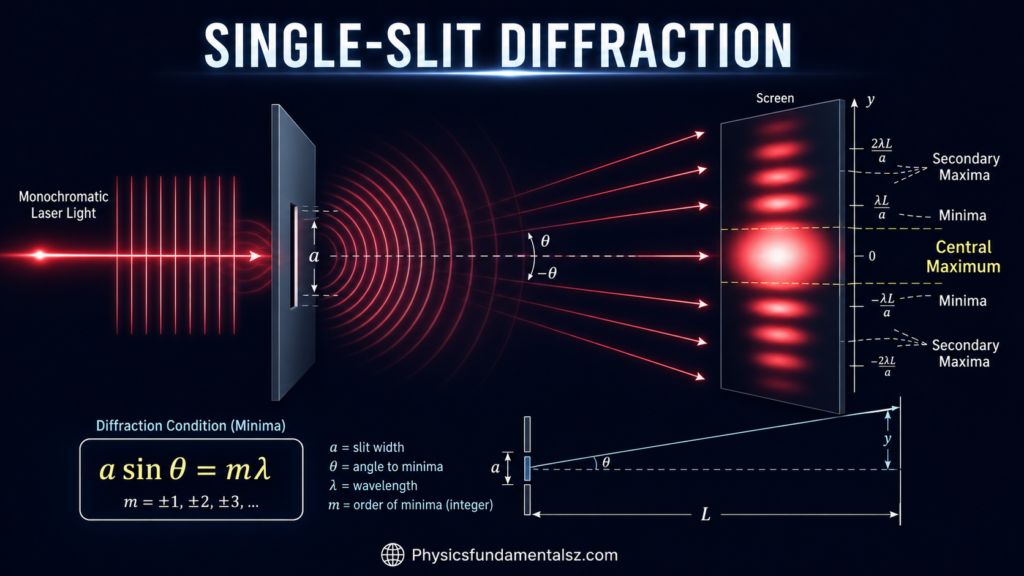
| Single-slit diffraction | A wave passes through one narrow opening, spreading into a central bright band with weaker side bands | Basic optics demonstrations, laser experiments |
| Double-slit diffraction | A wave passes through two closely spaced slits, producing an interference-diffraction pattern | Young’s experiment, quantum mechanics foundations |
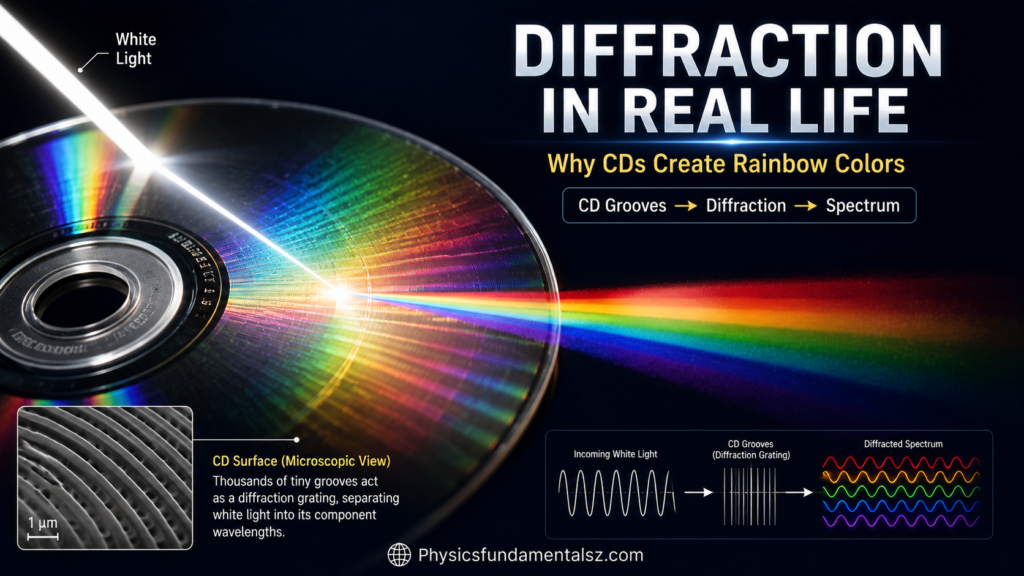
| Diffraction grating (multi-slit) | Many closely spaced slits or grooves split light into sharp, separated spectral lines | Spectrometers, spectroscopy, CD/DVD rainbow effect |
Fraunhofer vs. Fresnel Diffraction
The distinction matters because it changes which mathematical approximation physicists use to predict the resulting pattern:
- Fraunhofer diffraction assumes parallel wavefronts and is mathematically simpler — it’s the model used for most classroom slit and grating problems.
- Fresnel diffraction accounts for wavefront curvature and is used when the source or observation point is close to the aperture, such as in near-field optics and some modern photonics applications.
Diffraction vs. Other Wave Phenomena
One of the most common points of confusion is telling diffraction apart from refraction, interference, reflection, and scattering. Here’s a direct, side-by-side breakdown.
| Phenomenon | What Happens | Trigger | Example |
|---|---|---|---|
| Diffraction | Wave bends around an obstacle or spreads through an opening | Obstacle/opening comparable to wavelength | Sound bending around a corner |
| Refraction | Wave changes direction and speed when passing through a new medium | Change in medium (air → water, air → glass) | A straw looking bent in a glass of water |
| Interference | Two or more waves overlap and combine (constructively or destructively) | Multiple coherent wave sources | Bright/dark bands in a double-slit pattern |
| Reflection | Wave bounces off a surface | Hitting a boundary/surface | Light bouncing off a mirror |
| Scattering | Wave is redirected in many directions by small particles | Interaction with particles smaller than wavelength | The sky appearing blue (Rayleigh scattering) |
Diffraction vs. Refraction
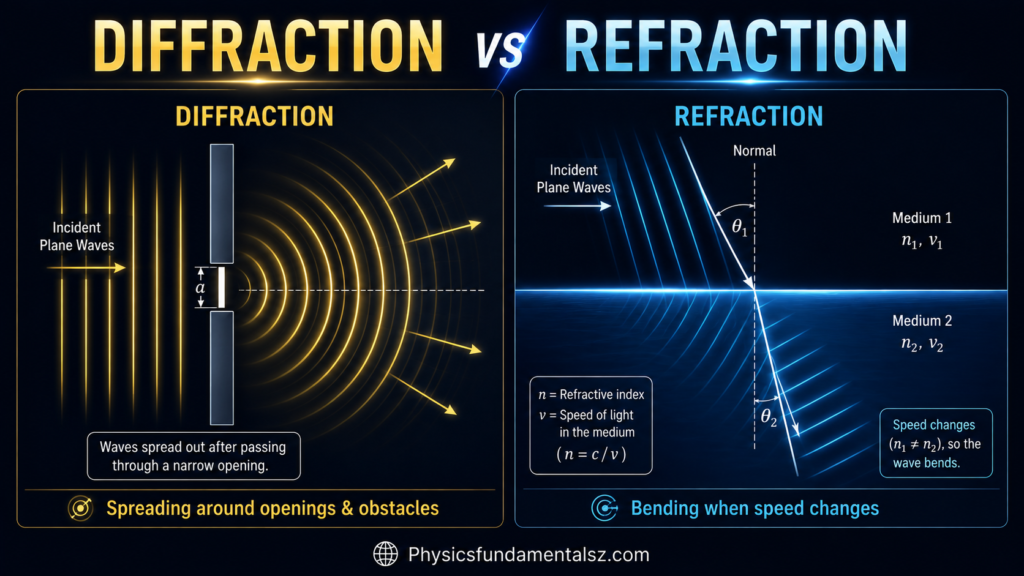
Quick Answer: Refraction bends waves as they pass through a different medium (like air into water); diffraction bends waves around obstacles or through narrow openings, without necessarily changing medium.
A classic mix-up: refraction follows Snell’s law and depends on the refractive index of the two materials. Diffraction depends purely on wavelength versus opening/obstacle size — no change in medium is required at all.
Diffraction vs. Interference
Quick Answer: Diffraction is the spreading of a single wave around an obstacle or opening; interference is what happens when two or more waves overlap and combine. In practice, real diffraction patterns (like the double-slit pattern) are actually a combination of both effects.
Diffraction vs. Scattering
Quick Answer: Diffraction involves organized wave-bending around structures comparable in size to the wavelength, producing predictable patterns. Scattering involves waves being redirected by particles, often much smaller than the wavelength, in a less structured way. The sky’s blue color, for example, is caused by Rayleigh scattering — not diffraction.
Diffraction Across Different Wave Types
Diffraction isn’t limited to light. It’s a universal wave behavior. Here’s how it plays out across different types of waves.
| Wave Type | Typical Wavelength Range | Everyday Diffraction Example |
|---|---|---|
| Light (visible) | ~400–700 nanometers | Rainbow effect on a CD/DVD surface |
| Sound | ~17 mm – 17 m | Hearing conversation around a corner or wall |
| Water waves | Centimeters to meters | Waves bending around a harbor jetty or small island |
| Radio waves | Millimeters to kilometers | Wi-Fi or radio signals reaching around buildings |
| X-rays | ~0.01–10 nanometers | Determining crystal and molecular structures |
| Electrons (matter waves) | Sub-nanometer (De Broglie wavelength) | Electron microscopy, proving particle-wave duality |
Diffraction of Light
Light diffraction is the most commonly studied form, largely because it’s visually striking and mathematically well understood through the Huygens–Fresnel principle. It’s the basis for diffraction gratings, spectrometers, and much of modern optical engineering.
Diffraction of Sound
Sound waves have much longer wavelengths than light, so they diffract far more easily around everyday objects. This is why you can hear a conversation through an open doorway without seeing the speaker — the sound wave bends around the doorframe far more than light does.
Diffraction of Water Waves
Ocean and harbor engineers rely on diffraction models to predict how waves behave around jetties, breakwaters, and islands. When a wave hits a barrier, part of it bends and continues into the “shadow” zone behind the obstacle — a critical factor in coastal engineering and surf forecasting.
Diffraction of Radio Waves
Radio and Wi-Fi signals diffract around buildings and obstacles, which is partly why you can still get a signal indoors or around corners, even without a direct line of sight to a transmitter. Signal strength still weakens with distance and obstruction, but diffraction is one reason coverage isn’t limited strictly to line-of-sight.
X-Ray Diffraction
X-ray diffraction (XRD) is one of the most powerful tools in modern science. Because X-ray wavelengths are similar in scale to the spacing between atoms in a crystal, X-rays diffract predictably off crystal lattices, producing patterns that reveal atomic structure. This technique, guided by Bragg’s law, was essential in determining the double-helix structure of DNA.
Electron Diffraction
Electrons, despite being particles, also produce diffraction patterns — direct experimental proof of wave-particle duality in quantum mechanics. Electron diffraction underlies modern electron microscopy, which achieves far higher resolution than light microscopes because electron wavelengths are much shorter than visible light.
The Diffraction Grating Equation
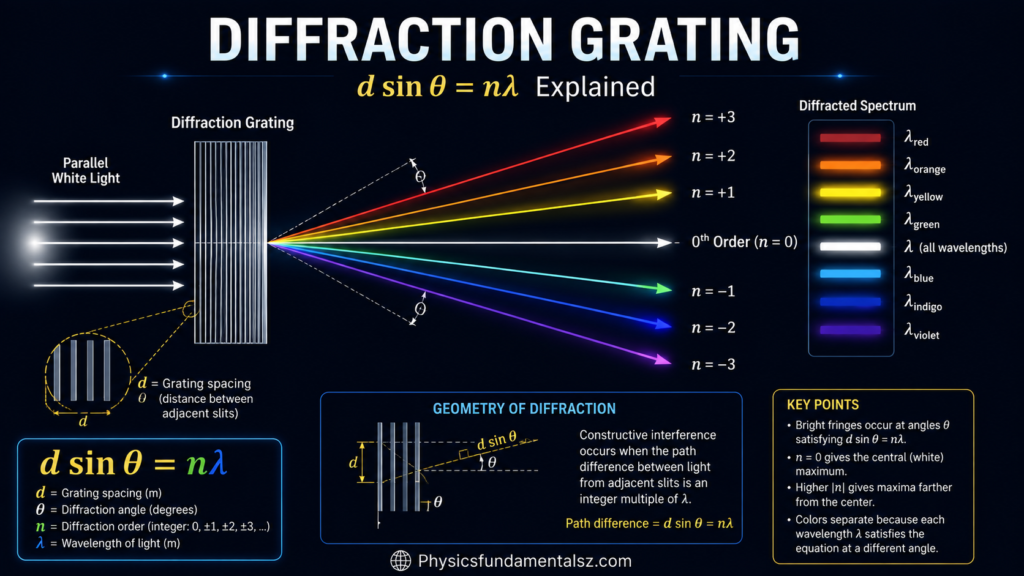
A diffraction grating is a surface etched with thousands of closely spaced parallel lines or grooves. When light passes through or reflects off it, the grating splits the light into its component wavelengths — much like a prism, but with far greater precision.
Formula Breakdown
The core diffraction grating equation is:
d sin θ = mλ
| Variable | Meaning |
|---|---|
| d | Distance between adjacent grating lines |
| θ (theta) | Angle of the diffracted beam from the normal |
| m | Diffraction order (an integer: 0, ±1, ±2, …) |
| λ (lambda) | Wavelength of the light |
Worked Example
Suppose a diffraction grating has 500 lines per millimeter, meaning d = 1/500 mm = 2,000 nm. If red light with a wavelength of λ = 650 nm passes through it, the first-order diffraction angle (m = 1) is found by:
sin θ = (mλ) / d = (1 × 650) / 2000 = 0.325
θ = sin⁻¹(0.325) ≈ 19°
This kind of calculation is exactly how spectrometers determine the wavelength — and therefore the chemical composition — of light sources, from lab samples to distant stars.
The Diffraction Limit
Quick Answer: The diffraction limit is the fundamental boundary on how sharp or detailed an optical image can be, caused by diffraction of light through a lens or aperture. No optical system, no matter how well built, can beat this physical limit.
The Rayleigh Criterion
The Rayleigh criterion defines the minimum angular separation at which two point sources of light (like two stars) can be distinguished as separate, rather than blurring into one. It’s directly tied to the wavelength of light and the diameter of the aperture (lens or mirror) being used.
Larger apertures reduce diffraction effects and improve resolution — which is exactly why telescopes use huge primary mirrors, and why professional camera lenses are physically larger than smartphone lenses.
Diffraction-Limited Telescopes and Microscopes
- Telescopes: A telescope’s maximum possible resolution is set by its aperture diameter relative to the wavelength of light being observed. This is why observatories build enormous mirrors — bigger apertures push the diffraction limit lower, revealing finer detail.
- Microscopes: Traditional light microscopes are diffraction-limited to roughly half the wavelength of visible light (~200 nanometers), which is why techniques like electron microscopy (using much shorter electron wavelengths) are used to see smaller structures, such as viruses.
Diffraction and Camera Lens Sharpness
Photographers encounter diffraction directly. At very small apertures (high f-stop numbers, such as f/16 or f/22), diffraction spreads light across more pixels than the sensor can cleanly resolve, softening overall image sharpness — even though a smaller aperture normally increases depth of field. This trade-off is often called diffraction-limited aperture, and it’s a key consideration in landscape and macro photography.
Real-World Examples of Diffraction
Everyday Examples
- Hearing conversation or music around a corner before seeing the source.
- The rainbow-colored reflection you see on the surface of a CD or DVD.
- Slightly blurred, fuzzy edges on shadows, even in bright, direct light.
- Wi-Fi signals reaching rooms without a direct line of sight to the router.
- Ocean waves bending around a jetty, harbor wall, or small island.
Scientific and Industrial Applications
- Spectroscopy: Diffraction gratings split light into spectral lines, letting scientists identify the chemical composition of stars, gases, and materials.
- X-ray crystallography: Used to determine molecular and crystal structures, including landmark discoveries like the structure of DNA.
- Holography: Relies on diffraction and interference patterns to record and reconstruct three-dimensional images.
- Fiber optics: Diffraction principles inform the design of components used in high-speed data transmission.
- Semiconductor lithography: Diffraction effects must be carefully managed when manufacturing microchips, where feature sizes approach the wavelength of the light used in the process.
- Laser diffraction particle sizing: Industrial instruments measure particle size distributions in powders and liquids by analyzing how they diffract laser light.
How to Observe Diffraction (Simple Experiments)
You don’t need a lab to see diffraction for yourself.
- CD/DVD rainbow test: Hold a CD or DVD up to a bright light source and tilt it slowly — the closely spaced tracks act as a diffraction grating, splitting light into visible spectral colors.
- Two-pencil slit test: Hold two pencils close together to form a narrow slit, and look at a small, bright light source (like a distant streetlight) through the gap. You’ll see the light spread into a pattern of bands.
- Fabric or feather test: Look at a bright light source through a tightly woven fabric or a bird feather — the fine, regular fibers create a visible diffraction pattern.
- Doorway sound test: Stand outside an open doorway where you can’t see into the room, and notice how you can still clearly hear sound coming from inside — a simple demonstration of acoustic diffraction.
Safety tip: Never look directly at intense light sources, including lasers or the sun, even during a diffraction demonstration.
Common Mistakes and Misconceptions
- Mistake: Assuming diffraction and refraction are the same thing. Reality: Refraction requires a change in medium; diffraction does not.
- Mistake: Believing diffraction only applies to light. Reality: It applies to all wave phenomena, including sound, water, radio waves, and even particles like electrons.
- Mistake: Thinking smaller camera apertures always produce sharper images. Reality: Beyond a certain point, diffraction actually reduces sharpness.
- Mistake: Assuming diffraction patterns are random. Reality: They’re highly predictable and governed by precise mathematical equations.
Expert Tips
- When comparing diffraction and interference, remember: diffraction is about a single wave interacting with an obstacle or opening, while interference is about multiple waves interacting with each other. Real-world patterns, like the double-slit experiment, usually show both effects simultaneously.
- If you’re a photographer trying to avoid diffraction softness, check your camera and lens’s documented “diffraction-limited aperture” — staying below that f-stop value preserves maximum sharpness.
- For students: the grating equation (d sin θ = mλ) is the single most exam-relevant formula in this topic — practice it with different wavelengths and grating spacings until it’s second nature.
Key Takeaways
- Diffraction is the bending and spreading of waves around obstacles or through narrow openings.
- It applies to all wave types: light, sound, water, radio waves, X-rays, and even electrons.
- Diffraction becomes significant when the wavelength is comparable to the size of the obstacle or opening.
- It differs from refraction (medium change), interference (multiple wave interaction), reflection (bouncing), and scattering (particle redirection).
- The Huygens–Fresnel principle explains diffraction mathematically, using the idea of secondary wavelets.
- The diffraction grating equation (d sin θ = mλ) is used to calculate diffraction angles precisely.
- The diffraction limit sets the maximum possible resolution for telescopes, microscopes, and camera lenses.
- Real-world applications range from spectroscopy and X-ray crystallography to Wi-Fi signal propagation and photography.
Frequently Asked Questions (FAQs)
1. What is diffraction in simple terms?
Diffraction is when a wave — like light or sound — bends around an obstacle or spreads out after passing through a narrow opening.
2. What is the scientific definition of diffraction?
Diffraction is the apparent bending of waves around small obstacles and their spreading after passing through small apertures, explained by the Huygens–Fresnel principle.
3. What causes diffraction to occur?
Diffraction occurs when a wave encounters an obstacle or opening comparable in size to its wavelength, causing the wave to bend and spread rather than travel in a perfectly straight line.
4. Who discovered diffraction?
Francesco Maria Grimaldi first observed and named diffraction in 1665, after noticing that light didn’t produce perfectly sharp shadows.
5. What is Huygens’ principle?
Huygens’ principle states that every point on a wavefront acts as a source of new spherical wavelets, which combine to form the wave’s future shape.
6. What are three examples of diffraction in everyday life?
Hearing sound around a corner, seeing rainbow colors on a CD surface, and slightly blurred shadow edges are all everyday examples of diffraction.
7. Does diffraction only happen with light?
No. Diffraction happens with all wave types, including sound, water waves, radio waves, X-rays, and even particles like electrons.
8. What is the difference between diffraction and refraction?
Refraction bends waves as they pass into a different medium; diffraction bends waves around obstacles or through openings without requiring a medium change.
9. What is the difference between diffraction and interference?
Diffraction describes a single wave spreading around an obstacle or opening; interference describes how two or more waves combine, constructively or destructively.
10. What is the difference between diffraction and reflection?
Reflection is a wave bouncing off a surface; diffraction is a wave bending around an obstacle or spreading through an opening.
11. What is the difference between diffraction and scattering?
Scattering redirects waves through interaction with small particles, while diffraction involves structured wave-bending around obstacles or openings comparable to the wavelength.
12. Why does diffraction increase with longer wavelengths?
Longer wavelengths are more likely to be comparable in size to everyday obstacles and openings, making the bending effect more noticeable.
13. What is Fraunhofer diffraction?
Fraunhofer diffraction occurs when the light source and observation screen are effectively at infinite distance, producing parallel wavefronts — the standard model for gratings and slits.
14. What is Fresnel diffraction?
Fresnel diffraction accounts for wavefront curvature and applies when the light source or observation point is close to the diffracting object.
15. What is single-slit diffraction?
Single-slit diffraction occurs when a wave passes through one narrow opening, producing a central bright band flanked by weaker side bands.
16. What did Young’s double-slit experiment prove?
It proved that light behaves as a wave, since the resulting interference pattern could only be explained by wave behavior, not particle behavior alone.
17. What is a diffraction grating?
A diffraction grating is a surface with thousands of closely spaced lines that splits light into its component wavelengths with high precision.
18. What is the diffraction grating equation?
The equation is d sin θ = mλ, where d is the line spacing, θ is the diffraction angle, m is the diffraction order, and λ is the wavelength.
19. What is X-ray diffraction used for?
X-ray diffraction is used to determine the atomic and molecular structure of crystals, famously including the structure of DNA.
20. What is Bragg’s law?
Bragg’s law describes the conditions under which X-rays diffract constructively off the atomic planes of a crystal, enabling structural analysis.
21. Does sound diffract more than light? Why?
Yes. Sound waves have much longer wavelengths than light, so they diffract more easily around everyday-sized objects.
22. What is the diffraction limit in optics?
The diffraction limit is the maximum possible resolution an optical system can achieve, caused by diffraction of light through its aperture.
23. Why do camera photos get blurry at very small apertures?
At very small apertures (high f-stop numbers), diffraction spreads light across more sensor pixels than can be cleanly resolved, softening image detail.
24. Is diffraction proof that light is a wave?
Yes. Diffraction patterns can only be explained if light behaves as a wave, making it one of the key pieces of evidence for the wave theory of light.
25. How is diffraction used in real life? Diffraction underpins spectroscopy, X-ray crystallography, holography, fiber optics, semiconductor manufacturing, and particle-size analysis, among many other applications.
Conclusion
Diffraction explains far more of the world around you than most people realize — from why you can hear around corners, to how scientists mapped the structure of DNA.
Once you understand that it comes down to a simple relationship between wavelength and obstacle size, the everyday examples and advanced applications both start to make intuitive sense.
Whether you’re a student working through the grating equation, a photographer managing lens sharpness, or simply curious about how waves behave, diffraction is a foundational concept that connects classroom physics to real, tangible technology.