Kirchhoff’s Laws Advanced: Solving Multi-Loop Circuits Step by Step
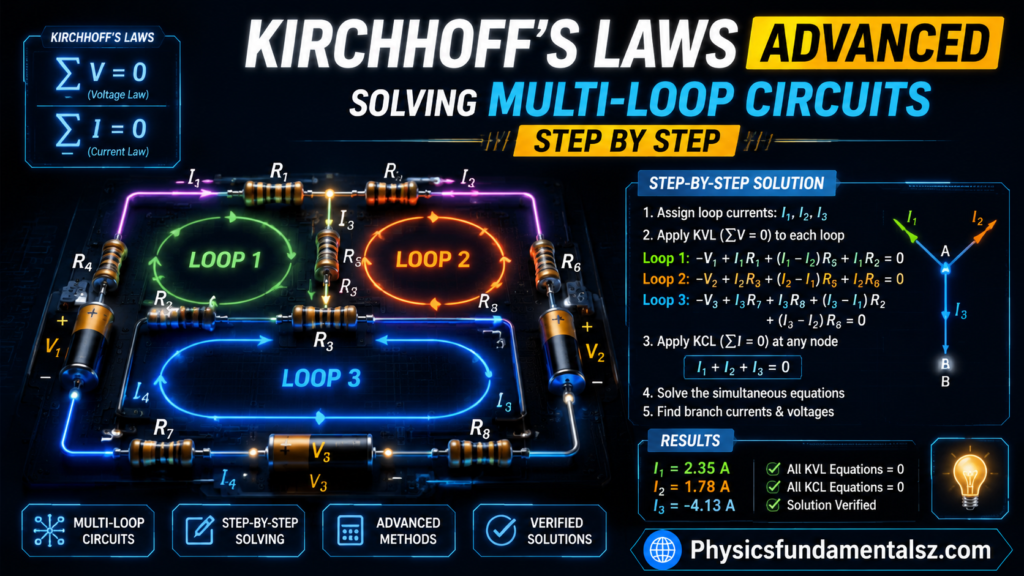
Basic Kirchhoff’s Laws Advanced get you through a single-loop circuit. They fall apart the moment you’re staring at four nodes, two voltage sources, one dependent source, and a deadline. That’s the gap this guide closes.
Kirchhoff’s Current Law (KCL) and Kirchhoff’s Voltage Law (KVL) are simple to state but genuinely hard to apply once a circuit has multiple loops, mixed source types, or an AC waveform.
Table of Contents
What “Advanced” Kirchhoff’s Law Analysis Means
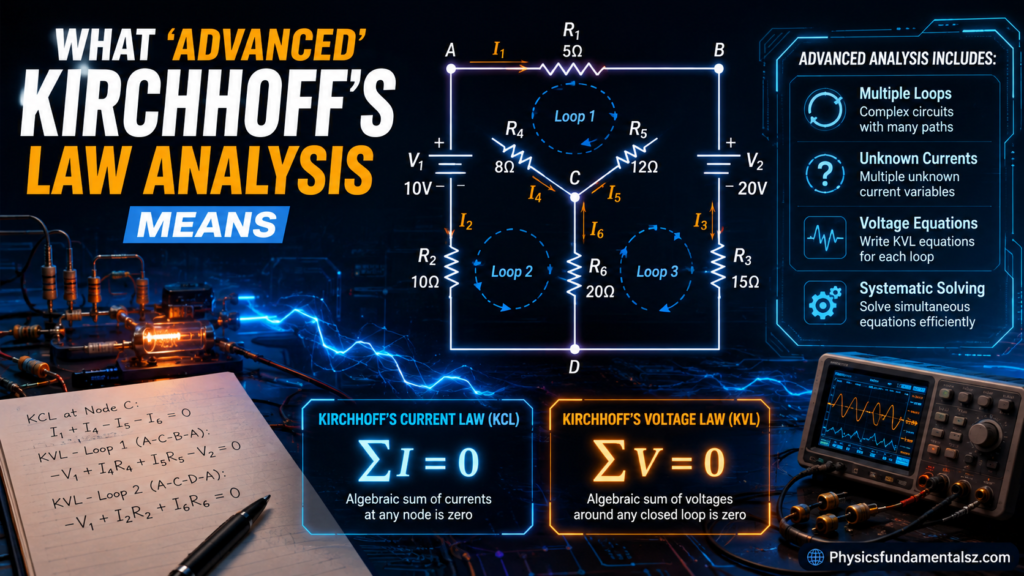
Advanced Kirchhoff’s law analysis refers to using KCL and KVL systematically — through mesh analysis, nodal analysis, supernodes, supermeshes, and phasor notation — to solve circuits with multiple sources, loops, or components that basic series-parallel reduction can’t handle. It extends the same two conservation principles (charge and energy) into matrix-based, AC, and nonlinear-adjacent problem-solving.
Key takeaways:
- KCL and KVL don’t change in advanced analysis — the bookkeeping method does.
- Mesh analysis (loop currents) and nodal analysis (node voltages) turn Kirchhoff’s laws into solvable systems of equations.
- Supernodes and supermeshes handle voltage/current sources that don’t fit the standard pattern.
- In AC circuits, the same laws apply to phasors, with impedance replacing resistance.
- Kirchhoff’s laws are an approximation that breaks down at high frequencies and with distributed circuit elements.
Kirchhoff’s Laws Recap — KCL and KVL in One Minute
Before going further, a fast refresher, since every advanced technique is built directly on these two rules.
Kirchhoff’s Current Law (KCL)
KCL states that the total current entering a node equals the total current leaving it. It’s a direct statement of conservation of charge — charge can’t accumulate at a point in a circuit under steady conditions, so whatever flows in must flow out.
Kirchhoff’s Voltage Law (KVL)
KVL states that the algebraic sum of all voltage rises and drops around any closed loop equals zero. This is conservation of energy applied to an electrical loop: whatever energy a source supplies per unit charge must be exactly consumed by the elements in that loop.
Why These Two Laws Matter Beyond Basic Circuits
Every advanced circuit-analysis technique — mesh analysis, nodal analysis, Thevenin/Norton reduction, superposition, SPICE simulation — is just KCL and KVL applied systematically. Nothing “new” is being invented at the advanced level; the laws are simply organized into a solvable structure instead of applied ad hoc.
Core Vocabulary for Advanced Circuit Analysis
Nodes, Branches, Loops, and Meshes
- Node — a point where two or more circuit elements connect.
- Branch — a single path between two nodes, containing one element.
- Loop — any closed path through the circuit that doesn’t repeat a node.
- Mesh — a loop that contains no other loop inside it (only meaningful for planar circuits).
Mixing these terms up is one of the fastest ways to write the wrong number of equations.
Planar vs. Non-Planar Circuits
A planar circuit can be drawn on paper with no wires crossing. Mesh analysis only works cleanly on planar circuits, because “meshes” are only well-defined in that case. Non-planar circuits — common in dense PCB layouts and integrated circuits — require nodal analysis or graph-theory-based methods instead.
Mesh Analysis (Loop Current Method)
Mesh analysis assigns a circulating current to each independent mesh and applies KVL around each one.
Step-by-Step Mesh Analysis Process
- Confirm the circuit is planar.
- Identify every mesh and assign a clockwise loop current to each.
- Apply KVL around each mesh, expressing resistor voltages in terms of mesh currents (using Ohm’s law).
- Solve the resulting system of simultaneous equations for the mesh currents.
- Convert mesh currents back into branch currents and voltages as needed.
Mesh analysis usually produces fewer equations than nodal analysis when a circuit has more nodes than loops, which is common in simple planar networks.
Supermesh Analysis for Circuits with Current Sources
When a current source sits on the boundary shared by two meshes, you can’t write a normal KVL equation for either mesh individually, because the voltage across an ideal current source is unknown. The fix is a supermesh: treat both meshes as one combined loop for KVL purposes, then add a separate equation stating the known relationship between the two mesh currents and the shared current source.
Nodal Analysis (Node Voltage Method)
Nodal analysis assigns an unknown voltage to each non-reference node and applies KCL at each one.
Step-by-Step Nodal Analysis Process
- Choose a reference (ground) node — typically the node with the most connections.
- Label every other node’s voltage as an unknown.
- Apply KCL at each non-reference node, expressing branch currents in terms of node voltages divided by resistance.
- Solve the resulting system of simultaneous equations for the node voltages.
- Use the node voltages to calculate any current or power values needed.
Nodal analysis scales well to large circuits and is the method most circuit simulation software uses internally.
Supernode Analysis for Floating Voltage Sources
When a voltage source connects two non-reference nodes directly (a “floating” source with no path to ground), neither node’s KCL equation can be written normally because the current through that source is unknown. The solution is a supernode: combine the two nodes into one KCL equation, then add a constraint equation stating the fixed voltage difference the source enforces between them.
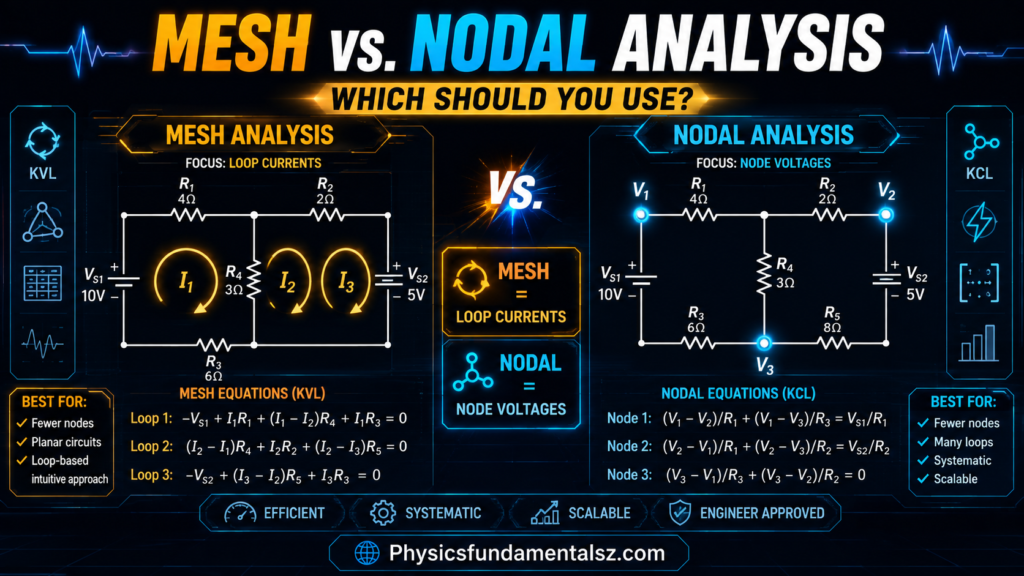
Mesh vs. Nodal Analysis — Which Should You Use?
| Factor | Mesh Analysis | Nodal Analysis |
|---|---|---|
| Based on | KVL (loops) | KCL (nodes) |
| Works on non-planar circuits | ❌ No | ✅ Yes |
| Best when | Circuit has voltage sources and few loops | Circuit has current sources and many voltage sources |
| Scales to large circuits | Moderately | Very well (used by SPICE) |
| Unknowns produced | Number of independent meshes | Number of non-reference nodes |
| Special case | Supermesh (shared current source) | Supernode (floating voltage source) |
Rule of thumb: count nodes and count meshes — pick whichever method gives you fewer unknowns, unless the circuit is non-planar, in which case nodal analysis is the only real option.
Worked Example: Solving a Multi-Source, Multi-Loop Circuit
Consider a circuit with two independent voltage sources (V1 = 12 V, V2 = 6 V) and three resistors (R1 = 2 Ω, R2 = 4 Ω, R3 = 6 Ω) forming two meshes.
Setting up the equations:
Assign mesh currents I1 (left loop) and I2 (right loop), both clockwise. Applying KVL:
- Mesh 1:
12 = I1(R1 + R2) − I2(R2)→12 = 6I1 − 4I2 - Mesh 2:
−6 = −I1(R2) + I2(R2 + R3)→−6 = −4I1 + 10I2
Solving with matrix methods:
Written in matrix form:
[ 6  −4 ] [I1]   [ 12 ]
[−4  10 ] [I2] = [ −6 ]
Using Cramer’s rule:
- Determinant = (6 × 10) − (−4 × −4) = 60 − 16 = 44
- I1 = [(12 × 10) − (−4 × −6)] / 44 = (120 − 24) / 44 ≈ 2.18 A
- I2 = [(6 × −6) − (12 × −4)] / 44 = (−36 + 48) / 44 ≈ 0.27 A
This is exactly how SPICE-class solvers handle circuits with dozens of meshes — by building a matrix and solving it numerically instead of by hand.
Kirchhoff’s Laws with Dependent (Controlled) Sources
Voltage-Controlled and Current-Controlled Sources
A dependent source’s value depends on a voltage or current elsewhere in the circuit rather than being fixed. When writing KCL or KVL equations, treat the dependent source like any other source symbolically — but you’ll need one extra “constraint” equation expressing the source’s value in terms of the controlling variable, then solve the whole system together.
Op-Amp Circuits and KCL
Operational amplifier circuits are a classic advanced application of KCL. Using the ideal op-amp assumptions (no current into the input terminals, virtual short between inputs), KCL at the inverting-input node is usually all you need to derive the gain equation for common configurations like inverting and non-inverting amplifiers.
Kirchhoff’s Laws in AC Circuits (Phasor Domain)
Impedance and the Phasor Form of KCL/KVL
Kirchhoff’s laws hold in AC steady-state analysis exactly as they do in DC — the only change is that voltages and currents become phasors (complex numbers with magnitude and phase), and resistance is replaced by impedance (Z), a complex quantity combining resistance and reactance:
- Resistor:
Z_R = R - Inductor:
Z_L = jωL - Capacitor:
Z_C = 1 / (jωC)
KCL still states that phasor currents entering a node sum to the phasor currents leaving it. KVL still states that phasor voltages around a loop sum to zero.
Nodal and Mesh Analysis with Phasors
Both mesh and nodal analysis extend directly into the AC domain — you simply substitute impedance for resistance and solve the resulting complex-number simultaneous equations. The mechanics (supernodes, supermeshes, matrix solving) are identical; only the arithmetic involves complex numbers instead of real ones.
Kirchhoff’s Laws and Other Circuit Theorems
Superposition Theorem
Superposition uses KCL/KVL repeatedly, once per independent source (with all other sources turned off), then sums the individual results. It only applies to linear circuits, and it cannot be used directly to calculate power, since power depends on the square of voltage or current.
Thevenin’s and Norton’s Theorems
Both theorems reduce any linear two-terminal network — solved originally via KCL/KVL — into a single equivalent source and resistance. Thevenin’s theorem produces a voltage source in series with a resistance; Norton’s theorem produces a current source in parallel with a resistance. The two are mathematically interchangeable through V = IR.
Delta-Wye (Star-Delta) Transformation
This transformation converts a three-terminal delta (triangle) resistor network into an equivalent wye (star) network, or vice versa, simplifying circuits that resist ordinary series-parallel and Kirchhoff’s-law-based reduction.
When Kirchhoff’s Laws Break Down (Limitations)
High-Frequency and Distributed-Parameter Circuits
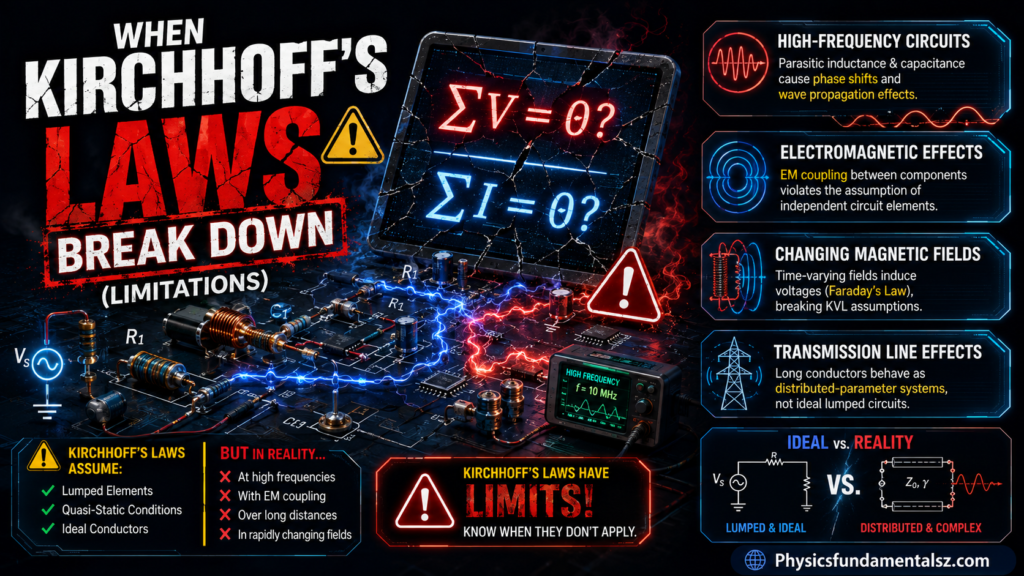
Kirchhoff’s laws assume a lumped element model, where components are small compared to the wavelength of the signals involved, and electromagnetic effects outside the circuit are negligible. At high frequencies — RF design, transmission lines, long PCB traces — this assumption fails, and distributed-parameter models (accounting for propagation delay and radiation) become necessary instead.
Relationship to Maxwell’s Equations
Both of Kirchhoff’s laws can be derived as low-frequency corollaries of Maxwell’s equations. KCL follows from the continuity equation (conservation of charge) when charge accumulation at a node is negligible; KVL follows from Faraday’s law when the changing magnetic flux through a loop is negligible. Advanced practitioners should understand this connection — it’s exactly why the laws hold for DC and low-frequency AC but require correction at RF and microwave frequencies.
Common Mistakes in Advanced Kirchhoff’s Law Analysis
| Mistake | Why It Happens | Fix |
|---|---|---|
| Inconsistent current direction | Switching assumed direction mid-equation | Mark all current arrows before writing any equation |
| Wrong loop traversal direction | Mixing clockwise/counterclockwise mid-loop | Pick one direction and keep it for the entire loop |
| Missing supernode/supermesh constraint | Treating a floating source like a normal branch | Always add the constraint equation for shared sources |
| Redundant equations | Writing KCL at every node, including the reference node | Skip the reference node — its equation is dependent on the others |
| Ignoring negative results | Assuming a negative current means an error | A negative value means the actual current flows opposite to your assumed direction — not that the math is wrong |
| Applying resistor-only Ohm’s law in AC | Forgetting reactance | Use impedance (Z), not just resistance, for AC KCL/KVL |
How SPICE and Circuit Simulators Use Kirchhoff’s Laws
Every SPICE-class simulator (LTspice, PSpice, Multisim) builds a nodal admittance matrix from KCL at every node, then solves it numerically — this is often called Modified Nodal Analysis (MNA). Understanding manual nodal analysis is directly useful because it’s the same process a simulator performs internally, just automated and scaled to thousands of nodes.
Real-World Applications of Advanced Kirchhoff’s Law Analysis
- Power systems — fault current and load-flow analysis on transmission networks
- PCB design — signal integrity and multi-source power-rail analysis
- Electrician troubleshooting — diagnosing a fault when measured loop voltages don’t sum to zero
- Amplifier and filter design — deriving transfer functions with dependent sources
- Automotive and aerospace electronics — verifying redundant power distribution networks
- Robotics and embedded systems — analyzing sensor and actuator driver circuits
Frequently Asked Questions (FAQs)
What does “advanced” Kirchhoff’s law analysis mean compared to the basics?
It means applying the same KCL/KVL principles through systematic, scalable techniques — mesh analysis, nodal analysis, supernodes/supermeshes, and phasor notation — instead of solving circuits by inspection.
What is Kirchhoff’s Current Law (KCL) in one sentence?
The total current entering a node equals the total current leaving it, reflecting conservation of charge.
What is Kirchhoff’s Voltage Law (KVL) in one sentence?
The algebraic sum of all voltage rises and drops around any closed loop equals zero, reflecting conservation of energy.
Who discovered Kirchhoff’s laws and when?
German physicist Gustav Kirchhoff formulated both laws in 1845.
How are Kirchhoff’s laws related to conservation of charge and energy?
KCL is a direct statement of charge conservation at a node; KVL is a direct statement of energy conservation around a closed loop.
What is the difference between a node, a branch, and a loop?
A node is a connection point, a branch is a single path between two nodes, and a loop is any closed path that doesn’t revisit a node.
What is a mesh, and how is it different from a loop?
A mesh is a loop that contains no smaller loop inside it — a concept that only applies cleanly to planar circuits.
What is mesh analysis (loop current method)?
A technique that assigns a circulating current to each mesh and applies KVL to solve for those currents.
What is nodal analysis (node voltage method)?
A technique that assigns an unknown voltage to each non-reference node and applies KCL to solve for those voltages.
How do I decide between mesh analysis and nodal analysis?
Count the number of meshes versus nodes and pick whichever produces fewer unknowns; use nodal analysis by default for non-planar circuits.
What is a supernode and when do I need one?
A supernode combines two nodes connected by a floating voltage source into a single KCL equation, plus a constraint equation for the source’s voltage.
What is a supermesh and when do I need one?
A supermesh combines two meshes sharing a current source into a single KVL equation, plus a constraint equation for the source’s current.
Can Kirchhoff’s laws be applied to non-planar circuits?
Yes for KCL-based nodal analysis; mesh analysis, however, is only well-defined for planar circuits.
How many independent KCL equations does a circuit need?
One fewer than the total number of nodes, since the reference node’s equation is redundant.
How many independent KVL equations does a circuit need?
One per independent loop (or mesh, in a planar circuit).
What’s the most common sign-convention mistake in KVL?
Switching the assumed direction of current or loop traversal partway through the equation.
What does a negative current result actually mean?
The actual current flows in the direction opposite to what you originally assumed — the calculation is still correct.
How do dependent (controlled) sources change the KCL/KVL equations?
They require one additional constraint equation expressing the source’s value in terms of the controlling voltage or current elsewhere in the circuit.
How is KCL used to analyze operational amplifier circuits?
Applying KCL at the inverting-input node, combined with ideal op-amp assumptions, typically yields the circuit’s gain equation directly.
Do Kirchhoff’s laws apply to AC circuits?
Yes — they apply identically in the phasor domain, with impedance replacing resistance.
How do KCL and KVL work with phasors and impedance?
Currents and voltages become complex phasors, and Ohm’s law becomes V = IZ, where Z is impedance; the summing rules of KCL and KVL are unchanged.
What is the phasor form of Kirchhoff’s Voltage Law?
The algebraic sum of phasor voltages around a closed loop equals zero, exactly as in DC, but with complex-number arithmetic.
How does impedance replace resistance in AC Kirchhoff’s law equations?
Resistors keep Z = R, while inductors and capacitors contribute imaginary impedance components (jωL and 1/jωC respectively).
What’s the relationship between Kirchhoff’s laws and Ohm’s law?
Ohm’s law defines the voltage-current relationship for individual elements; Kirchhoff’s laws define how those voltages and currents combine across an entire network.
How does superposition theorem relate to Kirchhoff’s laws?
Superposition solves a circuit by applying KCL/KVL separately for each independent source (with others deactivated) and summing the results — valid only for linear circuits.
How do Thevenin’s and Norton’s theorems simplify Kirchhoff’s-law-based analysis?
They reduce any linear two-terminal network into one equivalent source and resistance, avoiding repeated full KCL/KVL solutions for changing loads.
What is the delta-wye (star-delta) transformation used for?
Converting between triangular (delta) and star (wye) three-terminal resistor networks to simplify circuits that resist standard reduction.
When do Kirchhoff’s laws stop being accurate?
At high frequencies or with physically large circuits, where the lumped element assumption no longer holds.
How do Kirchhoff’s laws relate to Maxwell’s equations?
Both laws are low-frequency corollaries of Maxwell’s equations — KCL from charge continuity, KVL from Faraday’s law.
Why do Kirchhoff’s laws fail at high frequencies or with distributed elements?
Because electromagnetic radiation and propagation delay become significant, violating the lumped element assumption that underlies both laws.
How does SPICE software use Kirchhoff’s laws internally?
It builds a nodal admittance matrix from KCL at every node (Modified Nodal Analysis) and solves it numerically.
What is the matrix method for solving simultaneous circuit equations?
Writing mesh or nodal equations in matrix form and solving via methods like Cramer’s rule or Gaussian elimination.
What’s the difference between transient and steady-state Kirchhoff’s law analysis?
Transient analysis captures time-varying behavior right after a change (e.g., a switch closing); steady-state analysis assumes the circuit has settled into a repeating or constant pattern.
Can Kirchhoff’s laws be used for troubleshooting real circuits?
Yes — if measured loop voltages don’t sum to zero, it points directly to a fault such as a high-resistance connection or partial short.
What is a floating node and why is it a problem in nodal analysis?
A floating node has no direct path to the reference ground, making its voltage undefined without additional constraints — often resolved with a supernode.
How do you choose a reference (ground) node in nodal analysis?
Pick the node with the most connections, since it typically simplifies the resulting equations the most.
What is a spanning tree in circuit graph theory, and why does it matter?
A spanning tree connects all nodes without forming a loop; it’s used in graph-theory-based circuit analysis to determine independent loops and equations systematically.
How many unknowns does mesh analysis produce versus nodal analysis?
Mesh analysis produces one unknown per independent mesh; nodal analysis produces one unknown per non-reference node.
What industries rely most heavily on advanced Kirchhoff’s law analysis?
Power systems, telecommunications, automotive and aerospace electronics, semiconductor design, and renewable energy.
What’s the best way to practice advanced Kirchhoff’s law problems?
Work through multi-source planar circuits by hand using both mesh and nodal analysis, then verify your results in a free simulator like LTspice.
Key Takeaways
- Advanced Kirchhoff’s law analysis is the same two laws (KCL, KVL), applied through mesh analysis, nodal analysis, supernodes, and supermeshes.
- Choose mesh vs. nodal analysis based on which produces fewer unknowns — and default to nodal analysis for non-planar circuits.
- Dependent sources add one constraint equation each; op-amp circuits are a common real-world case.
- In AC circuits, KCL and KVL hold in the phasor domain with impedance replacing resistance.
- Kirchhoff’s laws are a low-frequency approximation of Maxwell’s equations and break down at high frequencies or with distributed circuit elements.
- SPICE simulators implement nodal analysis internally — manual practice with these techniques directly builds simulation literacy.