Ohm’s Law and Temperature: How Resistance Really Changes With Heat
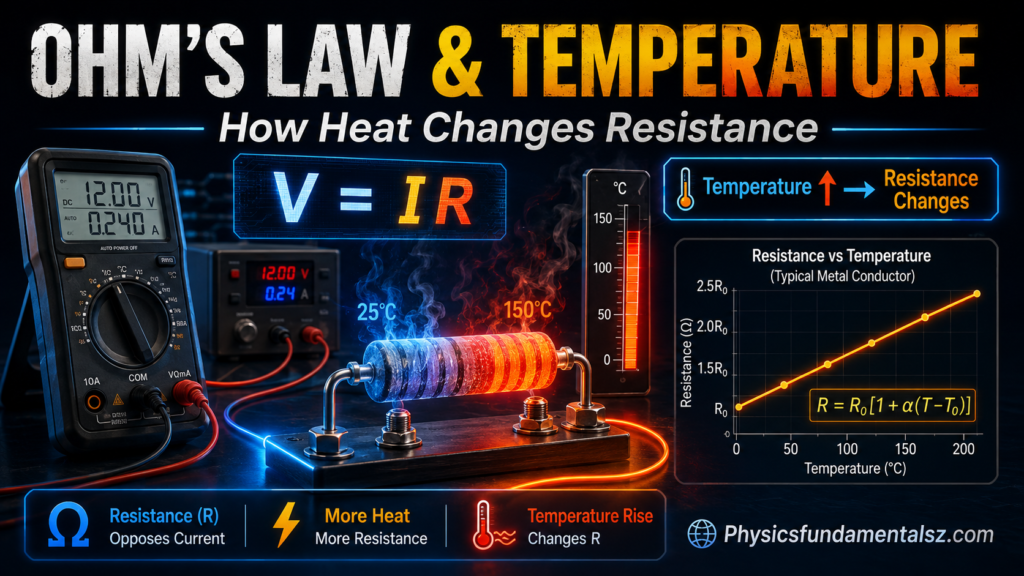
If you’ve ever wondered why a light bulb filament glows white-hot without simply burning out the moment you flip the switch, you’ve already bumped into one of Ohm’s Law’s biggest asterisks: temperature.
Most people learn Ohm’s Law and Temperature as a fixed rule — voltage equals current times resistance — but resistance itself isn’t fixed. It shifts as a conductor heats up or cools down, and that shift can throw off calculations if you don’t account for it.
Table of Contents
Does Temperature Affect Ohm’s Law? Ohm’s Law and Temperature
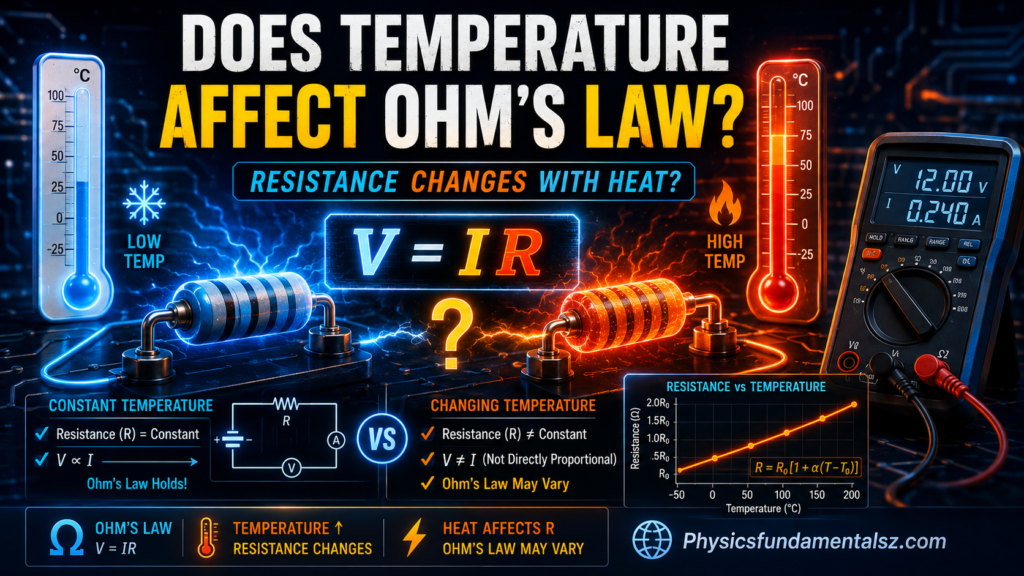
Yes. Ohm’s Law (V = IR) is only strictly accurate when resistance stays constant, and resistance changes with temperature. In most metals, resistance rises as temperature increases, because heat makes atoms vibrate more and scatter the flowing electrons. In semiconductors, the opposite happens — resistance typically falls as temperature rises, because heat frees up more charge carriers. The relationship is calculated using the formula R = R₀(1 + αΔT), where α is the material’s temperature coefficient of resistance.
What Is Ohm’s Law? A Fast Refresher
Ohm’s Law, named after German physicist Georg Simon Ohm, describes the relationship between voltage, current, and resistance in an electrical circuit. It’s one of the first equations anyone learns in electronics, and it’s the foundation for nearly every circuit calculation you’ll ever do.
The V = IR Formula
The law is written as:
V = I × R
- V = voltage, measured in volts
- I = current, measured in amps
- R = resistance, measured in ohms (Ω)
In plain terms: for a fixed resistance, more voltage pushes more current through a circuit. Rearranged, you can also solve for current (I = V/R) or resistance (R = V/I), depending on what you’re trying to find.
Why Ohm’s Law Assumes “Constant Temperature”
Here’s the detail most introductory explanations skip. The full, technically accurate statement of Ohm’s Law includes a condition: it holds true for a conductor at a constant temperature. That’s because resistance isn’t a fixed physical constant like the speed of light — it’s a property that depends on the material’s internal structure, and that structure behaves differently as heat is added or removed.
So when a circuit heats up during operation, the resistance you measured when it was cold may no longer be accurate. This is why precision electronics, industrial heating elements, and temperature sensors all need a way to account for resistance shifting with heat — which is exactly what the rest of this guide covers.
How Temperature Affects Resistance
Resistance vs. Resistivity — What’s the Difference?
These two terms get mixed up constantly, so it’s worth separating them clearly.
- Resistance (R) is a property of a specific object — a particular wire, resistor, or component. It depends on the material and the object’s shape (length and cross-sectional area).
- Resistivity (ρ) is a property of the material itself, independent of shape. It tells you how strongly a given material resists current flow, regardless of whether it’s a thin wire or a thick bar.
Resistance and resistivity are related by:
R = ρ × (L / A)
Where L is the conductor’s length and A is its cross-sectional area. Since resistivity is what actually changes with temperature at the atomic level, resistance changes as a direct consequence.
Why Resistance Increases With Temperature in Metals
In a metal conductor like copper or aluminum, free electrons drift through a lattice of atoms to carry current. As temperature rises, those atoms vibrate more vigorously. This increased vibration causes more frequent collisions between the drifting electrons and the vibrating lattice — a process called electron scattering (or phonon scattering).
Every collision disrupts the smooth flow of electrons, effectively increasing opposition to current flow. More heat means more vibration, more collisions, and higher resistance. This is why nearly all common metals — copper, aluminum, silver, tungsten — have a positive temperature coefficient: resistance goes up as temperature goes up.
Why Resistance Decreases With Temperature in Semiconductors
Semiconductors like silicon and germanium behave in the opposite direction, and the reason is fundamentally different from metals.
In a semiconductor, current depends on the number of available charge carriers (electrons and “holes”) — and at low temperatures, relatively few of these carriers are free to move. As temperature rises, thermal energy frees up more carriers, increasing conductivity. The gain in available carriers outweighs the extra scattering effect, so overall resistance decreases as temperature increases.
This is called a negative temperature coefficient, and it’s the operating principle behind NTC thermistors, which are widely used as temperature sensors.
The Temperature Coefficient of Resistance Formula
R = R₀(1 + αΔT) Explained
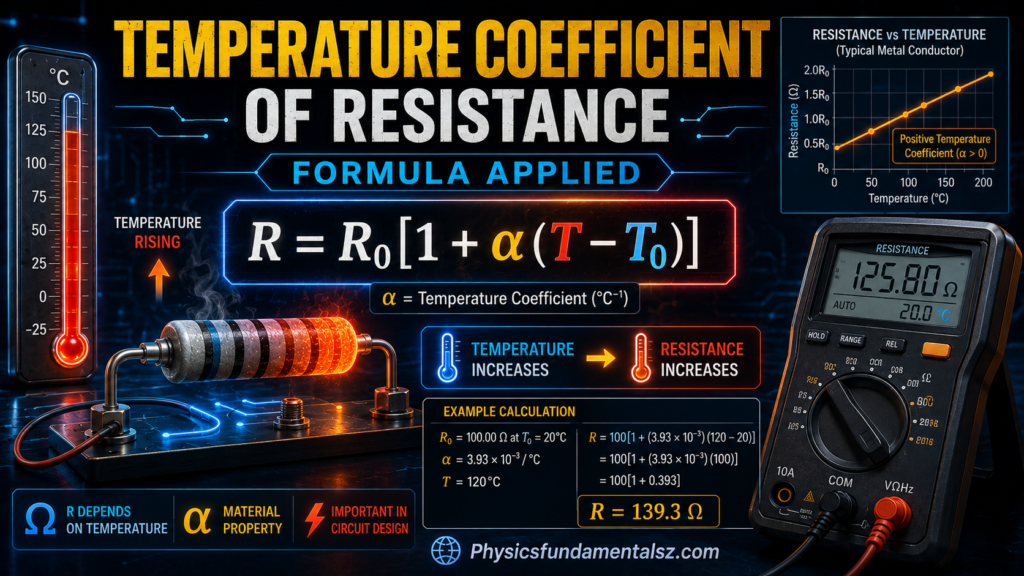
The standard formula used to calculate resistance at a new temperature is:
R = R₀ (1 + αΔT)
Where:
- R = resistance at the new temperature
- R₀ = resistance at a known reference temperature (commonly 0°C or 20°C)
- α = the temperature coefficient of resistance for that material (units: per °C, or °C⁻¹)
- ΔT = the change in temperature (new temperature minus reference temperature)
This equation is a linear approximation. It works well for moderate temperature ranges, but for very large temperature swings, real materials deviate from a perfectly straight line, and more advanced polynomial models are used instead.
Worked Example: Calculating Resistance at a New Temperature
Let’s say you have a copper wire with a resistance of 10 Ω at 20°C, and copper’s temperature coefficient of resistance is approximately 0.00393 per °C. What is the resistance if the wire heats up to 80°C?
Step 1: Identify your values.
- R₀ = 10 Ω
- α = 0.00393 /°C
- ΔT = 80°C − 20°C = 60°C
Step 2: Plug into the formula.
R = 10 × (1 + 0.00393 × 60) R = 10 × (1 + 0.2358) R = 10 × 1.2358 R ≈ 12.36 Ω
So the wire’s resistance rises from 10 Ω to about 12.36 Ω after heating from 20°C to 80°C — a roughly 24% increase. In a real circuit, that’s enough to noticeably change current draw if it isn’t accounted for.
Temperature Coefficient of Resistance Table (Common Materials)
| Material | Temperature Coefficient α (per °C, approx.) | Behavior |
|---|---|---|
| Copper | 0.00393 | Positive (resistance rises with heat) |
| Aluminum | 0.00390 | Positive |
| Silver | 0.00380 | Positive |
| Gold | 0.00340 | Positive |
| Tungsten | 0.00450 | Positive |
| Nichrome | 0.00017 | Positive, but nearly flat (used in heating elements for stability) |
| Platinum | 0.00392 | Positive (used in precision RTD sensors) |
| Constantan | ~0.00001 | Near-zero — engineered for stable resistors |
| Carbon (as a resistor material) | −0.0005 | Negative (rare among common conductors) |
| Silicon (semiconductor) | Negative, non-linear | Resistance drops sharply with heat |
| Germanium (semiconductor) | Negative, non-linear | Resistance drops sharply with heat |
Values are commonly cited approximations at a 20°C reference point and can vary slightly by source and purity of material. For precision engineering work, always verify against a current materials data sheet or standard such as those published by NIST.
Metals vs. Semiconductors: Opposite Temperature Behavior
| Property | Metals (e.g., copper, tungsten) | Semiconductors (e.g., silicon, germanium) |
|---|---|---|
| Effect of rising temperature on resistance | Increases | Decreases |
| Temperature coefficient sign | Positive | Negative |
| Underlying cause | More electron-lattice collisions (scattering) | More free charge carriers available |
| Common real-world use of this property | Filament bulbs, heating elements, precision resistors | NTC thermistors, temperature sensors |
Positive Temperature Coefficient (PTC) Materials
PTC materials increase in resistance as they heat up. Beyond common metals, engineered PTC components (often ceramic-based) are deliberately designed to sharply increase resistance past a certain temperature, which makes them useful as self-resetting fuses — once a circuit overheats, resistance spikes, current drops, and the component protects the circuit without needing to be replaced.
Negative Temperature Coefficient (NTC) Materials
NTC materials, mostly semiconductor-based ceramics, decrease in resistance as temperature rises. This predictable relationship makes NTC thermistors excellent, low-cost temperature sensors — you measure the resistance, and a calibration curve tells you the corresponding temperature.
Real-World Applications
RTD Temperature Sensors
A Resistance Temperature Detector (RTD) uses a precisely known metal — almost always platinum — whose resistance changes predictably with temperature. By measuring resistance and applying a standardized formula (such as the Callendar-Van Dusen equation), an RTD can determine temperature with excellent accuracy and stability, making it a go-to sensor in industrial and laboratory settings.
Thermistors (NTC and PTC)
Thermistors are compact, inexpensive, and highly sensitive to temperature change, which makes them common in household thermostats, automotive systems, battery packs, and consumer electronics. NTC thermistors are used for general temperature sensing; PTC thermistors are used for overcurrent and overtemperature protection.
Incandescent Filament Bulbs
A tungsten filament might have a resistance of just a few ohms when cold, but once current flows and the filament heats to over 2,000°C, its resistance can rise to ten times its cold value or more. This is exactly why incandescent bulbs draw a large inrush current the instant they’re switched on — the filament is at its lowest resistance right before it heats up.
Superconductors and Zero Resistance
At the extreme end of this relationship, certain materials cooled to very low temperatures — near absolute zero — undergo a sudden transition into a superconducting state, where electrical resistance drops to essentially zero. This isn’t just an extension of the normal metal trend; it’s a distinct quantum phenomenon, but it illustrates just how dramatically temperature can reshape a material’s resistance behavior.
Common Mistakes When Applying Ohm’s Law With Temperature
- Treating resistance as a fixed constant. Many circuit calculations assume resistance never changes — fine for quick estimates, risky for anything operating across a wide temperature range.
- Confusing resistance with resistivity. Resistivity is the material property that actually changes with temperature; resistance also depends on the object’s physical dimensions.
- Applying the linear formula over too large a temperature range. R = R₀(1 + αΔT) is a linear approximation and becomes less accurate over very large ΔT — especially for semiconductors, which are inherently non-linear.
- Ignoring self-heating during measurement. Passing even a small test current through a resistor generates some heat, which can slightly skew a resistance reading if not accounted for in precision work.
- Using the wrong reference temperature. α values are typically specified relative to a stated reference temperature (often 20°C) — mixing up reference points introduces calculation errors.
Expert Tips for Accurate Resistance Measurement

- Use a four-wire (Kelvin) measurement setup for low-resistance components to eliminate lead and contact resistance from skewing your reading.
- Allow components to reach thermal equilibrium before taking a reference measurement, especially with precision resistors or RTDs.
- When designing circuits that will experience meaningful temperature swings (automotive, outdoor, industrial), select components with a known, published temperature coefficient rather than assuming standard behavior.
- For heating elements where stable resistance is desired despite high heat, materials like nichrome or constantan are chosen specifically because their temperature coefficient is very low.
Frequently Asked Questions (FAQs)
Does temperature affect Ohm’s Law?
Yes. Ohm’s Law technically applies only when resistance stays constant, and resistance itself changes with temperature in nearly all real conductors.
Why does Ohm’s Law specify “constant temperature”?
Because resistance is not a fixed physical constant — it depends on temperature-sensitive properties like electron scattering, so the law’s proportionality only holds cleanly when temperature doesn’t change during measurement.
Why does resistance increase with temperature in metals?
Heat causes atoms in the metal’s lattice to vibrate more, increasing collisions with flowing electrons and raising resistance.
Why does resistance decrease with temperature in semiconductors?
Heat frees up more charge carriers in a semiconductor, and this increase in available carriers outweighs the added scattering effect, lowering overall resistance.
What is the temperature coefficient of resistance?
It’s a value (α) that describes how much a material’s resistance changes per degree of temperature change, expressed in units of per °C.
What is the formula for resistance at a new temperature?
R = R₀(1 + αΔT), where R₀ is the resistance at a known reference temperature and ΔT is the temperature change.
What is R₀ in the resistance-temperature formula?
R₀ is the resistance of the material at a defined reference temperature, commonly 0°C or 20°C.
What are typical units for the temperature coefficient (α)?
Per degree Celsius (°C⁻¹), sometimes expressed per Kelvin (K⁻¹).
Is resistivity the same as resistance?
No. Resistivity is an intrinsic material property; resistance also depends on the object’s length and cross-sectional area.
How is resistivity related to temperature?
Resistivity generally increases with temperature in metals and decreases with temperature in semiconductors, and resistance follows the same trend since R = ρL/A.
What is a positive temperature coefficient (PTC) material?
A material whose resistance increases as temperature rises — most common metals fall into this category.
What is a negative temperature coefficient (NTC) material?
A material whose resistance decreases as temperature rises — most semiconductors behave this way.
What is the temperature coefficient of copper?
Approximately 0.00393 per °C near a 20°C reference point.
What is the temperature coefficient of aluminum?
Approximately 0.00390 per °C near a 20°C reference point.
What is the temperature coefficient of tungsten?
Approximately 0.00450 per °C, which is why tungsten filaments show large resistance changes when heated.
What is the temperature coefficient of nichrome?
Very low, around 0.00017 per °C, which is exactly why nichrome is used in heating elements that need stable resistance despite intense heat.
Which materials have a near-zero temperature coefficient?
Alloys like constantan and manganin are engineered specifically to have a near-zero temperature coefficient for use in precision resistors.
Why do incandescent bulb filaments have higher resistance when hot?
Tungsten has a strongly positive temperature coefficient, so as the filament heats to over 2,000°C, its resistance rises dramatically compared to its cold-state value.
How does a thermistor use resistance to measure temperature?
A thermistor’s resistance changes predictably with temperature, so measuring its resistance and applying a calibration curve reveals the corresponding temperature.
How does an RTD (resistance temperature detector) work?
An RTD uses a precisely characterized metal, typically platinum, whose resistance change with temperature follows a well-established standard formula, allowing accurate temperature calculation from a resistance measurement.
What’s the difference between a thermistor and an RTD?
Thermistors are typically ceramic-based semiconductors with high sensitivity but a narrower, non-linear range; RTDs use metal elements (usually platinum) with a more linear response and higher long-term stability, often at a higher cost.
Why do semiconductors behave oppositely to metals with temperature?
In metals, added heat mainly increases electron scattering, raising resistance. In semiconductors, added heat mainly increases the number of available charge carriers, lowering resistance.
What causes resistance in a conductor at the atomic level?
Resistance arises from collisions between moving electrons and the vibrating atomic lattice (or impurities) within the material, which impede smooth current flow.
What is electron scattering, and how does it relate to resistance?
Electron scattering is the deflection of flowing electrons caused by collisions with lattice vibrations or impurities; more scattering means more resistance.
What is a superconductor, and why does its resistance drop to zero?
A superconductor is a material that, below a critical temperature, undergoes a quantum transition allowing electrons to flow with effectively zero electrical resistance.
Is Ohm’s Law valid for semiconductors?
Only partially — many semiconductor devices show non-linear, non-ohmic behavior, meaning voltage and current aren’t simply proportional across all conditions.
What is a non-ohmic device?
A component, like a diode or transistor, where the relationship between voltage and current isn’t a straight proportional line, often because resistance itself changes with voltage, current, or temperature.
What is the difference between ohmic and non-ohmic behavior?
Ohmic behavior means resistance stays constant regardless of voltage or current (a straight-line V-I graph); non-ohmic behavior means resistance varies, producing a curved V-I graph.
How do you measure resistance accurately at different temperatures?
Use a calibrated ohmmeter or four-wire measurement setup, allow the component to stabilize at the target temperature, and reference the manufacturer’s temperature coefficient data.
What is self-heating error in resistance measurement?
It’s the small inaccuracy introduced when the test current itself heats the component being measured, slightly shifting its resistance during the measurement.
How does current cause a conductor to heat up?
As current flows through a resistance, electrical energy is converted into heat through collisions between electrons and the material’s atoms — a process known as Joule heating.
What is Joule heating, and how does it relate to Ohm’s Law?
Joule heating describes the power dissipated as heat in a resistor, calculated as P = I²R, directly tying current and resistance (both central to Ohm’s Law) to the heat a component generates.
Can resistance become negative?
In standard passive components, no — resistance is always positive. Some specialized active devices can exhibit “negative differential resistance” over a specific operating range, but this is a distinct, advanced phenomenon.
How do engineers compensate for temperature effects on resistance?
By selecting low-tempco materials for stable components, adding temperature compensation circuitry, or actively correcting readings using a known temperature coefficient.
Why is platinum used in precision RTD sensors?
Platinum offers a highly stable, well-characterized, and repeatable resistance-temperature relationship, along with strong corrosion resistance, making it ideal for accurate long-term sensing.
What temperature range does the linear resistance formula work for?
It’s generally reliable over moderate ranges (roughly within 100–150°C of the reference temperature); very large temperature swings require more advanced, non-linear models.
How do you calculate the temperature coefficient of resistance experimentally?
By measuring a material’s resistance at two known temperatures and solving α = (R − R₀) / (R₀ × ΔT).
What is the difference between Celsius and Kelvin in these formulas?
Since the formula uses a temperature difference (ΔT), the numerical size of a degree is the same in Celsius and Kelvin, so ΔT is identical in either scale — only absolute temperature values differ.
Does wire length or thickness change with temperature affect resistance too?
Slightly, through thermal expansion, but this effect is roughly two orders of magnitude smaller than the resistivity change, so it’s typically considered negligible in standard calculations.
Why does a light bulb draw more current when it’s first switched on (cold)?
Because the filament’s resistance is at its lowest when cold, allowing a brief surge of higher current before the filament heats up and resistance rises.
Key Takeaways
- Ohm’s Law (V = IR) assumes constant resistance, but resistance itself changes with temperature in real materials.
- Metals generally have a positive temperature coefficient (resistance rises with heat); semiconductors generally have a negative one (resistance falls with heat).
- The formula R = R₀(1 + αΔT) lets you calculate resistance at a new temperature using a material’s known temperature coefficient (α).
- Real devices — RTDs, thermistors, incandescent filaments, and superconductors — all put this resistance-temperature relationship to practical use.
- For precision work, always account for self-heating, reference temperature, and the limits of the linear approximation over large temperature ranges.