Electromagnetic Waves: Speed, Spectrum & Wave Properties
Look up at the sky on a clear night and the light reaching your eyes has been traveling for years, sometimes millions of years, before it finally lands on your retina.
That light is one small slice of a much bigger family called electromagnetic waves, and understanding how these waves move, spread out, and behave is one of the most rewarding parts of physics.
Electromagnetic waves explain everything from why your phone can pick up a signal in another room to why the sky is blue and why an X-ray machine can see through skin but not bone.
Along the way we will connect these ideas to related wave concepts like transverse waves, wave speed, frequency and wavelength, and wave superposition, so you can build a complete picture of wave physics rather than a list of isolated facts.
Table of Contents
What Are Electromagnetic Waves?
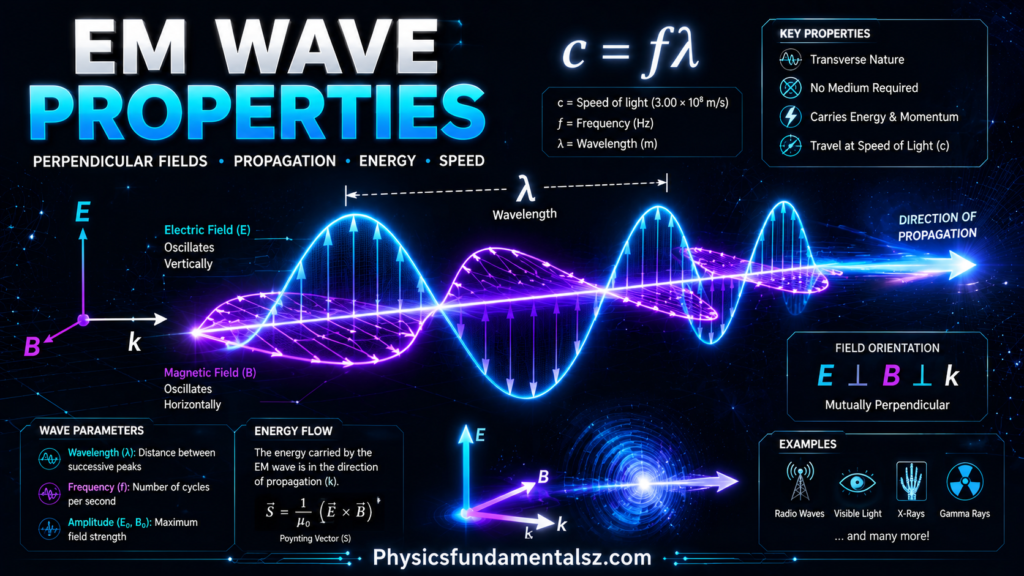
Electromagnetic waves are disturbances made up of oscillating electric and magnetic fields that travel through space, carrying energy from one point to another. Unlike sound waves, which need air, water, or some other medium to move through, electromagnetic waves can travel through the vacuum of space with nothing to push against at all. This is why sunlight can reach Earth across roughly 150 million kilometers of empty space, while a bell rung on the Moon would make no sound whatsoever, since there is no medium there to carry it.
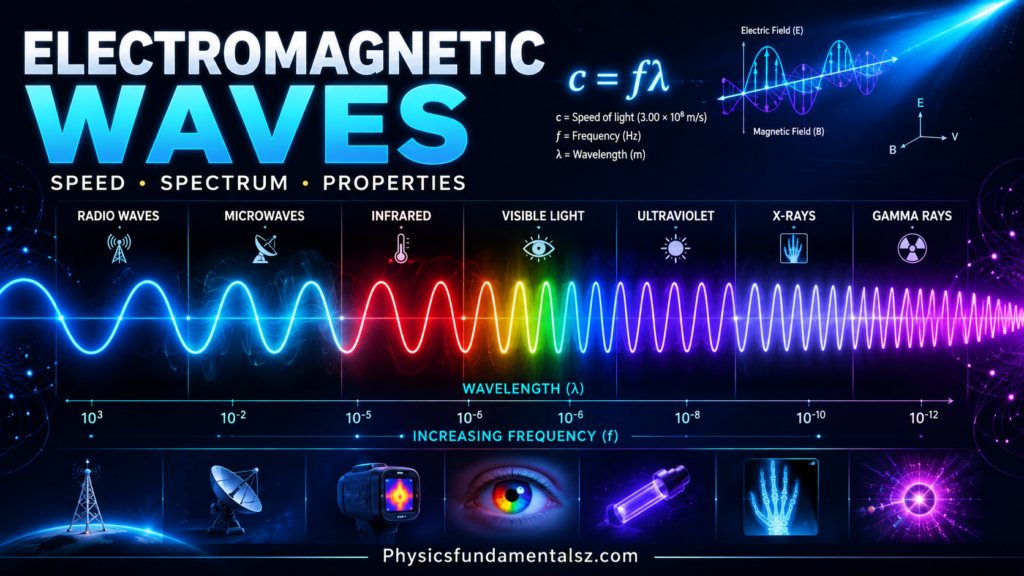
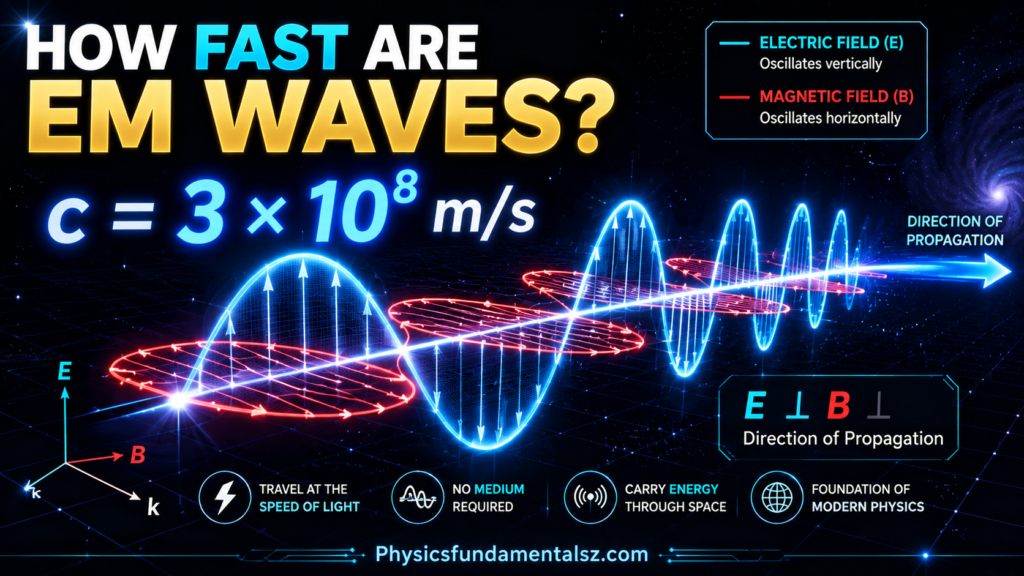
The electric field and magnetic field inside an electromagnetic wave oscillate at right angles to each other, and both fields oscillate perpendicular to the direction the wave is traveling. This makes every electromagnetic wave a type of transverse wave, similar in geometry to the transverse waves you might already be familiar with from a vibrating string or a ripple on water, though the mechanism producing them is entirely different. If you want a refresher on that underlying wave shape, our guide on transverse waves walks through the geometry in detail.
How Electromagnetic Waves Are Produced
Electromagnetic waves are generated whenever an electric charge accelerates. A stationary charge produces only a static electric field, and a charge moving at constant velocity produces a steady magnetic field alongside it, but the moment that charge speeds up, slows down, or changes direction, it radiates energy outward as a wave. This is exactly what happens inside a radio antenna, where electrons are pushed back and forth rapidly to generate radio waves, and it is also what happens inside the hot filament of a light bulb, where thermally agitated electrons radiate visible light and infrared radiation.
The Speed of Electromagnetic Waves
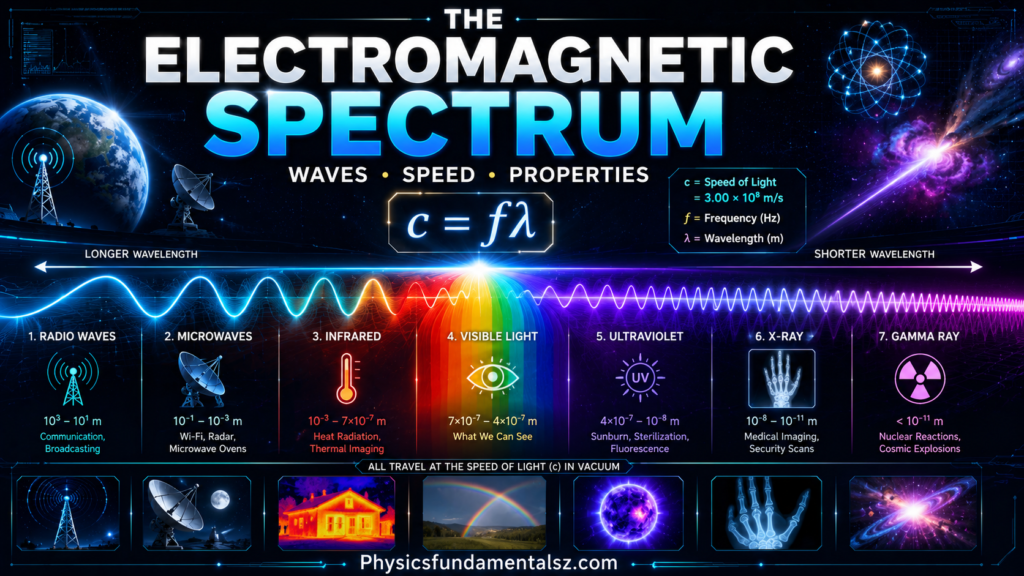
One of the most remarkable facts in all of physics is that every electromagnetic wave travels at the same speed through a vacuum, regardless of its frequency or wavelength. This speed is known as the speed of light, denoted c, and it has a value of approximately 299,792,458 meters per second, usually rounded to 3 x 10^8 m/s for everyday calculations.
This constant speed was one of the great predictions of James Clerk Maxwell’s equations in the 1860s. Maxwell showed mathematically that oscillating electric and magnetic fields should propagate as a wave, and when he calculated the predicted speed of that wave from known electrical and magnetic constants, it matched the experimentally measured speed of light almost exactly. That match is what first revealed light itself is an electromagnetic wave, unifying optics with electricity and magnetism into a single branch of physics.
The Universal Wave Speed Equation
The speed of any wave, including an electromagnetic wave, is linked to its frequency and wavelength through the equation:
v = fλ
where v is wave speed, f is frequency, and λ (lambda) is wavelength. For electromagnetic waves in a vacuum, v is always equal to c, so the equation becomes:
c = fλ
This tells us something important: frequency and wavelength are inversely related for electromagnetic waves. A wave with a very short wavelength must have a very high frequency, and a wave with a long wavelength must have a low frequency, since their product always has to equal the same constant speed. If you want to practice applying this relationship with worked numbers, our dedicated breakdown of wave speed, frequency and wavelength covers the calculations step by step.
Does the Speed of Electromagnetic Waves Ever Change?
Electromagnetic waves only travel at exactly c when moving through a vacuum. When they pass through a material medium like glass, water, or air, they slow down slightly because the wave interacts with the atoms of that material. This slowing down is described by the refractive index of the medium, and it is precisely what causes light to bend when it passes from one medium into another, an effect explained in detail by Snell’s Law. The greater the refractive index of a material, the slower electromagnetic waves travel through it, and the more sharply light bends at the boundary.
The Electromagnetic Spectrum
The electromagnetic spectrum is the full range of electromagnetic waves, arranged in order of increasing frequency and decreasing wavelength. Every type of electromagnetic wave, from the radio waves broadcasting your favorite station to the gamma rays released by nuclear reactions, is fundamentally the same phenomenon; they only differ in frequency, wavelength, and the amount of energy they carry.
Radio Waves
Radio waves have the longest wavelengths in the electromagnetic spectrum, ranging from about one millimeter up to hundreds of kilometers, and correspondingly the lowest frequencies and lowest photon energies. They are used for broadcasting, wireless communication, and radar, and their long wavelength allows them to diffract around large obstacles like buildings and hills.
Microwaves
Microwaves sit just above radio waves in frequency, with wavelengths from about one millimeter to one meter. Beyond heating food in a microwave oven, this band of the electromagnetic spectrum is used for satellite communication, Wi-Fi signals, and mobile phone networks.
Infrared Radiation
Infrared radiation lies just beyond the red end of visible light and is closely associated with heat. Every object with a temperature above absolute zero emits infrared radiation, which is why thermal cameras can visualize the heat signature of a person or a running engine even in complete darkness.
Visible Light
Visible light is the narrow band of the electromagnetic spectrum that the human eye can detect, with wavelengths roughly between 400 and 700 nanometers. Within this narrow band, different wavelengths correspond to the colors we perceive, from violet at the shortest wavelengths to red at the longest. The way visible light waves vibrate and interact is also central to phenomena like polarisation of light, which describes the specific direction in which the electric field of a light wave oscillates.
Ultraviolet Radiation
Ultraviolet radiation has shorter wavelengths and higher energy than visible light, which is why prolonged exposure to ultraviolet radiation from the Sun can damage skin cells and cause sunburn. It is also useful for sterilization, since its energy is high enough to disrupt the DNA of bacteria and viruses.
X-Rays
X-rays carry considerably more energy again, with wavelengths small enough to pass through soft tissue while being absorbed by denser material like bone. This differential absorption is exactly what makes medical X-ray imaging possible.
Gamma Rays
Gamma rays sit at the extreme high-frequency end of the electromagnetic spectrum, produced by nuclear reactions and some of the most energetic events in the universe, such as supernovae and neutron star collisions. Their wavelengths can be smaller than the nucleus of an atom, and their high energy makes them useful in cancer treatment as well as hazardous without proper shielding.
Key Wave Properties of Electromagnetic Waves
Understanding electromagnetic waves fully means understanding the core wave properties that describe their behavior. These properties are shared with other types of waves, but they take on specific significance when applied to electromagnetic radiation.
Wavelength
Wavelength is the distance between two successive points in phase on a wave, such as from one crest to the next crest. It is usually measured in meters, though for visible light and shorter wavelengths it is often more convenient to use nanometers.
Frequency
Frequency is the number of complete wave cycles that pass a fixed point every second, measured in hertz (Hz). Because c = fλ is fixed for electromagnetic waves, frequency and wavelength always move in opposite directions relative to one another.
Amplitude
Amplitude describes the maximum strength of the oscillating electric and magnetic fields in the wave. For electromagnetic waves, amplitude is directly related to intensity, meaning a higher amplitude wave carries more energy and appears brighter, in the case of visible light, or stronger, in the case of a radio signal.
Energy and Photon Behavior
While electromagnetic waves behave like continuous waves in many situations, they also behave like discrete packets of energy called photons. The energy of a single photon is given by:
E = hf
where h is Planck’s constant and f is frequency. This equation shows that higher-frequency electromagnetic waves, like gamma rays, carry far more energy per photon than lower-frequency waves, like radio waves, which is why gamma rays are dangerous to living tissue while radio waves are generally harmless.
Polarization
Polarization refers to the orientation of the oscillating electric field in an electromagnetic wave. Unpolarized light, like sunlight, contains electric field oscillations in every possible direction, while polarized light has its oscillations restricted to a single plane. Polarizing filters, used in sunglasses and camera lenses, work by blocking electromagnetic waves that are not aligned with the filter’s transmission axis. This behavior is explored more thoroughly in our guide to polarisation of light, including Malus’s Law and its practical applications.
Interference and Superposition
When two or more electromagnetic waves overlap, their electric fields add together according to the principle of superposition, producing regions of reinforced amplitude (constructive interference) and regions of cancelled amplitude (destructive interference). This is the same principle behind the colorful patterns seen in soap bubbles and thin oil films, and it is explained in full in our article on wave superposition.
Standing Waves and Resonance in Electromagnetic Systems
Electromagnetic waves can also form standing wave patterns, particularly inside cavities like microwave ovens, laser resonators, and antenna systems, where waves reflect back and forth and combine to create fixed nodes and antinodes. Our detailed guide to standing waves and resonance explains how nodes, antinodes, and harmonics arise, concepts that apply directly to how resonant cavities shape and amplify electromagnetic waves at specific frequencies.
Why Electromagnetic Waves Matter
Electromagnetic waves are not just an abstract topic confined to a physics classroom; they are the foundation of nearly every modern communication and imaging technology.
Mobile networks, Wi-Fi, GPS, medical imaging, remote sensing from satellites, and even the microwave oven in your kitchen all rely on a precise understanding of how electromagnetic waves behave across different parts of the electromagnetic spectrum.
Astronomers use electromagnetic waves across the full spectrum, not just visible light, to study the universe, since radio telescopes, infrared telescopes, and X-ray observatories each reveal different physical processes happening in distant stars and galaxies.
Frequently Asked Questions (FAQs)
What is the main difference between electromagnetic waves and mechanical waves?
Electromagnetic waves do not need a medium and can travel through a vacuum, while mechanical waves, such as sound waves, require a medium like air, water, or a solid to propagate.
Why do all electromagnetic waves travel at the same speed in a vacuum?
Because the speed of an electromagnetic wave in a vacuum is determined by fundamental electric and magnetic constants of space itself, not by the wave’s frequency or wavelength, every electromagnetic wave travels at c regardless of where it sits in the electromagnetic spectrum.
Is visible light the only type of electromagnetic wave humans can detect?
Visible light is the only part of the electromagnetic spectrum the human eye can detect directly, but humans can sense infrared radiation indirectly as heat, and technology allows us to detect and use every other part of the spectrum, from radio waves to gamma rays.
How is the energy of an electromagnetic wave related to its frequency?
Energy and frequency are directly proportional, described by E = hf, so higher-frequency electromagnetic waves like ultraviolet radiation, X-rays, and gamma rays carry significantly more energy per photon than lower-frequency waves like radio waves and microwaves.
Final Thoughts
Electromagnetic waves tie together electricity, magnetism, and light into one elegant framework, and once you understand their speed, their place in the electromagnetic spectrum, and the wave properties that govern their behavior, a huge portion of modern physics and technology starts to make sense.
From the wavelength and frequency relationship in c = fλ to the way polarization, interference, and standing waves shape real-world systems, these ideas are the backbone of everything from optics to wireless communication.
To keep building on these foundations, explore our guides on wave speed, frequency and wavelength, transverse waves, and the full Waves & Optics category for more in-depth articles on how waves shape the physical world.