How to Calculate De Broglie Wavelength of an Electron: Formulas, Steps and Worked Examples 2026
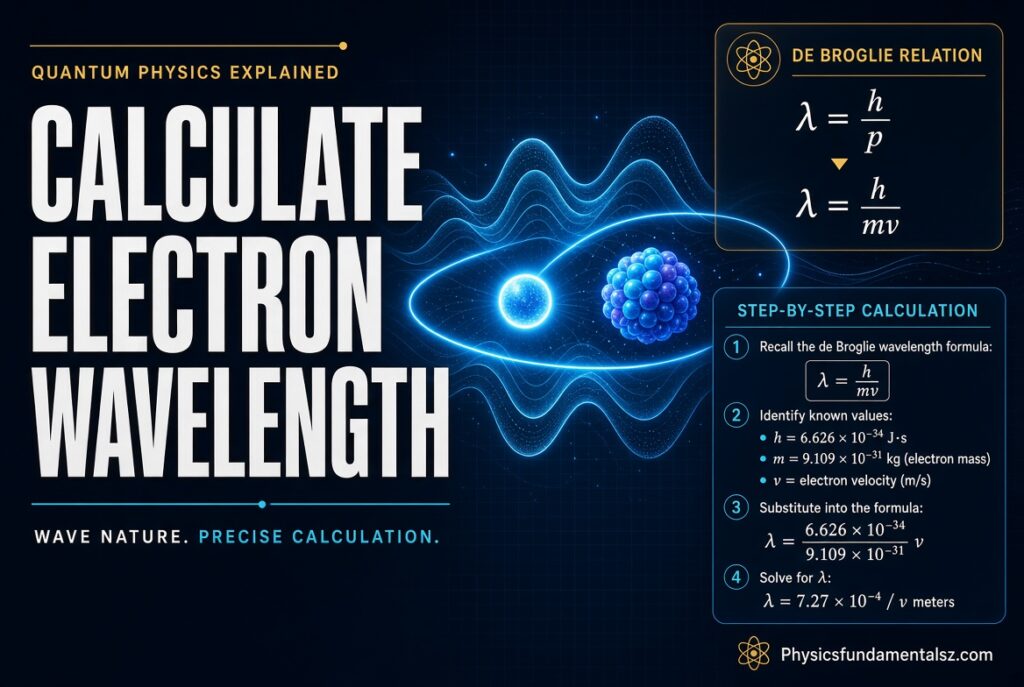
To calculate the de Broglie wavelength of an electron, divide Planck’s constant by the electron’s momentum: λ = h ÷ p. For a slow electron, the momentum is p = mv, so λ = h ÷ (m × v). For an electron accelerated through a voltage V, a handy shortcut is λ ≈ 1.226 nm ÷ √V.
Learning how to calculate de Broglie wavelength of an electron takes only a few steps. You need two constants, one measured quantity (speed, energy, or voltage), and a calculator. The tricky parts are picking the right form of the formula, keeping units straight, and knowing when relativity changes the answer.
A typical electron in an atom has a wavelength of about 0.3 nanometers. That is about the size of an atom, which is why electrons diffract off crystals and why electron microscopes can see far more detail than light microscopes.
Table of Contents
The De Broglie Wavelength Formula for an Electron
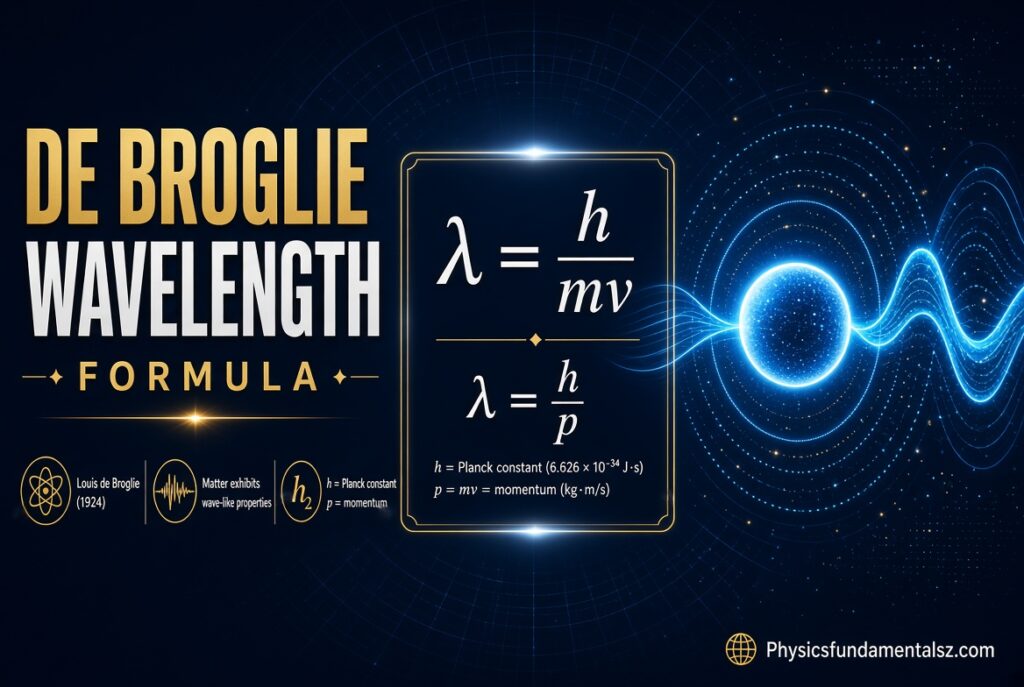
The de Broglie wavelength is the wavelength associated with a moving particle. It shows that matter behaves like a wave. The wavelength is inversely proportional to the particle’s momentum.
Main formula: λ = h ÷ p
- λ is the de Broglie wavelength in meters.
- h is Planck’s constant, 6.626 × 10⁻³⁴ J·s.
- p is the electron’s momentum in kg·m/s.
Choose the Formula That Matches Your Data
| What you are given | Formula for λ |
|---|---|
| Speed v (slow electron) | λ = h ÷ (m_e × v) |
| Momentum p | λ = h ÷ p |
| Kinetic energy K in joules | λ = h ÷ √(2 m_e K) |
| Accelerating voltage V (non-relativistic) | λ = h ÷ √(2 m_e e V) ≈ 1.226 nm ÷ √V |
| Kinetic energy K in eV (non-relativistic) | λ ≈ 1.226 nm ÷ √K |
| High energy (relativistic) | λ = hc ÷ √(K² + 2 K m_e c²) |
The Five-Step Method in One Glance
- Identify what is given: speed, momentum, energy, or voltage.
- Find the momentum p using the right relationship.
- Check whether relativity matters (speeds above about 10 percent of light speed).
- Substitute into λ = h ÷ p.
- Convert the answer to nanometers or picometers and check that it is reasonable.
What Is the De Broglie Wavelength?
The de Broglie wavelength is the wavelength that goes with a moving particle. It comes from the idea that particles such as electrons behave like waves as well as like tiny objects.
The formula applies to every moving object. For large objects, the wavelength is so small that you can never notice it. For electrons, it is large enough to measure.
The De Broglie Hypothesis
In 1924, French physicist Louis de Broglie proposed this idea in his doctoral thesis. Light was already known to act as both a wave and a particle. De Broglie asked whether matter might do the same.
He suggested that a particle with momentum p has a wavelength λ = h ÷ p. He received the 1929 Nobel Prize in Physics for the idea.
Wave-Particle Duality
Wave-particle duality says that quantum objects show both wave and particle behavior. The behavior you see depends on how you look.
An electron hits a detector at a single point, like a particle. Many electrons together build up an interference pattern, like a wave.
Why the Formula Looks Like Light’s Formula
For a photon, the momentum is p = h ÷ λ. This is the same relationship rearranged. De Broglie extended it from light to matter.
Experimental Confirmation
In 1927, Clinton Davisson and Lester Germer fired electrons at a nickel crystal and saw diffraction patterns. George Paget Thomson saw similar patterns when electrons passed through thin metal films. Davisson and Thomson shared the 1937 Nobel Prize.
Later, electron interference was shown even with single electrons going through a double slit, one at a time.
Constants You Need to Calculate the Wavelength
You only need a few constants. Memorize these or keep them handy.
| Constant | Symbol | Value |
|---|---|---|
| Planck’s constant | h | 6.626 × 10⁻³⁴ J·s |
| Electron mass | m_e | 9.109 × 10⁻³¹ kg |
| Elementary charge | e | 1.602 × 10⁻¹⁹ C |
| Speed of light | c | 2.998 × 10⁸ m/s |
| Electron rest energy | m_e c² | 0.511 MeV = 511 keV |
| h × c | hc | 1,239.84 eV·nm |
| One electron-volt | 1 eV | 1.602 × 10⁻¹⁹ J |
Using Rounded Values
Many textbooks use h = 6.63 × 10⁻³⁴ J·s and m_e = 9.11 × 10⁻³¹ kg. The difference is tiny. Use the values your course gives you.
Why hc in eV·nm Is Useful
When energy is in electron-volts, the product hc = 1,239.84 eV·nm lets you skip joules. This is handy for high-energy electrons.
Units and Conversions
Wavelengths of electrons are tiny. Use the right unit to make the answer readable.
| Unit | Symbol | Size in meters |
|---|---|---|
| Nanometer | nm | 10⁻⁹ m |
| Ångström | Å | 10⁻¹⁰ m |
| Picometer | pm | 10⁻¹² m |
| Femtometer | fm | 10⁻¹⁵ m |
Quick Conversions
- 1 nm = 10 Å = 1,000 pm.
- 0.1 nm = 1 Å = 100 pm.
- A typical atom is about 0.1 to 0.3 nm across.
Dimensional Check
Planck’s constant has units J·s, which equals kg·m²/s. Momentum has units kg·m/s. Dividing gives meters. That tells you the formula is dimensionally right.
The Momentum of an Electron
Everything starts with momentum. The formula for momentum depends on what you know.
From Speed (Non-Relativistic)
p = m_e v. This works well when the speed is much less than the speed of light. At 10 percent of light speed, the error is only about half a percent.
From Kinetic Energy (Non-Relativistic)
K = p² ÷ (2m_e), so p = √(2 m_e K). Use K in joules. If K is in eV, multiply by 1.602 × 10⁻¹⁹ to convert.
From Accelerating Voltage
An electron accelerated from rest through a potential difference V gains kinetic energy K = eV. So p = √(2 m_e e V).
Relativistic Momentum
For fast electrons, use p = γ m_e v, where γ = 1 ÷ √(1 − v²/c²). The total relativistic relation is (pc)² = K² + 2 K m_e c².
When Does Relativity Matter?
Relativity becomes important when the kinetic energy is not small compared with the electron’s rest energy of 511 keV.
| Kinetic energy | Speed (fraction of c) | Error if you ignore relativity |
|---|---|---|
| 100 eV | 0.020 | About 0.005% |
| 10 keV | 0.195 | About 0.5% |
| 100 keV | 0.548 | About 4.8% |
| 200 keV | 0.695 | About 9% |
| 1 MeV | 0.941 | About 41% |
For electron microscopes running at 100 kV or more, the relativistic formula is essential.
Deriving the Electron Wavelength Formulas
Seeing where the shortcuts come from makes them easier to trust.
From Speed
Start with λ = h ÷ p and p = m_e v. This gives λ = h ÷ (m_e v). It is direct and needs no derivation.
From Kinetic Energy
Start with K = ½ m_e v². Multiply both sides by 2m_e to get 2 m_e K = (m_e v)² = p². Take the square root: p = √(2 m_e K). So λ = h ÷ √(2 m_e K).
From Accelerating Voltage
Set K = eV. Then λ = h ÷ √(2 m_e e V).
Put in the numbers: h = 6.626 × 10⁻³⁴, m_e = 9.109 × 10⁻³¹, e = 1.602 × 10⁻¹⁹.
2 m_e e = 2 × 9.109 × 10⁻³¹ × 1.602 × 10⁻¹⁹ = 2.919 × 10⁻⁴⁹.
√(2.919 × 10⁻⁴⁹) = 5.402 × 10⁻²⁵.
λ = 6.626 × 10⁻³⁴ ÷ 5.402 × 10⁻²⁵ = 1.226 × 10⁻⁹ m = 1.226 nm.
So λ = 1.226 nm ÷ √V, with V in volts.
The Relativistic Form
Start with the relativistic energy relation, E² = (pc)² + (m_e c²)², and K = E − m_e c². Then (pc)² = K² + 2 K m_e c². The wavelength is λ = hc ÷ pc = hc ÷ √(K² + 2 K m_e c²).
A Common Practical Form
Electron microscopists often write the relativistic wavelength as λ = 1.2264 nm ÷ √[V (1 + 0.97845 × 10⁻⁶ V)], with V in volts. The correction term is tiny at low voltage and matters at high voltage.
How to Calculate De Broglie Wavelength of an Electron Step by Step
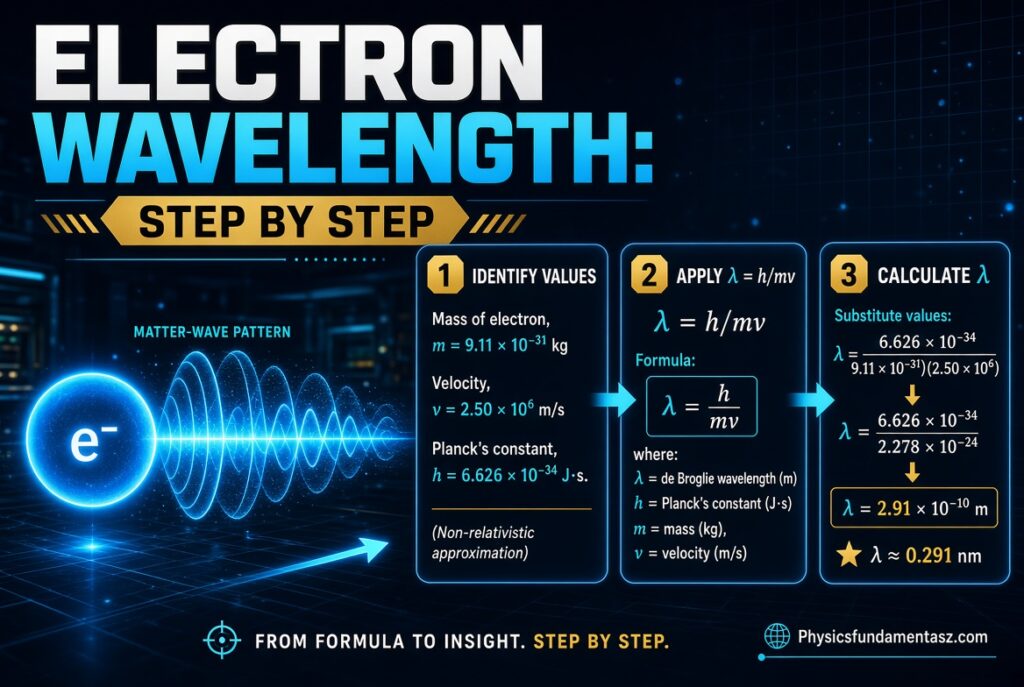
Here is the routine to use on any problem.
Step 1: Write Down What You Know
List the given quantity: speed, kinetic energy, momentum, or accelerating voltage. Note the unit. Write down h and m_e.
Step 2: Convert Units
Convert eV to joules by multiplying by 1.602 × 10⁻¹⁹. Convert km/s to m/s. Convert keV to eV by multiplying by 1,000.
Step 3: Decide Whether Relativity Matters
If the kinetic energy is below about 10 keV, or the speed is below about 0.1c, the non-relativistic formula is accurate to better than one percent. Above that, use the relativistic formula.
Step 4: Find the Momentum
Use p = m_e v, p = √(2 m_e K), or the relativistic expression, depending on the case.
Step 5: Apply λ = h ÷ p
Divide Planck’s constant by the momentum. Keep the exponent handling careful.
Step 6: Convert and Check
Convert the answer to nm or pm. For low-energy electrons, you should get values from about 0.01 to 10 nm. If you get something much larger or smaller, recheck.
Worked Example 1: Electron With a Given Speed
Find the de Broglie wavelength of an electron moving at 2.0 × 10⁶ m/s.
Step 1: Given Values
v = 2.0 × 10⁶ m/s, m_e = 9.109 × 10⁻³¹ kg, h = 6.626 × 10⁻³⁴ J·s.
Step 2: Check Relativity
The speed is about 0.7 percent of the speed of light. Use the non-relativistic formula.
Step 3: Momentum
p = m_e v = 9.109 × 10⁻³¹ × 2.0 × 10⁶ = 1.822 × 10⁻²⁴ kg·m/s.
Step 4: Wavelength
λ = h ÷ p = 6.626 × 10⁻³⁴ ÷ 1.822 × 10⁻²⁴ = 3.64 × 10⁻¹⁰ m.
λ = 0.364 nm, or 3.64 Å.
Check
The answer is about the size of an atom. That matches what we expect for electrons moving at typical atomic speeds.
Worked Example 2: Electron at 1.00 × 10⁶ m/s
Find the wavelength of an electron moving at 1.00 × 10⁶ m/s.
p = 9.11 × 10⁻³¹ × 1.00 × 10⁶ = 9.11 × 10⁻²⁵ kg·m/s.
λ = 6.626 × 10⁻³⁴ ÷ 9.11 × 10⁻²⁵ = 7.27 × 10⁻¹⁰ m = 0.727 nm.
What the Pattern Shows
Halving the speed doubled the wavelength compared with Example 1. Wavelength is inversely proportional to speed, so this is expected.
Worked Example 3: Electron Traveling at 1 Percent of the Speed of Light
Find the wavelength of an electron moving at 1 percent of the speed of light.
Step 1: Speed
v = 0.01 × 2.998 × 10⁸ = 2.998 × 10⁶ m/s.
Step 2: Momentum
p = 9.109 × 10⁻³¹ × 2.998 × 10⁶ = 2.731 × 10⁻²⁴ kg·m/s.
Step 3: Wavelength
λ = 6.626 × 10⁻³⁴ ÷ 2.731 × 10⁻²⁴ = 2.43 × 10⁻¹⁰ m = 0.243 nm.
Worked Example 4: Electron With a Given Kinetic Energy in Joules
An electron has a kinetic energy of 4.0 × 10⁻¹⁸ J. Find its de Broglie wavelength.
Step 1: Momentum From Kinetic Energy
p = √(2 m_e K) = √(2 × 9.109 × 10⁻³¹ × 4.0 × 10⁻¹⁸).
Inside the root: 7.287 × 10⁻⁴⁸. The square root is 2.70 × 10⁻²⁴ kg·m/s.
Step 2: Wavelength
λ = 6.626 × 10⁻³⁴ ÷ 2.70 × 10⁻²⁴ = 2.45 × 10⁻¹⁰ m = 0.245 nm.
Cross-Check With the Shortcut
K in eV = 4.0 × 10⁻¹⁸ ÷ 1.602 × 10⁻¹⁹ = 24.97 eV. Using λ = 1.226 nm ÷ √K gives 1.226 ÷ 4.997 = 0.245 nm. The answers match.
Worked Example 5: Electron Accelerated Through 100 Volts
An electron starts from rest and is accelerated through a potential difference of 100 V. Find its wavelength.
Step 1: Kinetic Energy
K = eV = 100 eV = 1.602 × 10⁻¹⁷ J.
Step 2: Use the Shortcut
λ = 1.226 nm ÷ √100 = 1.226 ÷ 10 = 0.1226 nm = 1.226 Å.
Step 3: Check With the Full Formula
p = √(2 × 9.109 × 10⁻³¹ × 1.602 × 10⁻¹⁷) = √(2.919 × 10⁻⁴⁷) = 5.402 × 10⁻²⁴.
λ = 6.626 × 10⁻³⁴ ÷ 5.402 × 10⁻²⁴ = 1.227 × 10⁻¹⁰ m. The two methods agree.
Worked Example 6: Finding the Voltage for a Required Wavelength
What accelerating voltage gives an electron a wavelength of 0.050 nm?
Step 1: Rearrange the Shortcut
λ = 1.226 nm ÷ √V, so √V = 1.226 ÷ λ and V = (1.226 ÷ λ)².
Step 2: Substitute
V = (1.226 ÷ 0.050)² = (24.52)² = 601 V.
Step 3: Check
At 601 V the electron has 601 eV of energy, which is far below 10 keV, so the non-relativistic formula is valid.
Worked Example 7: The Davisson-Germer Experiment
In 1927, Davisson and Germer used electrons accelerated through 54 V. Find the electron’s wavelength and compare it with the diffraction result.
Step 1: Wavelength
λ = 1.226 ÷ √54 = 1.226 ÷ 7.348 = 0.1668 nm.
Step 2: Diffraction Condition
The experiment used nickel with an atomic row spacing of about 0.215 nm. A strong peak appeared at a scattering angle of 50 degrees. For a surface grating, D sin φ = λ.
λ = 0.215 × sin 50° = 0.215 × 0.766 = 0.165 nm.
Step 3: Compare
The de Broglie prediction is 0.167 nm and the measured value is 0.165 nm. The agreement within about one percent was strong evidence for the wave nature of electrons.
Worked Example 8: Finding Speed From a Wavelength
An electron has a de Broglie wavelength of 0.50 nm. Find its speed and kinetic energy.
Step 1: Momentum
p = h ÷ λ = 6.626 × 10⁻³⁴ ÷ 5.0 × 10⁻¹⁰ = 1.325 × 10⁻²⁴ kg·m/s.
Step 2: Speed
v = p ÷ m_e = 1.325 × 10⁻²⁴ ÷ 9.109 × 10⁻³¹ = 1.455 × 10⁶ m/s.
Step 3: Kinetic Energy
K = p² ÷ (2 m_e) = (1.325 × 10⁻²⁴)² ÷ (2 × 9.109 × 10⁻³¹) = 9.64 × 10⁻¹⁹ J.
In electron-volts, that is 9.64 × 10⁻¹⁹ ÷ 1.602 × 10⁻¹⁹ = 6.02 eV.
Quick Check
Using the shortcut, K = (1.226 ÷ 0.50)² = 6.01 eV. The two answers agree.
Worked Example 9: Electron at Thermal Energy
Find the wavelength of an electron with a kinetic energy of 0.025 eV, which is about the thermal energy at room temperature.
Step 1: Shortcut
λ = 1.226 nm ÷ √0.025 = 1.226 ÷ 0.1581 = 7.75 nm.
What This Means
A slow, thermal electron has a wavelength of nearly 8 nm. That is far larger than an atom. Such electrons spread out as waves across many atoms, which matters in solids.
Worked Example 10: The Electron in the Hydrogen Atom
In the Bohr model, the electron in the ground state of hydrogen moves at about 2.19 × 10⁶ m/s in an orbit of radius 0.0529 nm. Find its de Broglie wavelength and compare it with the orbit.
Step 1: Wavelength
λ = h ÷ (m_e v) = 6.626 × 10⁻³⁴ ÷ (9.109 × 10⁻³¹ × 2.19 × 10⁶) = 3.32 × 10⁻¹⁰ m = 0.332 nm.
Step 2: Orbit Circumference
C = 2πr = 2π × 0.0529 nm = 0.332 nm.
Step 3: The Standing Wave Idea
The circumference equals exactly one wavelength. De Broglie used this to explain Bohr’s allowed orbits. An orbit is allowed only if a whole number of wavelengths fit around it: 2πr = nλ.
This is how the idea of matter waves explained why atoms have discrete energy levels.
Relativistic De Broglie Wavelength of an Electron
When an electron moves at a large fraction of the speed of light, p = mv is no longer accurate. The correct momentum is larger, so the real wavelength is shorter than the simple formula predicts.
The Relativistic Formulas
If you know the speed: p = γ m_e v, where γ = 1 ÷ √(1 − v²/c²).
If you know the kinetic energy K: pc = √(K² + 2 K m_e c²).
Then λ = h ÷ p, or λ = hc ÷ (pc). When K is in eV and you use hc = 1,239.84 eV·nm, the answer comes out in nanometers.
Which Method Is Easier?
For energy or voltage problems, the second form is quicker. For speed problems, the first form is direct. Both give the same answer.
Worked Example 11: A 10 keV Electron
An electron has a kinetic energy of 10 keV, as in a scanning electron microscope. Find its wavelength using both methods.
Non-Relativistic
λ = 1.226 nm ÷ √10,000 = 0.01226 nm = 12.26 pm.
Relativistic
K = 10,000 eV and 2 m_e c² = 1,022,000 eV.
K(K + 2 m_e c²) = 10,000 × 1,032,000 = 1.032 × 10¹⁰ eV².
√(1.032 × 10¹⁰) = 101,589 eV.
λ = 1,239.84 ÷ 101,589 = 0.012205 nm = 12.20 pm.
Comparison
The two answers differ by about 0.5 percent. At 10 keV, the non-relativistic formula is still a good approximation.
Worked Example 12: A 200 keV Electron in a Transmission Electron Microscope
Find the wavelength of an electron accelerated through 200 kV.
Step 1: Kinetic Energy
K = 200,000 eV.
Step 2: Relativistic Product
K + 2 m_e c² = 200,000 + 1,022,000 = 1,222,000 eV.
K(K + 2 m_e c²) = 200,000 × 1,222,000 = 2.444 × 10¹¹ eV².
√(2.444 × 10¹¹) = 494,368 eV.
Step 3: Wavelength
λ = 1,239.84 ÷ 494,368 = 0.002508 nm = 2.51 pm.
What a Non-Relativistic Calculation Gives
1.226 ÷ √200,000 = 0.002742 nm = 2.74 pm. That is about 9 percent too long. Instrument designers must use the relativistic formula.
Worked Example 13: Electron at Half the Speed of Light
Find the wavelength of an electron moving at 0.5c.
Step 1: Gamma Factor
γ = 1 ÷ √(1 − 0.25) = 1 ÷ √0.75 = 1.1547.
Step 2: Momentum
v = 0.5 × 2.998 × 10⁸ = 1.499 × 10⁸ m/s.
p = γ m_e v = 1.1547 × 9.109 × 10⁻³¹ × 1.499 × 10⁸ = 1.577 × 10⁻²² kg·m/s.
Step 3: Wavelength
λ = 6.626 × 10⁻³⁴ ÷ 1.577 × 10⁻²² = 4.20 × 10⁻¹² m = 4.20 pm.
Without Relativity
λ = h ÷ (m_e v) = 6.626 × 10⁻³⁴ ÷ 1.365 × 10⁻²² = 4.85 pm. The non-relativistic answer is about 15 percent too large.
Worked Example 14: Electron at 2.0 × 10⁸ m/s
Many online answers use λ = h ÷ (m v) for an electron at 2.0 × 10⁸ m/s. That speed is about two-thirds of the speed of light, so the simple formula is not valid. Here is the correct calculation.
Step 1: Gamma Factor
v ÷ c = 2.0 × 10⁸ ÷ 2.998 × 10⁸ = 0.667.
γ = 1 ÷ √(1 − 0.445) = 1 ÷ 0.745 = 1.342.
Step 2: Relativistic Momentum
p = 1.342 × 9.109 × 10⁻³¹ × 2.0 × 10⁸ = 2.445 × 10⁻²² kg·m/s.
Step 3: Wavelength
λ = 6.626 × 10⁻³⁴ ÷ 2.445 × 10⁻²² = 2.71 × 10⁻¹² m = 2.71 pm.
The Naive Answer
Using p = m_e v gives 3.64 pm. That is about 34 percent too large. If your problem says to use the classical formula, follow the instructions. If it says to be accurate, use the relativistic form.
Worked Example 15: A 1 MeV Electron
Find the wavelength of an electron with 1 MeV of kinetic energy.
K = 1,000,000 eV and K + 2 m_e c² = 2,022,000 eV.
K(K + 2 m_e c²) = 2.022 × 10¹² eV².
√(2.022 × 10¹²) = 1.422 × 10⁶ eV.
λ = 1,239.84 ÷ 1.422 × 10⁶ = 8.72 × 10⁻⁴ nm = 0.872 pm.
The non-relativistic formula would give 1.226 ÷ 1,000 = 1.226 pm, which is about 41 percent too long.
Worked Example 16: Finding the Voltage for a Target Wavelength at High Energy
What accelerating voltage gives an electron a wavelength of 2.0 pm?
Step 1: Momentum Times c
pc = hc ÷ λ = 1,239.84 eV·nm ÷ 0.0020 nm = 619,920 eV.
Step 2: Kinetic Energy
K = √[(pc)² + (m_e c²)²] − m_e c².
(pc)² = 3.843 × 10¹¹. (m_e c²)² = 2.611 × 10¹¹ using 511,000 eV.
Sum = 6.454 × 10¹¹. Square root = 803,380 eV.
K = 803,380 − 511,000 = 292,380 eV ≈ 292 keV.
Step 3: Voltage
The accelerating voltage is about 292 kV.
Why Relativity Matters Here
A non-relativistic estimate gives V = (1.226 ÷ 0.0020)² = 376,000 V. That is far too high. Designers who ignored relativity would overestimate the voltage by almost 30 percent.
De Broglie Wavelength of an Electron at Different Voltages
This table shows how the wavelength changes with accelerating voltage. Values for 10 kV and above use the relativistic formula.
| Accelerating voltage | Kinetic energy | Wavelength |
|---|---|---|
| 1 V | 1 eV | 1.226 nm |
| 10 V | 10 eV | 0.388 nm |
| 100 V | 100 eV | 0.123 nm |
| 1 kV | 1 keV | 38.8 pm |
| 10 kV | 10 keV | 12.2 pm |
| 30 kV | 30 keV | 6.98 pm |
| 100 kV | 100 keV | 3.70 pm |
| 200 kV | 200 keV | 2.51 pm |
| 300 kV | 300 keV | 1.97 pm |
| 1 MV | 1 MeV | 0.872 pm |
Reading the Table
Each increase of voltage by a factor of 100 shortens the wavelength by about a factor of 10 at low energy. The factor is slightly larger at high energy because of relativity.
De Broglie Wavelength of an Electron vs Other Particles
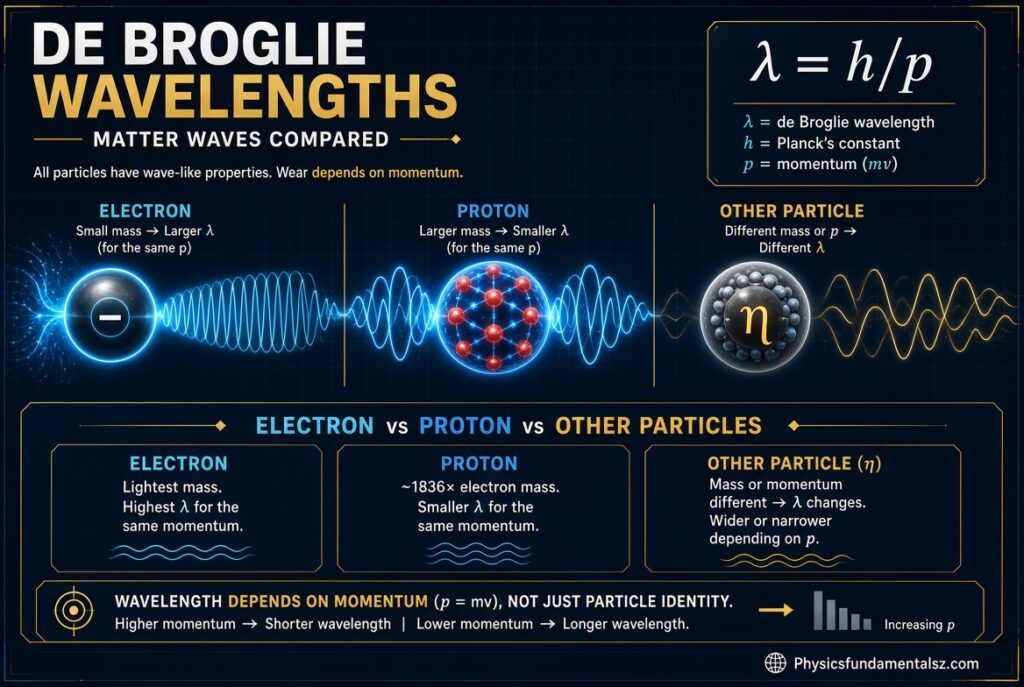
Wavelength depends on momentum. At the same kinetic energy, a heavier particle has more momentum and a shorter wavelength.
Same Energy, Different Mass
For the same kinetic energy, λ is proportional to 1 ÷ √m. A proton is 1,836 times heavier than an electron, so its wavelength is about 43 times shorter.
| Particle | Kinetic energy | Wavelength |
|---|---|---|
| Electron | 100 eV | 0.123 nm |
| Proton | 100 eV | 2.86 pm |
| Thermal neutron | 0.025 eV | 0.181 nm |
| Electron | 0.025 eV | 7.75 nm |
Everyday Objects
For macroscopic objects, momentum is huge, so the wavelength is tiny.
| Object | Mass and speed | Wavelength |
|---|---|---|
| Baseball | 0.145 kg at 40 m/s | 1.1 × 10⁻³⁴ m |
| Person walking | 70 kg at 1.5 m/s | 6.3 × 10⁻³⁶ m |
| Electron in an atom | 9.1 × 10⁻³¹ kg at 2.2 × 10⁶ m/s | 3.3 × 10⁻¹⁰ m |
Why You Never See Wave Behavior in a Baseball
The wavelength of a baseball is about 10¹⁹ times smaller than a proton. No slit, gap, or crystal is small enough to make it diffract. Wave effects are real but completely hidden at everyday scales.
Why Wave Effects Show Up for Electrons
A wave shows diffraction when it passes through gaps that are comparable to its wavelength. Electron wavelengths of about 0.1 nm match the spacing between atoms in a crystal, which is about 0.2 to 0.3 nm.
That is why crystals act as natural diffraction gratings for electrons. They are also natural gratings for X-rays, which have similar wavelengths.
Bragg’s Law for Electrons
Electrons that scatter from crystal planes obey Bragg’s law: n λ = 2 d sin θ. Here d is the spacing between planes and θ is the angle from the plane. Measuring θ lets you find d, or, if d is known, the wavelength.
Worked Check With Bragg’s Law
Suppose electrons with λ = 0.167 nm reflect from planes with d = 0.203 nm. For n = 1: sin θ = λ ÷ 2d = 0.167 ÷ 0.406 = 0.411, so θ = 24.3 degrees. This is the kind of calculation used in electron diffraction.
Electron in a Box: Standing Matter Waves
De Broglie waves explain why confined electrons have only certain energies. An electron trapped in a region must fit a whole number of half-wavelengths inside it.
The Wavelength Condition
For an electron in a one-dimensional box of length L, the allowed wavelengths are λ = 2L ÷ n, where n = 1, 2, 3, and so on.
Worked Example 17: Electron in a 1 nm Box
Find the longest wavelength and the lowest energy of an electron in a box 1.0 nm wide.
The longest wavelength is λ = 2L = 2.0 nm.
The momentum is p = h ÷ λ = 6.626 × 10⁻³⁴ ÷ 2.0 × 10⁻⁹ = 3.313 × 10⁻²⁵ kg·m/s.
The energy is E = p² ÷ (2 m_e) = (3.313 × 10⁻²⁵)² ÷ (2 × 9.109 × 10⁻³¹) = 6.02 × 10⁻²⁰ J.
That equals about 0.376 eV.
Why This Matters
This is the idea behind quantum dots and other nanostructures. Shrinking the box shortens the wavelength and raises the energy. Changing the size changes the color of light a quantum dot gives off.
Uses of the Electron De Broglie Wavelength
The wavelength is not just a classroom number. It sets the limits of real instruments and drives several technologies.
Electron Microscopes
A light microscope cannot see detail much smaller than half the wavelength of light, which is about 200 nanometers. Electrons at 100 to 300 kV have wavelengths of a few picometers, tens of thousands of times shorter than visible light.
In practice, lens aberrations limit electron microscopes to resolutions far larger than the wavelength. Modern aberration-corrected instruments reach resolutions below 0.1 nm, enough to image individual atoms.
Transmission and Scanning Electron Microscopes
A transmission electron microscope (TEM) shoots electrons through a thin sample and forms an image from those that pass. A scanning electron microscope (SEM) scans a focused beam across a surface and detects electrons that bounce back or are knocked out. The first working electron microscope was built in the early 1930s, and Ernst Ruska shared the 1986 Nobel Prize in Physics for that work.
Electron Diffraction
Electron diffraction identifies the structure of crystals and thin films. Low-energy electron diffraction (LEED) uses electrons of 20 to 200 eV, with wavelengths near 0.1 to 0.3 nm, to probe the top layers of a surface. Reflection high-energy electron diffraction (RHEED) monitors crystal growth.
Double-Slit Experiments
In 1961, Claus Jönsson showed electron interference through slits. In 1989, a team led by Akira Tonomura in Japan showed that single electrons, sent one at a time, still build up an interference pattern. Each electron lands at one point, but the pattern appears over many.
Other Matter Waves
Neutrons and atoms also diffract. Neutron diffraction is used to study magnetic structure and materials. Atom interferometers measure gravity and rotation with great precision.
Wave-Particle Duality and the Uncertainty Principle
The de Broglie wavelength links to another basic quantum idea. A wave with a sharply defined wavelength spreads out in space. A wave localized to a small region has a mix of wavelengths.
The Connection
Heisenberg’s uncertainty principle says Δx × Δp ≥ ħ ÷ 2, where ħ = h ÷ 2π. Because p = h ÷ λ, sharpening position blurs momentum, and so blurs wavelength.
A Quick Example
If an electron is confined to a region about 0.1 nm wide, its momentum uncertainty is at least ħ ÷ (2 × 0.1 × 10⁻⁹) = 1.055 × 10⁻³⁴ ÷ 2 × 10⁻¹⁰ = 5.3 × 10⁻²⁵ kg·m/s. That is about the momentum of an electron in an atom. This is why electrons in atoms move at about 10⁶ m/s.
Phase Velocity and Group Velocity
A matter wave has two speeds. They are easy to confuse.
Group Velocity
The group velocity is the speed of the wave packet, which represents the particle. It equals the particle’s speed, v.
Phase Velocity
The phase velocity is the speed of the wave crests. For a free particle it equals c² ÷ v, which is greater than the speed of light. This does not break relativity, because the crests carry no information or energy.
Common Mistakes When Calculating the De Broglie Wavelength of an Electron
Most errors repeat. Check this list before you finalize an answer.
Mixing Up Mass and Momentum
The formula needs momentum, not mass. If you only have kinetic energy, find momentum first with p = √(2 m_e K).
Using eV Instead of Joules
If you use the formula with m_e in kilograms, K must be in joules. Convert electron-volts first by multiplying by 1.602 × 10⁻¹⁹.
Dropping Exponents
Planck’s constant is about 10⁻³⁴. Momentum is about 10⁻²⁴. Dividing gives about 10⁻¹⁰. Losing one exponent changes your answer by a factor of ten.
Forgetting Relativity
For energies above about 10 keV, check the relativistic correction. At 100 kV or more, ignoring it gives errors of five percent or larger.
Using the Wrong Mass
An electron’s mass is 9.109 × 10⁻³¹ kg. A proton’s mass is 1.673 × 10⁻²⁷ kg. Do not mix them.
Using the Shortcut Out of Range
The shortcut λ = 1.226 nm ÷ √V assumes non-relativistic energy. It is also built for an electron specifically, so it does not work for other particles.
Reporting the Wrong Unit
Answers in meters often look like 10⁻¹⁰ or 10⁻¹². Convert to nm or pm so the result is easy to read.
Rearranging the Formulas for Any Unknown
Different problems ask for different quantities. This table covers the common cases for an electron.
| To find | Formula |
|---|---|
| Wavelength from momentum | λ = h ÷ p |
| Momentum from wavelength | p = h ÷ λ |
| Speed from wavelength | v = h ÷ (m_e λ) |
| Kinetic energy from wavelength | K = h² ÷ (2 m_e λ²) |
| Kinetic energy in eV from wavelength (nm) | K ≈ (1.226 ÷ λ)² |
| Voltage from wavelength | V = (1.226 nm ÷ λ)² |
| Wavelength from voltage | λ = 1.226 nm ÷ √V |
How to Compute the Wavelength With a Spreadsheet or Calculator
A few steps turn the formula into a reusable tool.
On a Scientific Calculator
Enter 6.626E-34 for h. Enter 9.109E-31 for m_e. For speed input, compute h ÷ (m_e × v). For voltage input, compute 1.226 ÷ √V.
In a Spreadsheet
Put the voltage in cell A1. In cell B1, enter =1.226/SQRT(A1) for a wavelength in nanometers. For the relativistic version, enter =1239.84/SQRT(A1*(A1+1022000)) with A1 in eV. Fill the formula down a column to build a table.
Practice Problems With Answers
Try these before checking the solutions. Use h = 6.626 × 10⁻³⁴ J·s and m_e = 9.109 × 10⁻³¹ kg.
Problem 1
Find the wavelength of an electron moving at 3.0 × 10⁶ m/s.
Answer: p = 9.109 × 10⁻³¹ × 3.0 × 10⁶ = 2.733 × 10⁻²⁴. λ = 6.626 × 10⁻³⁴ ÷ 2.733 × 10⁻²⁴ = 2.42 × 10⁻¹⁰ m = 0.242 nm.
Problem 2
Find the wavelength of an electron accelerated through 25 V.
Answer: λ = 1.226 ÷ √25 = 0.245 nm.
Problem 3
Find the wavelength of an electron with 50 eV of kinetic energy.
Answer: λ = 1.226 ÷ √50 = 1.226 ÷ 7.071 = 0.173 nm.
Problem 4
An electron has a wavelength of 0.20 nm. Find its speed and its kinetic energy in eV.
Answer: p = 6.626 × 10⁻³⁴ ÷ 2.0 × 10⁻¹⁰ = 3.313 × 10⁻²⁴. v = 3.313 × 10⁻²⁴ ÷ 9.109 × 10⁻³¹ = 3.64 × 10⁶ m/s. K = (1.226 ÷ 0.20)² = 37.6 eV.
Problem 5
What voltage gives an electron a wavelength of 0.10 nm?
Answer: V = (1.226 ÷ 0.10)² = 150 V.
Problem 6
Find the wavelength of a 20 keV electron using the relativistic formula.
Answer: K + 2 m_e c² = 20,000 + 1,022,000 = 1,042,000. K × that = 2.084 × 10¹⁰. Square root = 144,361. λ = 1,239.84 ÷ 144,361 = 0.00859 nm = 8.59 pm.
Problem 7
Find the wavelength of a 500 keV electron.
Answer: K + 2 m_e c² = 1,522,000. Product = 7.61 × 10¹¹. Square root = 872,353. λ = 1,239.84 ÷ 872,353 = 1.42 × 10⁻³ nm = 1.42 pm.
Problem 8
If an electron’s speed triples (and stays non-relativistic), what happens to its wavelength?
Answer: Wavelength is inversely proportional to speed. It becomes one-third of the original.
Problem 9
An electron and a proton move at the same speed. Which has the longer wavelength, and by what factor?
Answer: The electron has the longer wavelength. The ratio is λ_e ÷ λ_p = m_p ÷ m_e ≈ 1,836.
Problem 10
Find the wavelength of an electron moving at 0.8c.
Answer: γ = 1 ÷ √(1 − 0.64) = 1.667. v = 0.8 × 2.998 × 10⁸ = 2.398 × 10⁸ m/s. p = 1.667 × 9.109 × 10⁻³¹ × 2.398 × 10⁸ = 3.641 × 10⁻²². λ = 6.626 × 10⁻³⁴ ÷ 3.641 × 10⁻²² = 1.82 × 10⁻¹² m = 1.82 pm.
Which Formula Should You Use? A Decision Guide
Choosing the right formula is half the battle. Use this table to decide quickly.
| Situation | Best formula | Notes |
|---|---|---|
| Speed given, below 0.1c | λ = h ÷ (m_e v) | Simplest case |
| Speed given, above 0.1c | λ = h ÷ (γ m_e v) | Include the gamma factor |
| Kinetic energy in J, below 10 keV | λ = h ÷ √(2 m_e K) | Convert eV to J first |
| Kinetic energy in eV, below 10 keV | λ = 1.226 nm ÷ √K | Fast shortcut |
| Accelerating voltage, below 10 kV | λ = 1.226 nm ÷ √V | Same shortcut |
| Energy or voltage above 10 keV | λ = hc ÷ √(K² + 2 K m_e c²) | Relativistic |
| Momentum given | λ = h ÷ p | Direct |
| Wavelength given, find energy | K = (1.226 nm ÷ λ)² in eV | Non-relativistic only |
A Simple Rule of Thumb
If the problem gives a speed in the range of 10⁶ m/s or a voltage up to a few hundred volts, the simple formulas are fine. If it mentions a microscope, an accelerator, or hundreds of kilovolts, use the relativistic formula.
Electron vs Photon: Same Wavelength, Very Different Energy
Both electrons and photons can have a wavelength of 0.1 nm. Their energies are very different, and that difference is why electron probes are useful.
Photon Energy
For a photon, E = hc ÷ λ = 1,239.84 eV·nm ÷ 0.1 nm = 12,398 eV, about 12.4 keV. That is an X-ray.
Electron Energy
For an electron with the same wavelength, K = (1.226 ÷ 0.1)² = 150 eV.
Comparison
| Property at λ = 0.1 nm | Photon (X-ray) | Electron |
|---|---|---|
| Energy | About 12,400 eV | About 150 eV |
| Charge | None | −e |
| Mass | None | 9.109 × 10⁻³¹ kg |
| Penetration into solids | Deep | Shallow |
| Typical use | X-ray diffraction | Surface diffraction, microscopy |
Why This Matters
Low-energy electrons interact strongly with matter and penetrate only a few atomic layers. That makes them ideal for studying surfaces. X-rays pass deeper, which suits bulk crystal studies.
The Davisson-Germer Discovery in More Detail
The experiment that confirmed de Broglie’s idea started as an accident. Clinton Davisson and Lester Germer were studying how electrons scatter from a nickel target at Bell Telephone Laboratories.
The Accident
In 1925, a vacuum tube broke and air oxidized the nickel. To clean it, they heated the target for a long time. The heating turned the nickel from many tiny crystals into a few large ones.
When they resumed the experiment, the scattering changed. The electrons formed sharp peaks at certain angles instead of spreading smoothly.
The Insight
After learning about de Broglie’s hypothesis, they realized the peaks were diffraction. They tuned the electron energy and found a strong peak at 54 eV and 50 degrees. The measured wavelength matched the de Broglie prediction.
Why It Was Important
The result gave direct evidence that matter has wave properties. It supported the new quantum mechanics and helped win acceptance for it. Davisson shared the 1937 Nobel Prize in Physics with G. P. Thomson.
How De Broglie Reached His Formula
De Broglie’s idea came from combining relativity, light quanta, and symmetry.
The Starting Point
Light has energy E = hf and momentum p = h ÷ λ. De Broglie asked why nature would treat light and matter so differently. He proposed that matter also has a wavelength given by the same relationship.
The Atom Test
He tested the idea on the hydrogen atom. If the electron is a wave, only orbits that hold a whole number of wavelengths can persist. That reproduced Bohr’s quantized angular momentum, L = n ħ.
Derivation of the Orbit Condition
Require 2πr = nλ with λ = h ÷ (m v). Then 2πr = n h ÷ (m v). Rearranging gives m v r = n h ÷ 2π = n ħ. That is Bohr’s rule.
Conduction Electrons in a Metal
In a metal, the fastest conduction electrons have an energy called the Fermi energy. For copper, it is about 7.0 eV in the free-electron model.
Wavelength at the Fermi Energy
Using the shortcut, λ = 1.226 nm ÷ √7.0 = 0.463 nm. This is about twice the spacing between copper atoms, which shows that conduction electrons behave as waves spread through the crystal.
Why This Is Important
This wave behavior explains electrical resistance, band gaps, and many properties of solids. Electrons moving through a perfect crystal lattice do not scatter. Resistance comes from deviations in the lattice, like impurities and vibrations.
Exam Tips for Electron Wavelength Problems
Small habits save marks. Use them in tests and homework.
Show the Momentum Step
Many mark schemes give credit for finding the momentum. Write p = m_e v or p = √(2 m_e K) explicitly before using λ = h ÷ p.
Keep Units on Every Line
Write J·s for h, kg for mass, and m/s for speed. Check that kg·m/s results from the momentum calculation.
Use Constants as Given
Use the values printed on your formula sheet. Rounding differences are normally accepted, but start with the supplied numbers.
Judge Reasonableness
Electron wavelengths usually fall between 1 pm and 10 nm. If your result is far outside, check your exponent.
State the Final Unit
Give the answer in meters or a suitable multiple, such as nm or pm. Match the number of significant figures to the data.
Why the Electron Wavelength Is Not the Size of the Electron
A common confusion is to treat the de Broglie wavelength as the size of the electron. It is not.
What the Wavelength Describes
The wavelength describes how the electron’s quantum wave oscillates in space. It sets how the electron diffracts and interferes. It does not measure the electron’s physical size.
Electron Size
Experiments show that the electron behaves as a point-like particle, with no measurable internal structure down to extremely small scales. Its wave nature and its point-like nature coexist in quantum mechanics.
More Worked Examples for Common Exam Situations
These extra examples cover situations that often appear in tests and lab reports.
Worked Example 18: An Old Television Electron Gun
A cathode-ray tube accelerates electrons through 25 kV. Find the wavelength using the relativistic formula.
K = 25,000 eV and K + 2 m_e c² = 1,047,000 eV.
K(K + 2 m_e c²) = 2.6175 × 10¹⁰ eV².
√(2.6175 × 10¹⁰) = 161,787 eV.
λ = 1,239.84 ÷ 161,787 = 0.007664 nm = 7.66 pm.
The non-relativistic shortcut gives 7.75 pm, about 1.2 percent higher.
Worked Example 19: A Scanning Electron Microscope at 5 kV
An SEM operates at 5 kV. Find the electron wavelength.
λ = 1.226 nm ÷ √5,000 = 1.226 ÷ 70.71 = 0.01734 nm = 17.3 pm.
At this energy, the relativistic correction is only about 0.25 percent, so the shortcut is accurate.
Worked Example 20: Energy for a 0.010 nm Wavelength
What kinetic energy gives an electron a wavelength of 0.010 nm?
Non-Relativistic Estimate
K = (1.226 ÷ 0.010)² = 122.6² = 15,031 eV, or about 15.0 keV.
Relativistic Answer
pc = hc ÷ λ = 1,239.84 ÷ 0.010 = 123,984 eV.
K = √[(123,984)² + (511,000)²] − 511,000.
(123,984)² = 1.5372 × 10¹⁰. (511,000)² = 2.6112 × 10¹¹. Sum = 2.7649 × 10¹¹. Square root = 525,821 eV.
K = 525,821 − 511,000 = 14,821 eV, or about 14.8 keV.
Comparison
The two answers differ by about 1.4 percent. Use the relativistic value if your problem asks for accuracy at this energy.
Worked Example 21: Ratio Problem
How do the wavelengths of electrons accelerated through 100 V and 400 V compare?
λ is proportional to 1 ÷ √V. The voltage increased by a factor of 4, so the wavelength decreased by a factor of √4 = 2.
At 100 V, λ = 0.1226 nm. At 400 V, λ = 0.0613 nm.
Worked Example 22: Unit Check by Dimensional Analysis
Show that λ = h ÷ √(2 m_e K) has the unit of length.
h has units kg·m²/s. m_e K has units kg × (kg·m²/s²) = kg²·m²/s². The square root is kg·m/s. Dividing kg·m²/s by kg·m/s gives meters.
The unit works out to length, so the formula is dimensionally consistent.
Summary Table of Worked Examples
This table collects the results from the examples above for quick reference.
| Example | Given | Wavelength |
|---|---|---|
| 1 | v = 2.0 × 10⁶ m/s | 0.364 nm |
| 2 | v = 1.00 × 10⁶ m/s | 0.727 nm |
| 3 | v = 0.01c | 0.243 nm |
| 4 | K = 4.0 × 10⁻¹⁸ J | 0.245 nm |
| 5 | V = 100 V | 0.123 nm |
| 7 | V = 54 V | 0.167 nm |
| 9 | K = 0.025 eV | 7.75 nm |
| 10 | Hydrogen ground state | 0.332 nm |
| 11 | K = 10 keV | 12.2 pm |
| 12 | K = 200 keV | 2.51 pm |
| 13 | v = 0.5c | 4.20 pm |
| 14 | v = 2.0 × 10⁸ m/s | 2.71 pm |
| 15 | K = 1 MeV | 0.872 pm |
| 18 | V = 25 kV | 7.66 pm |
| 19 | V = 5 kV | 17.3 pm |
Electron Wavelengths Compared With Crystal Spacings
Electron diffraction works best when the wavelength is similar to or smaller than the spacing between atomic planes. This table shows typical plane spacings.
| Crystal and plane | Plane spacing d (approx.) |
|---|---|
| Nickel (111) | 0.203 nm |
| Copper (111) | 0.208 nm |
| Gold (111) | 0.235 nm |
| Sodium chloride (200) | 0.282 nm |
| Silicon (111) | 0.314 nm |
| Graphite (interlayer) | 0.335 nm |
Which Electron Energies Work?
For d around 0.2 to 0.3 nm, electrons of 10 to 200 eV have wavelengths of about 0.09 to 0.39 nm. These energies give clear diffraction in low-energy electron diffraction. At 200 keV, the wavelength is only 2.5 pm, so the diffraction angles become very small, and the technique works differently.
Small-Angle Diffraction at High Energy
Using Bragg’s law with n = 1, λ = 2d sin θ. For 200 keV electrons and d = 0.2 nm, sin θ = 0.002508 ÷ 0.4 = 0.00627, so θ ≈ 0.36 degrees. High-energy electrons scatter at very small angles, which suits TEM diffraction patterns.
Intuition: How to Picture an Electron Wave
Numbers are easier to trust when you can picture them. Here are a few ways to think about electron waves.
Ripples on a Pond
A single drop makes circular ripples. The spacing between crests is the wavelength. An electron’s quantum wave does something similar, though it describes the probability of finding the electron, not a physical ripple.
Probability, Not a Physical Wave
The amplitude of the electron wave squared gives the chance of detecting the electron at each point. Where the wave is large, detection is likely. Where it is small, detection is rare.
Interference
Two waves that overlap can add or cancel. Electrons passing through two slits show bright and dark bands because their waves add in some places and cancel in others. The band spacing depends on the wavelength.
Why Shorter Wavelength Means Finer Detail
A wave cannot resolve features much smaller than its wavelength. A shorter wavelength lets you map smaller features. That is why raising the voltage of an electron microscope helps resolution, up to the limit set by the lenses.
Quick Reference: Numbers Worth Remembering
Keeping a few numbers in mind speeds up every calculation.
| Quantity | Value |
|---|---|
| Electron wavelength at 1 V | 1.226 nm |
| Electron wavelength at 100 V | 0.123 nm |
| Electron wavelength at 100 kV | 3.70 pm |
| Planck’s constant h | 6.626 × 10⁻³⁴ J·s |
| Electron mass | 9.109 × 10⁻³¹ kg |
| Electron rest energy | 511 keV |
| hc | 1,239.84 eV·nm |
| Relativity threshold | About 10 keV |
Thermal De Broglie Wavelength
For a gas of particles at temperature T, physicists use the thermal de Broglie wavelength. It describes the typical quantum wavelength of the particles. The formula is λ_th = h ÷ √(2π m k_B T), where k_B is Boltzmann’s constant, 1.381 × 10⁻²³ J/K.
Worked Example 23: Electrons at 300 K
2π m k_B T = 2π × 9.109 × 10⁻³¹ × 1.381 × 10⁻²³ × 300 = 2.371 × 10⁻⁵⁰.
The square root is 1.540 × 10⁻²⁵.
λ_th = 6.626 × 10⁻³⁴ ÷ 1.540 × 10⁻²⁵ = 4.30 × 10⁻⁹ m = 4.3 nm.
Worked Example 24: Helium Atoms at 300 K
The mass of a helium atom is 6.646 × 10⁻²⁷ kg.
2π m k_B T = 2π × 6.646 × 10⁻²⁷ × 1.381 × 10⁻²³ × 300 = 1.730 × 10⁻⁴⁶.
The square root is 1.315 × 10⁻²³.
λ_th = 6.626 × 10⁻³⁴ ÷ 1.315 × 10⁻²³ = 5.04 × 10⁻¹¹ m = 0.050 nm.
What the Comparison Shows
Electrons at room temperature have a thermal wavelength of about 4 nm, far larger than the spacing between atoms. That is why electrons in solids need a quantum description. Helium atoms at room temperature have a thermal wavelength of only 0.05 nm, so they behave much more like classical particles.
Cooling Matter Until Waves Overlap
When the thermal wavelength grows comparable to the spacing between particles, quantum effects dominate. Cooling atoms to microkelvin and nanokelvin temperatures stretches their wavelengths to micrometers. This is how physicists create Bose-Einstein condensates.
Significant Figures and Precision
How many digits should you report? The answer depends on the data you were given.
Match the Input Precision
If the speed is given as 2.0 × 10⁶ m/s, which has two significant figures, report the wavelength to two significant figures, 0.36 nm. If the speed is 2.000 × 10⁶ m/s, report four, 0.3637 nm.
Keep Extra Digits in Intermediate Steps
Carry at least one or two more digits through the calculation and round at the end. This avoids small rounding errors adding up.
Constants Have Plenty of Precision
Planck’s constant and the electron mass are known to many digits. Using 6.626 and 9.109 gives results accurate to four digits, which is more than most problems need.
How Large Is a Picometer? A Sense of Scale
Electron wavelengths in microscopes are in picometers. It helps to know how small that is.
| Length | Size |
|---|---|
| Human hair width | About 70,000 nm |
| Wavelength of visible light | 400 to 700 nm |
| Large virus | About 100 nm |
| Hydrogen atom diameter | About 0.1 nm = 100 pm |
| Electron wavelength at 200 kV | 2.51 pm |
| Atomic nucleus | About 1 to 10 fm |
At 200 kV, the electron wavelength is about 40 times smaller than a hydrogen atom, and about 200,000 times smaller than the wavelength of visible light.
Key Takeaways: How to Calculate De Broglie Wavelength of an Electron
- The formula is λ = h ÷ p, where p is the electron’s momentum.
- For slow electrons, λ = h ÷ (m_e v).
- From voltage, λ ≈ 1.226 nm ÷ √V for non-relativistic electrons.
- From kinetic energy in eV, λ ≈ 1.226 nm ÷ √K.
- Wavelength is inversely proportional to momentum. Double the momentum and the wavelength halves.
- Electron wavelengths range from about 1 nm at 1 eV to about 1 pm at 1 MeV.
- Above about 10 keV, use the relativistic formula: λ = hc ÷ √(K² + 2 K m_e c²).
- Electrons diffract from crystals because their wavelengths match atomic spacings.
- Everyday objects have wavelengths far too small to detect.
- The Davisson-Germer experiment confirmed the electron’s wave nature.
Also Read:
- De Broglie Wavelength: λ = h/mv Formula, Derivation & Examples
- Photoelectric Effect Calculations: hf = work-function + KE_max
- Heisenberg Uncertainty Principle: ΔxΔp ≥ ℏ/2 — Explained Simply
- Bohr Model of the Atom: Energy Levels, Emission & Absorption Spectra
- Quantum Numbers: n, l, m_l, m_s and Electron Configuration
- Mass-Energy Equivalence: E = mc² Derivation & Nuclear Applications
- Mass Energy Equivalence Real Life Examples (2026 Guide)
- Special Relativity Explained
- Nuclear Decay Equations: Alpha, Beta & Gamma Decay Explained
- Half-Life Calculations: Formula & Worked Examples Explained
- Half Life Calculator With Steps: Formula, Examples & Full Guide 2026
- Difference Between Fission and Fusion With Examples: How Splitting and Joining Atoms Release Energy 2026
- Work-Energy Theorem: Complete Guide with Formula, Derivation, and Examples
- The Kinetic Theory of Gases
- Thermal Energy & Internal Energy: Heat, Temperature & Q = mcΔT
- The Doppler Effect
- How to Derive Wave Speed Formula? Full Derivation Guide 2026
- What Is the Formula for Conservation of Momentum? 2026
- Difference Between Speed and Velocity With Examples (2026 Guide)
- How to Calculate Thermal Expansion of a Metal Rod: Formula, Steps and Worked Examples 2026
- How to Solve Calorimetry Problems Step by Step: Formulas, Worked Examples and Practice 2026
- Physics Fundamentals: The Complete Guide to Core Concepts, Laws, and Equations
Frequently Asked Questions (FAQs)
How do you calculate the de Broglie wavelength of an electron?
Divide Planck’s constant by the electron’s momentum: λ = h ÷ p. For a slow electron, use p = m_e v. For example, an electron at 2.0 × 10⁶ m/s has a wavelength of about 0.364 nm.
What is the de Broglie wavelength formula?
The formula is λ = h ÷ p, where h is Planck’s constant (6.626 × 10⁻³⁴ J·s) and p is momentum. For a particle of mass m and speed v, p = mv, so λ = h ÷ (mv).
What is the de Broglie wavelength of an electron in terms of voltage?
For an electron accelerated from rest through V volts, λ ≈ 1.226 nm ÷ √V. At 100 V, the wavelength is about 0.123 nm. This shortcut works for energies below about 10 keV.
What is the value of Planck’s constant?
Planck’s constant is 6.626 × 10⁻³⁴ J·s. Many textbooks round it to 6.63 × 10⁻³⁴ J·s. In electron-volt units, hc equals 1,239.84 eV·nm.
What is the mass of an electron?
The electron’s mass is 9.109 × 10⁻³¹ kg. Textbooks often round it to 9.11 × 10⁻³¹ kg. Its rest energy is about 511 keV.
How do you find the wavelength from kinetic energy?
First find the momentum with p = √(2 m_e K), using K in joules. Then use λ = h ÷ p. If K is in electron-volts and below about 10 keV, use λ ≈ 1.226 nm ÷ √K.
How do you find the wavelength if only the speed is given?
Compute p = m_e v and then λ = h ÷ p. For a speed of 1.0 × 10⁶ m/s, the wavelength is 0.727 nm. If the speed is above about 0.1c, use the relativistic momentum γ m_e v.
How do you convert electron-volts to joules?
Multiply by 1.602 × 10⁻¹⁹. For example, 100 eV equals 1.602 × 10⁻¹⁷ J. You need joules when using h in J·s and mass in kilograms.
When do I need the relativistic formula?
Use it when the electron’s kinetic energy is not small compared with 511 keV. Above about 10 keV, the non-relativistic error exceeds 0.5 percent. At 100 keV it is about 5 percent, and at 1 MeV about 41 percent.
What is the relativistic de Broglie wavelength formula?
Use λ = hc ÷ √(K² + 2 K m_e c²), with K in eV and hc = 1,239.84 eV·nm. For a 200 keV electron, this gives 2.51 pm.
What is the wavelength of an electron in a transmission electron microscope?
At 200 kV, it is about 2.51 pm. At 100 kV, it is about 3.70 pm, and at 300 kV, about 1.97 pm. These values are far smaller than the spacing between atoms.
Why can’t we see the wave nature of a baseball?
A baseball’s momentum is so large that its wavelength is about 10⁻³⁴ m. No slit or crystal is small enough to make it diffract. The wave nature exists but cannot be detected.
Why do electrons diffract from crystals?
Electron wavelengths of about 0.1 nm are comparable to the spacing between atoms in a crystal. Waves diffract strongly when the gap size and wavelength match. A crystal acts as a natural grating.
What did the Davisson-Germer experiment show?
In 1927, it showed that electrons scattered from nickel form diffraction peaks. The peak at 54 eV and 50 degrees matched de Broglie’s prediction of 0.167 nm, confirming the wave nature of electrons.
Who proposed the de Broglie wavelength?
Louis de Broglie proposed it in 1924 in his doctoral thesis. He won the 1929 Nobel Prize in Physics for the discovery of the wave nature of electrons.
What is wave-particle duality?
It is the idea that quantum objects such as electrons and photons show both wave and particle behavior. Which behavior appears depends on the experiment.
What is the de Broglie wavelength of an electron at room temperature?
A thermal electron with about 0.025 eV of energy has a wavelength of roughly 7.75 nm. That is much larger than an atom, which is why electrons behave as extended waves in solids.
How does wavelength change if the electron’s speed doubles?
It halves. The wavelength is inversely proportional to momentum, and for non-relativistic speeds momentum is proportional to speed.
How does wavelength change if the accelerating voltage increases?
It decreases in proportion to 1 ÷ √V. Multiplying the voltage by 4 cuts the wavelength in half, in the non-relativistic range.
Does a heavier particle have a longer or shorter wavelength?
Shorter, if the speed is the same. Wavelength is inversely proportional to mass at a fixed speed. At the same kinetic energy, it is inversely proportional to the square root of the mass.
What is the wavelength of a proton compared with an electron at the same energy?
The proton’s wavelength is about 43 times shorter, because its mass is 1,836 times larger. At 100 eV, an electron has a wavelength of 0.123 nm and a proton about 2.86 pm.
How do you find the accelerating voltage for a given wavelength?
For non-relativistic electrons, V = (1.226 nm ÷ λ)². A 0.050 nm wavelength needs about 601 V. For picometer wavelengths, use the relativistic formula.
What is the de Broglie wavelength of an electron in the hydrogen atom?
In the ground state, the electron’s wavelength is about 0.332 nm. That equals the circumference of the first Bohr orbit, 2πr, which shows one full wave fits around the orbit.
How does the de Broglie wavelength explain Bohr’s orbits?
An orbit is stable only if a whole number of wavelengths fits around its circumference, 2πr = nλ. This gives m v r = n ħ, which is Bohr’s quantization rule.
What units should I use for the electron wavelength?
Use nanometers for low-energy electrons and picometers for high-energy ones. One nanometer equals 10⁻⁹ m, and one picometer equals 10⁻¹² m. Convert only at the end.
What is the relationship between the de Broglie wavelength and the uncertainty principle?
A sharply defined wavelength means a sharply defined momentum, which spreads the particle over space. Confining the electron to a small region blurs its momentum, as Δx Δp ≥ ħ ÷ 2 states.
Is the de Broglie wavelength the size of an electron?
No. It describes the electron’s wave behavior, not its physical size. Experiments show the electron acts as a point-like particle.
Why do electron microscopes have better resolution than light microscopes?
Electrons at typical microscope voltages have wavelengths of a few picometers, while visible light has wavelengths of 400 to 700 nm. Shorter wavelengths allow much finer detail, although lens aberrations limit real resolution.
Can neutrons and atoms also have de Broglie wavelengths?
Yes. Every moving particle has one. A thermal neutron has a wavelength of about 0.18 nm, which is why neutron diffraction is used to study crystals.
What are common mistakes when calculating the electron wavelength?
Common mistakes include using eV instead of joules, forgetting relativity at high energy, losing exponents, confusing mass with momentum, and using the 1.226 shortcut outside its range.
Conclusion
To calculate the de Broglie wavelength of an electron, find its momentum and divide Planck’s constant by it: λ = h ÷ p. For slow electrons, p = m_e v. For electrons accelerated through a voltage, λ ≈ 1.226 nm ÷ √V. For high-energy electrons, use the relativistic formula λ = hc ÷ √(K² + 2 K m_e c²).
The key habits are simple. Convert electron-volts to joules when needed, keep track of the exponents, and check whether relativity matters. Electron wavelengths usually range from about 1 nm at low energy to about 1 pm at the megaelectron-volt scale, so a quick sanity check catches most mistakes.
The result is more than a number. It explains why electrons diffract from crystals, why the Davisson-Germer experiment convinced physicists that matter behaves like a wave, and why electron microscopes can image single atoms. It also explains why atoms have discrete energy levels and why everyday objects never show wave behavior.
Work through the examples and practice problems above until the steps feel natural. Once they do, you can handle any electron wavelength problem, from a simple speed question to a relativistic microscope design.