How to Derive Wave Speed Formula? Full Derivation Guide 2026
Every wave you have ever seen, from a plucked guitar string to a ripple in a pond, obeys one clean rule connecting speed, frequency, and wavelength.
Learning how to derive wave speed formula is one of the most useful skills in introductory physics because the same logic reappears in sound, light, and even quantum mechanics.
Table of Contents
How to Derive Wave Speed Formula?
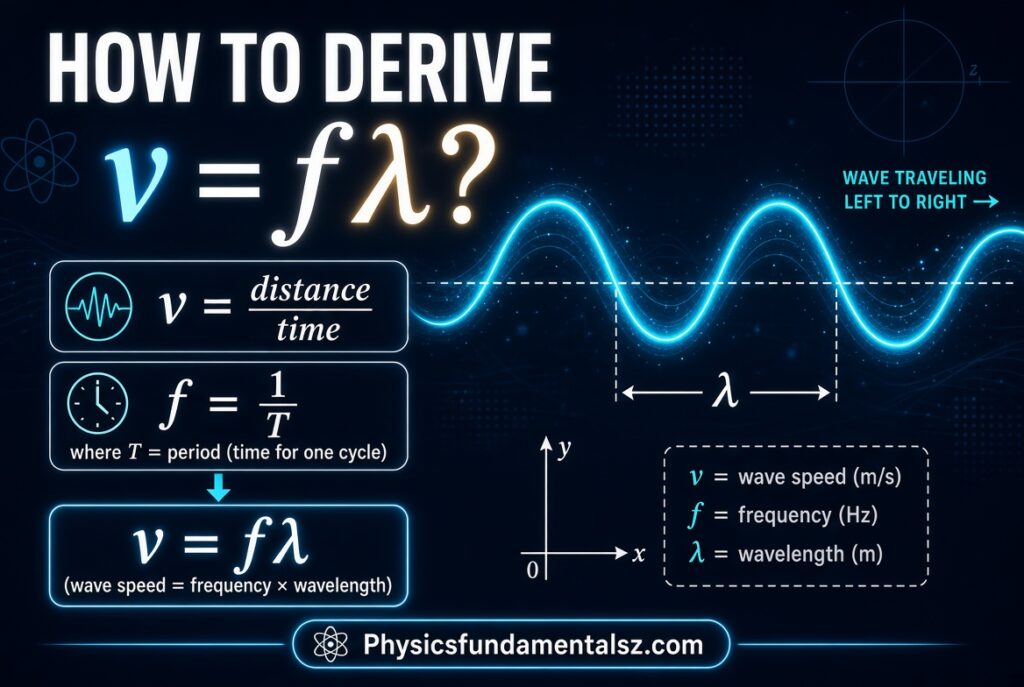
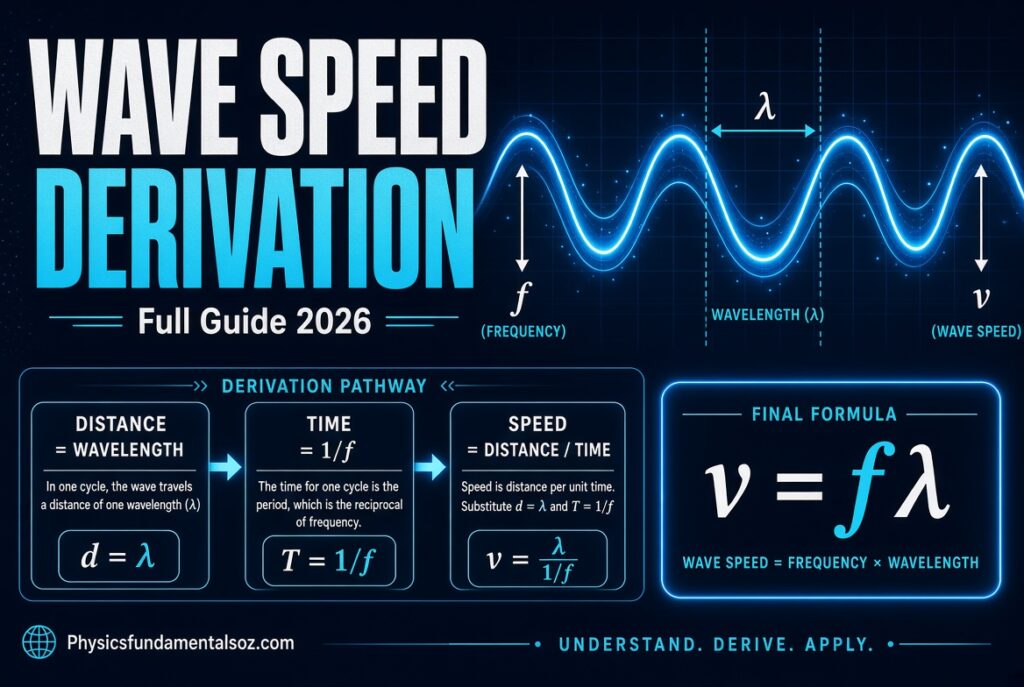
The wave speed formula is derived from the basic definition of speed, distance divided by time.
For one full wave cycle, the distance traveled equals the wavelength (λ), and the time taken equals the period (T).
Substituting these into v = distance/time gives v = λ/T, and since frequency f = 1/T, this simplifies to the final wave speed equation: v = fλ.
What Is Wave Speed?
Wave speed is the rate at which a wave’s disturbance moves through a medium or through space.
It is not the same as the speed of individual particles in the medium, which only oscillate back and forth around a fixed point.
Wave Speed Definition
Wave speed (v) is defined as the distance a wave crest travels per unit time, measured in meters per second (m/s) in SI units.
It depends on the properties of the medium the wave travels through, such as tension, density, temperature, or elasticity.
The Wave Speed Formula
The most common form of the wave speed formula is v = fλ, where v is speed, f is frequency in hertz, and λ is wavelength in meters.
An equivalent form is v = λ/T, where T is the period, the time taken to complete one full oscillation.
Both versions describe the same physical relationship and can be used interchangeably depending on the data given in a problem.
How to Derive Wave Speed Formula Step by Step
This derivation uses only the basic definition of speed and the properties of periodic motion, so no advanced calculus is required.
Step 1: Start With the Basic Speed Equation
Speed is always defined as distance divided by time: speed = distance/time.
This is the same equation used for a car or a ball, and it applies equally well to a wave crest moving through a medium.
Step 2: Define Wavelength and Period
Wavelength (λ) is the distance between two identical points on consecutive waves, such as crest to crest.
Period (T) is the time required for one complete wave cycle to pass a fixed point.
Step 3: Substitute Wavelength Into the Speed Equation
Because a wave travels exactly one wavelength in one period, the distance term becomes λ and the time term becomes T.
Substituting these values gives the wave speed equation in its first form: v = λ/T.
Step 4: Replace Period With Frequency
Frequency (f) is defined as the number of complete cycles per second, and it is mathematically the reciprocal of the period: f = 1/T.
Rearranging gives T = 1/f, which can be substituted directly into v = λ/T.
Step 5: Final Derived Formula
Substituting T = 1/f into v = λ/T produces v = λ ÷ (1/f), which simplifies to v = fλ.
This is the standard wave speed formula used across mechanical waves, sound waves, and electromagnetic waves.
Derivation Using the Wave Equation (Alternative Method)
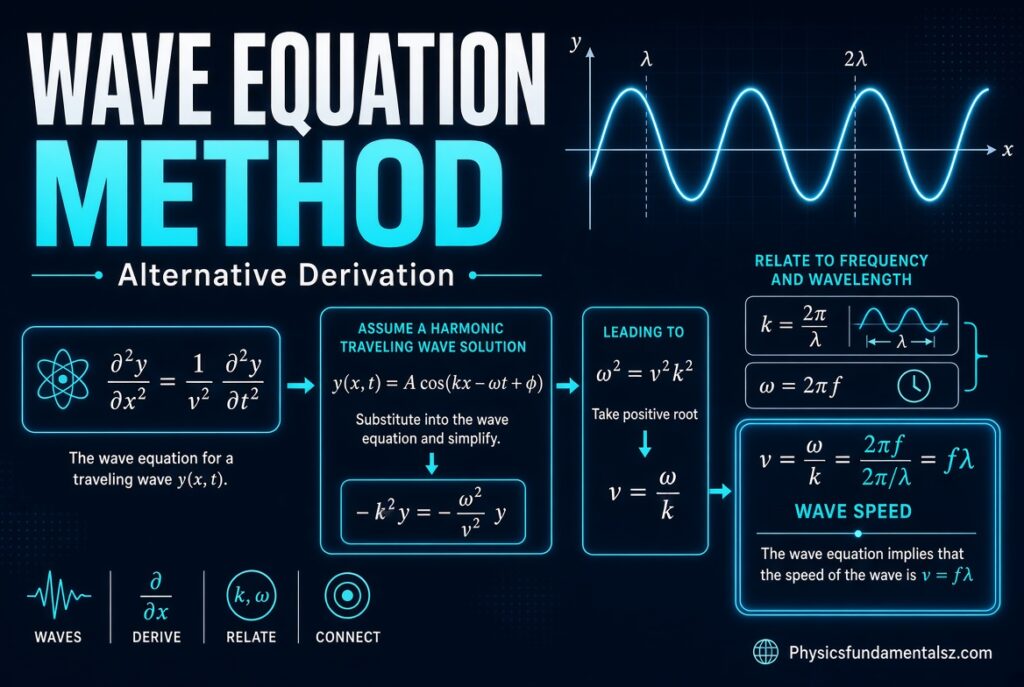
A wave traveling in the x-direction can be written as y(x, t) = A sin(kx − ωt), where k is the wave number and ω is angular frequency.
The wave number is defined as k = 2π/λ, and angular frequency is defined as ω = 2π/T = 2πf.
Wave speed is the ratio of these two quantities, v = ω/k, and substituting the definitions gives v = (2πf)/(2π/λ), which again simplifies to v = fλ.
This method is preferred in advanced physics and engineering courses because it extends naturally to phase velocity and group velocity.
Deriving Wave Speed for a String (Tension-Based Formula)
For a wave traveling along a stretched string, speed depends on tension and mass density rather than only frequency and wavelength.
Applying Newton’s second law to a small string element under tension T and linear mass density μ gives the formula v = √(T/μ).
Here, T is the tension in newtons and μ is the mass per unit length in kilograms per meter.
This derivation explains why tightening a guitar string raises pitch: higher tension increases wave speed, which increases frequency for a fixed string length.
Deriving the Speed of Light From Maxwell’s Equations
Electromagnetic waves follow the same v = fλ relationship, but their speed in a vacuum is fixed by two physical constants.
Maxwell’s equations show that the speed of light equals c = 1/√(μ₀ε₀), where μ₀ is permeability and ε₀ is permittivity of free space.
This constant, roughly 3 × 10⁸ m/s, sets the maximum speed for any wave traveling through empty space.
Worked Examples
Working through numbers makes the derivation easier to remember and apply on tests.
Example 1: Sound Wave
A sound wave has a frequency of 440 Hz and a wavelength of 0.78 meters.
Using v = fλ: v = 440 × 0.78 = 343 m/s, which matches the known speed of sound in air at room temperature.
Example 2: Water Wave
An ocean wave crest moves 20 meters in 10 seconds.
Using v = distance/time: v = 20/10 = 2.0 m/s, showing the derivation works directly without needing frequency data.
Example 3: String Wave
A guitar string has a tension of 60 N and a linear density of 0.006 kg/m.
Using v = √(T/μ): v = √(60/0.006) = √10000 = 100 m/s.
Wave Speed Formula Comparison Table
| Wave Type | Formula | Key Variables |
|---|---|---|
| General wave | v = fλ | Frequency, wavelength |
| General wave (alternate) | v = λ/T | Wavelength, period |
| String wave | v = √(T/μ) | Tension, linear density |
| Light in vacuum | c = 1/√(μ₀ε₀) | Permittivity, permeability |
| Sound in a gas | v = √(γRT/M) | Adiabatic index, temperature, molar mass |
Common Mistakes When Deriving Wave Speed
Many students confuse wave speed with the speed of a single particle in the medium, which oscillates rather than travels.
Others forget that frequency and period are reciprocals, leading to incorrect substitution during the derivation.
A third common error is mixing units, such as combining wavelength in centimeters with speed in meters per second without converting first.
Expert Tips for Remembering the Derivation
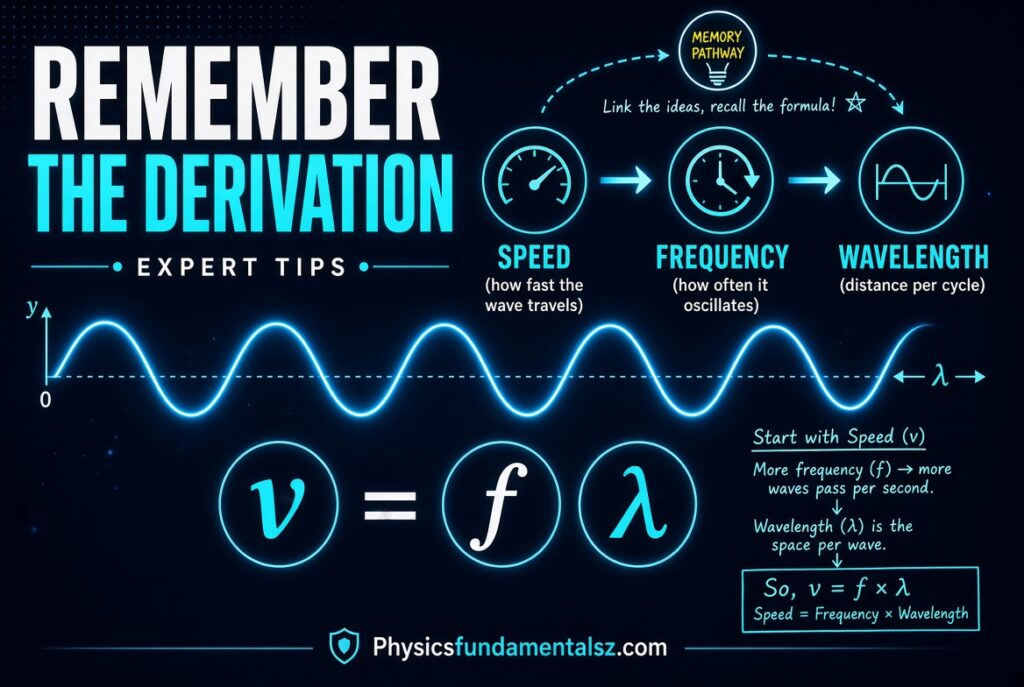
Always start from the universal definition speed = distance/time before introducing wave-specific terms.
Remember that one wavelength always corresponds to exactly one period, which is the core insight behind the entire derivation.
Practice deriving v = fλ from v = ω/k as well, since many exam questions test the angular frequency form.
Also Read:
- Wave Speed, Frequency and Wavelength
- Wave Speed Calculator Frequency Wavelength: Formula, Steps & Worked Examples
- Transverse Waves Explained
- Longitudinal Waves Explained
- Wave Superposition: Adding Waves, Phase & Interference Patterns
- The Doppler Effect
- The Electromagnetic Spectrum
- Reflection and Refraction
- Young’s Double-Slit Experiment
- Snell’s Law: Derivation & Total Internal Reflection
- Newton’s Laws of Motion
- What Is Energy?
- Projectile Motion: Complete Guide
- Projectile Motion Calculator With Angle
- Conservation of Momentum
- What Is the Formula for Conservation of Momentum?
- Momentum Calculator Physics: Formula, Steps & Worked Examples
- Kinetic Energy Calculator Physics
- Mass-Energy Equivalence: E = mc² Derivation & Nuclear Applications
- E=mc2 Explained for Beginners
- De Broglie Wavelength: Formula, Derivation & Examples
- De Broglie Wavelength Calculator: Formula, Steps & Worked Examples
- Photoelectric Effect Equation Explained
- Photoelectric Effect Calculations
- Electric Charge and Coulomb’s Law
Frequently Asked Questions (FAQs)
What is the formula to derive wave speed?
The wave speed formula is v = fλ, derived from v = distance/time by substituting one wavelength for distance and one period for time.
How do you derive v = fλ?
Start with speed = distance/time, replace distance with wavelength (λ) and time with period (T) to get v = λ/T, then substitute f = 1/T to get v = fλ.
What is the difference between wave speed and particle speed?
Wave speed describes how fast the disturbance pattern moves, while particle speed describes how fast individual points in the medium oscillate up and down.
Does wave speed depend on amplitude?
No, wave speed does not depend on amplitude for most simple waves; it depends on medium properties like tension, density, or elasticity.
What is the formula for wave speed on a string?
The formula is v = √(T/μ), where T is string tension in newtons and μ is linear mass density in kilograms per meter.
How is the speed of sound derived?
Speed of sound in a gas is derived as v = √(γRT/M), using the adiabatic index, gas constant, absolute temperature, and molar mass.
What is the relationship between frequency and period?
Frequency and period are reciprocals of each other: f = 1/T and T = 1/f.
Can wave speed be negative?
Wave speed itself is a magnitude and is always positive, though wave velocity can be negative if the wave travels in the negative direction.
What units are used in the wave speed formula?
Speed is measured in meters per second, frequency in hertz, and wavelength in meters, following SI convention.
How do you derive wave speed using angular frequency?
Using v = ω/k, where ω = 2πf and k = 2π/λ, substitution simplifies directly back to v = fλ.
Why does frequency stay constant when a wave changes medium?
Frequency is set by the source producing the wave, so it remains constant while wavelength and speed adjust based on the new medium.
What happens to wave speed when wavelength increases?
If frequency stays constant, increasing wavelength proportionally increases wave speed, since v = fλ.
Is the wave speed formula the same for light and sound?
The relationship v = fλ applies to both, but the actual speed value differs because light and sound travel through very different mediums.
How do you calculate wave speed from a graph?
Read the wavelength and period directly from a displacement-time or displacement-position graph, then apply v = λ/T.
What is phase velocity in wave derivation?
Phase velocity is the speed at which a single phase point, such as a crest, moves through space, calculated as v = ω/k.
Why is the wave speed formula important in physics?
It connects three measurable quantities, letting you calculate any one value if the other two are known, which is essential for waves, optics, and acoustics.
How accurate is v = fλ for real-world waves?
It is highly accurate for simple periodic waves in a uniform medium, though complex or dispersive waves may require additional correction terms.
What is the derivation of the speed of light formula?
The speed of light is derived from Maxwell’s equations as c = 1/√(μ₀ε₀), independent of frequency or wavelength.
Do all waves travel at the same speed in a given medium?
Not always; in dispersive media, wave speed can depend on frequency, meaning different frequencies travel at slightly different speeds.
What is a common mistake in wave speed derivation problems?
Mixing up period and frequency, or using inconsistent units, are the two most frequent errors students make.
Conclusion
Deriving the wave speed formula comes down to one core idea: a wave travels exactly one wavelength during exactly one period.
From there, substituting the definition of frequency turns v = λ/T into the widely used v = fλ.
The same logic extends to strings, sound, and light, each with its own medium-specific version of the formula.
With the step-by-step derivation and worked examples above, you should be able to reproduce this proof confidently in any physics exam or homework problem.