Photoelectric Effect Equation Explained (2026 Simple Guide)
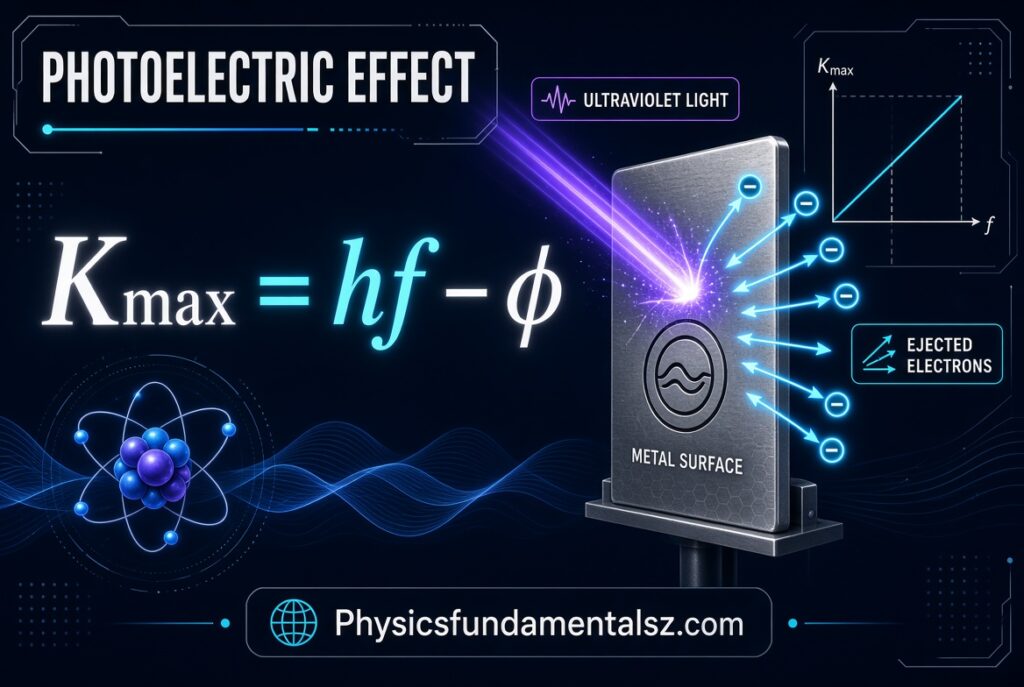
Shine light on a clean metal surface and, above a certain frequency, electrons pop off it instantly. The photoelectric effect equation explained in one line is this: KE_max = hf − φ.
That single formula ended a century of confusion about light. It also won Einstein the Nobel Prize, not relativity.
Table of Contents
What Is the Photoelectric Effect Equation?
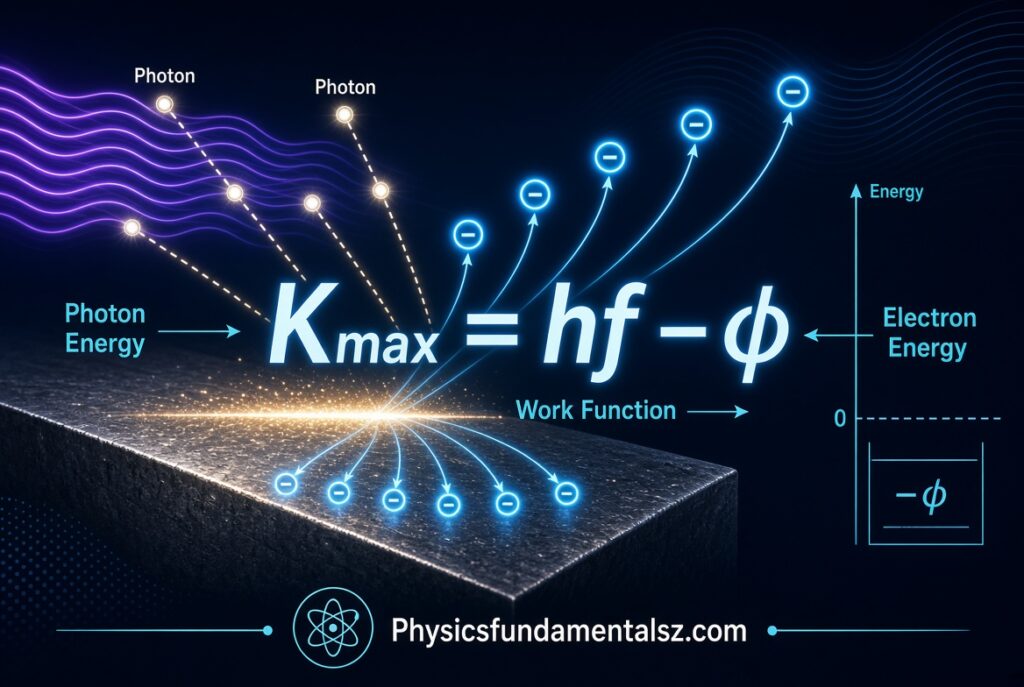
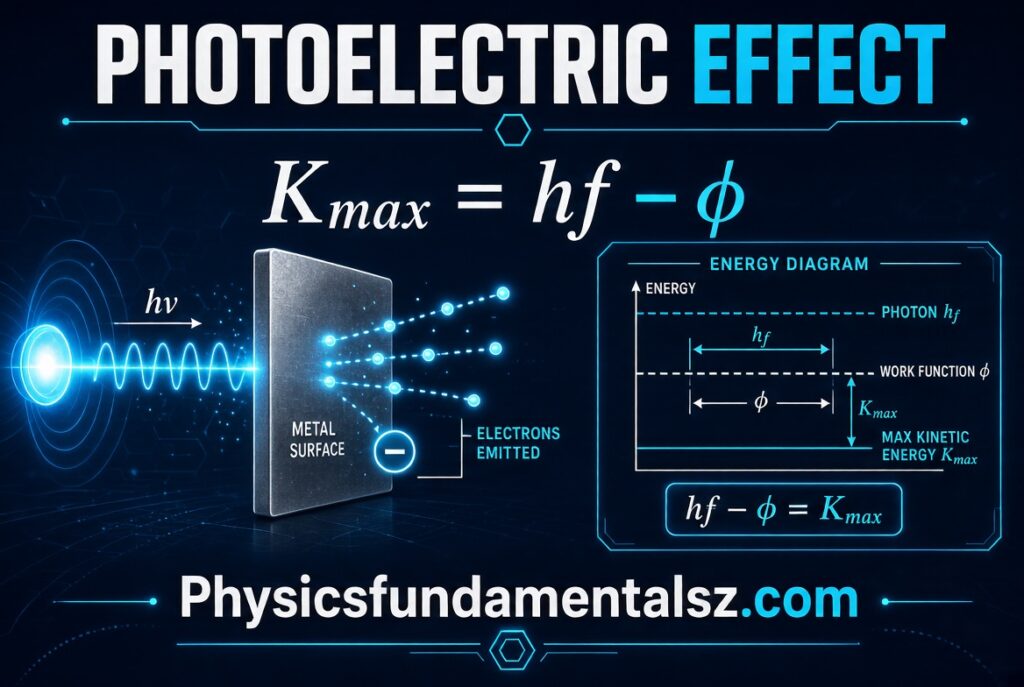
The photoelectric effect equation is KE_max = hf − φ, where KE_max is the maximum kinetic energy of an ejected electron, h is Planck’s constant, f is the frequency of incoming light, and φ is the work function of the metal.
It says a photon hands over its entire energy to one electron. Whatever energy is left after breaking the electron free becomes its kinetic energy.
What Is the Photoelectric Effect?
The photoelectric effect is the emission of electrons from a metal surface when light of sufficient frequency strikes it. Heinrich Hertz first observed it in 1887, and Albert Einstein explained it correctly in 1905.
Electrons only leave the surface if the light’s frequency clears a threshold value. Below that threshold, nothing happens, no matter how bright the light is.
Why Classical Physics Failed to Explain It
Classical wave theory predicted that brighter light should always eject electrons, given enough time to build up energy. Experiments showed the opposite.
Three observations broke the wave model completely:
- Electrons appear the instant light hits the surface, with no delay.
- Below the threshold frequency, no electrons are emitted, regardless of intensity.
- Increasing intensity raises the number of electrons, not their individual energy.
Only a particle picture of light could explain all three results at once.
The Photoelectric Effect Equation, Term by Term
Einstein’s equation is written as:
KE_max = hf − φ
Some textbooks write it as KE_max = hf − W₀, or as hf = φ + KE_max. All three versions say the same thing.
Photon Energy (hf)
Light arrives as discrete packets called photons, not as a continuous wave. Each photon carries energy equal to hf, where h is Planck’s constant (6.626 × 10⁻³⁴ J·s) and f is the light’s frequency.
Higher frequency light carries more energetic photons. Intensity, by contrast, only changes how many photons arrive per second.
Work Function (φ)
The work function is the minimum energy needed to pull one electron free from a specific metal’s surface. It’s a fixed property of the material, usually measured in electron-volts (eV).
Metals like sodium and potassium have low work functions, so they release electrons easily. Metals like platinum need much higher-energy photons.
Maximum Kinetic Energy (KE_max)
Whatever photon energy remains after overcoming the work function becomes the electron’s kinetic energy. This is the maximum possible value, since some electrons lose energy through internal collisions on the way out.
KE_max can be measured directly using the stopping potential in a photoelectric experiment.
Threshold Frequency (f₀)
The threshold frequency is the minimum frequency at which photoemission just barely begins, where KE_max equals zero. Setting KE_max to zero in the main equation gives f₀ = φ/h.
Below f₀, even an extremely intense beam of light produces zero photoelectrons.
How the Equation Is Derived
Einstein started from Planck’s idea that energy is quantized, not continuous. He extended it further, proposing that light itself travels as discrete photons.
Step 1: Energy Conservation
A single photon transfers all of its energy to a single electron in one interaction. That total energy must go somewhere.
Step 2: Splitting the Energy
Part of the photon’s energy, equal to φ, breaks the electron’s bond to the metal. Whatever energy remains becomes the electron’s kinetic energy.
Step 3: The Final Equation
Combining both steps gives hf = φ + KE_max, which rearranges to the familiar KE_max = hf − φ. This simple bookkeeping explained every anomaly classical physics couldn’t.
Photoelectric Effect Equation vs Classical Prediction
| Feature | Classical Wave Theory | Einstein’s Photon Theory |
|---|---|---|
| Emission delay | Expected at low intensity | None, ever |
| Threshold frequency | Not predicted | Predicted and confirmed |
| Effect of intensity | Should raise electron energy | Only raises electron count |
| Effect of frequency | Not directly linked to energy | Directly sets electron energy |
| Light model | Continuous wave | Discrete photon (quantum) |
Worked Examples
Example 1: Finding Kinetic Energy
A metal has a work function of 2.30 eV. Light of frequency 7.50 × 10¹⁴ Hz strikes it.
Photon energy: E = hf = (4.136 × 10⁻¹⁵ eV·s)(7.50 × 10¹⁴ Hz) ≈ 3.10 eV. Subtracting the work function gives KE_max = 3.10 − 2.30 = 0.80 eV.
Example 2: Finding Threshold Frequency
For a metal with φ = 2.14 eV (sodium), the threshold frequency is f₀ = φ/h. Dividing 2.14 eV by 4.136 × 10⁻¹⁵ eV·s gives f₀ ≈ 5.17 × 10¹⁴ Hz, which falls in the visible green-light range.
Example 3: Checking If Emission Occurs
Ultraviolet light at 6.0 × 10¹⁴ Hz hits a metal with φ = 3.0 eV. Photon energy here is roughly 2.48 eV, below the work function.
Since photon energy is less than φ, no electrons are emitted at all, regardless of how intense the beam is.
Key Takeaways
- Light behaves as discrete photons, each carrying energy hf.
- KE_max = hf − φ is the master relationship linking frequency, work function, and electron energy.
- A threshold frequency exists for every material; below it, no photoemission happens.
- Intensity controls electron count, never individual electron energy.
Real-World Applications
- Solar panels rely on a related process to convert photon energy into usable electrical current.
- Photomultiplier tubes amplify single-photon detections for medical imaging and particle physics.
- Night-vision devices use photoelectric surfaces to convert faint light into detectable electron signals.
- Barcode scanners and light meters apply the same photon-to-electron conversion principle.
Common Mistakes to Avoid
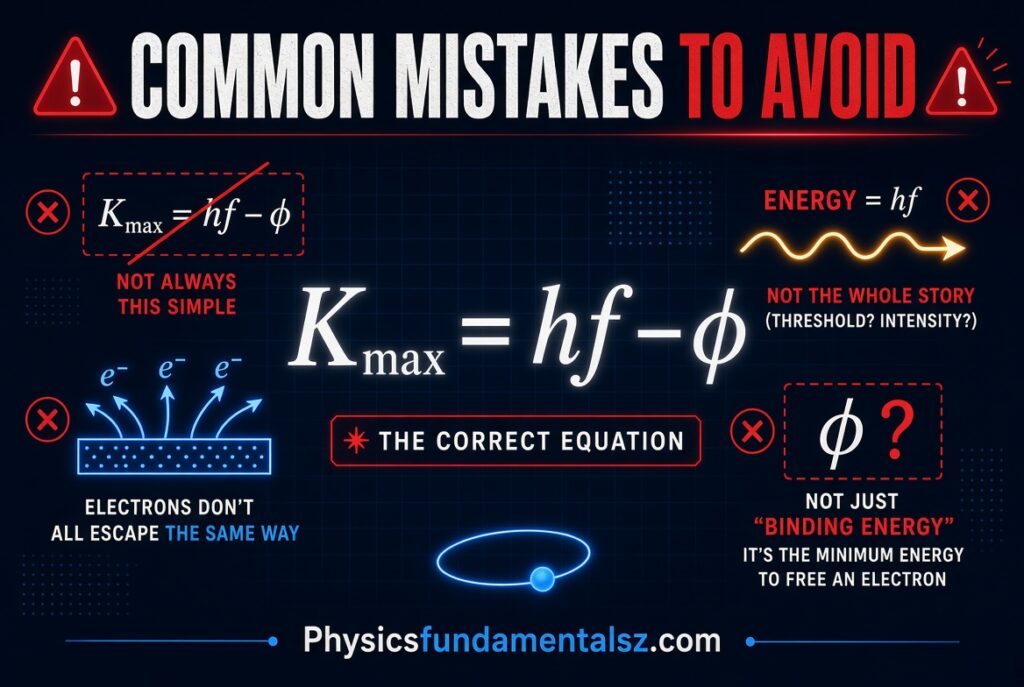
- Confusing intensity with frequency; only frequency determines whether emission happens at all.
- Forgetting that KE_max is a maximum, not the energy of every emitted electron.
- Mixing units between eV and joules without converting Planck’s constant correctly.
- Assuming a brighter light source can substitute for a higher-frequency one below threshold.
Also Read:
Explore more physics guides on physicsfundamentalsz.com:
- Photoelectric Effect Calculations: hf = work-function + KE_max
- De Broglie Wavelength: λ = h/mv Formula, Derivation & Examples
- De Broglie Wavelength Calculator: Formula, Steps & Worked Examples
- Heisenberg Uncertainty Principle: ΔxΔp ≥ ℏ/2 — Explained Simply
- Bohr Model of the Atom: Energy Levels, Emission & Absorption Spectra
- Quantum Numbers: n, l, m_l, m_s and Electron Configuration
- Mass-Energy Equivalence: E = mc² Derivation & Nuclear Applications
- E=mc2 Explained for Beginners (2026 Simple Guide)
- Nuclear Decay Equations: Alpha, Beta & Gamma Decay Explained
- Half-Life Calculations: Formula & Worked Examples Explained
- Half Life Calculator With Steps: Formula, Examples & Full Guide
- Electric Charge and Coulomb’s Law: F = kq₁q₂/r² Explained
- Coulomb’s Law Calculations: F = kQ1Q2/r² Formula & Examples
- Electric Potential Energy: E = kQq/r, Work Done & Worked Examples
- Electric Current: I = Q/t, Drift Velocity & Ohm’s Law Connection
- Ohm’s Law Calculator Solve for Current: Formula, Steps & Examples
- Ohm’s Law and Temperature: How Resistance Really Changes With Heat
- Resistors in Series and Parallel: Formulas, Rules & Worked Examples
- Electric Circuits & Kirchhoff’s Laws: KCL, KVL & Worked Examples
- Kirchhoff’s Laws Advanced: Solving Multi-Loop Circuits Step by Step
- Magnetic Field of a Current-Carrying Wire: B = μ0I/2πr
- Magnetic Flux and Faraday’s Law: Formula, Examples & Applications
- Lenz’s Law: The Direction of Induced Current Explained
- Capacitors and Capacitance: C = Q/V Formula, Energy Storage & Examples
- Wave Speed, Frequency & Wavelength
Frequently Asked Questions (FAQs)
What is the photoelectric effect equation?
The photoelectric effect equation is KE_max = hf − φ. It relates the maximum kinetic energy of an ejected electron to the photon’s energy and the metal’s work function.
Who discovered the photoelectric effect equation?
Albert Einstein published the equation in 1905, building on Max Planck’s earlier quantum theory. This work earned him the 1921 Nobel Prize in Physics.
What does KE_max mean in the photoelectric equation?
KE_max is the maximum kinetic energy any single ejected electron can have. Electrons deeper inside the metal lose extra energy escaping, so their actual kinetic energy is often lower.
What is the work function in physics?
The work function is the minimum energy required to remove an electron from a specific metal’s surface. Every metal has its own characteristic value, usually given in electron-volts.
What is threshold frequency?
Threshold frequency is the lowest light frequency that can still eject an electron, where KE_max equals zero. Below this frequency, photoemission never occurs.
Why doesn’t intensity affect electron energy?
Intensity only changes how many photons strike the surface per second. Each photon still interacts with just one electron, so individual electron energy depends solely on frequency.
Does the photoelectric effect prove light is a particle?
It proves light must behave like discrete particles, called photons, during this interaction. Light still shows wave behavior in other experiments, which is why physicists describe it as having wave-particle duality.
How is Planck’s constant used in this equation?
Planck’s constant, h, converts a photon’s frequency into its energy through E = hf. Its value is 6.626 × 10⁻³⁴ joule-seconds.
Can visible light cause the photoelectric effect?
Yes, if the metal’s work function is low enough. Sodium and potassium, for example, release electrons under ordinary visible light.
What happens below the threshold frequency?
Absolutely no electrons are emitted, no matter how bright or prolonged the light exposure is. This result was impossible to explain using classical wave theory alone.
How do you calculate stopping potential?
Stopping potential is the voltage needed to stop the fastest photoelectrons, found using eV_stop = KE_max. Measuring it experimentally lets physicists calculate KE_max directly.
Is the photoelectric effect equation linear?
Yes, KE_max increases linearly with frequency f, with slope equal to Planck’s constant h. Plotting KE_max against f produces a straight line whose y-intercept is −φ.
What units are used in the photoelectric equation?
Energy terms are commonly expressed in electron-volts (eV) or joules (J). Frequency is measured in hertz (Hz), and Planck’s constant must match whichever energy unit you’re using.
What is a photon?
A photon is a discrete packet of electromagnetic energy with zero rest mass. Its energy depends only on its frequency, following E = hf.
Why is the photoelectric effect important in physics?
It provided the first solid experimental proof of quantum theory, showing light isn’t purely a wave. This discovery helped launch the entire field of quantum mechanics.
Does every metal have the same work function?
No, work function varies significantly between metals. Alkali metals have low values, while metals like platinum have much higher ones.
How does the photoelectric effect relate to solar panels?
Solar panels use a related quantum process, the photovoltaic effect, to convert absorbed photon energy into electrical current. Both effects rely on light transferring energy to electrons.
What is the difference between photoelectric and photovoltaic effects?
The photoelectric effect ejects electrons completely from a surface into a vacuum or gas. The photovoltaic effect moves electrons across a junction inside a solid material, generating current without ejection.
Can X-rays cause the photoelectric effect?
Yes, X-rays carry very high-frequency photons and readily cause photoemission. This is actually how photoelectric absorption works in medical imaging and materials science.
What is the significance of Millikan’s experiments?
Robert Millikan experimentally verified Einstein’s equation with high precision between 1914 and 1916. His measurements confirmed the linear relationship between frequency and kinetic energy.
Conclusion
The photoelectric effect equation, KE_max = hf − φ, explains one of physics’ cleanest experimental puzzles. It shows that light energy arrives in discrete photon packets, not as a smooth continuous wave.
Once you know the work function of a material and the frequency of incoming light, finding the ejected electron’s energy is simple algebra. This single equation reshaped how physicists understand light, energy, and matter at the quantum level.