Photoelectric Effect Calculations: hf = work-function + KE_max
Shine light on a piece of metal and, if the light is energetic enough, electrons fly off it instantly.
That single observation broke classical physics and helped launch quantum mechanics.
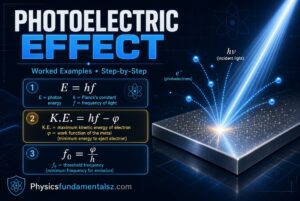
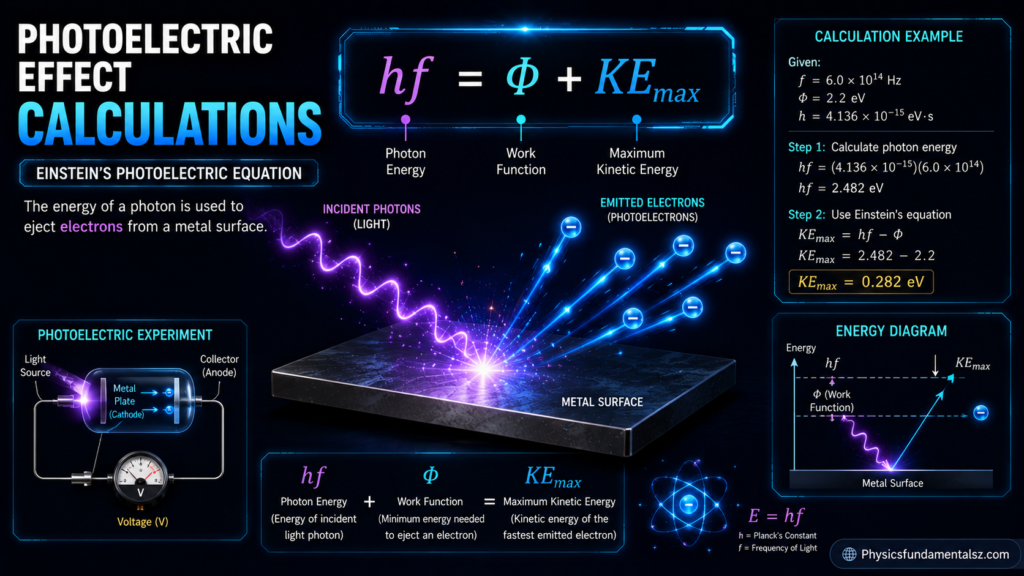
Photoelectric Effect Calculations: The core formula is Einstein’s photoelectric equation, Kmax = hf − φ, where Kmax is the maximum kinetic energy of an ejected electron, h is Planck’s constant, f is the frequency of the incoming light, and φ (phi) is the metal’s work function.
Table of Contents
What Is the Photoelectric Effect?
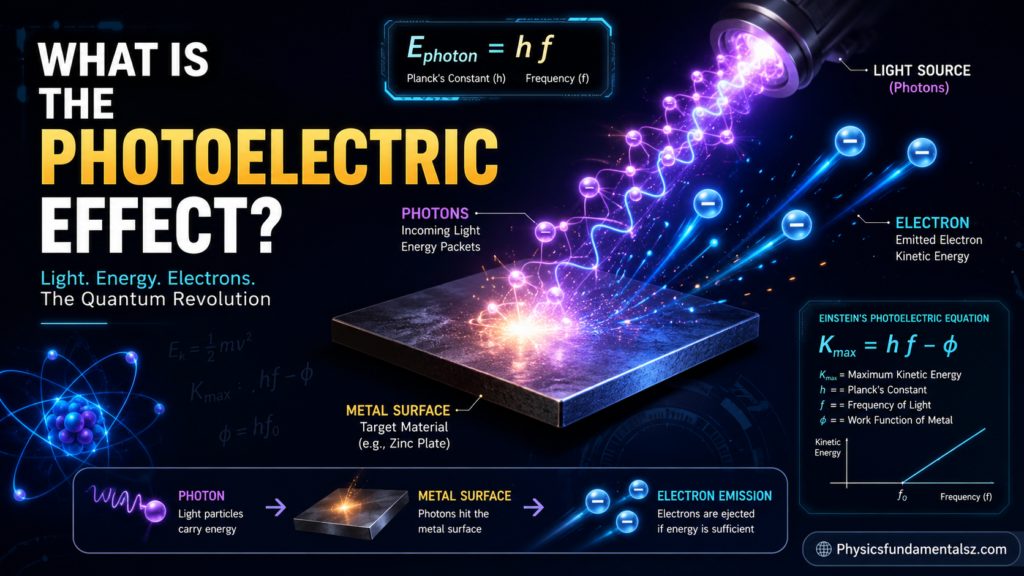
The photoelectric effect is the emission of electrons from a metal surface when light of sufficiently high frequency strikes it. Each photon carries a fixed packet of energy, E = hf. If that energy exceeds the metal’s work function, an electron is knocked free; any leftover energy becomes the electron’s kinetic energy.
This matters because it proved light behaves like a stream of particles (photons), not just a wave — a discovery that earned Albert Einstein the 1921 Nobel Prize in Physics and helped establish quantum mechanics as a working theory of nature.
The Photoelectric Effect Formula (Einstein’s Equation)
Einstein’s photoelectric equation ties together everything you need for photoelectric effect calculations:
Kmax = hf − φ
Every quantity in this equation can be calculated on its own, and every problem you’ll encounter is really just solving for one of these variables while the others are given.
Photon Energy: E = hf = hc/λ
A photon’s energy depends only on its frequency (or equivalently, its wavelength):
- E = hf, where h = 6.626 × 10⁻³⁴ J·s (Planck’s constant) and f is frequency in Hz
- E = hc/λ, where c = 3.00 × 10⁸ m/s (speed of light) and λ is wavelength in meters
These two forms are interchangeable because light obeys v = fλ, a relationship covered in more depth in our guide to wave speed.
Work Function (φ) Explained
The work function is the minimum energy needed to remove an electron from a specific metal’s surface. It’s a fixed property of the material — sodium (2.28 eV), zinc (4.3 eV), and platinum (6.35 eV) all have different work functions because their electrons are bound with different strengths.
Maximum Kinetic Energy: Kmax = hf − φ
Once a photon’s energy exceeds the work function, the excess energy becomes the electron’s kinetic energy:
Kmax = hf − φ = ½mv²max
If hf is less than φ, no electrons are emitted — no matter how bright the light is. Brightness only changes how many photons arrive per second, not how much energy each one carries.
Stopping Potential: eV0 = Kmax
Stopping potential (V0, sometimes written Vs) is the reverse voltage needed to stop even the fastest photoelectrons from reaching the collector:
eV0 = Kmax, so V0 = Kmax / e
where e = 1.602 × 10⁻¹⁹ C is the elementary charge. This is how Kmax is actually measured in a real photoelectric experiment.
Threshold Frequency and Threshold Wavelength
The threshold frequency (f0) is the minimum frequency that can eject an electron at all — the point where Kmax = 0:
f0 = φ / h and λ0 = hc / φ
Below f0 (or above λ0), the photoelectric effect simply doesn’t happen for that metal.
Step-by-Step Method for Solving Photoelectric Effect Problems
- Identify what’s given — wavelength, frequency, work function, Kmax, or stopping potential.
- Convert units first. Wavelength in nm → meters; work function in eV → joules (or keep everything in eV using the shortcut below).
- Calculate photon energy using E = hf or E = hc/λ.
- Apply Kmax = hf − φ to find the unknown, rearranging as needed.
- Convert to the requested quantity (velocity, stopping potential, threshold frequency, etc.) using the relevant secondary formula.
- Sanity-check the sign. A negative Kmax means no photoemission occurs — that’s a valid, meaningful result, not an error.
Worked Examples
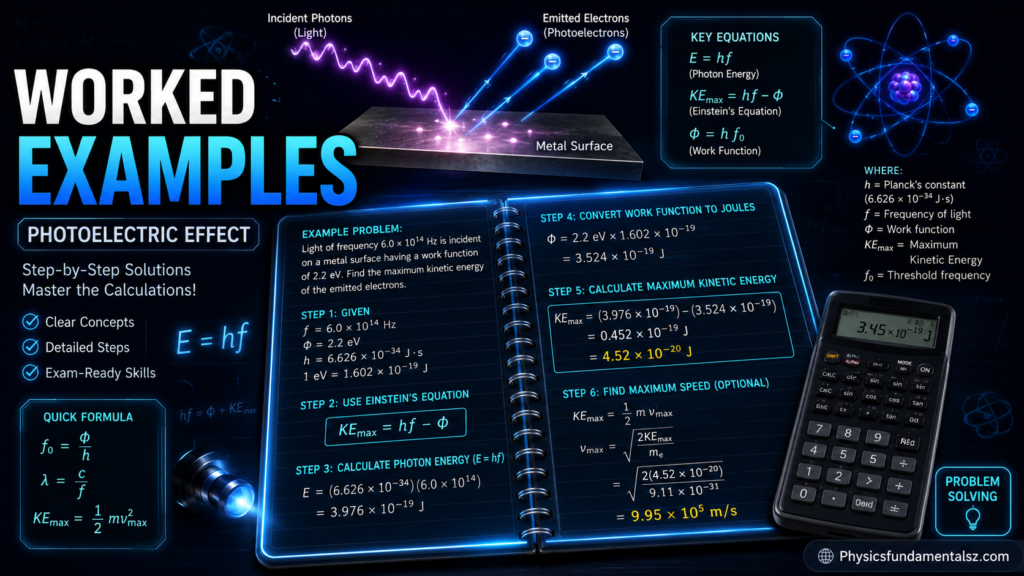
Example 1 – Finding Maximum Kinetic Energy (Basic)
Problem: Light of wavelength 300 nm strikes sodium (work function φ = 2.28 eV). Find Kmax.
Solution: Using the shortcut hc = 1240 eV·nm: E = 1240 / 300 = 4.13 eV Kmax = E − φ = 4.13 − 2.28 = 1.85 eV
Example 2 – Finding Stopping Potential (Intermediate)
Problem: Using the same electrons from Example 1, find the stopping potential.
Solution: eV0 = Kmax → V0 = Kmax / e Since Kmax = 1.85 eV, and dividing eV by e simply cancels the unit: V0 = 1.85 V
Example 3 – Finding Work Function from Threshold Wavelength (Intermediate)
Problem: A metal has a threshold wavelength of 680 nm. Find its work function in eV.
Solution: φ = hc / λ0 = 1240 / 680 = 1.82 eV
Example 4 – Two-Wavelength Comparison Problem (Advanced)
Problem: A metal is illuminated with two wavelengths, 248 nm and 310 nm, producing photoelectrons with maximum speeds u1 and u2 where u1 : u2 = 2 : 1. Find the work function (hc = 1240 eV·nm).
Solution: ½mu1² = 1240/248 − φ = 5.0 − φ ½mu2² = 1240/310 − φ = 4.0 − φ Since u1 = 2u2, ½mu1² = 4 × (½mu2²): 5.0 − φ = 4(4.0 − φ) 5.0 − φ = 16.0 − 4φ 3φ = 11.0 φ ≈ 3.7 eV
Reading the Kmax vs. Frequency Graph
Plotting Kmax against frequency f produces a straight line described by Kmax = hf − φ — the same form as y = mx + b.
What the Slope Represents
The slope of the line is exactly h, Planck’s constant. This is how Millikan experimentally confirmed Einstein’s equation: he measured Kmax at several frequencies and found the slope matched Planck’s constant to within 0.5%.
What the Intercepts Represent
- Y-intercept = −φ (where the line crosses the Kmax axis at f = 0, extrapolated)
- X-intercept = f0, the threshold frequency (where Kmax = 0)
Common Units and Conversion Shortcuts
The hc = 1240 eV·nm Shortcut
Instead of converting wavelength to meters and Planck’s constant to joules every time, use:
E (eV) = 1240 / λ (nm)
This single shortcut eliminates most unit-conversion errors in photoelectric effect calculations.
Converting Between eV and Joules
1 eV = 1.602 × 10⁻¹⁹ J. To convert eV to joules, multiply by 1.602 × 10⁻¹⁹. To convert joules to eV, divide by the same number.
| Convert | Formula |
|---|---|
| nm → m | multiply by 10⁻⁹ |
| eV → J | multiply by 1.602 × 10⁻¹⁹ |
| J → eV | divide by 1.602 × 10⁻¹⁹ |
| Hz → energy (eV) | E = hf, with h = 4.136 × 10⁻¹⁵ eV·s |
Common Mistakes in Photoelectric Effect Calculations
- Mixing units — using wavelength in nm directly in E = hc/λ without converting to meters (unless using the eV·nm shortcut consistently).
- Forgetting Kmax can’t be negative — if your answer is negative, the correct conclusion is “no electrons are emitted,” not a calculation error to fix.
- Assuming intensity affects Kmax — intensity only changes the number of photoelectrons (current), never their maximum kinetic energy.
- Confusing threshold frequency and threshold wavelength — they’re inversely related, not interchangeable in formulas.
- Dropping the charge (e) when converting Kmax to stopping potential — remember V0 = Kmax/e, and in eV-based problems the numeric value of V0 in volts equals Kmax in eV.
Photoelectric Effect vs. Compton Effect vs. Photoionization
| Feature | Photoelectric Effect | Compton Effect | Photoionization |
|---|---|---|---|
| Photon fate | Fully absorbed | Scattered, loses partial energy | Fully absorbed |
| Typical photon energy | Low–moderate (UV/visible) | High (X-ray) | Any (UV to X-ray) |
| Target | Bound electron in a solid | Loosely bound/free electron | Bound electron in a gas atom |
| Key equation | Kmax = hf − φ | Δλ = (h/mc)(1 − cosθ) | E = hf − Ei (ionization energy) |
| Where it matters | Solar cells, photodetectors | Medical imaging, gamma-ray physics | Atomic/molecular spectroscopy |
Real-World Applications of Photoelectric Effect Calculations
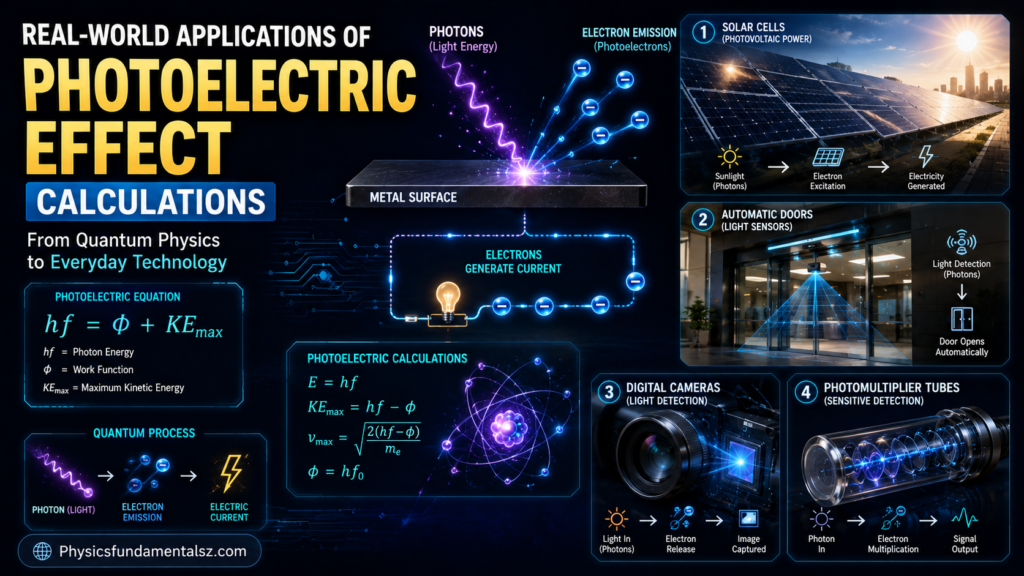
- Solar cells rely on a related process (the photovoltaic effect) where photon-absorption calculations determine efficiency.
- Photoelectric smoke detectors use light-sensitive elements that respond when smoke scatters a light beam.
- Photomultiplier tubes in scintillation detectors amplify single-photon events, used in medical imaging and particle physics.
- Camera light meters and automatic exposure systems use photodetectors built on this same physics.
- Night-vision devices convert photons to photoelectrons and amplify them for visibility in low light.
Related Articles
- The Photoelectric Effect
- Wave-Particle Duality
- The Heisenberg Uncertainty Principle
- The Speed of Light
- Special Relativity Explained
- Nuclear Fission and Fusion
- Radioactive Decay
- Work-Energy Theorem: Complete Guide with Formula, Derivation, and Examples
- Simple Pendulum: Definition, Formula, Time Period, and Derivation
- Electromagnetic Waves: Speed, Spectrum & Wave Properties
- Young’s Double-Slit Experiment: Fringe Formula, Proof & Applications
- Diffraction: Single Slit, Diffraction Gratings & dsinθ = nλ Explained
- Interference of Waves: Constructive, Destructive & Superposition Explained
- Standing Waves & Resonance: Nodes, Antinodes & Harmonics Explained
- Polarisation of Light: Malus’s Law I = I₀cos²θ & Applications
- Snell’s Law: n₁sinθ₁ = n₂sinθ₂, Derivation & Total Internal Reflection
- Wave Superposition: Adding Waves, Phase & Interference Patterns
- Coulomb’s Law Calculations: F = kQ1Q2/r² Formula & Examples
- Capacitors and Capacitance: C = Q/V Formula, Energy Storage & Examples
- Electric Potential Energy: E = kQq/r, Work Done & Worked Examples
- Electric Current: I = Q/t, Drift Velocity & Ohm’s Law Connection
- Magnetic Field of a Current-Carrying Wire: B = μ0I/2πr
- Electric Circuits & Kirchhoff’s Laws: KCL, KVL & Worked Examples
- Magnetic Flux and Faraday’s Law: Formula, Examples & Applications
- Physics Fundamentals: The Complete Guide to Core Concepts, Laws, and Equations
Frequently Asked Questions (FAQs)
What is the formula for photoelectric effect calculations?
The core formula is Einstein’s equation, Kmax = hf − φ, where Kmax is maximum kinetic energy, h is Planck’s constant, f is light frequency, and φ is the work function.
What is Einstein’s photoelectric equation?
Kmax = hf − φ. It states that the maximum kinetic energy of an emitted electron equals the photon’s energy minus the energy needed to free the electron (work function).
How do you calculate the maximum kinetic energy of a photoelectron?
Subtract the metal’s work function from the incoming photon’s energy: Kmax = hf − φ, or use E = hc/λ for photon energy when wavelength is given.
How do you calculate stopping potential?
Divide the maximum kinetic energy by the elementary charge: V0 = Kmax / e. In eV-based problems, the numeric value of V0 in volts equals Kmax in eV.
What is the work function of a metal?
It’s the minimum energy required to remove an electron from a metal’s surface, typically measured in electron volts (eV), and it varies by material.
How do you calculate threshold frequency?
Divide the work function by Planck’s constant: f0 = φ / h.
How do you calculate threshold wavelength?
Use λ0 = hc / φ, or the shortcut λ0 (nm) = 1240 / φ (eV).
What is the shortcut formula hc = 1240 eV·nm used for?
It lets you find photon energy in electron volts directly from wavelength in nanometers using E = 1240/λ, skipping separate unit conversions.
Why doesn’t increasing light intensity increase the kinetic energy of photoelectrons?
Intensity only increases the number of photons arriving per second, not the energy of each individual photon, so Kmax stays the same while photocurrent increases.
What happens if photon energy is less than the work function?
No electrons are emitted at all, regardless of how intense or prolonged the light exposure is.
What is the significance of the slope in a Kmax vs. frequency graph?
The slope equals Planck’s constant, h — this is how the constant was experimentally verified.
What does the y-intercept represent in the Kmax vs. frequency graph?
It represents −φ, the negative of the metal’s work function.
Why is the photoelectric effect considered proof of the particle nature of light?
Because emission depends on frequency (not intensity) and occurs instantaneously above threshold frequency — behavior that only makes sense if light delivers energy in discrete photon packets.
Can the photoelectric effect happen with visible light?
Yes, for metals with low work functions like sodium, cesium, and potassium; metals with higher work functions require ultraviolet light.
Does every metal have the same work function?
No — work function depends on the material; alkali metals have low work functions while metals like platinum have much higher ones.
How do you calculate the number of photons emitted per second by a light source?
Divide the source’s power (in watts) by the energy of a single photon (E = hf), giving photons per second.
What is the difference between threshold frequency and threshold wavelength?
Threshold frequency is the minimum frequency that causes emission; threshold wavelength is the corresponding maximum wavelength. They’re inversely related through f0 = c/λ0.
Is photoelectric current proportional to light intensity?
Yes, above the threshold frequency, photocurrent (number of electrons per second) increases proportionally with intensity, while Kmax remains unaffected.
What is the difference between the photoelectric effect and the Compton effect?
In the photoelectric effect, the photon is fully absorbed and the electron is ejected from a bound state; in the Compton effect, the photon scatters off a loosely bound or free electron and only loses partial energy.
How do solar cells relate to the photoelectric effect?
Solar cells use the closely related photovoltaic effect, where absorbed photons generate electron-hole pairs in a semiconductor rather than fully ejecting free electrons.
What common mistakes do students make in photoelectric effect calculations?
The most common errors are unit mismatches (nm vs. m, eV vs. J), forgetting that a negative Kmax means “no emission” rather than an error, and assuming intensity changes Kmax.
Key Takeaways
- Kmax = hf − φ is the single formula behind virtually all photoelectric effect calculations.
- Use E = hc/λ (or the 1240 eV·nm shortcut) to find photon energy from wavelength.
- Stopping potential (V0 = Kmax/e) is how Kmax is measured experimentally.
- Threshold frequency (f0 = φ/h) is the minimum frequency needed for emission — below it, nothing happens regardless of intensity.
- The Kmax vs. frequency graph has slope h and x-intercept f0, which is how Millikan verified Einstein’s equation experimentally.
- Light intensity affects photocurrent, never Kmax — this is the conceptual crux most exam questions test.