The Photoelectric Effect
Shine light on a clean metal surface and, under the right conditions, electrons fly off it. This is the photoelectric effect, and at first glance it seems unremarkable. Yet its details broke nineteenth-century physics so completely that explaining them won Einstein his Nobel Prize and helped launch quantum theory.
What the experiment shows
The setup is straightforward. Light strikes a metal plate inside a vacuum, and any ejected electrons are collected, producing a measurable current. By varying the light’s colour and brightness and measuring the electrons’ energy, physicists found several surprising facts.
- Below a certain threshold frequency, no electrons are emitted at all, no matter how bright the light.
- Above that threshold, electrons are emitted instantly, even for very dim light.
- The energy of each ejected electron depends on the light’s frequency, not its brightness.
- Brighter light of the same colour ejects more electrons, but not more energetic ones.
Why classical wave theory failed
If light were purely a wave, as nineteenth-century physics insisted, brighter light should carry more energy and therefore eject more energetic electrons. A dim light should take a while to build up enough energy to free an electron, causing a delay. Both predictions are wrong. Brightness changes the number of electrons, not their energy, and there is no delay. The wave picture simply could not account for the threshold or the instant response.
Einstein’s quantum leap
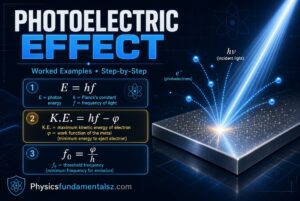
In 1905 Einstein proposed that light is not a smooth wave but a stream of discrete energy packets, later called photons. Each photon carries an energy proportional to the light’s frequency:
Here h is Planck’s constant, a tiny number (6.63 × 10⁻³⁴ J·s), and f is the frequency. Blue light has a higher frequency than red, so each blue photon carries more energy. Brightness corresponds to the number of photons per second, not the energy of each one.
One electron absorbs one photon. If that single photon does not carry enough energy to free the electron, no amount of extra photons will help, because they arrive one at a time. This is why a threshold frequency exists.
The work function and the energy equation
Every metal holds its electrons with a characteristic minimum energy called the work function, written φ. To escape, an electron must absorb at least this much energy. Any photon energy beyond the work function becomes the electron’s kinetic energy as it leaves. Einstein captured this in one elegant equation:
This predicts a clean straight line: plot the maximum electron energy against frequency and the slope is exactly Planck’s constant, while the intercept reveals the work function. Robert Millikan confirmed this experimentally with great precision, despite initially doubting Einstein’s idea.
Threshold frequency explained
The threshold frequency is the frequency at which a photon carries just enough energy to free an electron with none left over. Setting the kinetic energy to zero gives:
Below f₀, photons are simply too weak individually, so the metal stays dark no matter how intensely you illuminate it. Above f₀, even a faint beam ejects electrons immediately. This sharp cutoff is the signature of light’s particle nature.
Why it mattered so much
The photoelectric effect was the first hard evidence that light is quantised, behaving as particles in some situations even though it clearly behaves as a wave in others. This duality became a cornerstone of quantum mechanics. The same effect powers solar cells, light sensors, and the image sensors in digital cameras. To see how light’s dual nature plays out more fully, read about wave-particle duality, and for the wave side of light’s behaviour, see reflection and refraction.
Frequently asked questions
Why does brighter light not eject more energetic electrons?
Brightness means more photons per second, but each photon still carries the same energy fixed by frequency. Since one electron absorbs one photon, more photons free more electrons, not faster ones.
What is the work function?
It is the minimum energy needed to remove an electron from a particular metal’s surface. Metals like caesium have low work functions and emit electrons with visible light, while others need ultraviolet.
Does the photoelectric effect prove light is a particle?
It proves light has particle-like properties in this context. Light also clearly behaves as a wave in interference experiments. The full picture is wave-particle duality: light is neither purely one nor the other, but exhibits both depending on the experiment.