De Broglie Wavelength Calculator: Formula, Steps & Worked Examples 2026
Every moving object has a wavelength, even a thrown baseball. A de broglie wavelength calculator turns that strange quantum fact into a number you can actually compute.
Table of Contents
What Is the De Broglie Wavelength Formula?
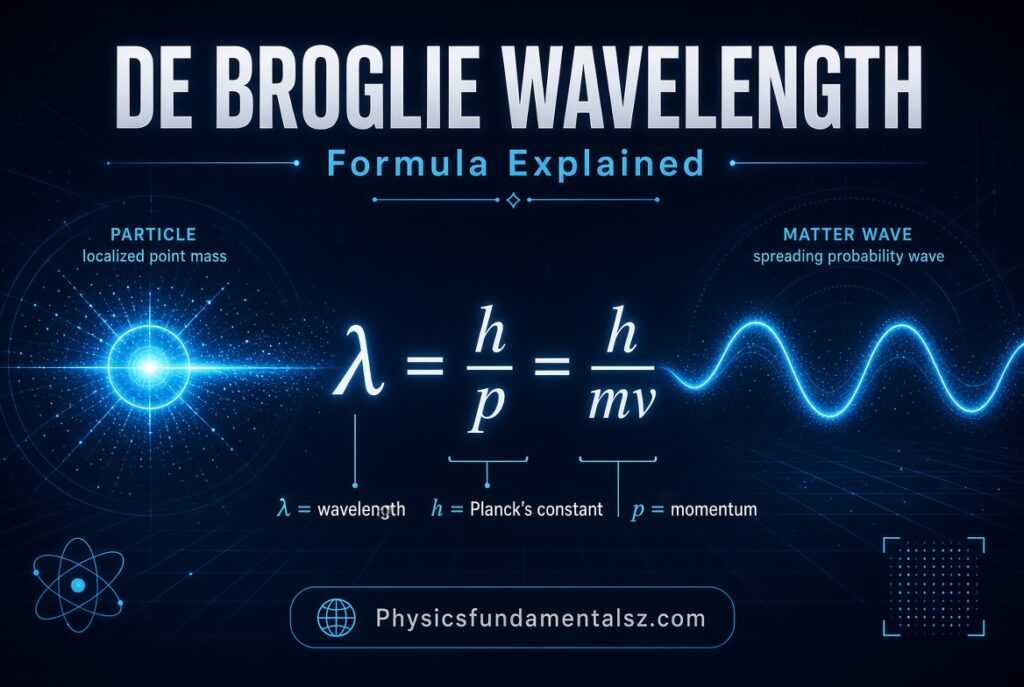
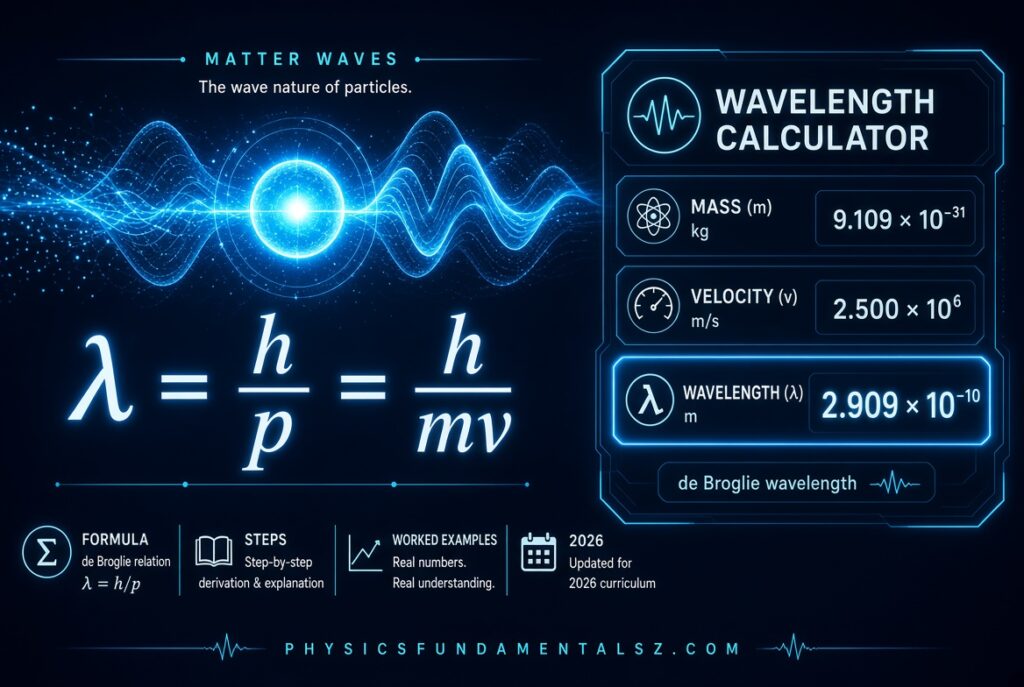
The de Broglie wavelength formula is λ = h / (m × v), where λ is the wavelength, h is Planck’s constant (6.626 × 10⁻³⁴ J·s), m is the particle’s mass, and v is its velocity.
A de broglie wavelength calculator simply plugs your values of mass and velocity into this equation and returns λ, usually in nanometers, picometers, or angstroms.
Smaller mass or lower velocity gives a longer wavelength. That is why electrons show clear wave behavior while everyday objects do not.
What Does a De Broglie Wavelength Calculator Actually Do?
A de broglie wavelength calculator is a tool that computes the wavelength associated with any moving particle, based on Louis de Broglie’s 1924 hypothesis of wave-particle duality.
It takes mass and velocity (or sometimes momentum or kinetic energy) as inputs and returns the matter wavelength as output.
This matters because wave-particle duality is not just theory. It explains electron diffraction, the design of electron microscopes, and the quantized structure of atomic spectra.
The Core Formula
The standard, non-relativistic de Broglie wavelength formula is:
λ = h / p, which expands to λ = h / (m × v)
- λ (lambda) = de Broglie wavelength, in meters
- h = Planck’s constant, 6.62607015 × 10⁻³⁴ J·s
- p = momentum of the particle (p = m × v)
- m = mass of the particle, in kilograms
- v = velocity of the particle, in meters per second
The Relativistic Version
For particles moving close to the speed of light, such as high-energy electrons in accelerators, classical mechanics breaks down.
The relativistic de Broglie wavelength formula corrects for this using the Lorentz factor:
λ = h / (γmv), where γ = 1 / √(1 − v²/c²)
Use this version only when velocity exceeds roughly 10% of the speed of light. Below that threshold, the classical formula is accurate enough for almost any calculation.
How to Use a De Broglie Wavelength Calculator: Step by Step
Step 1: Identify Your Known Values
Decide whether you have mass and velocity, momentum, or kinetic energy. Most calculators accept any one of these three input pairs.
Step 2: Convert Units to SI
Mass should be in kilograms and velocity in meters per second. Many calculators let you pick a unit like grams or km/h, but converting to SI yourself avoids errors.
Step 3: Enter the Values
Type mass into the mass field and velocity into the velocity field. If you only have kinetic energy, enter that instead and let the tool derive velocity internally.
Step 4: Read the Output
The calculator divides Planck’s constant by momentum and displays λ. Most tools let you switch the output unit between meters, nanometers, picometers, and angstroms.
Step 5: Sanity-Check the Result
Compare your answer to a known reference, such as an electron’s wavelength at typical speeds, to confirm the scale looks correct.
Worked Example 1: De Broglie Wavelength of an Electron
An electron with mass 9.109 × 10⁻³¹ kg travels at 2.998 × 10⁶ m/s.
Momentum: p = m × v = 9.109 × 10⁻³¹ × 2.998 × 10⁶ = 2.731 × 10⁻²⁴ kg·m/s
Wavelength: λ = h / p = 6.626 × 10⁻³⁴ / 2.731 × 10⁻²⁴ ≈ 2.43 × 10⁻¹⁰ m, or about 0.243 nm
This is close to the spacing between atoms in a crystal lattice, which is exactly why electron diffraction works.
Worked Example 2: De Broglie Wavelength of a Thrown Baseball
A 0.145 kg baseball thrown at 40 m/s has momentum p = 0.145 × 40 = 5.8 kg·m/s.
λ = 6.626 × 10⁻³⁴ / 5.8 ≈ 1.14 × 10⁻³⁴ m
That wavelength is trillions of times smaller than a single proton, which explains why nobody has ever observed a baseball diffracting through a doorway.
Worked Example 3: Using Kinetic Energy Instead of Velocity
Sometimes you know kinetic energy (KE) rather than velocity. Momentum can be found from p = √(2 × m × KE).
For an electron accelerated through a potential difference to gain KE = 100 eV (1.602 × 10⁻¹⁷ J):
p = √(2 × 9.109 × 10⁻³¹ × 1.602 × 10⁻¹⁷) ≈ 5.40 × 10⁻²⁴ kg·m/s
λ = 6.626 × 10⁻³⁴ / 5.40 × 10⁻²⁴ ≈ 1.23 × 10⁻¹⁰ m, or about 0.123 nm
This kinetic-energy approach is exactly how electron microscope resolution gets calculated in practice.
De Broglie Wavelength Quick Reference Table
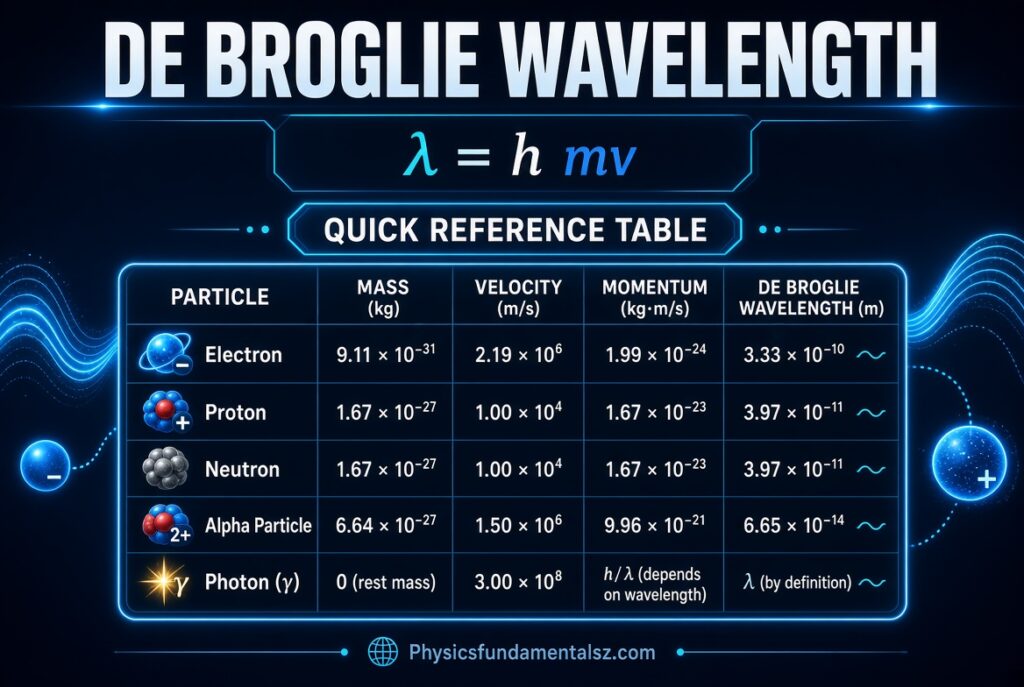
| Object | Mass | Typical Velocity | Approx. De Broglie Wavelength |
|---|---|---|---|
| Electron (thermal) | 9.109 × 10⁻³¹ kg | ~10⁶ m/s | ~0.1–1 nm |
| Proton (in accelerator) | 1.673 × 10⁻²⁷ kg | ~10⁷ m/s | ~4 × 10⁻¹⁴ m |
| Helium atom (gas, 300 K) | 6.646 × 10⁻²⁷ kg | ~1400 m/s | ~7 × 10⁻¹¹ m |
| Baseball | 0.145 kg | 40 m/s | ~1.1 × 10⁻³⁴ m |
| Human walking | 70 kg | 1.4 m/s | ~6.8 × 10⁻³⁶ m |
Why the De Broglie Wavelength Matters
It Explains Wave-Particle Duality
De Broglie proposed that every particle, not just light, carries both wave and particle properties. This unified how physicists thought about matter and radiation.
It Powers Electron Microscopy
Electron microscopes use fast electrons because their de Broglie wavelength is far shorter than visible light, allowing far higher resolution imaging of tiny structures.
It Explains Atomic Structure
Bohr’s model of quantized electron orbits makes physical sense once you realize an electron’s wavelength must fit as a standing wave around the nucleus.
It Sets the Boundary Between Classical and Quantum Behavior
When de Broglie wavelength is comparable to an object’s size, quantum effects dominate. When it is far smaller, classical physics works fine.
Common Mistakes When Calculating De Broglie Wavelength
- Forgetting to convert mass to kilograms before calculating.
- Using velocity in km/h or mph instead of m/s.
- Mixing up momentum (p = mv) with kinetic energy (KE = ½mv²).
- Applying the classical formula to relativistic speeds without the Lorentz factor.
- Misplacing decimal points in Planck’s constant, which is a very small number.
Expert Tips for Accurate Results
Always double-check the exponent on your mass value before hitting calculate, since a single misplaced power of ten changes the wavelength by orders of magnitude.
For particles near light speed, confirm whether your calculator applies the relativistic correction automatically or expects you to.
When comparing results, express wavelength in the unit that matches the physical scale, nanometers for electrons and picometers or angstroms for faster or heavier particles.
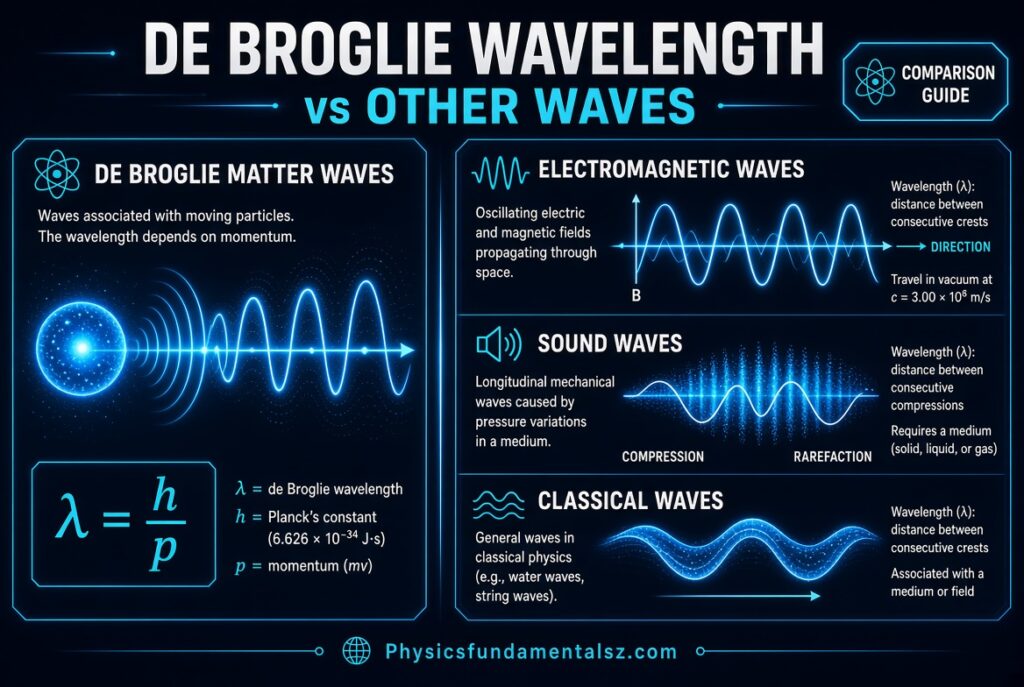
De Broglie Wavelength vs Other Wave Concepts
De Broglie Wavelength vs Photon Wavelength
A photon’s wavelength comes from λ = c / f or λ = hc / E, since photons are massless and travel at light speed. The de Broglie formula instead applies to particles with mass and uses momentum directly.
De Broglie Wavelength vs Thermal De Broglie Wavelength
The thermal de Broglie wavelength averages the wavelength of particles in a gas at a given temperature, useful in statistical mechanics, while the standard formula applies to one specific particle’s velocity.
Also Read:
- De Broglie Wavelength: λ = h/mv Formula, Derivation & Examples
- Heisenberg Uncertainty Principle: ΔxΔp ≥ ℏ/2 — Explained Simply
- Bohr Model of the Atom: Energy Levels, Emission & Absorption Spectra
- Half-Life Calculations: Formula & Worked Examples Explained
- Half Life Calculator With Steps: Formula, Examples & Full Guide 2026
- Kinetic Energy Calculator Physics: Formula, Steps & Real-World Examples 2026
- Momentum Calculator Physics: Formula, Steps & Worked Examples
- Wave Speed Calculator Frequency Wavelength: Formula, Steps & Worked Examples 2026
- Wave Speed, Frequency & Wavelength
- Transverse Waves Explained
- Ohm’s Law Calculator Solve for Current: Formula, Steps & Examples 2026
- Ohm’s Law and Temperature: How Resistance Really Changes With Heat
- Ideal Gas Law Calculator With Steps: PV = nRT Formula & Examples 2026
- Projectile Motion Calculator With Angle: Formulas & Worked Examples 2026
- Projectile Motion
- Newton’s Laws of Motion
- Conservation of Momentum
- What Is Energy?
- Electric Potential Energy: E = kQq/r, Work Done & Worked Examples
- Electric Current: I = Q/t, Drift Velocity & Ohm’s Law Connection
- Electric Circuits & Kirchhoff’s Laws: KCL, KVL & Worked Examples
- Kirchhoff’s Laws Advanced: Solving Multi-Loop Circuits Step by Step
- Lenz’s Law: The Direction of Induced Current Explained
- Magnetic Flux and Faraday’s Law: Formula, Examples & Applications
- Resistors in Series and Parallel: Formulas, Rules & Worked Examples
- Power in Electrical Circuits: P = IV = I²R = V²/R Explained
Frequently Asked Questions (FAQs)
What is the de Broglie wavelength formula?
The formula is λ = h / (m × v), where h is Planck’s constant, m is mass in kilograms, and v is velocity in meters per second.
What does a de broglie wavelength calculator need as input?
Most calculators need mass and velocity, though many also accept momentum or kinetic energy as an alternative input pair.
Who discovered the de Broglie wavelength?
Louis de Broglie proposed it in his 1924 doctoral thesis, and it later earned him the 1929 Nobel Prize in Physics.
Why do electrons show wave behavior but baseballs do not?
An electron’s tiny mass gives it a wavelength close to atomic spacing, while a baseball’s huge mass gives it a wavelength far too small to ever detect.
What units is de Broglie wavelength usually expressed in?
It is usually expressed in nanometers (nm), picometers (pm), or angstroms (Å), depending on the particle’s scale.
Is de Broglie wavelength the same for all particles at the same speed?
No. Wavelength depends on both mass and velocity, so particles with different masses at the same speed have different wavelengths.
Can de Broglie wavelength be calculated without velocity?
Yes, if you know momentum or kinetic energy instead, since both can be converted into an equivalent velocity or used directly with λ = h/p.
What is the de Broglie wavelength of an electron at rest?
An electron at rest has zero velocity, which mathematically gives an undefined or infinite wavelength, so the formula only applies to moving particles.
How is de Broglie wavelength used in electron microscopy?
Faster electrons have shorter de Broglie wavelengths, which lets electron microscopes resolve details far smaller than what visible light can show.
Does temperature affect de Broglie wavelength?
Yes, higher temperature increases average particle velocity in a gas, which shortens the average de Broglie wavelength.
What is the relativistic de Broglie wavelength formula?
It is λ = h / (γmv), where γ is the Lorentz factor, and it is needed when velocity approaches a significant fraction of the speed of light.
Why is Planck’s constant used in the de Broglie formula?
Planck’s constant links energy and frequency in quantum mechanics, and it sets the fundamental scale at which wave-like behavior becomes noticeable.
What is a typical de Broglie wavelength value for a proton?
A proton moving at typical accelerator speeds has a de Broglie wavelength on the order of 10⁻¹⁴ meters, far smaller than an electron’s at similar speeds.
Can de Broglie wavelength be negative?
No, wavelength is always a positive quantity since it comes from the magnitude of momentum, not its direction.
How accurate are online de Broglie wavelength calculators?
They are accurate as long as correct units are entered, since the calculation itself is a simple division using a fixed physical constant.
What happens to de Broglie wavelength as velocity increases?
Wavelength decreases as velocity increases, because wavelength is inversely proportional to momentum, and momentum grows with velocity.
Is de Broglie wavelength relevant outside physics class?
Yes, it underlies real technologies including electron microscopes, tunneling diodes, and the physical limits of transistor miniaturization.
What is the de Broglie wavelength of light?
Photons do not use this formula directly since they are massless. Their wavelength instead comes from λ = c/f, though both describe wave-particle duality.
How do I convert de Broglie wavelength to frequency?
Once you have λ, use v = λf for matter waves, or compare directly to photon relations if you are working with radiation instead of particles.
Does mass alone determine de Broglie wavelength?
No, wavelength depends on the product of mass and velocity together, so a heavy slow object and a light fast object can have similar wavelengths.
Conclusion
A de broglie wavelength calculator makes a genuinely strange quantum idea easy to work with. Once you know λ = h / (m × v), you can compute the wavelength of an electron, a proton, or even a thrown ball in seconds.
The real skill is knowing which inputs you have, converting units correctly, and choosing the relativistic formula only when speeds get close to light speed.
With the worked examples and reference table above, you now have everything needed to calculate de Broglie wavelength confidently and understand what the number actually means.