Projectile Motion Calculator With Angle: Formulas & Worked Examples 2026
Punch numbers into any online tool and you get an answer, but not always an understanding of where it came from. That gap is exactly what a proper Projectile Motion Calculator With Angle should close.
Every projectile problem really comes down to splitting one launch angle into two independent motions, horizontal and vertical.
Table of Contents
What a Projectile Motion Calculator With Angle Actually Does
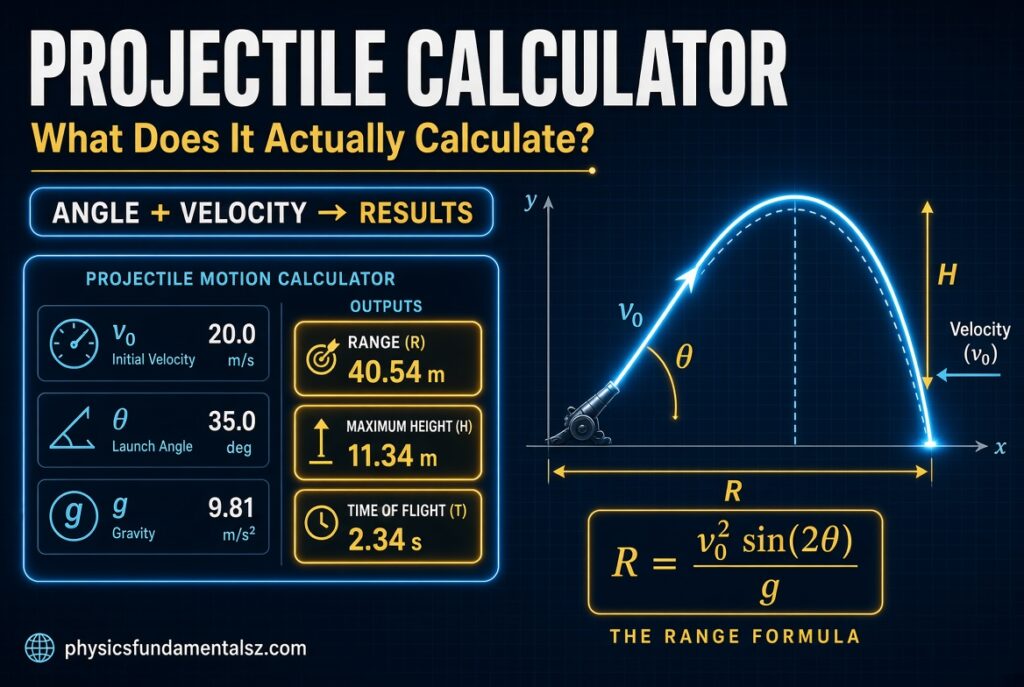
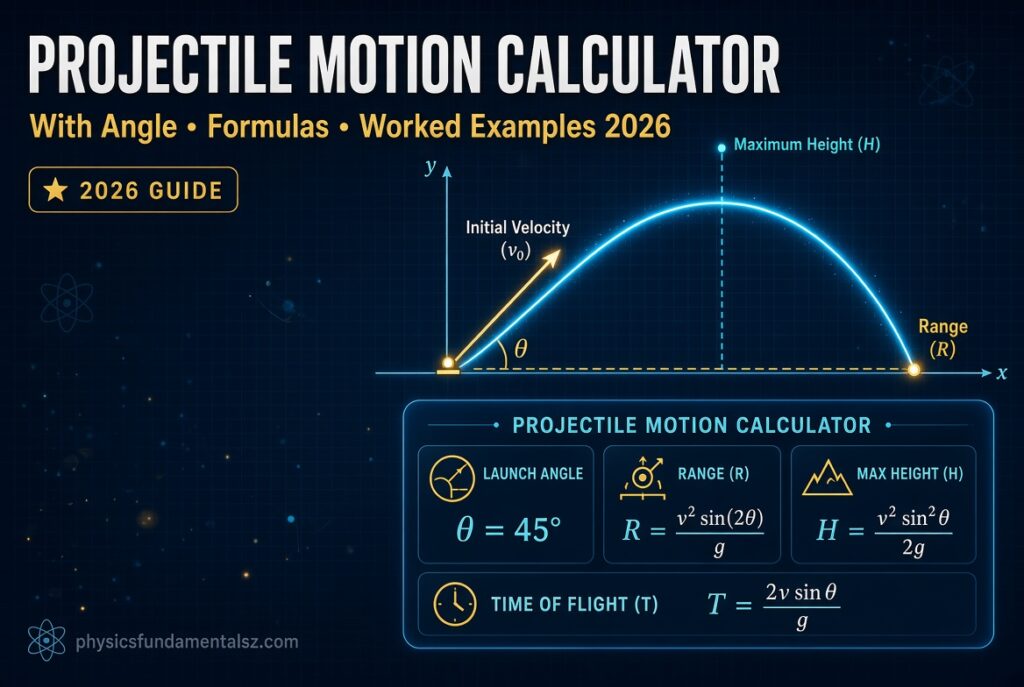
A projectile motion calculator with angle takes your launch speed, launch angle, and gravity, then outputs range, maximum height, time of flight, and impact velocity using standard kinematic equations.
It works by splitting the initial velocity into a horizontal component and a vertical component using the launch angle.
Those two components are then treated completely separately, since gravity only ever acts on the vertical part of the motion.
The Core Formulas Behind the Calculation
Velocity Components
The horizontal and vertical components come from basic trigonometry applied to the launch angle.
- Horizontal velocity: v₀ₓ = v₀ · cos(θ)
- Vertical velocity: v₀ᵧ = v₀ · sin(θ)
Time of Flight
For equal launch and landing height, time of flight is found from: t = 2v₀sin(θ) / g
Maximum Height
Maximum height is reached when vertical velocity hits zero: H = v₀²sin²(θ) / 2g
Range
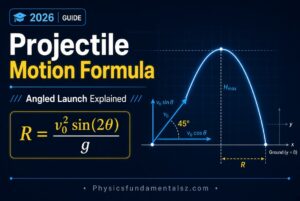
The horizontal distance traveled uses: R = v₀²sin(2θ) / g
This range formula only applies when launch and landing heights are equal. Uneven ground needs a slightly different approach, covered further down.
Worked Example: Calculating by Hand
Say a ball is launched at 20 m/s at a 30° angle, with g = 9.8 m/s². Here is how each value comes out.
- Horizontal velocity: v₀ₓ = 20 × cos(30°) = 17.3 m/s
- Vertical velocity: v₀ᵧ = 20 × sin(30°) = 10 m/s
- Time of flight: t = (2 × 10) / 9.8 ≈ 2.04 seconds
- Maximum height: H = 10² / (2 × 9.8) ≈ 5.1 meters
- Range: R = 20² × sin(60°) / 9.8 ≈ 35.3 meters
Why 45° Gives Maximum Range
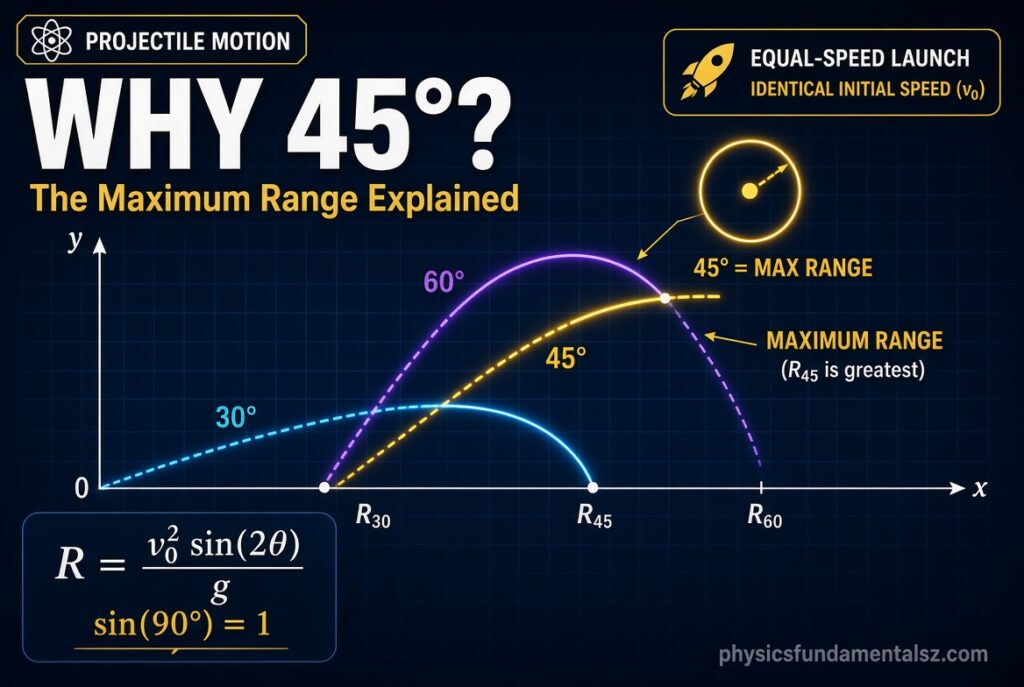
On level ground, a 45° launch angle produces the maximum possible range for any given initial speed.
This happens because the range formula includes sin(2θ), and sin(2θ) reaches its maximum value of 1 exactly when θ equals 45°.
Interestingly, complementary angles like 30° and 60° produce the exact same range, even though their flight paths look completely different.
Angle vs Range vs Maximum Height
| Launch Angle | Relative Range | Relative Max Height | Flight Path |
|---|---|---|---|
| 15° | Short | Very low | Flat, fast |
| 30° | Medium-long | Low-medium | Shallow arc |
| 45° | Maximum | Medium | Balanced arc |
| 60° | Medium-long | High | Steep arc |
| 75° | Short | Very high | Near-vertical |
When the Simple Formulas Don’t Apply
Uneven Launch and Landing Heights
If the projectile lands at a different height than it launched from, the simple range formula no longer works. You need to solve the vertical position equation for time first, then use that time to find horizontal distance.
Air Resistance
All the formulas above assume a vacuum, with no drag. Real-world air resistance reduces both range and maximum height, and shifts the truly optimal angle for maximum distance below 45°, often closer to 35-42° for sports like golf.
Common Mistakes When Using a Projectile Motion Calculator
- Mixing degrees and radians. Most calculators default to degrees, but some trigonometric functions in code expect radians.
- Using the wrong sign for gravity. Some tools expect gravity as a negative number when “up” is treated as positive.
- Applying the flat-ground range formula to uneven terrain. This only works when launch and landing heights match.
- Forgetting to decompose velocity. Using the full initial velocity instead of its horizontal or vertical component is one of the most common errors.
Real-World Applications of Projectile Motion
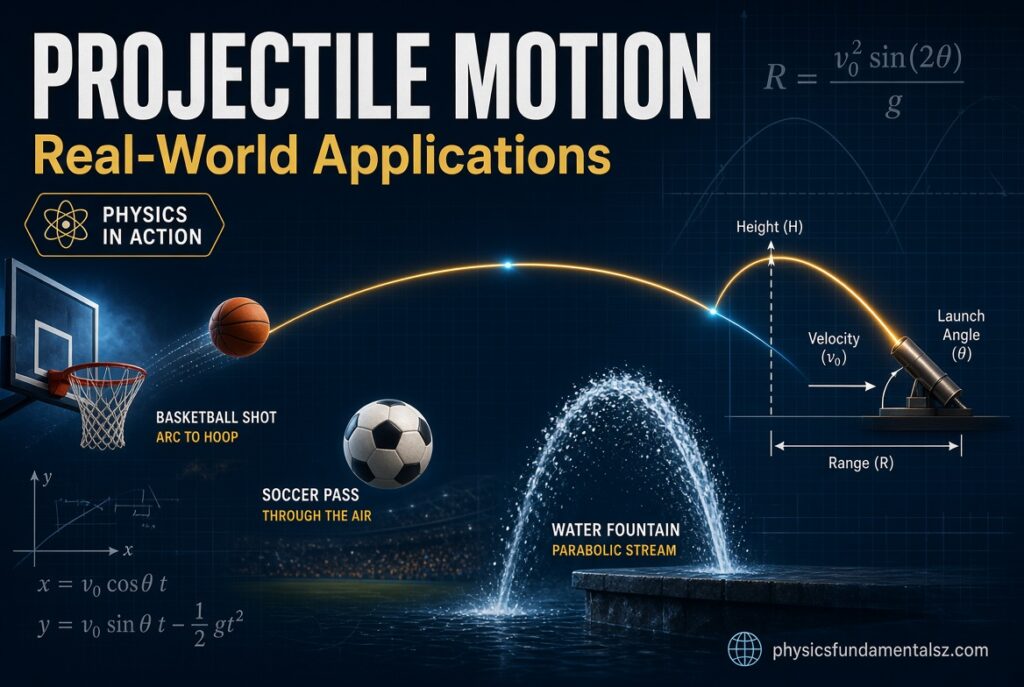
- Sports: Analyzing basketball shots, football punts, and golf ball trajectories.
- Military ballistics: Calculating artillery range tables and mortar firing angles.
- Civil engineering: Designing water fountain arcs and drainage outfall trajectories.
- Space exploration: Working out launch angles and velocities for suborbital rocket paths.
Key Takeaways
- Launch velocity splits into v₀cos(θ) horizontal and v₀sin(θ) vertical components.
- Range formula R = v₀²sin(2θ)/g only applies when launch and landing heights are equal.
- Maximum range on flat ground always occurs at a 45° launch angle.
- Complementary angles like 30° and 60° give identical range but very different flight paths.
- Air resistance shifts the true optimal angle below 45° for real-world sports and ballistics.
Also Read:
- Newton’s Laws of Motion
- Conservation of Momentum
- Work-Energy Theorem: Complete Guide with Formula, Derivation, and Examples
- What Is Energy?
- Wave Speed, Frequency & Wavelength
- Transverse Waves Explained
- Simple Pendulum: Definition, Formula, Time Period, and Derivation
- Special Relativity Explained
- Bohr Model of the Atom: Energy Levels, Emission & Absorption Spectra
- De Broglie Wavelength: λ = h/mv Formula, Derivation & Examples
- Quantum Numbers: n, l, m_l, m_s and Electron Configuration
- Photoelectric Effect Calculations: hf = work-function + KE_max
- Half-Life Calculations: Formula & Worked Examples Explained
- Mass-Energy Equivalence: E = mc² Derivation & Nuclear Applications
- Nuclear Decay Equations: Alpha, Beta & Gamma Decay Explained
- Coulomb’s Law Calculations: F = kQ1Q2/r² Formula & Examples
- Capacitors and Capacitance: C = Q/V Formula, Energy Storage & Examples
- Electric Potential Energy: E = kQq/r, Work Done & Worked Examples
- Electric Current: I = Q/t, Drift Velocity & Ohm’s Law Connection
- Magnetic Field of a Current-Carrying Wire: B = μ0I/2πr
- Electric Circuits & Kirchhoff’s Laws: KCL, KVL & Worked Examples
- Kirchhoff’s Laws Advanced: Solving Multi-Loop Circuits Step by Step
- Lenz’s Law: The Direction of Induced Current Explained
- Magnetic Flux and Faraday’s Law: Formula, Examples & Applications
- Ohm’s Law and Temperature: How Resistance Changes with Heat
Frequently Asked Questions (FAQs)
What formula does a projectile motion calculator with angle use?
It uses R = v₀²sin(2θ)/g for range, H = v₀²sin²(θ)/2g for maximum height, and t = 2v₀sin(θ)/g for time of flight.
What angle gives the maximum range in projectile motion?
On level ground, 45° always gives the maximum range for any given initial launch speed.
Do 30° and 60° launch angles give the same range?
Yes, complementary angles like 30° and 60° produce identical range values, though their maximum heights differ significantly.
Can I use these formulas if the landing height is different from launch height?
No, the standard range formula only applies when launch and landing heights are equal; uneven terrain needs the full quadratic approach.
How do you split initial velocity into components using the angle?
Horizontal velocity is v₀cos(θ) and vertical velocity is v₀sin(θ), based on standard trigonometric decomposition.
Does air resistance change the ideal launch angle?
Yes, real-world air resistance typically shifts the optimal range angle below 45°, often to around 35-42° for sports like golf.
What happens if the launch angle is 0°?
A 0° launch angle means purely horizontal motion, equivalent to an object launched off a cliff or ledge with no vertical component initially.
What happens if the launch angle is 90°?
At 90°, all velocity is vertical, meaning the object goes straight up and comes straight back down with zero horizontal range.
Why do calculators sometimes give different results for the same inputs?
Differences usually come from degree versus radian settings, gravity sign conventions, or whether air resistance is included in the model.
How is time of flight calculated in projectile motion?
For equal launch and landing heights, time of flight equals 2v₀sin(θ) divided by gravitational acceleration g.
What is the trajectory shape in projectile motion?
Without air resistance, the trajectory forms a perfect parabola, symmetric around the point of maximum height.
Can projectile motion formulas be used for real sports like golf or basketball?
Yes, though real trajectories are affected by air resistance and spin, so true optimal angles differ slightly from the ideal 45° prediction.
What is the relationship between launch angle and maximum height?
Maximum height increases as the launch angle increases toward 90°, since more of the initial velocity becomes vertical.
Is gravity always 9.8 m/s² in these calculations?
9.8 m/s² is the standard value used on Earth’s surface, though some calculators allow adjusting it for other planets or precision needs.
Conclusion
A projectile motion calculator with angle is only as useful as your understanding of what it is actually computing behind the scenes.
Once you can decompose velocity into horizontal and vertical parts, every range, height, and flight-time formula follows naturally from there.
Practice a few problems by hand first, then use a calculator to check your work rather than replace the understanding entirely.