What Causes Terminal Velocity in Free Fall Physics? A Complete Guide 2026
Drop a coffee filter and a pebble from the same height. The pebble slams into the floor while the filter drifts down at an almost steady pace. Same gravity, very different outcomes.
So what causes terminal velocity in free fall physics? In short, the air pushes back harder the faster you fall, until that push equals your weight. From then on, your speed stops increasing.
Table of Contents
What Causes Terminal Velocity?
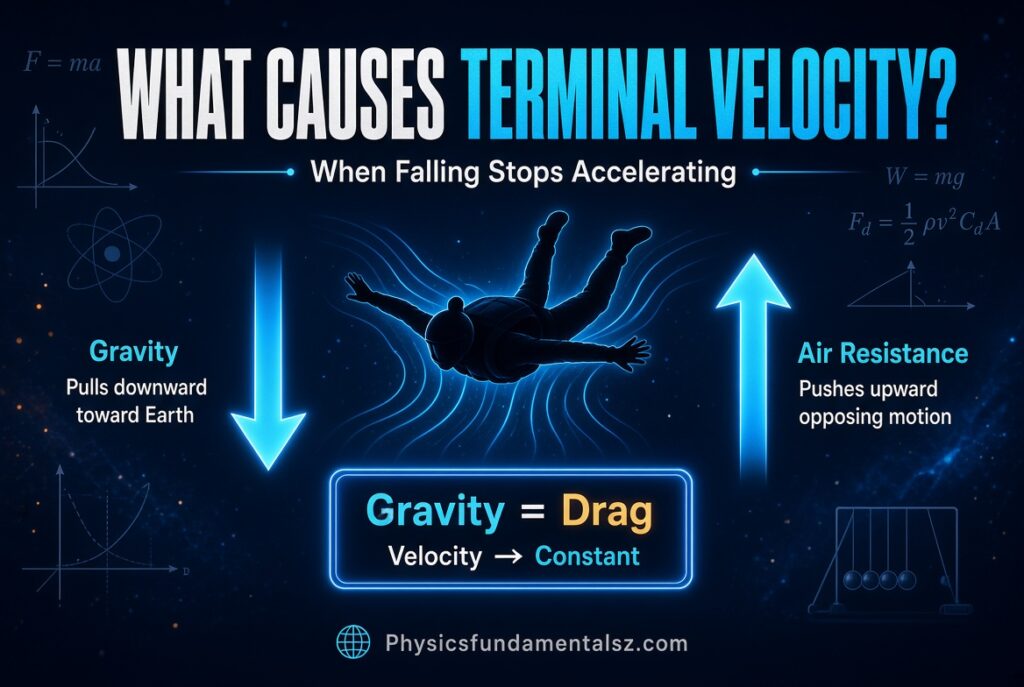
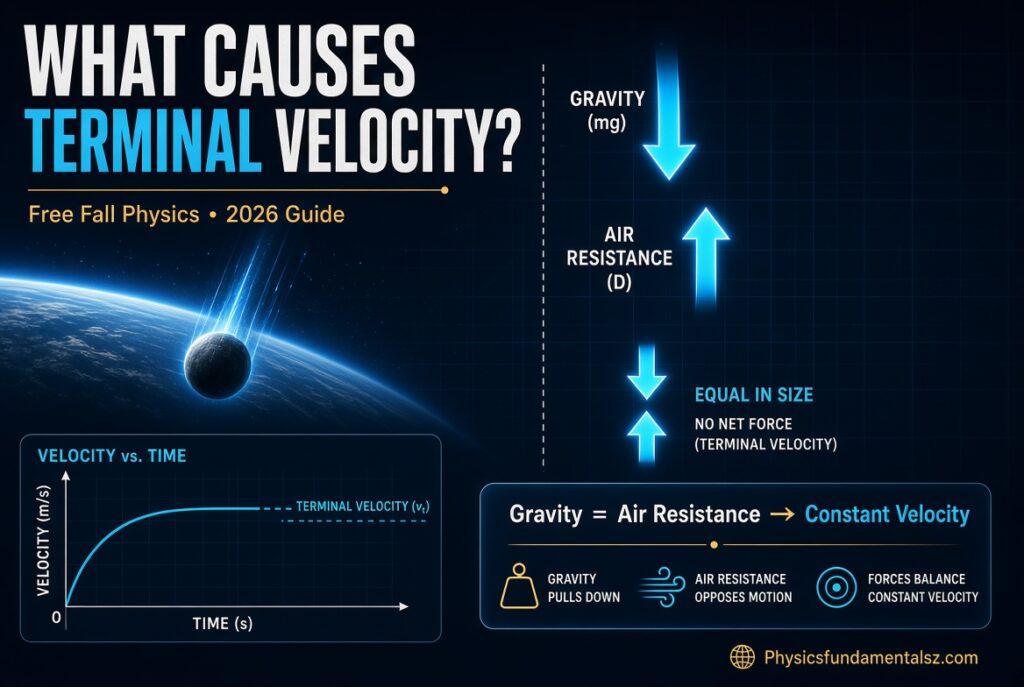
Definition box: Terminal velocity is the constant speed a falling object reaches when the upward drag force from the fluid (usually air) equals the downward force of gravity. The net force becomes zero, so acceleration stops and the object falls at a steady speed.
Terminal velocity has one cause: drag increases with speed while weight stays the same. Eventually the two forces balance.
The formula for that balance is:
v_t = √(2mg / (ρ · C_d · A))
Every symbol in that equation is unpacked below.
What Is Terminal Velocity?
Terminal velocity is the highest steady speed a falling object can reach in a given fluid. “Terminal” here means final. The object may keep falling, but it stops speeding up.
Physicists often say “terminal speed” when they only care about the size of the velocity. In everyday physics classes, the two terms are used interchangeably.
Terminal Velocity vs. Free Fall
Strict free fall means gravity is the only force acting on an object. In a vacuum, every object then accelerates at about 9.8 m/s² regardless of its mass.
A skydiver at terminal velocity is not in true free fall. Air drag cancels gravity, so the acceleration is zero. Everyday language still calls it free fall, which causes confusion.
Why the Name “Terminal”?
The word describes the end of the speeding-up stage. After that point, the velocity-time graph goes flat. Nothing in the situation changes unless the object’s shape, the air density, or the fluid changes.
The Two Forces That Create Terminal Velocity
Only two forces matter in the simple model. One pulls down and one pushes up.
Gravity (Weight)
Gravity pulls a falling object toward the center of Earth. The force is called weight and equals mass times gravitational acceleration:
W = mg
Near Earth’s surface, g is about 9.81 m/s². Weight stays roughly constant during a fall of a few kilometers. That constancy is what makes the balance possible.
Air Resistance (Drag)
Drag is the force a fluid exerts against a moving object. It always points opposite to the direction of motion. For a falling object, it points upward.
At everyday speeds, drag is well described by this equation:
F_d = ½ · ρ · C_d · A · v²
The key feature is the v². Drag grows much faster than speed does.
Step-by-Step: How an Object Reaches Terminal Velocity
The whole story fits in six steps.
- Release: The object starts at rest. Speed is zero, so drag is zero.
- Gravity dominates: Weight is the only meaningful force. Acceleration is close to 9.8 m/s².
- Speed builds: Every second, the object falls faster than the second before.
- Drag rises: As speed increases, drag grows with the square of speed.
- Net force shrinks: Net force equals weight minus drag. Since drag climbs, net force falls, and so does acceleration.
- Balance: Drag equals weight. Net force is zero, acceleration is zero, and speed holds steady.
This is Newton’s second law at work. When the net force is zero, the acceleration is zero, and velocity stays constant.
Why Does Drag Increase With Speed?
A falling object has to shove air out of the way. The faster it moves, the more air it pushes aside each second, and the harder it pushes that air.
The Speed-Squared Effect
Two things grow with speed at the same time. The mass of air hit per second rises in proportion to speed. The push given to each bit of air also rises in proportion to speed.
Multiply those together and drag scales with v². Double your speed and drag becomes four times larger.
Quadratic Drag vs. Linear Drag
Two drag models exist, and they apply in different situations.
| Drag model | Formula | Applies to | Example |
|---|---|---|---|
| Quadratic drag | F = ½ρC_dAv² | Fast, large objects (high Reynolds number) | Skydiver, baseball, car |
| Linear (Stokes) drag | F = 6πηrv | Very slow, tiny objects (low Reynolds number) | Fog droplet, dust, ball bearing in syrup |
Both models create a terminal velocity. Only the formula for the final speed changes.
What Is the Reynolds Number?
The Reynolds number compares inertial forces to viscous forces in a flow. A low value means thick, syrupy flow. A high value means the object churns the fluid into turbulence.
It tells you which drag model to trust. Most falling objects in classroom problems use the quadratic model.
The Terminal Velocity Formula Explained
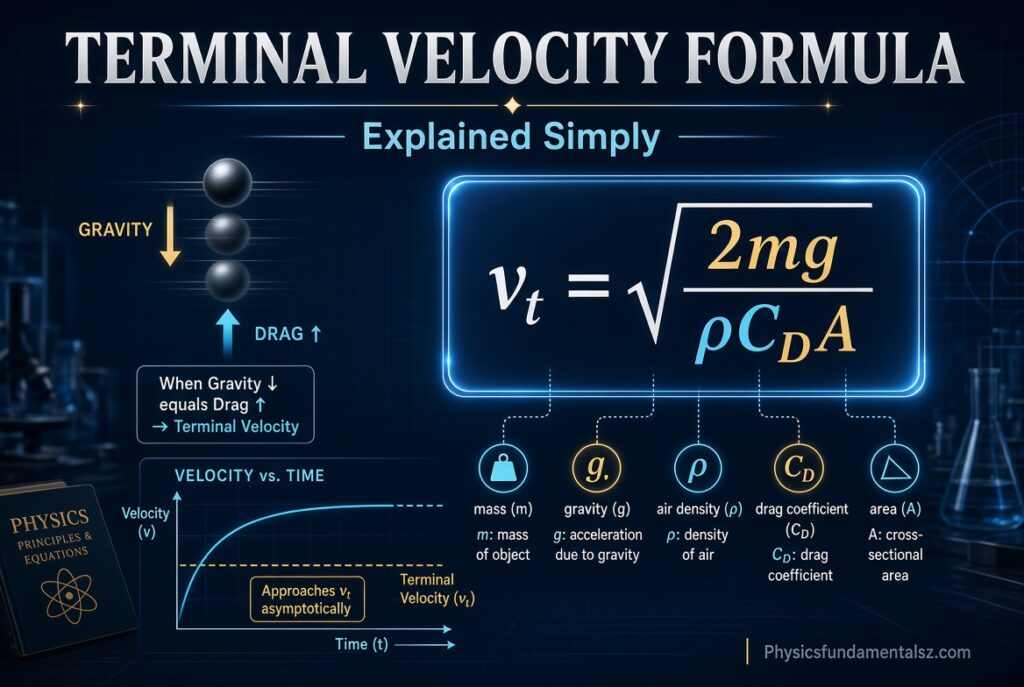
At terminal velocity, drag equals weight. Set the two expressions equal:
mg = ½ρC_dAv_t²
Solve for v_t and you get:
v_t = √(2mg / (ρ · C_d · A))
Meaning of Each Variable
| Symbol | Meaning | Unit | Typical value |
|---|---|---|---|
| v_t | Terminal velocity | m/s | Depends on object |
| m | Mass of the object | kg | Varies |
| g | Gravitational acceleration | m/s² | 9.81 on Earth |
| ρ (rho) | Fluid density | kg/m³ | About 1.225 for sea-level air |
| C_d | Drag coefficient (shape factor) | none | About 0.47 for a smooth sphere |
| A | Cross-sectional area facing the flow | m² | Varies |
What the Formula Tells You
The square root makes the dependence gentle. Four times the mass gives only twice the terminal speed. Four times the area cuts terminal speed in half.
Thicker air lowers terminal speed. Thinner air raises it. This is why altitude matters so much.
Worked Example: Terminal Velocity of a Skydiver
Let’s estimate a skydiver in a spread-out belly-down position. The numbers below are reasonable assumptions, not measurements.
- Mass m = 75 kg
- Air density ρ = 1.225 kg/m³
- Drag coefficient C_d = 1.0
- Frontal area A = 0.5 m²
Plug them in:
v_t = √(2 × 75 × 9.81 / (1.225 × 1.0 × 0.5)) = √(1471.5 / 0.6125) ≈ 49 m/s
That is about 176 km/h or 110 mph. Measured values for real belly-to-earth skydivers are usually quoted near 53 m/s (about 120 mph). The small gap comes from the rough area and drag inputs.
What If the Mass Doubles?
Double the mass to 150 kg and the speed rises by a factor of √2. That gives about 69 m/s. Heavier objects fall faster in air, but not twice as fast.
What If the Skydiver Curls Up?
Cut the effective frontal area in half and speed rises by the same √2 factor. Skydivers use this to control their fall rate.
How Long Does It Take to Reach Terminal Velocity?
An object never reaches terminal velocity exactly. It approaches it more and more slowly, like filling a glass that never quite overflows.
For quadratic drag, the speed at time t follows a neat formula:
v(t) = v_t · tanh(g·t / v_t)
The distance fallen is:
y(t) = (v_t² / g) · ln[cosh(g·t / v_t)]
Speed Over Time for a 53 m/s Skydiver
| Time (s) | Speed with drag (m/s) | Speed with no drag (m/s) | % of terminal speed |
|---|---|---|---|
| 3 | 26.7 | 29.4 | 50% |
| 5 | 38.6 | 49.1 | 73% |
| 10 | 50.5 | 98.1 | 95% |
| 15 | 52.6 | 147.2 | 99% |
In this model a skydiver falls roughly 450 meters (about 1,500 feet) in about 12 seconds. That is why skydivers reach a steady rate quickly, then enjoy a long, calm fall.
The table also shows drag’s effect. At 10 seconds, a drag-free object would be moving at nearly double the skydiver’s speed.
Factors That Change Terminal Velocity
Terminal velocity is not a fixed number for a given object. Several conditions shift it.
Mass
More mass means more weight to balance, so drag must grow larger. That requires a higher speed. This is why a steel ball beats a similarly sized foam ball in air.
Cross-Sectional Area
A bigger frontal area catches more air. Drag is larger at any given speed, so the balance arrives sooner, at a lower speed. Parachutes exploit this directly.
Shape and Drag Coefficient
Streamlined shapes slip through air. Blunt shapes leave a messy wake behind them. A flat plate facing the flow has a drag coefficient around 1.0 to 1.3, while a streamlined body can be as low as 0.04.
Air Density and Altitude
Air gets thinner as you climb. Less air means less drag at any speed, so terminal velocity is higher at altitude and drops as you descend.
Felix Baumgartner’s 2012 jump from about 39 km showed this clearly. In the extremely thin upper air he passed 1,300 km/h (faster than the speed of sound), then slowed dramatically as the air thickened.
Type of Fluid
Water is roughly 800 times denser than air. Objects reach terminal velocity in water at much lower speeds. This is why a stone that plunges in air sinks slowly through water.
Real-World Examples of Terminal Velocity
The table below compares approximate values. Numbers vary with size, posture, and air conditions.
| Falling object | Approximate terminal velocity | Main reason |
|---|---|---|
| Fog droplet (about 20 μm) | About 0.05 m/s | Tiny size, viscous drag |
| Drizzle drop (about 0.5 mm) | About 2 m/s | Small mass compared with area |
| Large raindrop (about 5 mm) | About 9 m/s (20 mph) | Larger mass raises the balance speed |
| Skydiver, belly-to-earth | About 53 m/s (120 mph) | Large frontal area |
| Skydiver, head-down | About 67 to 80 m/s (150 to 180 mph) | Streamlined body, small area |
| Skydiver under an open parachute | A few m/s | Huge area, huge drag |
Skydiving
A skydiver controls speed by changing body position. Spread out, the diver falls more slowly. Tucked in head-down, the diver falls much faster.
After the parachute opens, drag jumps far above weight. The diver slows down until drag equals weight again, at a much lower terminal velocity.
Raindrops
Raindrops do not hit like bullets because drag caps their speed. Bigger drops fall faster than small ones, but very large drops break apart. That limits raindrop speed to roughly 9 m/s.
Small Animals
Small animals have a large surface area compared with their mass. Their terminal velocity is low, which is why tiny creatures survive falls that would seriously hurt large ones.
Terminal Velocity Without Air: The Moon and Vacuum
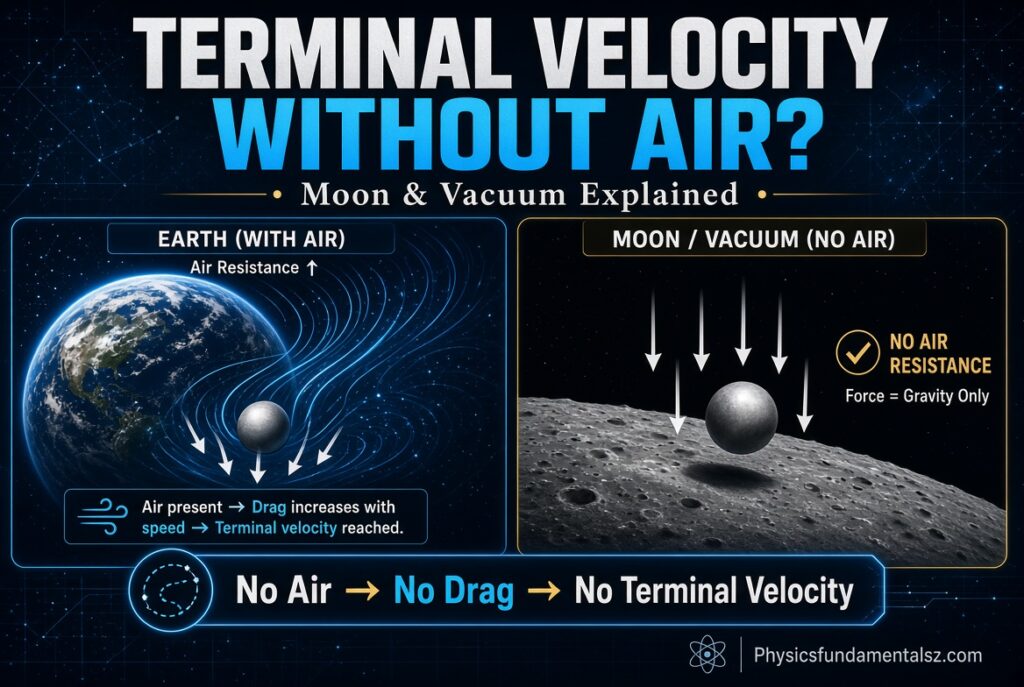
No fluid means no drag. Without drag, nothing balances gravity and no terminal velocity exists.
During the Apollo 15 mission in 1971, astronaut David Scott dropped a hammer and a feather together on the Moon. They landed at the same time. The Moon has virtually no atmosphere, so there was nothing to hold the feather back.
Terminal Velocity on Other Planets
The formula includes air density, so every world with an atmosphere gives a different answer. Gravity matters too.
| World | Atmosphere | Effect on terminal velocity |
|---|---|---|
| Earth | Moderate density | Baseline values |
| Mars | Very thin (about 1% of Earth’s surface density) | Much higher for the same object |
| Venus | Extremely dense at the surface | Much lower for the same object |
| Moon | Essentially none | No terminal velocity |
This is one reason landing on Mars is so hard. Thin air gives parachutes little to work with.
The Energy View: Where Does the Energy Go?
At terminal velocity, speed is constant, so kinetic energy is constant. Yet the object is still losing height, so gravitational potential energy keeps decreasing.
That lost energy does not vanish. Drag converts it into heat and moving air. You can calculate the rate directly: power lost to drag equals weight times speed (P = mg·v_t). For our 75 kg skydiver at 53 m/s, that is about 39,000 watts.
To explore energy in more depth, see our guide to kinetic energy under “Also Read” below.
Reading the Graphs
Three graphs tell the whole story.
Velocity-Time Graph
The curve starts steep and bends over. It flattens into a horizontal line at v_t. The slope at any moment is the acceleration.
Acceleration-Time Graph
Acceleration starts at g and decays toward zero. It never goes negative unless drag suddenly exceeds weight, as it does when a parachute opens.
Force-Time Graph
Weight stays flat. Drag rises from zero up to meet weight. Where the lines meet, terminal velocity begins.
Common Misconceptions About Terminal Velocity
Several ideas circulate that sound plausible but are wrong.
“Terminal Velocity Means Gravity Stops Working”
Gravity never turns off. It is still pulling with the same force. Drag simply cancels it, so the net force is zero.
“Heavier Objects Always Fall at the Same Rate”
That is only true in a vacuum. In air, a heavier object of the same shape and size reaches a higher terminal velocity and lands first.
“Terminal Velocity Is the Same for Everyone”
A person’s terminal velocity depends on mass, posture, clothing, and air density. There is no single number.
“An Object Slows Down at Terminal Velocity”
It does not. Speed stays constant. Slowing down requires drag to exceed weight, such as when a parachute opens.
“Acceleration Is Still 9.8 m/s² at Terminal Velocity”
Acceleration is zero at terminal velocity. Only the gravitational force stays the same. This is a very common exam mistake.
A Simple Experiment: Coffee Filters
You can see terminal velocity at home with a stack of basket-style coffee filters.
- Drop a single filter from about two meters and time the fall.
- Drop two nested filters and time again.
- Repeat with three and four filters.
Each extra filter adds weight but keeps the same frontal area. Theory predicts terminal speed rises with the square root of the number of filters. Four filters should fall about twice as fast as one.
A phone camera in slow motion makes timing easier. Drop from a high staircase for a longer, cleaner run.
Common Mistakes When Solving Terminal Velocity Problems
Watch for these errors on homework and exams.
- Using the wrong area: Use the frontal area facing the flow, not the surface area.
- Forgetting the square root: The answer is v_t, not v_t².
- Mixing units: Keep mass in kilograms, area in square meters, and density in kg/m³.
- Using sea-level density at altitude: Air density falls as you climb.
- Assuming acceleration is 9.8 m/s² at terminal speed: It is zero.
Key Takeaways
- Terminal velocity is caused by drag rising with speed until it equals weight.
- At that point, net force and acceleration are both zero.
- The formula is v_t = √(2mg / (ρ · C_d · A)).
- Heavier, smaller, and more streamlined objects fall faster.
- Thinner air raises terminal velocity; thicker fluids lower it.
- No fluid means no terminal velocity.
- A skydiver reaches most of the terminal speed in about 10 to 15 seconds.
Also Read:
- Physics Fundamentals: The Complete Guide to Core Concepts, Laws, and Equations
- Kinetic Energy: Formula, Meaning, and Examples
- Angular Momentum Explained
- Conservation of Momentum Real Life Examples
- What Is the Formula for Conservation of Momentum?
- Momentum Calculator Physics: Formula, Steps and Worked Examples
- Entropy Explained for Beginners
- The Doppler Effect Explained
- Bernoulli’s Principle: P + ½ρv² + ρgh = Constant
- Free Fall Calculator and 19 Other Physics Calculators
- Play Physics Games: Gravity Lab and More
- All Physics Articles on Physics Fundamentals
- Physics Fundamentals Home
- Newton’s Laws of Motion
- Newton’s Second Law: F = ma
- Projectile Motion Explained
- What Is Energy?
- Transverse Waves Explained
- Wave Speed, Frequency and Wavelength
- Ideal Gas Law: PV = nRT
Frequently Asked Questions (FAQs)
What causes terminal velocity in free fall physics?
Air drag grows with speed while weight stays constant. When drag equals weight, net force becomes zero and acceleration stops. The object then falls at a constant speed.
What is terminal velocity in simple words?
It is the fastest steady speed a falling object reaches in air or another fluid. After that, it stops speeding up.
What is the formula for terminal velocity?
v_t = √(2mg / (ρ · C_d · A)). It comes from setting drag equal to weight.
Does gravity stop at terminal velocity?
No. Gravity keeps pulling with the same force. Drag simply cancels it, so the net force is zero.
Is acceleration zero at terminal velocity?
Yes. Net force is zero, so acceleration is zero. Velocity stays constant.
What is the terminal velocity of a human?
A belly-down skydiver reaches about 53 m/s (120 mph or 190 km/h). A head-down diver can exceed 150 mph.
How long does it take to reach terminal velocity?
A skydiver reaches most of it in roughly 10 to 15 seconds. The final approach is gradual, so the exact value is never fully reached.
Do heavier objects have a higher terminal velocity?
Yes, if size and shape stay the same. Terminal speed rises with the square root of mass.
Why do feathers fall slowly?
A feather has very low weight and a large area. Drag balances that small weight at a very low speed.
Do all objects have a terminal velocity?
Only objects falling through a fluid do. In a vacuum, there is no drag, so no terminal velocity exists.
Is a skydiver in free fall?
In everyday language, yes. In strict physics, no, because drag acts on the skydiver.
Why does terminal velocity depend on shape?
Shape sets the drag coefficient. Streamlined shapes create less drag, so they must move faster to reach balance.
How does a parachute lower terminal velocity?
A parachute has a huge area. Drag jumps far above weight, so the diver slows until the forces balance again at a low speed.
Does air density affect terminal velocity?
Yes. Thinner air means less drag and a higher terminal velocity. That is why high-altitude jumpers fall so fast.
What is the terminal velocity of a raindrop?
A large raindrop falls at about 9 m/s. Smaller drizzle drops are much slower.
Can terminal velocity be exceeded?
Yes, temporarily. If an object is thrown downward faster than v_t, drag exceeds weight, and it slows until it settles at v_t.
Is there terminal velocity in water?
Yes. Water is much denser than air, so terminal speeds there are far lower.
What is the difference between terminal velocity and free fall?
Free fall has gravity as the only force, so speed keeps rising. Terminal velocity has drag balancing gravity, so speed is constant.
Why is drag proportional to velocity squared?
A faster object hits more air per second and pushes each bit harder. Both effects grow with speed, giving a v² relationship.
Is there terminal velocity on the Moon?
No. The Moon has essentially no atmosphere, so there is no drag to balance gravity.
Conclusion
So, what causes terminal velocity in free fall physics? It is a balance of two forces. Gravity pulls down with a steady weight, while air drag pushes up with a force that grows as the square of speed. When they match, acceleration ends and speed levels off.
Mass, frontal area, shape, and air density decide where that balance happens. That explains why skydivers, raindrops, and coffee filters all fall at different steady speeds. Once you can write the force balance, the formula and the speed curve follow naturally.