Conservation of Momentum Real Life Examples (2026 Guide)
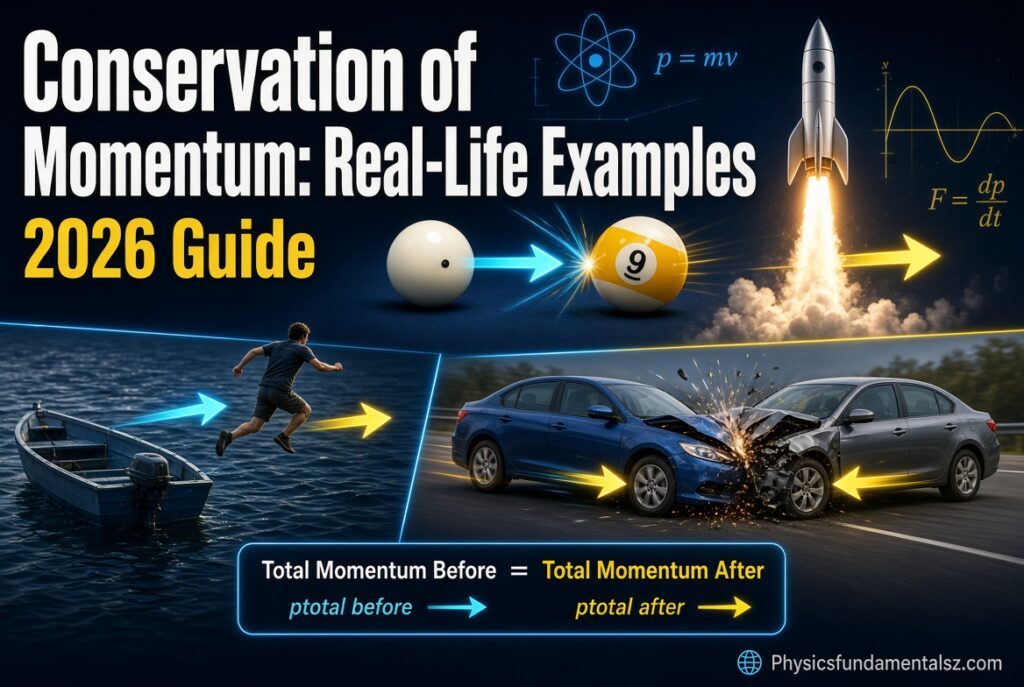
If you have ever watched a gun recoil, a rocket lift off, or two pool balls collide, you have already seen conservation of momentum real life examples in action. This single law explains why moving objects behave the way they do when they push, pull, or crash into each other.
Table of Contents
What Is Conservation of Momentum?
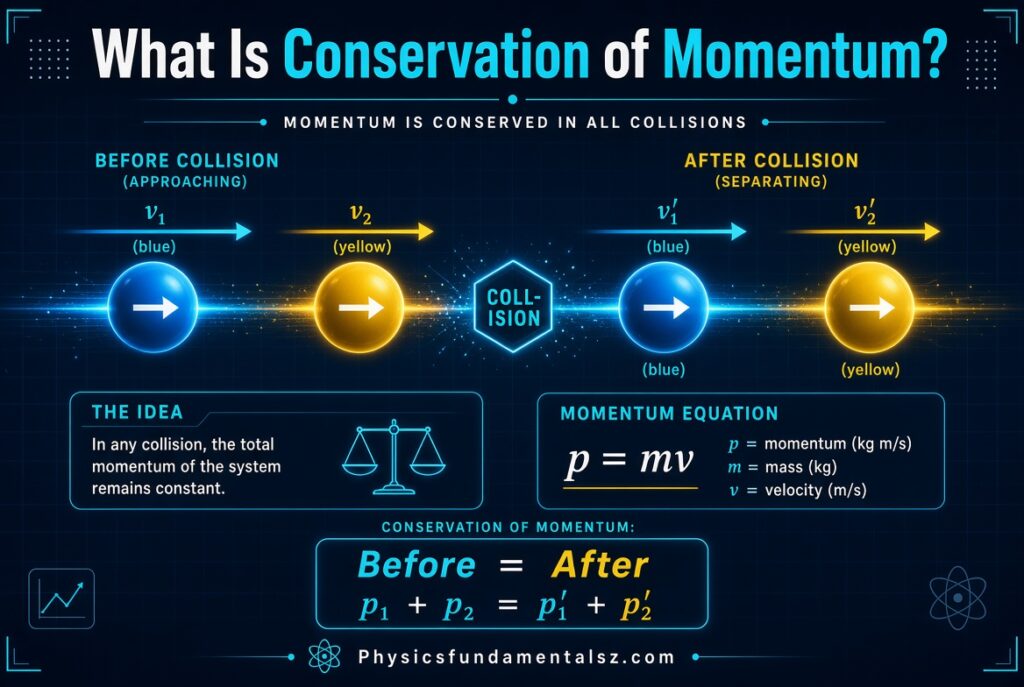
The law of conservation of momentum states that the total momentum of a closed system stays constant if no external force acts on it.
In simple terms, momentum lost by one object is gained by another. Nothing disappears; it just transfers.
The Formula for Conservation of Momentum
The law is written as:
m₁u₁ + m₂u₂ = m₁v₁ + m₂v₂
Here, m₁ and m₂ are the masses of two objects. u₁ and u₂ are their velocities before interaction, and v₁ and v₂ are their velocities after.
Momentum itself is mass times velocity (p = mv). Since it is a vector quantity, direction always matters when you add it up.
Why Momentum Stays Constant
Momentum is conserved because of Newton’s third law of motion. Every action force has an equal and opposite reaction force.
When two objects interact, they push on each other with equal force for the same amount of time. That equal push means equal and opposite change in momentum, so the total never changes.
This only holds true for an isolated system, meaning no outside force like friction or gravity is interfering.
Conservation of Momentum Real Life Examples
Below are the clearest, most commonly observed examples of this law at work, from everyday moments to engineering marvels.
1. Recoil of a Gun
When a bullet fires forward, the gun kicks backward into the shooter’s shoulder. The bullet’s tiny mass moves at high speed, while the gun’s larger mass moves backward at a much lower speed.
The two momenta are equal in size and opposite in direction, so the total stays at zero, just like before the shot.
2. Rocket Propulsion
A rocket burns fuel and expels hot gas downward at very high speed. That gas carries momentum in one direction.
To keep total momentum constant, the rocket itself gains equal momentum in the opposite direction, pushing it upward into space.
3. Car Collisions
When two vehicles crash, the combined momentum right before impact equals the combined momentum right after. This is why accident investigators can work backward from crash damage to estimate speed.
Momentum lost by the faster car is picked up by the slower one, or converted into deformation and heat.
4. Newton’s Cradle
This desk toy is one of the most visual conservation of momentum real life examples. Pull one ball back and release it, and only one ball flies off the opposite end.
Momentum travels through the row of touching balls like a wave, transferring cleanly from the first ball to the last.
5. Walking
Every step you take pushes your foot backward against the ground. By Newton’s third law, the ground pushes you forward with equal force.
That reaction force is what actually propels your body ahead, all governed by momentum exchange between you and the earth.
6. A Released Balloon Flying Away
When you let go of an inflated balloon without tying it, air rushes out one end at high speed. That escaping air carries momentum backward.
The balloon shoots forward in the opposite direction to keep the system’s total momentum unchanged.
7. Figure Skater Spins
A skater pulling their arms inward spins faster, an example of conservation of angular momentum. Reducing the distance of mass from the spin axis lowers rotational inertia.
Since angular momentum stays constant, the spin rate must increase to compensate.
8. Billiards and Pool Shots
When a cue ball strikes another ball, momentum transfers from the moving ball to the stationary one. Skilled players use this to control exactly where both balls end up.
The total momentum of the two balls after contact equals the cue ball’s momentum before contact.
9. Rowing a Boat
Each oar stroke pushes water backward. The reaction pushes the boat and rower forward, another everyday case of momentum being exchanged between two parts of a system.
The heavier the water pushed and the faster it moves, the more forward momentum the boat gains.
10. Sports Impacts
In cricket, baseball, tennis, or soccer, momentum transfers from the bat, racket, or foot into the ball. A harder, faster swing transfers more momentum, sending the ball farther and faster.
Coaches use this principle to teach proper follow-through technique for maximum transfer.
11. Jet Engines and Airplanes
Jet engines pull air in, compress it, and expel it backward at high speed. That backward-moving exhaust generates forward thrust on the aircraft.
This is the same rocket-style momentum exchange, just using atmospheric air instead of stored fuel gas alone.
12. Explosions
Before an explosion, a bomb or firework sits at rest with zero momentum. After it detonates, fragments fly outward in every direction.
The vector sum of every fragment’s momentum still equals zero, matching the system’s original state.
13. Swimming
Swimmers push water backward with their arms and legs. The reaction force from that displaced water pushes their body forward through the pool.
Better technique means moving more water with less wasted motion, improving forward momentum transfer.
14. Helicopter Rotors
A single main rotor spinning one way would cause the helicopter body to spin the opposite way to conserve angular momentum. That is why most helicopters use a tail rotor or dual rotors.
The tail rotor’s thrust cancels the twisting reaction, keeping the cabin stable.
15. Fireworks Bursting in the Sky
A firework shell rises with momentum, then explodes into a radial spray of glowing particles. Even though it spreads outward in all directions, the total momentum of every particle equals the shell’s momentum right before it burst.
Types of Collisions and Momentum Conservation
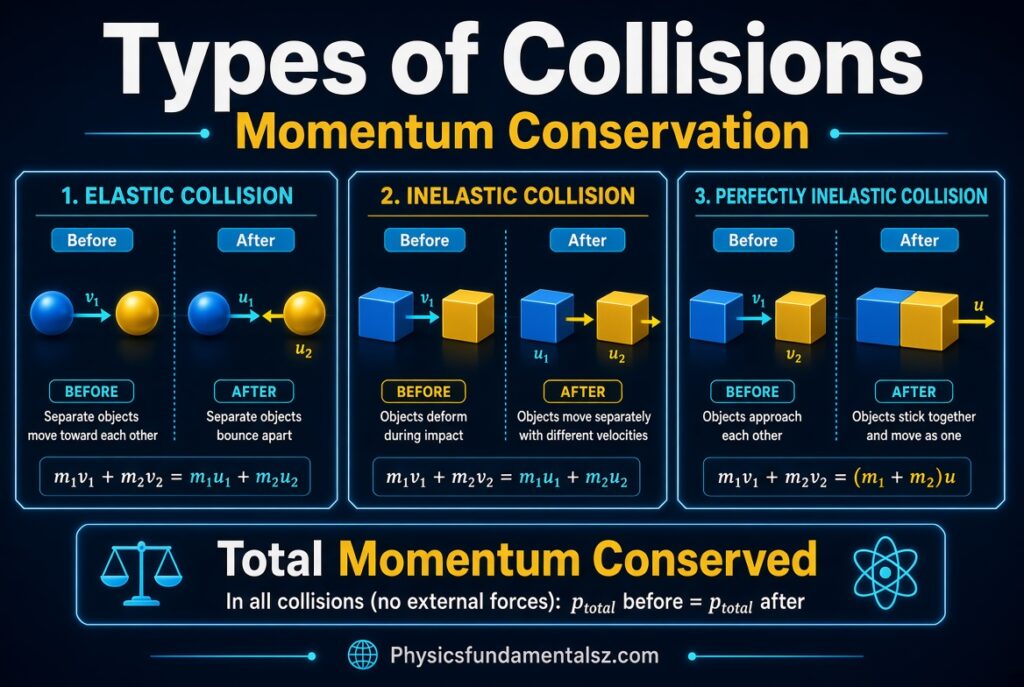
Momentum is conserved in every collision, but kinetic energy is not. The table below shows the difference.
| Collision Type | Momentum Conserved? | Kinetic Energy Conserved? | Real-Life Example |
|---|---|---|---|
| Elastic Collision | Yes | Yes | Newton’s cradle, billiard balls |
| Inelastic Collision | Yes | No, some converts to heat/sound | Car crash, clay ball impact |
| Perfectly Inelastic Collision | Yes | No, objects stick together | Train cars coupling |
Elastic vs Inelastic Collisions Explained
In an elastic collision, objects bounce apart and no kinetic energy is lost to heat, sound, or deformation.
In an inelastic collision, some kinetic energy converts into other forms, but the momentum total is unaffected. That distinction trips up many students.
Conservation of Momentum vs Conservation of Energy
These two laws often get confused because both apply to closed systems.
| Feature | Conservation of Momentum | Conservation of Energy |
|---|---|---|
| Quantity Conserved | Total momentum (mv) | Total energy |
| Vector or Scalar | Vector, direction matters | Scalar, no direction |
| Applies in Collisions | Always | Only elastic collisions |
| Common Formula | m₁u₁ + m₂u₂ = m₁v₁ + m₂v₂ | KE = ½mv² |
Common Mistakes to Avoid
- Forgetting that momentum is a vector, so direction and sign matter in every calculation.
- Assuming kinetic energy is always conserved along with momentum; it usually is not.
- Applying the law to a system with an outside force like friction still acting on it.
- Mixing up mass and weight when calculating momentum values.
Real-World Applications of Momentum Conservation

Engineers rely on this law far beyond the classroom. Car manufacturers use it to design crumple zones that absorb impact momentum safely.
Space agencies use it to calculate rocket fuel and thrust requirements for every launch. Sports scientists use it to improve technique in throwing, hitting, and kicking motions.
Safety equipment like airbags and seatbelts is engineered around slowing the rate of momentum change during a crash, which reduces the force felt by passengers.
Also Read:
- Newton’s Laws of Motion
- Conservation of Momentum: Full Guide
- What Is the Formula for Conservation of Momentum?
- Momentum Calculator Physics: Formula, Steps & Worked Examples
- What Is Energy?
- Kinetic Energy Calculator Physics
- Mass Energy Equivalence Real Life Examples
- Mass-Energy Equivalence: E = mc² Derivation & Nuclear Applications
- E=mc2 Explained for Beginners
- Projectile Motion: Complete Guide
- Projectile Motion Formula for Angled Launch Explained
- Projectile Motion Calculator With Angle
- Difference Between Speed and Velocity With Examples
- How to Calculate Acceleration From a Velocity Time Graph
- Wave Speed, Frequency & Wavelength
- Wave Speed Calculator Frequency Wavelength
- How to Derive Wave Speed Formula?
- Transverse Waves Explained
- Photoelectric Effect Equation Explained
- Bohr Model of the Atom
- De Broglie Wavelength: Formula, Derivation & Examples
- De Broglie Wavelength Calculator
- Heisenberg Uncertainty Principle Explained Simply
- Half-Life Calculations: Formula & Worked Examples
- Half Life Calculator With Steps
Frequently Asked Questions (FAQs)
What is the best example of conservation of momentum in real life?
A gun’s recoil is one of the clearest examples. The bullet moves forward while the gun moves backward, keeping total momentum at zero.
Is conservation of momentum the same as conservation of energy?
No. Momentum is always conserved in a closed system, but kinetic energy is only conserved in elastic collisions.
How does conservation of momentum apply to rockets?
Rockets expel gas backward at high speed, and the rocket gains equal forward momentum to balance it out.
Why does a skater spin faster when pulling in their arms?
Pulling arms inward reduces rotational inertia. Since angular momentum stays fixed, the spin rate rises to compensate.
What real-life object best demonstrates momentum conservation?
Newton’s cradle is the most visual demonstration, showing momentum pass cleanly through a row of touching balls.
Does friction affect conservation of momentum?
Yes. Friction is an external force, so momentum conservation only strictly applies to a truly isolated system without it.
Is momentum conserved in a car crash?
Yes, total momentum before and after a crash stays the same, even though kinetic energy is lost as heat and sound.
What is the law of conservation of momentum in simple words?
It states that the total momentum of two or more objects stays the same before and after they interact, as long as no outside force acts on them.
How is momentum different from force?
Momentum is mass times velocity, while force is the rate at which momentum changes over time.
Can momentum be negative?
Yes, momentum’s sign depends on direction. Moving left might be negative while moving right is positive, based on your chosen reference.
Why do astronauts use momentum conservation in space?
Astronauts can push off objects or use thrusters to move, since there is no ground friction, only momentum exchange, to rely on in space.
What everyday activity best shows conservation of momentum?
Walking is a constant, everyday example, where pushing the ground backward propels your body forward through reaction force.
Does conservation of momentum apply to explosions?
Yes, an exploding object’s fragments spread out, but their combined momentum still equals the object’s momentum before it burst.
What is the difference between elastic and inelastic collisions?
Elastic collisions conserve both momentum and kinetic energy. Inelastic collisions conserve only momentum, losing some energy to heat or deformation.
How do airbags relate to momentum conservation?
Airbags do not violate momentum conservation, but they extend the time over which momentum changes, lowering the force felt by passengers.
Why do helicopters need two rotors?
A single rotor would spin the helicopter body backward to conserve angular momentum. A second rotor cancels that unwanted rotation.
Is momentum conserved when a ball bounces off a wall?
Yes for the ball-wall-earth system overall, though the ball’s own momentum reverses direction if the bounce is elastic.
How is conservation of momentum used in sports science?
Coaches analyze momentum transfer from an athlete’s body into a bat, racket, or ball to improve swing mechanics and power output.
Conclusion
Conservation of momentum real life examples are everywhere, from a firing gun to a rocket launch to a simple walk across a room. The pattern is always the same: momentum lost by one object always shows up as momentum gained by another.
Once you can spot this exchange in everyday moments, the underlying physics stops feeling abstract and starts feeling obvious. That intuition is exactly what makes this one of the most practical laws in all of physics.