Difference Between Velocity and Acceleration in Physics: A Complete Guide With Examples
A car cruises along a motorway at a steady 30 metres per second. Its speedometer does not move, and the ride feels calm. Then the driver presses the accelerator, and the car surges forward. Something has changed, but what exactly?
The car had velocity before, and it still has velocity now. What changed is its acceleration. Velocity describes how fast position changes. Acceleration describes how fast velocity changes.
This guide explains the difference between velocity and acceleration in plain language. You will learn the definitions, formulas, units, and graphs, work through examples, and learn the mistakes examiners love to test.
By the end, you will be able to state each quantity correctly, calculate both from data, read velocity-time and acceleration-time graphs, and explain why an object can accelerate even while its speed stays the same.
Quick Answer: What Is the Difference Between Velocity and Acceleration?
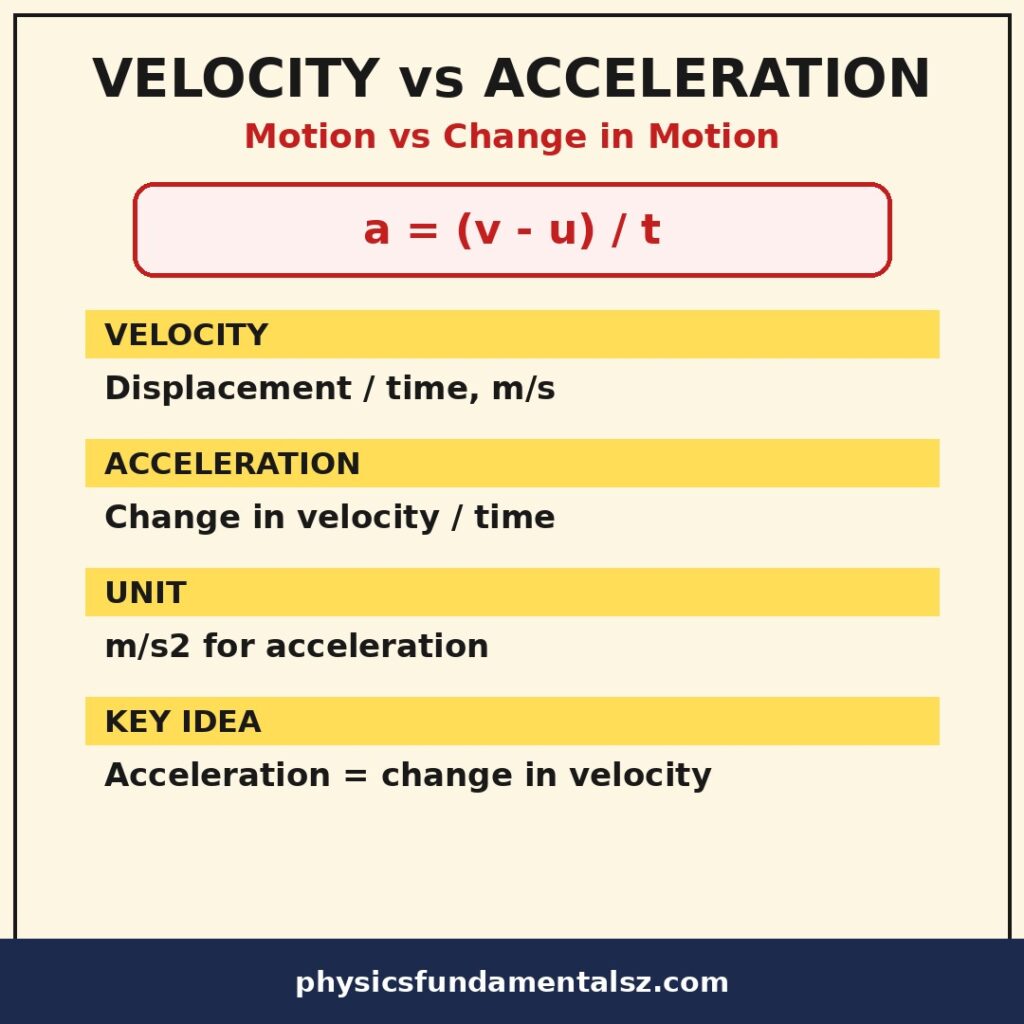
Velocity is the rate of change of displacement. It tells you how fast an object moves and in which direction. Its unit is metres per second (m/s).
Acceleration is the rate of change of velocity. It tells you how quickly velocity changes, in size or direction. Its unit is metres per second squared (m/s²).
In short: velocity answers “how fast, and where to?” Acceleration answers “how fast is that motion itself changing?” A car at constant velocity has zero acceleration. A car speeding up, slowing down, or turning has acceleration, even if its speedometer reading stays steady in a turn.
Definition Box — Velocity: Velocity is displacement divided by time. It is a vector quantity, with both magnitude and direction. Average velocity is total displacement over total time. Instantaneous velocity is the velocity at one instant, given by the gradient of a displacement-time graph.
Definition Box — Acceleration: Acceleration is the change in velocity divided by the time taken for that change. It is a vector quantity. Average acceleration is Δv / Δt. Constant acceleration is described by the equations of motion, also called SUVAT equations.
Definition Box — Speed: Speed is distance divided by time. It is a scalar, with magnitude only. Speed is the magnitude of velocity, but it carries no direction. A car going around a roundabout at steady speed still has changing velocity, because its direction changes.
Key Takeaways
- Velocity is displacement over time; acceleration is change in velocity over time.
- Velocity is measured in m/s; acceleration is measured in m/s².
- Both velocity and acceleration are vectors, with magnitude and direction.
- Speed is a scalar and is not the same as velocity, even though the words are often swapped.
- Zero velocity does not mean zero acceleration, and zero acceleration does not mean zero velocity.
- The gradient of a displacement-time graph gives velocity; the gradient of a velocity-time graph gives acceleration.
- The area under a velocity-time graph gives displacement; the area under an acceleration-time graph gives change in velocity.
- An object moving in a circle at constant speed accelerates toward the centre, because its direction changes.
- Negative acceleration is not always slowing down; it depends on the chosen positive direction.
- In free fall, acceleration is constant at about 9.81 m/s² downward, while velocity grows steadily.
What Is Velocity in Physics?
Velocity tells you where an object is heading and how quickly it gets there. A statement like “20 m/s north” is a velocity. A statement like “20 m/s” alone is only a speed.
Displacement is the key idea behind velocity. Displacement is the straight-line distance from a starting point to a finishing point, with direction. If you walk 100 m east and then 100 m west, your distance travelled is 200 m, but your displacement is zero. You ended where you started.
Average velocity divides total displacement by total time: v = Δx / Δt. If displacement is zero, average velocity is zero, however far you travelled. That distinction catches many students in their first kinematics test.
Instantaneous velocity is subtler. It is the velocity at a single moment, like a speedometer reading with a direction attached. On a displacement-time graph, it is the gradient of the tangent at that point. For uniform motion, average and instantaneous velocity are the same.
Velocity, Displacement, and Direction
Direction is what turns speed into velocity. Two cars travelling at 30 m/s in opposite directions have the same speed but opposite velocities. One might be +30 m/s and the other −30 m/s, if east is taken as positive.
Signs carry direction in one-dimensional problems. A negative velocity does not mean slow motion. It means motion in the negative direction. A velocity of −5 m/s is faster in magnitude than +3 m/s, but it points the other way.
In two dimensions, direction is given by an angle or a compass bearing. A velocity of 10 m/s at 30 degrees north of east is a complete description. Splitting it into horizontal and vertical components lets you analyse each direction separately, which is how projectile motion is solved.
Our guide to the difference between speed and velocity explains the scalar-vector distinction in full. The examples there show why a round trip can have high average speed but zero average velocity.
How Velocity Is Measured
Velocity is rarely measured directly. It is usually calculated from displacement and time, or read from a graph, or measured with motion sensors that track position many times per second.
In a school laboratory, a ticker timer or light gate measures the time for a trolley to pass known distances. Dividing each distance by its time gives a velocity for that interval. Plotting those velocities against time reveals the acceleration.
Modern motion sensors and video analysis do the same job more precisely. A phone camera recording at high frame rate can track a falling ball frame by frame. Each frame gives a position, and the change in position between frames gives a velocity.
The SI unit of velocity is metres per second. Kilometres per hour is common in everyday life, and miles per hour in some countries. Convert carefully: 1 m/s equals 3.6 km/h. Mixing units in one calculation is a frequent source of error.
| Unit | Symbol | Conversion |
|---|---|---|
| Metres per second | m/s | SI unit |
| Kilometres per hour | km/h | 1 m/s = 3.6 km/h |
| Miles per hour | mph | 1 m/s ≈ 2.24 mph |
| Centimetres per second | cm/s | 1 m/s = 100 cm/s |
Average Velocity vs Instantaneous Velocity
Average velocity smooths a whole journey into one number. A cyclist who rides 20 km in one hour has an average velocity of 20 km/h in the direction of travel, even if she stopped, sprinted, and coasted along the way.
Instantaneous velocity captures one moment. At the top of a hill, the cyclist might be moving at 5 km/h. On a descent, she might hit 40 km/h. Both are instantaneous velocities, and both differ from the average.
Exam questions usually say which one they want. “Average velocity” means total displacement over total time. “Velocity at t = 3 s” means instantaneous velocity, found from a graph gradient or an equation of motion. Using the wrong one gives a wrong answer even with perfect arithmetic.
For motion with constant acceleration, average velocity has a neat shortcut: it is the mean of the initial and final velocities, (u + v) / 2. This works only when acceleration is constant. For changing acceleration, you must use total displacement over total time, or integrate the velocity-time graph.
What Is Acceleration in Physics?
Acceleration is change. If velocity is steady, acceleration is zero. If velocity grows, shrinks, or turns, acceleration is present. The word “accelerate” in everyday speech usually means “speed up,” but in physics it covers all three changes.
Imagine a bus pulling away from a stop. Its velocity rises from zero to 10 m/s in 5 seconds. Its average acceleration is 10 / 5 = 2 m/s². Every second, on average, its velocity grows by 2 m/s.
Now imagine the same bus braking. Its velocity falls from 10 m/s to zero in 5 seconds. Its acceleration is −2 m/s², if forward is positive. The negative sign shows the change opposes the motion. Drivers call this deceleration, but physicists prefer “negative acceleration” or “acceleration opposite to velocity,” because the sign depends on the coordinate choice.
Turning counts too. A car going around a bend at steady speed changes direction continuously. Its velocity vector rotates, so velocity changes, so acceleration exists. The acceleration points toward the centre of the bend. Passengers feel pushed outward, but the real acceleration is inward.
The Acceleration Formula
Average acceleration is defined as:
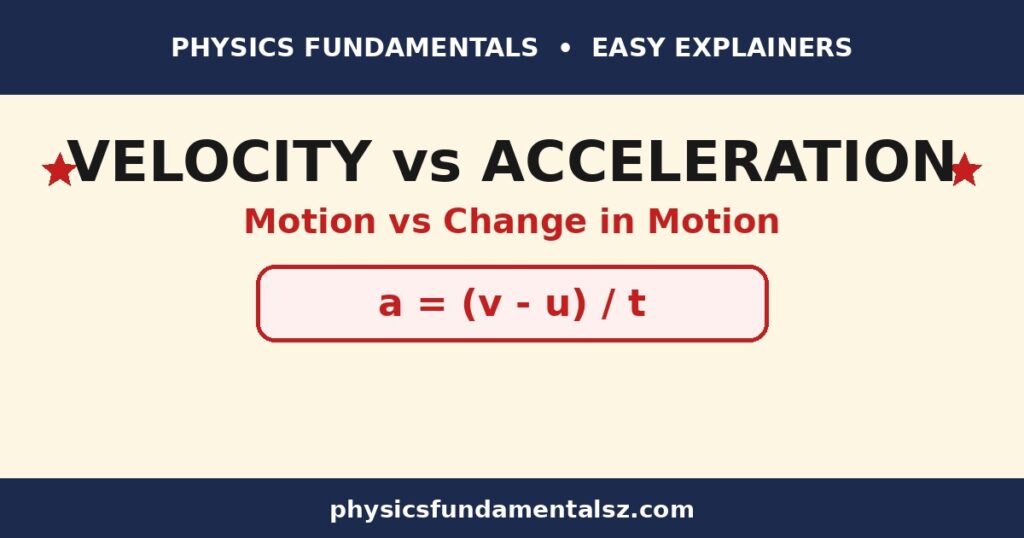
a = Δv / Δt = (v − u) / t
Here a is acceleration in m/s², v is final velocity in m/s, u is initial velocity in m/s, and t is the time interval in seconds. The symbol Δ means “change in.”
This formula gives average acceleration over the interval. If acceleration is constant, average and instantaneous acceleration are equal. If acceleration varies, the formula gives only the average, and instantaneous acceleration must be found from the gradient of a velocity-time graph.
Rearranging gives the first equation of motion: v = u + at. This is one of the most used formulas in mechanics. It says final velocity equals initial velocity plus the velocity gained through acceleration over time.
Check the units: (m/s) divided by s gives m/s². The unit reads “metres per second, per second,” which is exactly what acceleration means: how many metres per second of velocity are gained each second.
Why Acceleration Is Measured in m/s²
The unit m/s² looks odd at first. It becomes clear when you read it as a rate of a rate. Velocity is metres per second. Acceleration is the change in that quantity per second, so it is metres per second per second.
A car accelerating at 3 m/s² gains 3 m/s of velocity every second. After one second, it is 3 m/s faster than it started. After two seconds, 6 m/s faster, if acceleration stays constant. After ten seconds, 30 m/s faster.
Gravity provides the most familiar acceleration. Near Earth’s surface, freely falling objects accelerate downward at about 9.81 m/s², ignoring air resistance. That means a falling object’s downward velocity grows by about 9.81 m/s every second. After three seconds, it moves at about 29.4 m/s downward, if it started from rest.
Khan Academy explains acceleration with worked examples and interactive graphs in its unit on one-dimensional motion. The key insight is that acceleration is about change, not about speed itself.
Acceleration as a Vector
Acceleration has direction, just like velocity. An acceleration of 2 m/s² east is different from 2 m/s² north, even though the size is the same. In force problems, the direction of acceleration matches the direction of the net force, by Newton’s second law, F = ma.
Signs matter in one-dimensional problems. If east is positive, an acceleration of −4 m/s² points west. Whether the object slows down depends on its velocity direction. An object moving east with westward acceleration slows down. An object moving west with westward acceleration speeds up.
This is why “deceleration” can mislead. A negative acceleration is only a slowing down if velocity is positive. Teachers increasingly avoid the word deceleration for this reason, preferring to state the acceleration vector explicitly. State the direction, and the physics is unambiguous.
For a deeper look at how forces produce acceleration, see our guide to Newton’s third law of motion. Forces and acceleration are linked in every dynamics problem, and the vector nature of both is essential.
Velocity vs Acceleration: The Complete Comparison
The table below gathers every key difference in one place. Use it for revision, and check your answers against it before an exam. If a statement about velocity uses m/s², or a statement about acceleration uses m/s, something is wrong.
| Feature | Velocity | Acceleration |
|---|---|---|
| Definition | Rate of change of displacement | Rate of change of velocity |
| Formula | v = Δx / Δt | a = Δv / Δt |
| SI unit | m/s | m/s² |
| Symbol | v (or u for initial) | a |
| Quantity type | Vector | Vector |
| Zero means | No displacement change; at rest or returning to start | Velocity constant; no change in speed or direction |
| Graph gradient | Gradient of displacement-time graph | Gradient of velocity-time graph |
| Graph area | Not directly from a graph | Area under acceleration-time graph gives Δv |
| Depends on | Displacement and time | Velocity change and time |
| In free fall | Increases steadily downward | Constant at 9.81 m/s² downward |
| Can be negative | Yes, if direction is negative | Yes, if change is in negative direction |
Graphs: Displacement-Time, Velocity-Time, Acceleration-Time
Graphs are the heart of kinematics. Almost every exam paper includes a graph question, and the gradient-area rules above answer most of them. Learn to read all three graph types, and to convert one into another.
Displacement-Time Graphs
On a displacement-time graph, time runs along the horizontal axis and displacement along the vertical axis. The gradient at any point is the velocity at that time. A straight line means constant velocity. A curve means changing velocity.
A flat, horizontal line means zero velocity: displacement does not change, so the object is at rest. A steep line means high velocity. A line sloping downward means negative velocity, motion in the negative direction.
A curve bending upward means velocity is increasing, so acceleration is positive. A curve bending downward means velocity is decreasing. The curvature, or second gradient, is the acceleration. This is why displacement-time graphs carry information about all three quantities at once.
Velocity-Time Graphs
On a velocity-time graph, the gradient is acceleration. A straight line sloping upward means constant positive acceleration. A straight horizontal line means constant velocity and zero acceleration. A line sloping downward means constant negative acceleration.
The area under the graph, between the curve and the time axis, is displacement. For a rectangle, area is velocity times time. For a triangle, area is half base times height. For a trapezium, split it into a rectangle and a triangle, or use the average velocity formula.
Velocity-time graphs are the most versatile kinematics tool. From one graph you can read initial and final velocity, acceleration, displacement, and average velocity. Sketching one from a word problem often makes the solution obvious before any calculation begins.
HyperPhysics shows the three graph types side by side, with the gradient and area relationships labelled, in its pages on motion graphs. Comparing the graphs for the same motion builds the fluency exams require.
Acceleration-Time Graphs
On an acceleration-time graph, the area under the curve is the change in velocity. A horizontal line means constant acceleration. A line at zero means velocity is constant. A curve means acceleration itself is changing.
Acceleration-time graphs appear less often in school exams, but they are common in AP Physics free-response questions. A typical task gives an acceleration-time graph and asks for the velocity change over an interval. The answer is the area, with careful attention to sign: area below the axis counts as negative velocity change.
Sketching all three graphs for one motion is excellent practice. Start with a simple case: an object accelerates from rest, cruises at constant velocity, then brakes to a stop. Draw the acceleration-time graph first, then build velocity-time from its areas, then displacement-time from the velocity areas. The three graphs must agree with each other.
Worked Graph Example
A velocity-time graph shows a line from (0, 0) to (4 s, 20 m/s), then a horizontal line to (10 s, 20 m/s), then a line down to (14 s, 0). Find the acceleration in each section and the total displacement.
In the first section, acceleration is (20 − 0) / 4 = 5 m/s². In the middle section, acceleration is zero. In the last section, acceleration is (0 − 20) / 4 = −5 m/s².
Displacement is the total area. First triangle: ½ × 4 × 20 = 40 m. Rectangle: 6 × 20 = 120 m. Last triangle: ½ × 4 × 20 = 40 m. Total displacement is 200 m. Average velocity is 200 / 14 ≈ 14.3 m/s.
The Equations of Motion (SUVAT)
For motion with constant acceleration in a straight line, five equations link displacement, initial velocity, final velocity, acceleration, and time. They are often called SUVAT equations, from the symbols s, u, v, a, and t.
The five equations are: v = u + at; s = ut + ½at²; s = vt − ½at²; s = ½(u + v)t; and v² = u² + 2as. Each omits one variable, so you choose the equation that omits the quantity you do not know and do not need.
Choosing the right equation is a skill. List the knowns first: s, u, v, a, t. Cross out the unknown you are not asked for. Pick the equation that uses the remaining four. Substituting before rearranging reduces errors, and checking units at the end catches mistakes.
These equations assume constant acceleration and straight-line motion. They do not apply when acceleration varies, when motion curves, or when air resistance changes the acceleration significantly. In those cases, use graphs, energy methods, or calculus instead.
Worked Examples: Velocity and Acceleration Calculations
Worked examples build calculation fluency. Each example states the method, substitutes values, and checks the result. Show the same working in exams, because method marks are awarded for correct substitution and rearrangement.
Example 1: Average Velocity of a Runner
Question: A runner covers a displacement of 400 m in 50 s in a straight line. Calculate the average velocity.
Solution:
v = Δx / Δt = 400 / 50 = 8 m/s in the direction of the run.
Check: The unit is m/s, correct for velocity. If the runner had run out and back to the start, displacement would be zero and average velocity would be zero, even though average speed would be 8 m/s. Direction and displacement make the difference.
Example 2: Acceleration of a Cyclist
Question: A cyclist increases velocity from 4 m/s to 12 m/s in 4 s. Calculate the average acceleration.
Solution:
a = (12 − 4) / 4 = 8 / 4 = 2 m/s² in the direction of motion.
Check: The cyclist gains 2 m/s of velocity each second, on average. After 4 s, the gain totals 8 m/s, matching the change from 4 to 12 m/s. The check confirms the arithmetic.
Example 3: Velocity After Acceleration
Question: A car starts from rest and accelerates at 3 m/s² for 6 s. What is its final velocity?
Solution:
v = u + at = 0 + 3 × 6 = 18 m/s.
Check: The car gains 3 m/s each second for 6 s, totalling 18 m/s. The answer is in m/s, correct for velocity. Starting from rest means u = 0, which simplifies the calculation.
Example 4: Braking Distance
Question: A van travelling at 20 m/s brakes with a constant acceleration of −4 m/s². How far does it travel before stopping?
Solution:
Use v² = u² + 2as with v = 0, u = 20, a = −4. Then 0 = 400 − 8s, so s = 50 m.
Check: The stopping distance grows with the square of initial speed. Doubling speed would quadruple the distance, if deceleration stayed the same. This square law is why speed limits matter so much for safety.
Example 5: Free Fall Velocity
Question: A stone is dropped from rest from a cliff. Ignoring air resistance, what is its velocity after 3 s, and how far has it fallen? Use g = 9.81 m/s².
Solution:
Velocity: v = u + gt = 0 + 9.81 × 3 = 29.43 m/s downward.
Distance: s = ut + ½gt² = 0 + 0.5 × 9.81 × 9 = 44.1 m.
Check: Velocity grows linearly with time, while distance grows with the square of time. After 3 s, the stone has fallen 44.1 m, which is consistent with an average velocity of 14.7 m/s over the fall. Both results use the same constant acceleration.
Example 6: Negative Velocity, Positive Acceleration
Question: An object moves with velocity −6 m/s and acceleration +2 m/s². Describe its motion over the next 3 s.
Solution:
The object moves in the negative direction, but acceleration points positive, opposing the motion. It slows down, stops, then moves in the positive direction.
After 3 s, v = −6 + 2 × 3 = 0 m/s. It comes momentarily to rest at exactly 3 s. After that, velocity becomes positive and the object speeds up in the positive direction.
Check: This example shows why sign matters more than the word “deceleration.” Positive acceleration slowed the object here, because velocity was negative. Always compare the signs of velocity and acceleration to decide whether speed rises or falls.
Example 7: Circular Motion at Constant Speed
Question: A car travels around a roundabout at a constant speed of 12 m/s. Does it accelerate? Explain.
Solution:
Yes. Speed is constant, but direction changes continuously. Velocity is a vector, so changing direction changes velocity. Acceleration points toward the centre of the circle.
Check: The magnitude of centripetal acceleration is v² / r, where r is the radius. For a radius of 24 m, acceleration is 144 / 24 = 6 m/s² toward the centre. Constant speed does not mean constant velocity, and constant velocity is what zero acceleration requires.
Special Cases That Confuse Students
Several special cases appear in almost every kinematics test. They feel counterintuitive at first, but each follows directly from the definitions. Learn them as named cases, and they become easy marks.
Zero Velocity With Non-Zero Acceleration
A ball thrown upward reaches its highest point and momentarily stops. Its velocity is zero at that instant. Its acceleration is still 9.81 m/s² downward. Gravity does not switch off at the top.
Students often answer that acceleration is zero at the top because velocity is zero. That confuses a quantity with its rate of change. Velocity is zero, but velocity is changing, from upward to downward. Change means acceleration.
The same logic applies to a pendulum at its turning point, a spring at maximum stretch, and any object at the instant it reverses direction. Momentary rest does not mean momentary zero acceleration. Check the forces: if a net force acts, acceleration is present.
Velocity and Acceleration in Real Life
Kinematics governs transport, sport, and safety engineering. The formulas in this guide are the same ones engineers use, with larger numbers and tighter tolerances.
Cars, Braking, and Safety
Stopping distance has two parts: thinking distance and braking distance. Thinking distance grows linearly with speed, because the driver travels at constant velocity during reaction time. Braking distance grows with the square of speed, from v² = u² + 2as.
At 30 mph, a typical stopping distance is about 23 m. At 60 mph, it is about 73 m, more than triple, not double. The square law in the braking part explains the difference. This is why small speed increases have large safety consequences.
Acceleration limits also matter for comfort and design. A car accelerating at 3 m/s² feels brisk. A roller coaster launch at 15 m/s² feels extreme. Engineers set acceleration limits for lifts, trains, and amusement rides to keep forces on passengers safe and comfortable.
Common Mistakes to Avoid
The same errors appear in exam after exam. Each one below is easy to avoid once you name it. Check your work against this list before you submit an answer.
Mistake 1: Using Speed When Velocity Is Needed
Speed ignores direction; velocity includes it. A question asking for velocity needs a direction in the answer. “20 m/s” is incomplete. “20 m/s east” is complete. Average speed over a round trip is positive, but average velocity is zero, because displacement is zero. Read the wording: “speed” and “velocity” are different quantities, even when the numbers match.
Mistake 2: Confusing Velocity With Acceleration
A fast object does not necessarily accelerate. A cruise at constant 30 m/s has zero acceleration. A slow object can accelerate strongly: a car pulling away from rest at 5 m/s² accelerates hard while still moving slowly. Ask two separate questions: “How fast is it moving?” and “How fast is that motion changing?” The first is velocity; the second is acceleration.
Mistake 3: Assuming Zero Velocity Means Zero Acceleration
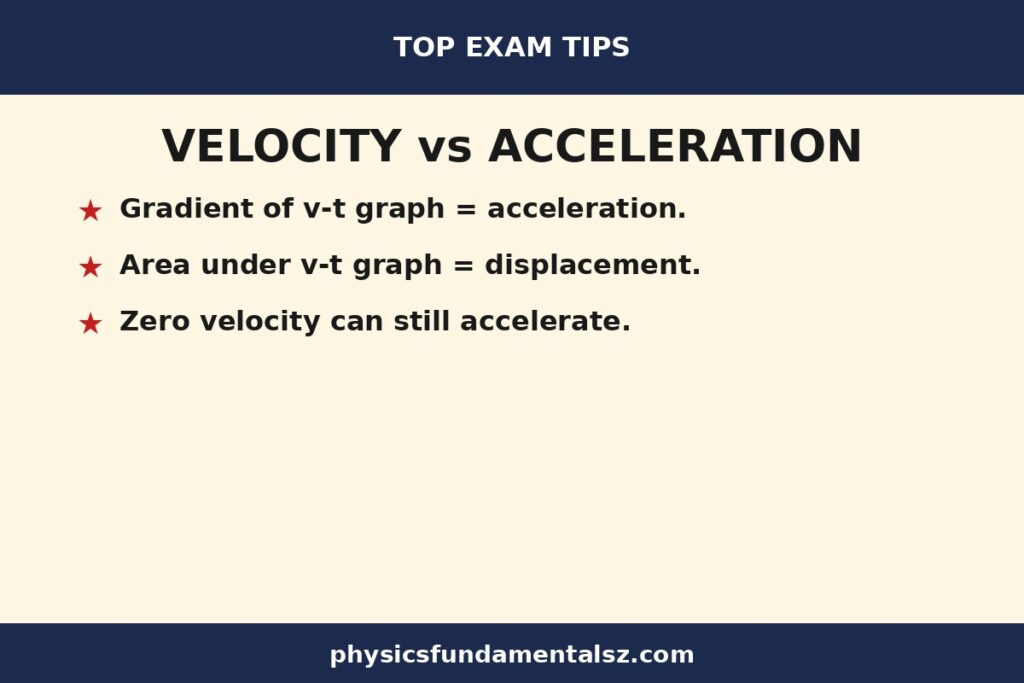
At the top of a throw, velocity is zero but acceleration is g downward. At a turning point, velocity is zero but acceleration is present. The quantity and its rate of change are independent at an instant. If a net force acts, acceleration is non-zero, whatever the velocity at that moment.
Mistake 4: Treating Negative Acceleration as Always Slowing Down
Negative is a direction, not a behaviour. If velocity is also negative, negative acceleration speeds the object up in the negative direction. Slowing down happens only when velocity and acceleration point in opposite directions. Always compare signs. State the positive direction at the start of a calculation, and interpret the sign against it.
Mistake 5: Reading the Wrong Graph Feature
Gradient and area answer different questions. On a velocity-time graph, gradient is acceleration and area is displacement. Swapping them is the most common graph error. On a displacement-time graph, gradient is velocity. There is no area meaning. Learn the pairs: displacement-time gradient → velocity; velocity-time gradient → acceleration; velocity-time area → displacement; acceleration-time area → change in velocity.
Mistake 6: Mixing Units
Calculations need consistent units. Mixing km/h with seconds, or cm with metres, produces wrong answers even with correct physics. Convert first: 1 m/s = 3.6 km/h; 1 km = 1,000 m; 1 cm = 0.01 m. Keep the unit with every number in working, and check the final unit: m/s for velocity, m/s² for acceleration, m for displacement.
Mistake 7: Forgetting That Direction Changes Velocity
An object moving in a circle at constant speed accelerates, because direction changes. An object reversing direction changes velocity even if speed stays the same. Any turn, bend, or reversal is a velocity change. If the question involves a bend or a return journey, direction is part of the physics, not a detail to ignore.
Expert Tips for Exams
Top scorers use a routine. It is not about talent; it is about habits that prevent the mistakes above.
List the knowns first. Write s, u, v, a, t, and fill in what the question gives. Mark the unknown you need. Then choose the equation that links them, and only then substitute numbers.
Draw the graph, even when the question does not ask for one. A quick velocity-time sketch shows the shape of the motion and catches sign errors. Label the gradient and the area you need before calculating.
State the positive direction in words. “Take east as positive” or “Take downward as positive” makes signs consistent and earns method marks. A sign error in a one-mark answer often traces back to an unstated direction.
Check sense at the end. A velocity of 300 m/s for a cyclist is wrong. An acceleration of 100 m/s² for a car is wrong. Compare the answer with everyday values: walking is about 1.4 m/s, a car on a motorway is about 30 m/s, free fall gains about 10 m/s each second.
Label gradients and areas explicitly. Write “gradient = acceleration” or “area = displacement” next to your working. Examiners award method marks for a labelled gradient or area even when the final number slips.
Practise converting between graphs. Given a velocity-time graph, sketch the displacement-time and acceleration-time graphs. Given a description, sketch all three. Conversion practice is the fastest way to make graph questions routine.
Frequently Asked Questions
What is the difference between velocity and acceleration in simple terms?
Velocity tells you how fast an object moves and in which direction. Acceleration tells you how quickly that velocity changes. A car cruising at steady speed has velocity but no acceleration. A car speeding up, slowing down, or turning has acceleration, because its velocity changes.
What is the formula for velocity and acceleration?
Velocity is v = Δx / Δt, displacement divided by time. Acceleration is a = Δv / Δt, change in velocity divided by time. For constant acceleration, v = u + at also links initial velocity u, final velocity v, acceleration a, and time t.
Is velocity the same as speed?
No. Speed is a scalar with magnitude only; velocity is a vector with magnitude and direction. Speed is the magnitude of velocity. A round trip can have high average speed but zero average velocity, because displacement is zero.
Can an object have velocity but no acceleration?
Yes. Constant velocity means zero acceleration. A car cruising at steady speed in a straight line has velocity but no acceleration, because velocity is not changing. Zero acceleration means constant velocity, not zero velocity.
Can an object have acceleration but no velocity?
Yes, at an instant. A ball at the top of its throw has zero velocity but acceleration g downward. Acceleration describes change, so it can be present even when the quantity it changes is momentarily zero.
How do you tell velocity from acceleration on a graph?
On a displacement-time graph, the gradient is velocity. On a velocity-time graph, the gradient is acceleration and the area is displacement. On an acceleration-time graph, the area is change in velocity. Name the graph first, then apply the correct gradient or area rule.
What are the units of velocity and acceleration?
Velocity is measured in metres per second (m/s). Acceleration is measured in metres per second squared (m/s²). The squared unit reads as metres per second, per second: how much velocity changes each second.
Is acceleration positive when an object speeds up?
Not always. Acceleration is positive when it points in the chosen positive direction. If velocity is negative, positive acceleration slows the object down. Speeding up happens when velocity and acceleration have the same sign; slowing down happens when they have opposite signs.
What does negative acceleration mean?
Negative acceleration points in the negative direction. It does not always mean slowing down. If velocity is positive, negative acceleration slows the object. If velocity is negative, negative acceleration speeds it up in the negative direction. Always compare the signs of velocity and acceleration.
Does acceleration always mean speeding up?
No. Acceleration means velocity changes. That change can be in size or direction. Slowing down, speeding up, and turning all count as acceleration. A car at constant speed around a bend accelerates, even though its speedometer does not move.
How do you calculate acceleration from a velocity-time graph?
Read the gradient. Choose two points on a straight section, divide the change in velocity by the change in time, and include the unit m/s². For a curved graph, draw a tangent at the point of interest and find its gradient. The gradient at each point is the instantaneous acceleration there.
What is the acceleration due to gravity?
Near Earth’s surface, freely falling objects accelerate at about 9.81 m/s² downward, ignoring air resistance. The value is often rounded to 10 m/s² in school calculations, or 9.8 m/s² in AP Physics. Velocity increases by about 9.81 m/s every second of fall, while acceleration stays constant.
Can velocity be zero while acceleration is non-zero?
Yes. At the top of a vertical throw, velocity is zero and acceleration is 9.81 m/s² downward. At any turning point, velocity is momentarily zero while acceleration is present. Zero velocity is an instant; acceleration is the rate of change through that instant.
What is the difference between average and instantaneous acceleration?
Average acceleration divides the total change in velocity by the total time, over an interval. Instantaneous acceleration is the acceleration at one moment, given by the gradient of the velocity-time graph at that point. For constant acceleration, the two are equal.
How are force and acceleration related?
Newton’s second law links them: F = ma. Net force equals mass times acceleration. A larger net force produces larger acceleration for the same mass, and a larger mass needs a larger force for the same acceleration. Force and acceleration share direction.
What is centripetal acceleration?
Centripetal acceleration is the acceleration of an object moving in a circle, pointing toward the centre. It changes direction, not speed. Its magnitude is v² / r, where v is speed and r is the radius. A tighter circle or a higher speed means larger centripetal acceleration.
Why does a turning car accelerate even at constant speed?
Velocity includes direction. Turning changes direction, so velocity changes, and a change in velocity is acceleration. The acceleration points toward the centre of the turn. The speedometer reads the same, but the velocity vector rotates continuously.
What is terminal velocity?
Terminal velocity is the constant velocity reached when drag balances weight during a fall. Net force becomes zero, so acceleration becomes zero, and velocity stops changing. The falling object then descends at steady velocity. Terminal velocity depends on mass, shape, and air density.
How do you find displacement from a velocity-time graph?
Find the area under the graph, between the curve and the time axis. For a rectangle, area is base × height. For a triangle, area is ½ × base × height. Count squares for a curved graph. Area below the time axis counts as negative displacement.
What mistakes should you avoid with velocity and acceleration?
The main mistakes are using speed for velocity, confusing velocity with acceleration, assuming zero velocity means zero acceleration, treating negative acceleration as always slowing down, reading the wrong graph feature, mixing units, and forgetting that direction changes velocity. State the positive direction, check units, and compare signs before you answer.
Conclusion
Velocity and acceleration describe motion at two levels. Velocity tells you how displacement changes: how fast, and in which direction. Acceleration tells you how velocity changes: how quickly speed or direction shifts. Both are vectors, both need directions and units, and both appear on the same graphs, as gradients and areas.
Remember the graph rules and the special cases. The gradient of a displacement-time graph is velocity. The gradient of a velocity-time graph is acceleration, and its area is displacement. Zero velocity does not mean zero acceleration, and constant speed does not mean zero acceleration when direction changes. These are the ideas that separate a memorised definition from real understanding.
Practise with the worked examples and graph sketches in this guide, then test yourself on mixed problems. List the knowns, state the positive direction, and check that each answer makes sense. For related ideas, see our guides to the difference between mass and weight in physics and what is density in physics.