What Is Potential Energy in Physics? A Complete Guide With Examples
A ball held high above the ground does nothing at all. It hangs still, silent, and apparently harmless. Yet the moment you let go, it falls fast and hits the ground hard.
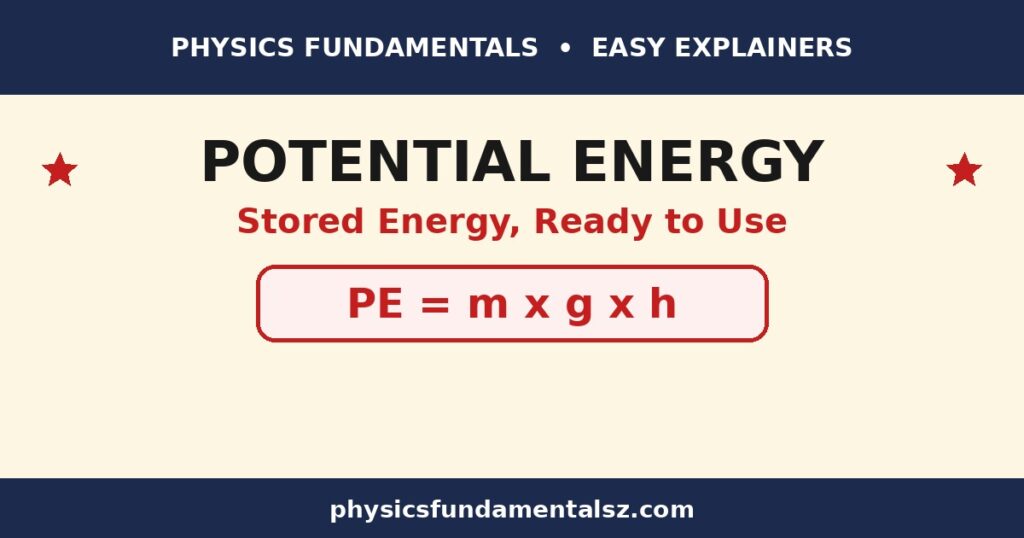
That stored ability to move is potential energy. It is energy held ready by position, shape, or arrangement, waiting for a change that releases it.
This guide explains what potential energy in physics means in plain language. You will learn gravitational potential energy, elastic potential energy, the PE = mgh formula, and how energy changes form without disappearing.
You will also work through step-by-step examples, compare potential energy with kinetic energy, and learn the mistakes that cost exam marks. By the end, you will be able to calculate potential energy, explain where it comes from, and predict what happens when it is released.
Quick Answer: What Is Potential Energy in Physics?
Potential energy is stored energy that an object has because of its position, shape, or arrangement. It is energy waiting to be used.
A book on a high shelf has gravitational potential energy because gravity can pull it down. A stretched rubber band has elastic potential energy because it can snap back. A charged battery stores chemical potential energy that can drive a current.
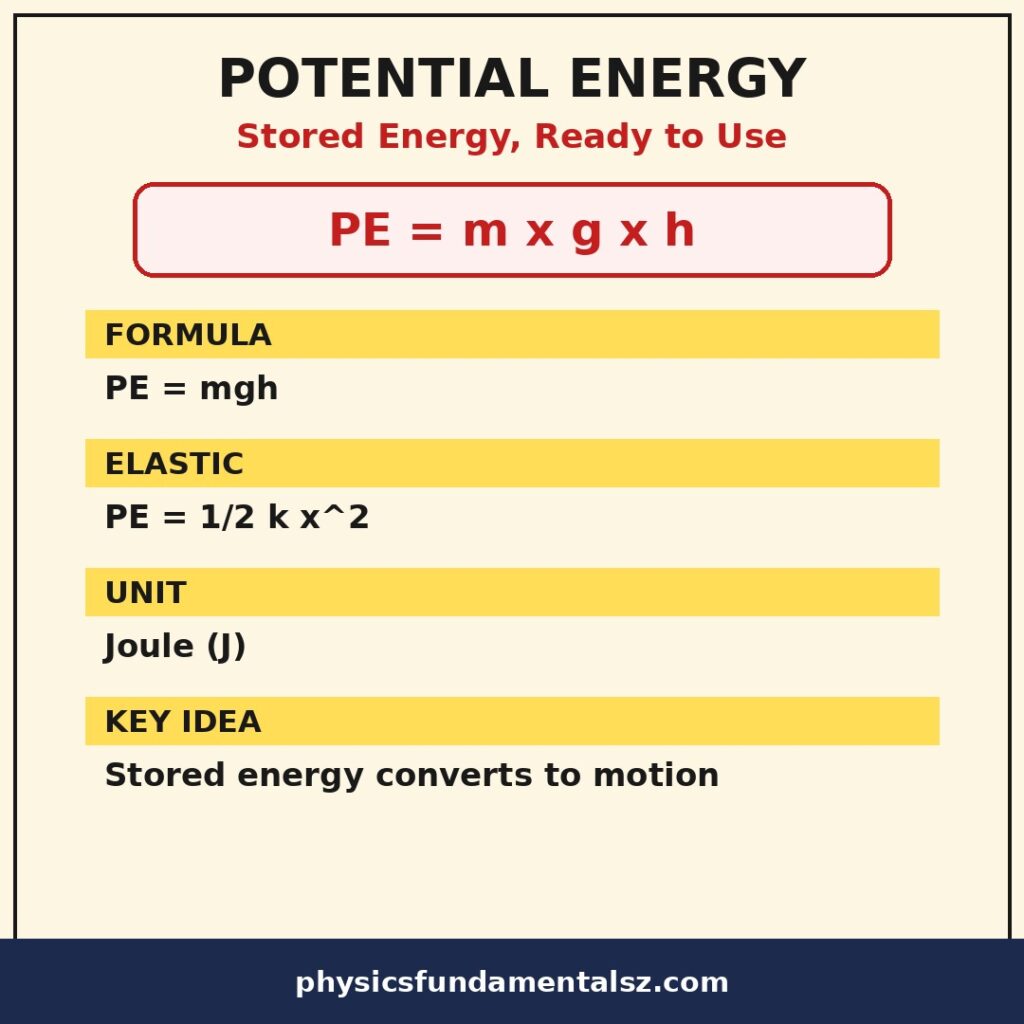
The most common formula in school physics is gravitational potential energy: PE = mgh. Here m is mass in kilograms, g is gravitational field strength in newtons per kilogram, and h is height in metres. The result is in joules.
Definition Box — Potential Energy: Potential energy is the energy stored in an object or system because of its position, deformation, or configuration. It can be converted into kinetic energy or other forms of energy when the position or shape changes. Its SI unit is the joule (J).
Definition Box — Gravitational Potential Energy: Gravitational potential energy is the energy an object has because of its height in a gravitational field. Lifting an object against gravity stores energy in the object-Earth system. That energy is released as the object falls.
Definition Box — Elastic Potential Energy: Elastic potential energy is the energy stored in a stretched, compressed, or twisted elastic object, such as a spring or rubber band. The energy is released when the object returns toward its natural shape.
Key Takeaways
- Potential energy is stored energy due to position, shape, or arrangement.
- Gravitational potential energy depends on mass, gravity, and height: PE = mgh.
- Elastic potential energy depends on how far a spring is stretched and how stiff it is.
- Energy is never created or destroyed; potential energy converts into kinetic energy and back.
- Potential energy is a scalar measured in joules, just like all energy.
- Only changes in potential energy matter in most calculations, not the absolute value.
- The reference height for h must be stated clearly, or answers will differ.
- At the top of a fall, energy is mostly potential; at the bottom, it is mostly kinetic.
- A stretched spring, a raised weight, and a bent bow all store potential energy in different ways.
- Confusing height with distance travelled is one of the most common exam errors.
What Is Energy, and Why Does Stored Energy Matter?
Energy is the capacity to do work or cause change. Physicists measure it in joules. One joule is a small amount, roughly the energy needed to lift a small apple by one metre.
Energy appears in many forms. Moving objects have kinetic energy. Hot objects have thermal energy. Stretched springs have elastic potential energy. Raised objects have gravitational potential energy.
Potential energy matters because it explains how change begins. A roller coaster does not need an engine on every hill. It is pulled to the top once, stores potential energy, and then trades that stored energy for speed on the way down.
The same idea explains a dam. Water held behind a dam sits still, yet it holds enormous potential energy. Open the gates and the falling water spins turbines and generates electricity. The energy was there all along, stored by height.
Without stored energy, every motion would need a continuous push. Potential energy lets systems save energy now and spend it later. That delay between storing and releasing is what makes machines, sports, and natural processes work.
Energy as a Bookkeeping System
Physicists often treat energy like money in a set of accounts. Energy can move from one account to another, but the total stays the same in an isolated system. This is the law of conservation of energy.
A falling ball moves energy from the gravitational potential account to the kinetic account. A bouncing ball moves energy into elastic potential energy at the moment of impact, then back into kinetic energy as it rebounds. Air resistance leaks a little energy into the thermal account each time.
Bookkeeping does not tell you everything. It does not say how fast a process happens, or which path the energy takes. It does give a powerful check. If your calculation loses energy with no explanation, something is wrong.
Khan Academy explains this bookkeeping idea clearly in its unit on work and energy. The same conservation principle runs through every example in this guide.
Gravitational Potential Energy Explained
Gravitational potential energy is the most tested form of potential energy in school and AP Physics. It appears in falling objects, roller coasters, pendulums, satellites, and hydroelectric power.
Imagine lifting a box from the floor to a table. You apply an upward force over a distance. You do work on the box. That work does not vanish. It is stored as gravitational potential energy.
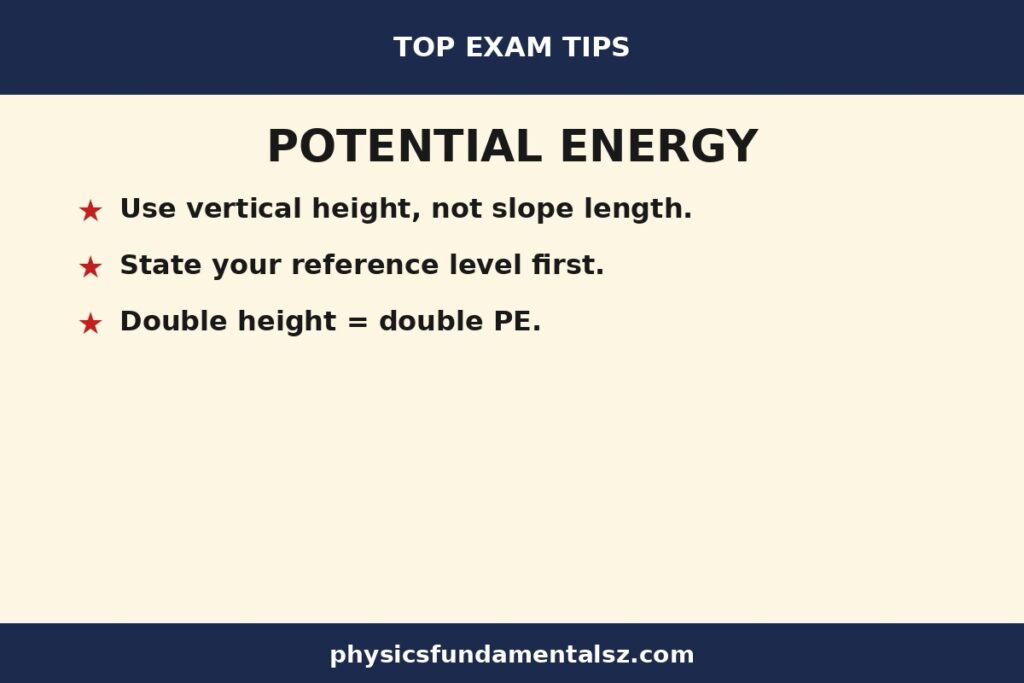
The higher you lift the box, the more work you do, and the more energy is stored. Double the height and you double the stored energy, if the mass and gravity stay the same. Double the mass and you also double the stored energy.
Gravity provides the restoring pull. Left alone, the box will fall, and the stored energy will turn into motion. The higher the starting point, the faster the box moves when it reaches the floor, ignoring air resistance.
The Formula: PE = mgh
The formula for gravitational potential energy near Earth’s surface is:
PE = mgh
Here PE is gravitational potential energy in joules (J), m is mass in kilograms (kg), g is gravitational field strength in newtons per kilogram (N/kg), and h is vertical height in metres (m).
On Earth’s surface, g is about 9.81 N/kg. Many school problems round it to 10 N/kg for simplicity. Always check which value the question tells you to use, and state it in your working.
Height h is the vertical distance from the chosen reference level, not the distance along a slope. A box pushed up a long ramp to a height of 2 m gains the same potential energy as a box lifted straight up by 2 m, ignoring friction. The path does not matter; only the vertical rise counts.
That path independence is a defining feature of gravitational potential energy. Gravity is a conservative force, which means the work it does depends only on start and end heights. Friction, by contrast, depends on the whole path.
Choosing a Reference Level
Potential energy has no fixed zero. You can set h = 0 at the floor, at sea level, at the table top, or anywhere else. The choice changes the numerical value of PE, but it does not change any physical prediction.
What matters is the change in potential energy, ΔPE = mgΔh. A ball falling 3 m loses the same amount of potential energy whether you measure heights from the floor or from the basement. The difference cancels out.
Examiners expect you to state your reference level when it matters. A common instruction is “take the ground as zero potential energy.” Follow it, and measure every height from the ground. If no level is given, choose a sensible one and say so.
Confusion arises when students measure h from the wrong point. If a pendulum bob swings 0.5 m above its lowest point, h is 0.5 m, not the length of the string. Always ask: how far has the object risen vertically from its lowest or reference point?
Elastic Potential Energy Explained
Not all potential energy comes from height. Stretching, compressing, or twisting an elastic object also stores energy. This is elastic potential energy, and it powers catapults, trampolines, bows, and suspension systems.
A spring at its natural length stores no elastic potential energy. Pull it longer, and you must do work against the spring’s restoring force. Push it shorter, and you must also do work. In both cases, the spring stores energy and tries to return to its natural length.
The amount stored depends on two things: how stiff the spring is, and how far it is deformed. A stiff spring stores more energy than a soft spring for the same stretch. A large stretch stores far more energy than a small one, because the energy grows with the square of the extension.
The Spring Formula
For a spring that obeys Hooke’s law, elastic potential energy is:
PE = ½kx²
Here k is the spring constant in newtons per metre (N/m), and x is the extension or compression from the natural length in metres (m). The result is in joules.
The spring constant measures stiffness. A car suspension spring has a large k. A soft toy spring has a small k. The same extension stores much more energy in the stiffer spring.
Note the square on x. Doubling the extension quadruples the stored energy. This is very different from gravitational potential energy, where doubling height only doubles the energy. Exam questions often test this square relationship directly.
The factor of one half appears because the spring force grows from zero to kx as the spring stretches. The average force over the stretch is half the final force, so the work done is half of kx times x. A force-extension graph makes this clear: the stored energy is the area under the graph, which is a triangle.
Everyday Elastic Examples
A drawn bow stores elastic potential energy in its bent limbs and stretched string. Release the string and the energy becomes kinetic energy of the arrow. A skilled archer controls the draw length precisely because energy grows with the square of the draw.
A trampoline stores elastic potential energy as its surface stretches under a jumper. At the lowest point, the jumper momentarily stops, and the energy is almost entirely elastic. The surface then pushes back, converting the stored energy into upward kinetic energy.
A diving board works the same way. The diver’s weight bends the board, storing energy. As the board springs back, it launches the diver upward. The board adds energy beyond what the diver’s legs alone could provide.
Even a rubber band is a lesson in elastic potential energy. Stretch it, aim carefully, and release. The band snaps back, and the stored energy becomes the motion of the band or a small projectile. The further the stretch, the faster the snap, as the square law predicts.
Other Forms of Potential Energy
Gravitational and elastic forms dominate school physics, but they are not the only kinds. Recognising the others helps you see potential energy as a general idea, not just two formulas.
Chemical potential energy is stored in the bonds between atoms and molecules. Fuels, food, and batteries all store chemical energy. Burning fuel or running a chemical reaction releases it as heat, light, or electrical energy.
Electric potential energy is stored when charges are separated against electric forces. A charged capacitor stores energy in the electric field between its plates. Two like charges pushed close together store energy that pushes them apart again.
Nuclear potential energy is stored in atomic nuclei. Splitting a heavy nucleus or fusing light nuclei releases enormous amounts of energy. The Sun runs on nuclear fusion, and nuclear power stations run on fission.
For AP Physics, focus your revision on gravitational and elastic forms. The other forms appear mainly as context, or as the source of energy in energy-transfer chains. The principle is always the same: arrangement stores energy, and change releases it.
Potential Energy vs Kinetic Energy
Potential and kinetic energy are partners. One stores energy, the other carries it in motion. Most interesting physics involves energy moving between the two.
Kinetic energy is the energy of motion: KE = ½mv². It depends on mass and on the square of speed. A moving object has kinetic energy; a still object does not, in that frame of reference.
A ball at the top of a hill has high potential energy and low kinetic energy. As it rolls down, potential energy falls and kinetic energy rises. At the bottom, potential energy is at its lowest and kinetic energy is at its highest, ignoring friction.
Our guide to kinetic energy in physics explains the kinetic side in full, including why speed matters more than mass. Reading the two guides together gives the complete energy picture.
| Feature | Potential Energy | Kinetic Energy |
|---|---|---|
| Definition | Stored energy from position or shape | Energy of motion |
| Depends on | Mass, height, or deformation | Mass and speed |
| Formula (common) | PE = mgh or PE = ½kx² | KE = ½mv² |
| When zero | At reference level or natural length | When the object is at rest |
| Unit | Joule (J) | Joule (J) |
| Quantity type | Scalar | Scalar |
| Increases when | Height or stretch increases | Speed increases |
| Converts to | Kinetic energy when released | Potential energy when climbing or stretching |
The Energy Trade in a Falling Object
Drop a ball from rest at height h. At the instant of release, its speed is zero, so kinetic energy is zero. All its mechanical energy is potential: E = mgh.
Halfway down, it has fallen h/2. It has lost half its potential energy and gained the same amount as kinetic energy. Its speed is set by the energy gained, not by the time elapsed.
Just before impact, potential energy is nearly zero, if the ground is the reference level. Almost all the original energy is now kinetic. The impact speed follows from mgh = ½mv², which simplifies to v = √(2gh). Mass cancels out, which is why heavy and light balls fall at the same rate in a vacuum.
This trade is exact only without air resistance. With air resistance, some energy becomes thermal energy in the air and the ball. The impact speed is then slightly lower than √(2gh) predicts. The missing energy has not vanished; it has changed form.
Conservation of Energy and Potential Energy
The law of conservation of energy states that energy cannot be created or destroyed, only transferred or transformed. In an isolated system, the total energy stays constant.
For mechanical systems without friction, this gives a simple and powerful equation: total mechanical energy = kinetic energy + potential energy = constant. What one form loses, the other gains.
This equation lets you solve problems without knowing forces or times. If you know the starting height and the starting speed, you can find the speed at any other height. You do not need to track the acceleration at each instant.
Conservation of energy is one of the most reliable tools in physics. It applies to falling objects, springs, pendulums, roller coasters, and orbits. When a problem gives heights and speeds but no times, energy methods are usually the fastest route.
Worked Examples: Gravitational Potential Energy
Worked examples turn the formula into a skill. Each example shows the full method: state the formula, substitute values with units, calculate, and check the answer. Always show your working in exams, because method marks are awarded even when the final number slips.
Example 1: A Book on a Shelf
Question: A book has a mass of 0.8 kg. It sits on a shelf 1.8 m above the floor. Calculate its gravitational potential energy relative to the floor. Use g = 9.81 N/kg.
Solution:
PE = mgh = 0.8 × 9.81 × 1.8 = 14.1264 J.
The book stores about 14.1 J of gravitational potential energy relative to the floor.
Check: The units work out: kg × N/kg × m = N·m = J. The value is small, which makes sense for a light book at a modest height. A common error is to forget to multiply by height and answer with the weight instead.
Example 2: A Climber on a Ladder
Question: A climber with a mass of 65 kg climbs to a platform 12 m above the ground. How much gravitational potential energy does the climber gain? Use g = 10 N/kg.
Solution:
PE = mgh = 65 × 10 × 12 = 7,800 J.
The climber gains 7,800 J, or 7.8 kJ, of gravitational potential energy.
Check: The gain depends only on the vertical rise of 12 m, not on the path taken to the platform. Climbing a winding staircase to the same height stores the same energy, ignoring the extra work against friction on the way.
Example 3: Finding Height From Energy
Question: A 2.5 kg object has 122.6 J of gravitational potential energy relative to the ground. How high above the ground is it? Use g = 9.81 N/kg.
Solution:
Rearrange PE = mgh to give h = PE / (mg) = 122.6 / (2.5 × 9.81) = 122.6 / 24.525 = 5.0 m.
The object is 5.0 m above the ground.
Check: Rearranging before substituting numbers reduces arithmetic errors. The answer is in metres, which is correct for height. Always verify that the rearranged formula makes sense: more energy or less mass means greater height.
Example 4: Speed From Height Using Energy Conservation
Question: A ball of mass 0.5 kg is dropped from rest from a height of 20 m. Ignoring air resistance, what is its speed just before it hits the ground? Use g = 10 N/kg.
Solution:
At the top, energy is all potential: PE = 0.5 × 10 × 20 = 100 J.
Just before impact, energy is all kinetic: KE = ½mv² = 100 J.
So ½ × 0.5 × v² = 100, which gives v² = 400, and v = 20 m/s.
Check: The same result follows from v = √(2gh) = √(2 × 10 × 20) = √400 = 20 m/s. Mass cancels out, as expected. The method works for any mass dropped from the same height in a vacuum.
Worked Examples: Elastic Potential Energy
Elastic examples need the spring constant and the extension. The square in the formula makes careful arithmetic essential. Work through each example slowly, and check that the extension is in metres, not centimetres.
Example 5: A Stretched Spring
Question: A spring has a spring constant of 200 N/m. It is stretched by 0.10 m from its natural length. Calculate the elastic potential energy stored.
Solution:
PE = ½kx² = 0.5 × 200 × (0.10)² = 100 × 0.01 = 1.0 J.
The spring stores 1.0 J of elastic potential energy.
Check: The extension must be squared before multiplying. Forgetting the square is the most common error in this topic. Also check the unit: x must be in metres, so 10 cm must be converted to 0.10 m first.
Example 6: Doubling the Extension
Question: The same spring is now stretched by 0.20 m. How much elastic potential energy is stored, and how does it compare with Example 7?
Solution:
PE = ½ × 200 × (0.20)² = 100 × 0.04 = 4.0 J.
Doubling the extension quadruples the stored energy, from 1.0 J to 4.0 J. This is the direct result of the x² term in the formula.
Check: If your answer only doubled, you forgot the square. The square law is a favourite exam trap, and it applies to kinetic energy as well, where energy grows with the square of speed.
Example 7: Spring Launch Speed
Question: A 0.20 kg ball is placed against a spring with k = 100 N/m, compressed by 0.15 m. The spring is released on a frictionless horizontal surface. What is the ball’s speed as it leaves the spring?
Solution:
Stored energy = ½ × 100 × (0.15)² = 50 × 0.0225 = 1.125 J.
This becomes kinetic energy: ½ × 0.20 × v² = 1.125, so v² = 11.25, and v = 3.35 m/s.
Check: All the stored energy is assumed to become kinetic energy. In a real launch, a little energy stays in the spring and some is lost to friction. The calculated speed is therefore a maximum, not an exact prediction.
Potential Energy Graphs and What They Show
Graphs make energy relationships visible. Three graphs appear often in exams: PE against height, PE against extension, and energy against time for a falling object or pendulum.
A graph of gravitational potential energy against height is a straight line through the origin, if the reference level is at zero height. The slope is mg. A heavier object gives a steeper line, because each extra metre of height stores more energy.
A graph of elastic potential energy against extension is a curve, a parabola. The energy grows slowly at first, then faster and faster. The curve shape is the visual signature of the x² term. A straight-line answer for a spring graph is always wrong.
A graph of energy against time for a pendulum shows two curves trading places. Potential energy falls as kinetic energy rises, and vice versa. The total energy line stays flat if friction is ignored. With friction, the total line slopes gently downward as energy leaks into heat.
Reading graphs correctly is a skill in itself. Always label the axes, check whether the relationship is linear or curved, and ask what the slope or area represents. For a force-extension graph, the area under the curve is the stored energy, which is why the triangle area gives ½kx².
Potential Energy in Real Life and Technology
Potential energy is not an abstract classroom idea. It drives power stations, sports, transport, and everyday tools. Seeing the applications makes the formulas easier to remember, because each formula is tied to a real device.
Hydroelectric Power
A hydroelectric dam stores gravitational potential energy in a reservoir. Water at height has energy ready to release. Turbines at the base convert falling water’s kinetic energy into electrical energy through generators.
The power available depends on the height difference, called the head, and the flow rate. A higher dam or a faster flow means more energy per second. Engineers calculate PE = mgh for the water passing through each second to estimate the maximum power.
Dams also show the importance of the reference level. The useful height is the drop from reservoir surface to turbine, not the height above sea level. Only the change in height matters, exactly as the theory predicts.
Common Mistakes to Avoid
Mistakes in potential energy questions follow predictable patterns. Learning the patterns now will save marks in every energy topic that follows, from work to power to momentum.
Mistake 1: Using Slant Distance Instead of Vertical Height
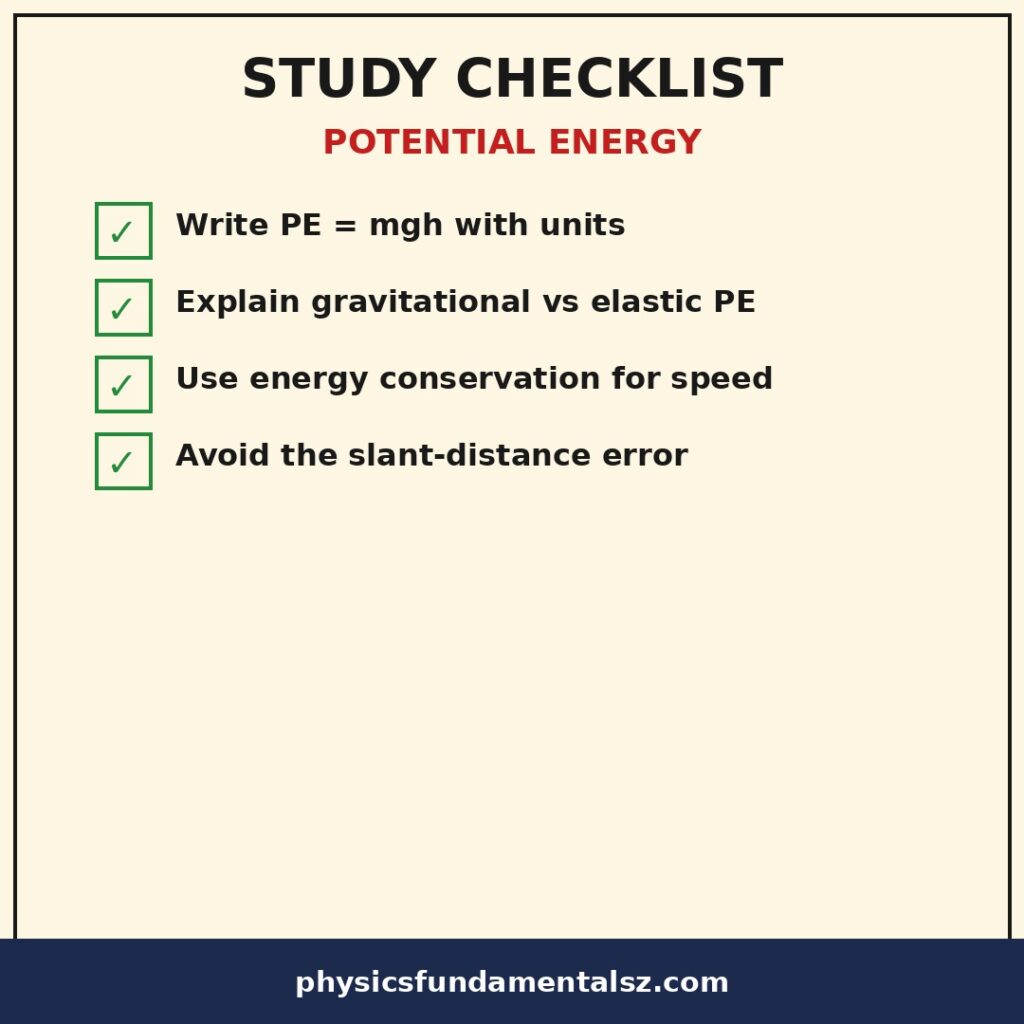
A box pushed up a ramp travels a long slant distance but rises only a short vertical height. Gravitational potential energy depends on the vertical rise only. Using the ramp length in mgh overstates the energy stored.
Always draw a vertical line from start to finish and measure that. If a problem gives a slope length and an angle, find the vertical height with trigonometry: h = L sin θ, where L is the slope length and θ is the angle to the horizontal.
Mistake 2: Forgetting the Reference Level
Two students can calculate different potential energies for the same object and both be right, if they chose different reference levels. Problems arise when a student switches reference levels halfway through a calculation, or measures some heights from one level and others from another.
Pick one reference level at the start and use it for every height in the problem. State it in your working. When only the change matters, the reference cancels, but consistency is still essential.
Mistake 3: Leaving Extension in Centimetres
Spring extensions are often given in centimetres. The formula PE = ½kx² needs metres. Forgetting to convert inflates the answer by a factor of 10,000, because the square magnifies the error.
Convert first, then square. Write “0.10 m” in your working, not “10 cm,” so the conversion is visible. The same rule applies to heights given in centimetres or millimetres.
Mistake 4: Forgetting the Square on Extension or Speed
Elastic potential energy grows with x², and kinetic energy grows with v². Treating either as linear is a serious error. Doubling the extension quadruples elastic energy; doubling speed quadruples kinetic energy.
Check every energy calculation for squares. If you doubled an input and your energy only doubled, you missed a square. This single check catches a large fraction of energy errors.
Mistake 5: Mixing Up Mass and Weight
Mass is in kilograms; weight is a force in newtons. The formula PE = mgh already includes weight, because mg is the weight. Multiplying by g a second time double-counts gravity.
Our guide to the difference between mass and weight in physics explains the distinction in detail. In energy problems, start from mass in kilograms, multiply by g once, and multiply by height. That is all the formula needs.
Mistake 6: Assuming Energy Disappears
Energy never disappears. If a calculation shows energy vanishing, it has changed into a form you have not counted, usually thermal energy from friction. State where the missing energy went, rather than ignoring the gap.
In a bouncing ball, each bounce is lower because some energy becomes heat and sound at impact. In a sliding block, friction warms the surfaces. Naming the destination form turns an apparent loss into a correct energy account.
Expert Tips for Exams
Exam success in energy topics comes from method, not memory alone. The tips below reflect how experienced teachers and examiners approach these questions.
Start with an energy statement. Write “initial energy = final energy” or “work done = change in energy” before any numbers. This frames the problem and earns method marks even if the arithmetic goes wrong.
Draw the situation. Sketch the start and end positions, mark heights, and label speeds. A sketch makes the vertical height obvious and prevents the slant-distance error.
List knowns and unknowns. Write m, g, h, v, k, and x with their values and units before calculating. Missing unit conversions become visible when the list is explicit.
Check units at the end. Energy must come out in joules. If your answer is in newtons, newtons per metre, or metres per second, the method is wrong. A unit check takes seconds and catches major errors.
Use g = 10 N/kg only when told to. If the question gives g = 9.81 N/kg, use that value. Mixing values within one paper creates inconsistencies that examiners notice.
Round sensibly. Give answers to two or three significant figures, matching the data given. Over-precise answers from rounded inputs look careless, and under-rounded answers lose accuracy.
Practise the square law. Make a small table: extension 1, 2, 3 units gives energy 1, 4, 9 units. Memorising the pattern makes the square relationship automatic under exam pressure.
For AP Physics, learn both energy methods. Conservation of energy solves many problems faster than Newton’s laws. Free-response questions often accept either method, but energy methods need fewer steps and fewer chances for error.
Frequently Asked Questions
What is potential energy in simple terms?
Potential energy is stored energy waiting to be used. A raised weight, a stretched spring, and a charged battery all store energy because of their position, shape, or arrangement. When the position or shape changes, the stored energy turns into motion, heat, or another form.
What is the formula for potential energy?
The most common formula is gravitational potential energy: PE = mgh, where m is mass, g is gravitational field strength, and h is vertical height. For springs, the formula is PE = ½kx², where k is the spring constant and x is the extension from natural length. Both answers are in joules.
What is gravitational potential energy?
Gravitational potential energy is energy stored because an object is raised in a gravitational field. Lifting an object does work against gravity, and that work is stored. The higher the object, the more energy is stored. The energy is released as the object falls.
What is elastic potential energy?
Elastic potential energy is energy stored in a stretched, compressed, or twisted elastic object. A spring, rubber band, or trampoline stores energy when deformed. The energy is released when the object returns toward its natural shape. It depends on stiffness and on the square of the deformation.
What are examples of potential energy?
Common examples include water behind a dam, a book on a high shelf, a stretched rubber band, a compressed spring, a drawn bow, a wound clock spring, and a roller coaster at the top of a hill. Chemical examples include fuel, food, and batteries. Each stores energy that can be released by a change in position or shape.
How is potential energy different from kinetic energy?
Potential energy is stored energy from position or shape. Kinetic energy is energy of motion. A still object at height has potential energy but no kinetic energy. A fast object at ground level has kinetic energy but little gravitational potential energy. Energy trades between the two forms as objects move.
Does potential energy increase with height?
Yes. Gravitational potential energy increases in direct proportion to height, if mass and gravity stay constant. Doubling the height doubles the stored energy. This linear relationship is different from elastic energy, which grows with the square of the extension.
Can potential energy be negative?
Yes, in the general gravitation formula, potential energy is negative because zero is defined at infinite separation. Near Earth’s surface, potential energy can also be negative if the reference level is above the object. For example, an object below the chosen zero level has negative PE. Only changes in potential energy affect motion.
What is the unit of potential energy?
The SI unit of potential energy is the joule (J). One joule equals one newton-metre. Kilojoules (kJ) are used for larger amounts, such as the energy stored by a climber or a vehicle. All forms of energy share the same unit, which is why they can be added and compared.
How do you calculate potential energy?
Identify the type of potential energy, choose the correct formula, and substitute values with consistent units. For height, use PE = mgh with mass in kilograms, g in N/kg, and height in metres. For a spring, use PE = ½kx² with k in N/m and extension in metres. Check that the answer is in joules.
What happens to potential energy when an object falls?
As an object falls, its gravitational potential energy decreases and its kinetic energy increases by the same amount, ignoring air resistance. The total mechanical energy stays constant. Just before impact, almost all the original potential energy has become kinetic energy, and the speed follows from v = √(2gh).
Is potential energy a vector or a scalar?
Potential energy is a scalar quantity. It has magnitude but no direction. That is true for all forms of energy. Direction matters for forces and velocities, but energy itself is directionless, which is why energy calculations are often simpler than force calculations.
What is the difference between potential energy and work?
Work is the transfer of energy by a force acting over a distance. Potential energy is stored energy resulting from that transfer. Lifting a box does work on it, and the work done becomes gravitational potential energy. Work changes potential energy; potential energy is the stored result.
Does mass affect potential energy?
Yes. Gravitational potential energy is directly proportional to mass. Doubling the mass doubles the stored energy at the same height. Elastic potential energy does not depend directly on mass, but the mass attached to a spring affects how the stored energy becomes motion.
What is potential energy at the top of a roller coaster?
At the top, the train has maximum gravitational potential energy and minimum kinetic energy, if it starts from rest. As it descends, potential energy converts into kinetic energy and the train speeds up. Friction removes a little energy as heat, so the real speed is slightly below the energy-conservation prediction.
How does a spring store potential energy?
Stretching or compressing a spring does work against its restoring force. The work is stored as elastic potential energy in the deformed spring. The stored energy equals the area under the force-extension graph, which is ½kx² for a spring obeying Hooke’s law. Releasing the spring converts the stored energy into motion.
What is the law of conservation of energy?
The law states that energy cannot be created or destroyed, only transferred or transformed. In an isolated system, total energy remains constant. Potential energy can become kinetic energy, thermal energy, or another form, but the total never changes. This law is the foundation of all energy calculations.
Why is the reference point important for potential energy?
Potential energy values depend on where zero is set. The reference point, or datum, fixes the zero level. Changing it shifts all potential energy values by the same amount, but changes in potential energy stay the same. Stating the reference level avoids confusion and makes answers comparable.
Can an object have both potential and kinetic energy?
Yes. Most moving objects have both at once. A swinging pendulum has both except at the turning points and the lowest point. A rolling ball on a slope has kinetic energy from motion and potential energy from height. The sum is the total mechanical energy, which stays constant without friction.
How is potential energy used in hydroelectric power?
Water stored in a reservoir has gravitational potential energy because of its height above the turbines. Released water falls, converting potential energy into kinetic energy. Turbines and generators convert that kinetic energy into electrical energy. The height difference and flow rate set the maximum power available.
Conclusion
Potential energy is stored energy, held ready by position, shape, or arrangement. A raised mass, a stretched spring, and a full reservoir all hold energy that change can release.
Remember the two key formulas. Gravitational potential energy is PE = mgh, growing in direct proportion to height. Elastic potential energy is PE = ½kx², growing with the square of the extension. Both are measured in joules, and both convert into kinetic energy when released.
Use conservation of energy to solve problems cleanly. Track where energy starts, where it ends, and what form it takes in between. State your reference level, convert units before calculating, and check for squares. Those habits turn energy questions into reliable marks.
For the other half of the energy story, read our guide to kinetic energy in physics and our guide to momentum in physics. Together, they cover how energy is stored, how it moves, and how it drives every motion in mechanics.