How to Calculate Mechanical Advantage of a Pulley: Formulas, Steps & Examples 2026

How to Calculate Mechanical Advantage of a Pulley becomes much easier once you understand how the pulley system changes the amount of force needed to lift a load. A pulley can redirect an applied force and, depending on its arrangement, reduce the effort required to raise a heavy object. This makes pulleys an important example of how simple machines provide mechanical advantage.
Mechanical advantage describes the relationship between the load force and the effort force used in a machine. For pulley systems, it can often be determined by counting the number of rope sections directly supporting the load, while the actual mechanical advantage can also be calculated by comparing the output force with the input force.
Understanding pulley mechanical advantage is useful in physics experiments, cranes, lifting systems, construction equipment, elevators, and everyday mechanical devices. By learning the correct formulas and following a few simple steps, you can determine the mechanical advantage of fixed, movable, and combined pulley systems and apply the concept to practical problems.
Table of Contents
How Do You Calculate Mechanical Advantage of a Pulley?

To calculate the ideal mechanical advantage of a pulley system, count the rope segments that support the moving load. That number is the mechanical advantage (MA).
A system with 4 supporting segments has an MA of 4. A 400 lb load then needs about 100 lb of pulling force, ignoring friction.
Key Takeaways
- Mechanical advantage (MA) = load force ÷ effort force.
- For an ideal pulley system, MA equals the number of rope segments supporting the load.
- A fixed pulley has MA = 1. A single movable pulley has MA = 2.
- Higher MA means less pulling force but more rope to pull.
- Real systems lose energy to friction, so actual MA is always lower than ideal MA.
- Efficiency = actual MA ÷ ideal MA × 100.
- Pulleys never reduce the work you must do. They only trade force for distance.
What Is Mechanical Advantage?
Simple Definition
Mechanical advantage is a number that tells you how much a machine multiplies your input force. It is a ratio, so it has no units.
If a machine lets you lift 300 lb by pulling with 100 lb, its MA is 3.
The Trade-Off Behind Every Simple Machine
A machine never gives you free energy. It trades force for distance.
Work equals force times distance. If you pull with one-third of the force, you must pull the rope three times as far.
Ideal vs Actual Mechanical Advantage
Ideal mechanical advantage (IMA) assumes no friction and a weightless rope and pulleys. It depends only on geometry.
Actual mechanical advantage (AMA) uses measured forces. Friction and pulley weight always make AMA smaller than IMA.
What Is a Pulley and How Does It Work?
A pulley is a wheel with a grooved rim that guides a rope, cable, or belt. It changes the direction of a force, and sometimes its size.
Pulleys are classic simple machines, alongside the lever, wheel and axle, inclined plane, wedge, and screw. Ancient engineers such as Archimedes already used compound pulleys to move enormous loads.
Fixed Pulley
A fixed pulley is attached to a support and does not move. It only changes the direction of your pull.
You pull down, and the load goes up. The effort equals the load, so MA = 1.
Movable Pulley
A movable pulley is attached to the load and moves with it. The rope supports the load on both sides of the wheel.
Each side carries half the weight. That gives an ideal MA of 2.
Compound Pulley (Block and Tackle)
A block and tackle combines fixed and movable pulleys in one rope system. More supporting segments mean more mechanical advantage.
This is the setup used in cranes, sailboat rigging, engine hoists, and rescue haul systems. It is the main focus of this guide.
Image suggestion: Labeled diagram of fixed, movable, and compound pulleys. Filename:
types-of-pulleys-diagram.webpALT text: Diagram showing fixed, movable, and block and tackle pulley systems with rope segments labeled.
Why Rope Tension Makes Pulleys Work
Inside a single continuous rope, the tension is the same everywhere in an ideal system. Friction-free pulleys just redirect that tension.
That is why a movable pulley halves the effort. Two rope segments each pull up with the full tension, so the load is shared. For a deeper look at how ropes transmit force, read our guide to tension force.
The Force Balance in One Line
For a load held at constant speed, the total upward pull equals the weight. If T is rope tension and n is the number of supporting segments, then n × T = load.
Solve for T and you get the effort force. Divide load by effort and you get n.
Mechanical Advantage Formulas You Need
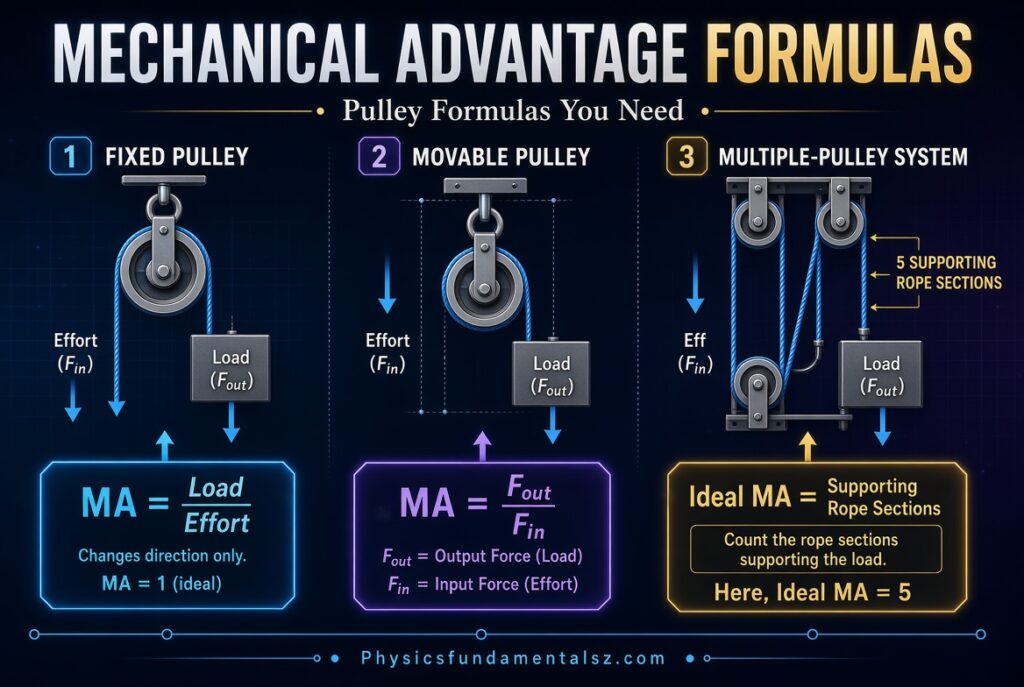
You only need a few formulas. Each one answers a slightly different question.
| Quantity | Formula | Meaning |
|---|---|---|
| Mechanical advantage | MA = F_load ÷ F_effort | Force multiplication |
| Ideal MA (rope count) | IMA = n (supporting segments) | Geometry only, no friction |
| Ideal MA (distance) | IMA = d_effort ÷ d_load | How far you pull vs how far the load rises |
| Actual MA | AMA = F_load ÷ F_effort (measured) | Real-world result |
| Efficiency | η = (AMA ÷ IMA) × 100% | Percent of ideal performance |
| Work input | W_in = F_effort × d_effort | Energy you put in |
| Work output | W_out = F_load × d_load | Useful energy delivered |
The MA = 2n Shortcut
Some textbooks write MA = 2n, where n is the number of movable pulleys. This works for a standard block and tackle because each movable pulley has two supporting segments.
Counting segments always works, so it is the safer method. Use the segment count when the setup looks unusual.
Units to Use
Use the same unit for load and effort. Newtons (N), pounds-force (lbf), or kilograms-force all work.
Mixing units is a common error. Convert first, then divide.
How to Calculate Mechanical Advantage of a Pulley Step by Step
Follow these five steps for any rope-and-pulley setup. They work for school problems and real rigging.
Step 1: Draw the System
Sketch the load, the pulleys, and the rope. Mark which pulleys are fixed and which are movable.
A clear diagram prevents most counting mistakes. Draw the rope as one continuous line.
Step 2: Identify the Moving Block
Find the pulley or block attached to the load. This is the part that moves up with the load.
Only rope touching this moving block can provide lifting force.
Step 3: Count the Supporting Segments
Count every rope segment that pulls up on the moving block. Do not count segments that only touch the fixed support.
If the free end you pull comes off the moving block, that segment counts too. If it comes off a fixed pulley, it does not.
Step 4: Set MA Equal to That Count
For an ideal system, IMA equals the segment count. Three supporting segments mean MA = 3.
Write the answer as a ratio, such as 3:1, or as the plain number 3.
Step 5: Find the Effort Force and Rope Distance
Effort = load ÷ MA. Rope pulled = load lift distance × MA.
Check that work in equals work out. If it does not, recount your segments.
Image suggestion: Step-by-step diagram with rope segments highlighted in color. Filename:
count-rope-segments-pulley-mechanical-advantage.webpALT text: Block and tackle diagram with four supporting rope segments highlighted to show mechanical advantage of 4.
Mechanical Advantage of Common Pulley Systems
Here is a quick reference chart. Use it to check your own answers.
| Pulley System | Supporting Segments | Ideal MA | Effort for a 600 lb Load | Rope Pulled per 1 ft Lift |
|---|---|---|---|---|
| Single fixed pulley | 1 | 1:1 | 600 lb | 1 ft |
| Single movable pulley | 2 | 2:1 | 300 lb | 2 ft |
| Gun tackle | 2 | 2:1 | 300 lb | 2 ft |
| Luff tackle | 3 | 3:1 | 200 lb | 3 ft |
| Double tackle | 4 | 4:1 | 150 lb | 4 ft |
| Five-segment system | 5 | 5:1 | 120 lb | 5 ft |
| Six-segment system | 6 | 6:1 | 100 lb | 6 ft |
Fixed Pulley: MA = 1
A fixed pulley gives no force advantage. Its value is comfort and safety, because you can pull down using your body weight.
The support above the pulley carries the load plus your pull. In an ideal case, that is twice the load.
Single Movable Pulley: MA = 2
Attach one end of the rope to a ceiling hook. Run it under the pulley on the load and pull up on the free end.
Two segments carry the load, so the effort is half. You must pull 2 feet of rope to lift the load 1 foot.
Gun Tackle, Luff Tackle, and Double Tackle
These are traditional sailing names for common block and tackle layouts. Their MA comes from the number of segments at the moving block.
Adding a pulley to redirect your pull does not change MA. Only extra supporting segments do.
Rescue and Rigging Systems: 3:1, 5:1, 6:1, 9:1
Climbers and rescuers use named haul systems. A Z-drag gives 3:1, and a C-pulley gives 2:1.
Systems can be stacked, or compounded. A 3:1 pulling on a 3:1 gives 9:1, because the ratios multiply.
Worked Examples: Calculate Mechanical Advantage of a Pulley
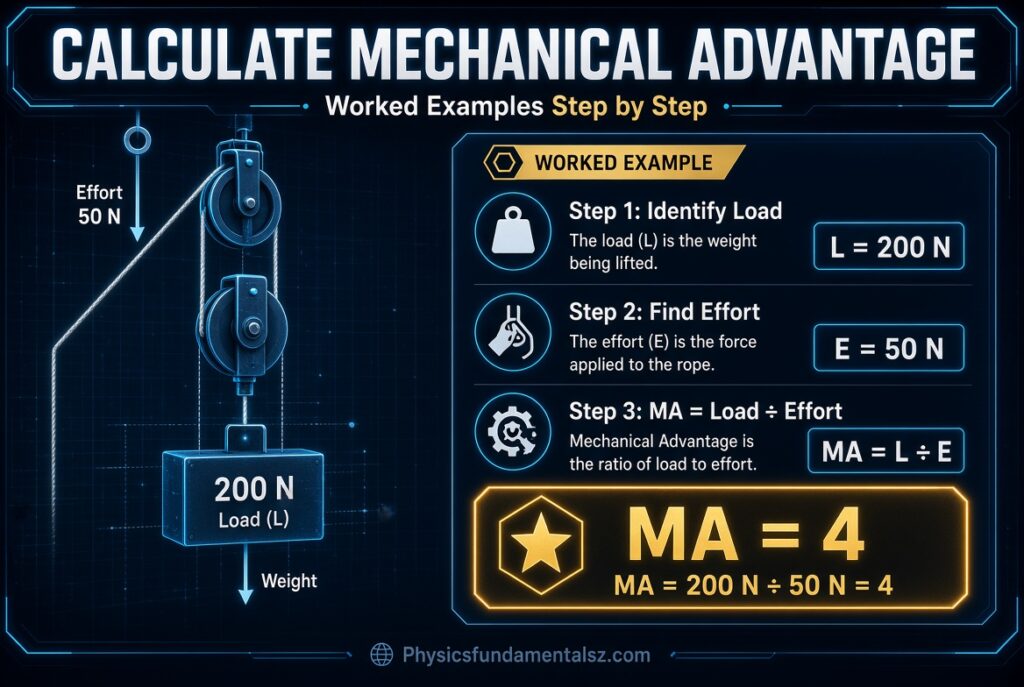
Practice makes the counting method automatic. Try each problem before reading the solution.
Example 1: Single Fixed Pulley
Problem: A 100 lb bucket hangs from a rope over a fixed pulley. What effort lifts it at constant speed?
Solution: One segment supports the load, so MA = 1. Effort = 100 ÷ 1 = 100 lb.
The pulley only redirects your pull. You still exert the full weight.
Example 2: Single Movable Pulley
Problem: A 200 N load hangs from a movable pulley. What effort is needed, and how much rope must you pull to lift it 1 m?
Solution: Two segments support the load, so MA = 2. Effort = 200 ÷ 2 = 100 N.
Rope pulled = 1 m × 2 = 2 m. You trade force for distance.
Example 3: Four-Segment Block and Tackle
Problem: A block and tackle has 4 segments supporting an 800 N load. Find the ideal effort and rope length to lift the load 2 m.
Solution: MA = 4, so effort = 800 ÷ 4 = 200 N. Rope pulled = 2 m × 4 = 8 m.
Check the work: 800 N × 2 m = 1,600 J, and 200 N × 8 m = 1,600 J. The results match.
Example 4: Actual Mechanical Advantage and Efficiency
Problem: A 4-segment system lifts a 500 N load with a measured 150 N effort. Find IMA, AMA, and efficiency.
Solution: IMA = 4. AMA = 500 ÷ 150 = 3.33.
Efficiency = 3.33 ÷ 4 × 100 ≈ 83%. The ideal effort would be 125 N, so friction added 25 N.
Example 5: Including the Weight of the Movable Block
Problem: A 6-segment system lifts a 1,200 N load. The movable block weighs 60 N. What is the ideal effort?
Solution: The block adds to the load being lifted: 1,200 + 60 = 1,260 N. Effort = 1,260 ÷ 6 = 210 N.
Ignoring the block would give 200 N. The extra 10 N matters in heavy or precise work.
Example 6: Differential Pulley
Problem: A chain differential hoist has a large wheel radius of 10 cm and a small wheel radius of 9 cm. Find its ideal MA.
Solution: For a differential pulley, IMA = 2R ÷ (R − r). So IMA = 2 × 10 ÷ (10 − 9) = 20.
A tiny difference in radius gives a huge advantage. The cost is a very long pull for each small lift.
How Friction and Efficiency Change the Answer
Real pulleys are never perfect. Bearings, rope bending, and sheave size all waste energy.
Rescue and rigging sources note that real pulley efficiency can range from roughly 50% to 98%, depending on design. Ball-bearing pulleys with large wheels sit near the high end.
Why Friction Grows With More Pulleys
Each added pulley adds friction. In a large system, the losses stack up.
That is why a 9:1 system rarely feels like 9:1 in practice. Always plan for the actual value, not the ideal one.
How to Estimate Actual Effort
Use this formula: Effort (actual) = Load ÷ (IMA × efficiency).
With a 400 lb load, IMA of 4, and 80% efficiency, effort = 400 ÷ (4 × 0.80) = 125 lb. The ideal answer was 100 lb.
Ways to Improve Pulley Efficiency
- Choose pulleys with ball or roller bearings.
- Use wheels with a diameter suited to the rope.
- Keep ropes clean and free of twists.
- Avoid sharp angles between the rope and the pulley.
- Lubricate bearings as the manufacturer recommends.
Belt and Pulley Drives: A Different Kind of Mechanical Advantage
Not every pulley lifts a load. In a belt drive, two pulleys of different sizes connect through a belt to transmit power.
Here, mechanical advantage describes torque and speed instead of lifting force. For more on rotation, see our guide to angular momentum.
Belt Drive Formulas
Torque MA = D_driven ÷ D_driver. Speed ratio = D_driver ÷ D_driven.
A bigger driven pulley multiplies torque but slows the output. You cannot gain both.
Belt Drive Example
Problem: A 4 in driver pulley turns a 12 in driven pulley at 900 RPM. Find torque gain and output speed.
Solution: Torque MA = 12 ÷ 4 = 3. Output speed = 900 × (4 ÷ 12) = 300 RPM.
Torque triples while speed drops to one-third. Belt slip and friction reduce the real values slightly.
Work, Energy, and Power: Why Pulleys Do Not Create Free Energy
An ideal pulley system keeps work input equal to work output. Force falls, but distance rises by the same factor.
Power stays the same too. Pull slowly with a light force or quickly with a heavy one, and the energy delivered matches.
Connecting Pulleys to Energy Ideas
The load gains gravitational potential energy as it rises. The work you do supplies that energy, minus losses to friction.
Explore the energy side in our guide to kinetic energy.
Real-World Applications of Pulley Mechanical Advantage
Pulley systems are everywhere once you know how to spot them. Each use relies on the same counting rule.
Construction and Cranes
Tower cranes and hoists use multi-line reeving to lift steel and concrete. Multiple falls of cable act as extra supporting segments.
Sailing and Rigging
Sailors use blocks and tackles to trim heavy sails. The purchase ratio tells them how much rope to haul.
Climbing, Rescue, and Arborist Work
Haul systems raise injured climbers and drag loads uphill. Correct MA calculation helps teams choose a safe setup.
Gyms and Home Workshops
Cable machines use pulleys to redirect resistance. Garage engine hoists and shop lifts use block and tackle for heavy engines.
Elevators and Theater Rigging
Counterweight systems and stage rigging use pulleys to balance loads. Here, the goal is often smooth motion, not just force reduction.
Image suggestion: Photo or illustration of a block and tackle on a crane or sailboat. Filename:
block-and-tackle-real-world-example.webpALT text: Block and tackle pulley system used to lift a heavy load with reduced pulling force.
Common Mistakes When Calculating Pulley Mechanical Advantage
Small errors lead to wrong answers. Watch for these.
Counting All Pulleys Instead of Rope Segments
The number of wheels is not the same as the number of supporting segments. A wheel can have zero, one, or two segments acting on the load.
Counting the Segment You Pull
If you pull down from a fixed pulley, that segment does not lift the load. Do not count it.
Forgetting the Weight of the Movable Block
Heavy blocks add to the load. Include them in precise calculations.
Treating Ideal MA as Actual MA
Friction always reduces the result. Use efficiency when you need a real-world effort.
Ignoring the Extra Rope Distance
More MA means more rope to pull. Plan enough rope and enough space to haul.
Mixing Units
Do not divide pounds by newtons. Convert everything to one system first.
Expert Tips for Getting Accurate Results
- Draw the system before counting. It takes 30 seconds and saves errors.
- Trace the rope from one end to the other with your finger.
- Check your answer with the distance ratio. The rope pulled must equal MA times the lift.
- Verify with work in and work out.
- For safety-critical work, measure real forces rather than trusting ideal numbers.
Which Pulley Setup Should You Choose?
Use this decision table to match your goal to a system.
| Goal | Best Setup | Why |
|---|---|---|
| Change pull direction only | Fixed pulley | Easy and safe, no MA |
| Halve the effort | Single movable pulley | Simple, 2:1 |
| Lift heavy engine or equipment | 4:1 or 6:1 block and tackle | Big force reduction |
| Minimize friction losses | Fewer, larger, bearing pulleys | Higher efficiency |
| Very high MA in a small space | Differential pulley | Extreme ratio |
| Change speed or torque | Belt drive with different diameters | Trades speed for torque |
Safety Notes for Real Lifting Systems
Never use a pulley calculation as the only safety check. Real loads involve shock, angles, and wear.
Load Ratings and Safety Factors
Check the working load limit (WLL) of every rope, pulley, hook, and anchor. Choose components rated well above the expected load.
Anchor Forces
The support holding a block and tackle carries the load plus the effort. For a fixed pulley, that is about twice the load in an ideal case.
Standards and Training
Lifting and rigging work follows industry standards, such as ASME B30 for hoisting equipment and OSHA regulations for workplaces. Rescue equipment falls under standards such as NFPA 1983.
Always follow manufacturer instructions and trained-professional guidance for overhead loads or life safety.
Practice Problems With Answers
Test yourself with these three questions.
Problem 1
A pulley system has 6 supporting segments. What ideal effort lifts a 900 N load?
Answer: MA = 6, so effort = 900 ÷ 6 = 150 N.
Problem 2
A worker lifts a 360 N load with a 100 N effort using a 4-segment system. Find AMA and efficiency.
Answer: AMA = 360 ÷ 100 = 3.6. Efficiency = 3.6 ÷ 4 × 100 = 90%.
Problem 3
A 6 in driver pulley turns an 18 in driven pulley. What are the torque MA and speed ratio?
Answer: Torque MA = 18 ÷ 6 = 3. Speed ratio = 6 ÷ 18 = 1/3, so output speed is one-third of input speed.
Frequently Asked Questions (FAQs)
How do you calculate the mechanical advantage of a pulley?
Count the rope segments supporting the moving load. That count is the ideal mechanical advantage. You can also divide load force by effort force.
What is the formula for mechanical advantage of a pulley system?
The basic formula is MA = F_load ÷ F_effort. For ideal systems, MA also equals the number of supporting rope segments.
What is the mechanical advantage of a fixed pulley?
It is 1. A fixed pulley only changes the direction of the force and does not reduce the effort.
What is the mechanical advantage of a movable pulley?
It is 2 in an ideal case. Two rope segments share the load, so the effort is half the weight.
How do you count rope segments in a pulley system?
Count each segment that pulls up on the moving block. Include the free end only if it leaves the moving block.
Does the number of pulleys equal the mechanical advantage?
No. The number of supporting rope segments sets the MA, not the number of wheels. Redirect pulleys add no advantage.
What is the difference between ideal and actual mechanical advantage?
Ideal MA ignores friction and depends on geometry. Actual MA uses measured forces and is always lower.
How do you calculate pulley efficiency?
Divide actual MA by ideal MA and multiply by 100. For example, 3.33 ÷ 4 × 100 is about 83%.
Why does more mechanical advantage mean more rope?
Work in equals work out in an ideal system. Less force over more distance delivers the same energy.
What is a block and tackle?
A block and tackle is a rope system of fixed and movable pulleys. It multiplies force by adding supporting rope segments.
How do you find the effort force in a pulley system?
Divide the load by the mechanical advantage. A 600 lb load with MA = 3 needs about 200 lb of effort.
How much rope do I need to pull to lift a load?
Multiply the lift height by the mechanical advantage. With MA = 4, a 3 ft lift needs 12 ft of rope.
Does a pulley reduce the work needed?
No. Pulleys reduce the force required, not the total work. Friction actually increases the work you must supply.
What is the mechanical advantage of a 2:1 system?
A 2:1 system halves the effort. You pull twice as much rope as the load rises.
How do you calculate mechanical advantage for a compound system?
Multiply the ratios of each stage. A 3:1 pulling on a 3:1 makes a 9:1 system, before friction losses.
What is the mechanical advantage of a belt and pulley?
It equals the ratio of pulley diameters, driven over driver. It multiplies torque and reduces speed by the same factor.
What is the formula for a differential pulley?
The ideal MA is 2R ÷ (R − r), where R and r are the radii of the large and small wheels.
Do heavy pulleys change the calculation?
Yes. The weight of a movable block adds to the load, so include it in precise work.
How efficient are real pulleys?
Efficiency depends on the design. Rigging sources cite a range of roughly 50% to 98% for real pulleys.
Can I use a pulley to lift more than I can pull?
Yes, within safe limits. A higher MA lets you lift heavier loads, but every component must be rated for the load and anchor forces.
Is mechanical advantage the same as efficiency?
No. Mechanical advantage is a force ratio. Efficiency compares actual results to the ideal and shows how much energy is lost.
Conclusion
Learning how to calculate mechanical advantage of a pulley comes down to one habit: count the rope segments that support the load. That number gives the ideal MA, the effort force, and the rope distance in one step.
Real systems lose some performance to friction, so use efficiency to find actual results. Check your work with the work-in equals work-out rule, and always respect load ratings when lifting real weight.
Use the reference chart and practice problems above to build confidence. Then explore the linked guides to connect pulleys with tension, energy, torque, and the rest of classical mechanics.